I Let Other Men Film Me While I Cheated… My Husband Found The Videos And Never Spoke To Me Again
The USB Drive Beside His Coffee Mug Ended Our Marriage—But It Was His Silence That Destroyed Me
My husband found videos of me with another man. He never screamed. He never asked a single question.
He simply locked the guest-room door—and began quietly removing me from his life.
It took me three weeks to understand that his silence wasn’t a punishment. It was an ending.
PART 1 — THE DAY HE STOPPED SEEING ME
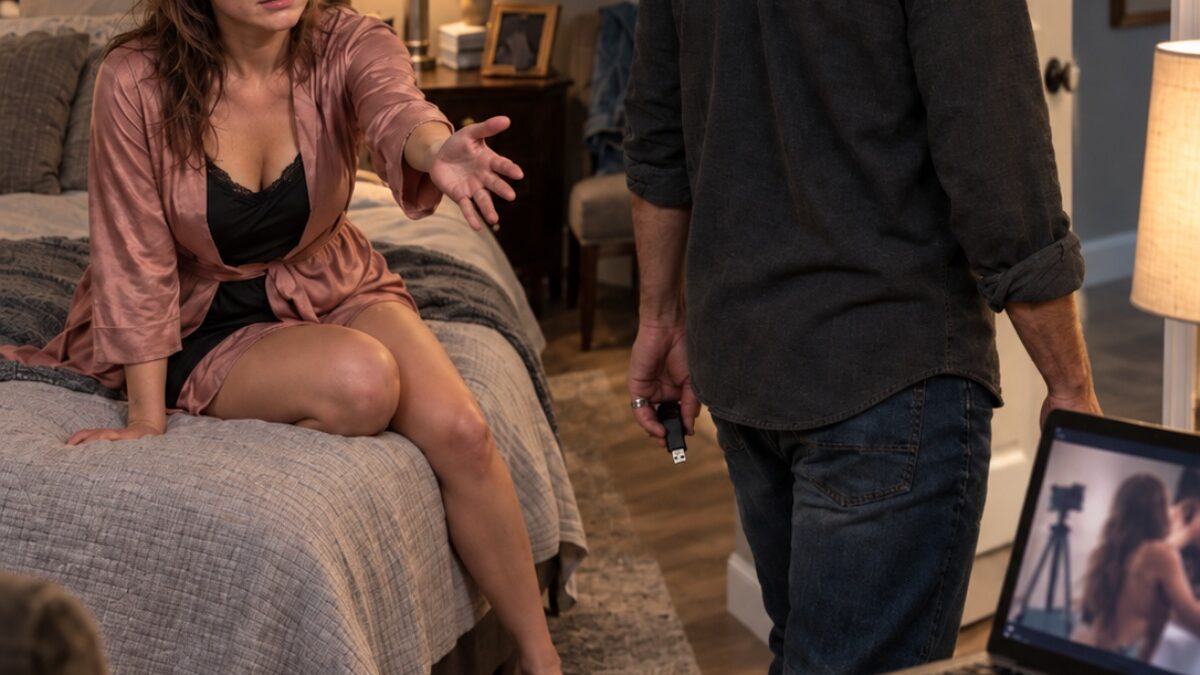
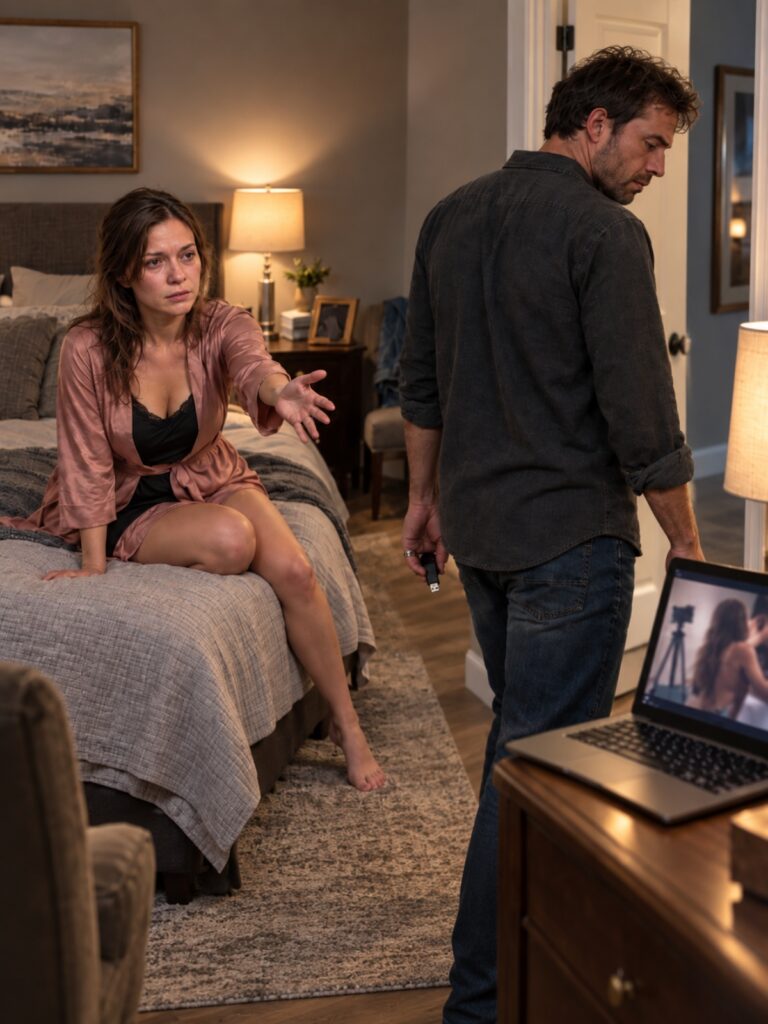
The USB drive was sitting beside Theo’s coffee mug like a coaster when I walked through the front door. Small. Black. Ordinary. Perfectly parallel to the mug handle, as if someone had placed it there carefully enough to make sure I could not pretend I hadn’t seen it. The moment my eyes landed on it, my entire body understood something my mind was still refusing to accept.
Theo had already rinsed his coffee cup and placed it in the drying rack. He walked past me toward the guest room without changing his pace, without brushing my shoulder, without lifting his eyes to my face. I waited for him to say my name. He didn’t. A few seconds later, the guest-room door closed, and I heard the lock turn.
My name is Bridget. I was twenty-nine years old when I destroyed my marriage. Theo was thirty-one, and we had been married for four years, together for almost seven. He was a warehouse supervisor who woke every weekday at 5:15 in the morning and came home smelling like diesel, cardboard, dust, and the industrial soap they kept beside the loading bays.
I worked as a dental hygienist. We had bought our house two years earlier, a modest three-bedroom place with a small yard, a cracked driveway, and a kitchen we kept promising ourselves we would renovate someday. We had talked about trying for a baby that spring. I had even started taking vitamins.
None of those details excuse what I did.
I used them as excuses anyway.
I told myself our marriage was stable. I told myself we were solid enough to survive things Theo would never know about. I told myself that because we paid our mortgage on time, watched crime shows together on Wednesdays, argued about laundry like normal people, and still kissed goodnight, I could somehow divide my life into separate rooms and keep the doors locked between them.
I believed secrecy could contain damage.
The jacket was what opened the door.
That morning, Theo had grabbed my old denim jacket from the hook near the garage because his heavier work jacket was still inside his truck. He left before sunrise. About forty minutes later, while I was getting ready for work, I suddenly remembered what was inside the inner pocket.
The USB drive.
I froze with my toothbrush in my hand.
For several seconds, I could hear nothing except the running faucet.
Then the realization came over me slowly and completely, like watching a vehicle slide toward you on black ice and knowing there is nowhere to move. The thing I had kept hidden for two months was now riding to work in my husband’s pocket.
And if he found it, he would know everything.
I called him once.
No answer.
I texted him something stupid about whether he had accidentally taken my jacket. He didn’t reply. I considered calling the warehouse office, but I could already imagine the receptionist putting me through and Theo asking why I sounded terrified over a denim jacket.
So I went to work.
I smiled at patients.
I polished teeth.
I told a six-year-old boy that the suction tube wasn’t going to swallow his tongue while my own hands trembled inside my gloves.
By lunchtime, Theo still hadn’t replied.
I drove home fourteen miles per hour over the speed limit.
I told myself maybe he hadn’t checked the pocket. Maybe the drive had fallen out in his truck. Maybe he would come home, hang the jacket back up, and I could remove it before he ever knew it existed. Human beings can create astonishing amounts of hope from nothing when the alternative is unbearable.
But when I opened the front door, I saw the drive beside his coffee mug.
And I knew hope was over.
There were three encounters on that drive.
The first involved a man named Gio, someone I had met at my gym months earlier. It began with conversations between sets, then jokes, then messages, then flirting I kept renaming in my head so I wouldn’t have to call it what it was.
Friendly.
Harmless.
Attention.
A little excitement.
Anything except betrayal.
Gio suggested filming the first time.
I agreed.
That fact matters.
I wasn’t drunk. I wasn’t manipulated. I wasn’t confused about what the camera was doing. I knew it was recording. I told myself it was a kink, something private and reckless that existed inside a sealed compartment disconnected from the woman who drove home afterward and slept beside Theo.
The next two encounters involved two of Gio’s friends.
I won’t describe them further.
What matters is that I participated willingly, and the camera was running.
What matters is that afterward, every single time, I drove home.
I walked through the same front door.
I took off my shoes.
I sometimes reheated whatever Theo had saved for me in the refrigerator.
And I kissed my husband on the mouth.
I asked about his day.
I listened while he complained about loading schedules or a forklift battery that wouldn’t hold a charge. Sometimes he rubbed my shoulders while we watched television. Sometimes I fell asleep against him.
And I told myself the two lives did not touch.
That was the lie underneath every other lie.
Theo and I had become routine. Comfortable. Predictable. We had started discussing grocery lists more often than vacations. We were tired on weeknights. Our intimacy had become familiar instead of dangerous, and rather than ask myself what responsibility I had for that distance, I treated boredom like something my husband had done to me.
Gio felt like voltage.
I borrowed it.
That was how I framed it.
I told myself I wasn’t taking anything from Theo because he didn’t know.
I actually believed that.
I believed betrayal only became damage when discovered.
Standing in our kitchen staring at that black USB drive, I finally understood how grotesque that logic was.
I walked toward the guest-room door.
My hand hovered over the wood for several seconds before I knocked.
Nothing.
“Theo?”
Nothing.
I knocked again.
“Theo, please.”
There was no movement.
“I can explain.”
Even as the words left my mouth, I hated them.
Explain what?
There was no interpretation of those videos that changed what they showed.
I stood outside that door for eleven minutes. I know because I kept checking my phone, watching the minutes advance while the house remained painfully still. At first I imagined Theo standing on the other side, fists clenched, trying not to explode.
Then I imagined him crying.
Then I imagined him packing.
But after several minutes, I realized there was no sound at all.
Not pacing.
Not drawers opening.
Not furniture moving.
Just breathing silence.
It wasn’t the silence of someone preparing an argument. It wasn’t even the silence of someone refusing to answer. It had a different quality, as if the person inside that room had simply withdrawn from the reality outside it.
I went to the kitchen and found an old utility-bill envelope.
On the back, I wrote, *Theo, please talk to me. I know what you saw. I will tell you everything. Please.*
I pushed it beneath the door.
Then I went to our bedroom alone.
I didn’t sleep.
Every sound made me sit up—the refrigerator cycling, pipes shifting, a car passing outside. I kept expecting the guest-room door to open. I expected footsteps in the hallway and then the confrontation I thought was inevitable.
It never came.
At 4:50 the next morning, I got out of bed and checked the note.
It was exactly where I had left it.
Half of the envelope remained visible beneath the door.
Untouched.
Theo had not picked it up and returned it.
He hadn’t crumpled it.
He hadn’t torn it in half.
He had either stepped around it or over it.
At 5:15, the door opened.
I was sitting at the kitchen table.
Theo walked past me.
He made coffee exactly the way he always did—two spoonfuls of grounds more than the machine supposedly required, a splash of milk, no sugar. He opened the refrigerator, took out the lunch container he had packed the night before, placed it inside his work bag, and checked his keys.
“Theo.”
He looked toward the counter.
Not at me.
“Theo, please say something.”
He zipped the bag.
I stood.
“Anything.”
He picked up his coffee.
Then he left for work.
The door closed softly behind him.
That softness terrified me more than if he had slammed it.
I had spent the entire night preparing for fury. I imagined shouting. I imagined him demanding names, dates, details. I imagined him calling me disgusting. I imagined plates breaking, accusations, maybe even him walking out.
I thought anger would be terrible.
I didn’t understand yet that anger would have been mercy.
Anger would have meant engagement.
Anger would have meant Theo still had enough emotional connection to me to demand something.
A question.
An explanation.
A confession.
A reason.
Anything.
Instead, he came home that evening, heated his own dinner, took the plate into the guest room, and locked the door.
The second day was almost identical.
So was the third.
He didn’t dramatically avoid me. That would have required acknowledging where I was standing. Instead, Theo moved through our house the way someone moves around furniture they’ve memorized in the dark.
If I stood near the refrigerator, he waited until I moved.
If I sat at the table, he used the counter.
If I entered the living room, he found something to do elsewhere.
He never glared.
Never sighed.
Never rolled his eyes.
Never muttered anything under his breath.
By the third day, I realized I was no longer waiting for him to become angry.
I was waiting for evidence that the man I married still existed somewhere behind his eyes.
That realization should have frightened me into understanding the truth.
Instead, I treated his silence like a problem I could solve.
On the fourth morning, I placed my unlocked phone beside the coffee maker.
Every password I could think of was written on a yellow sticky note: email, social media, banking, cloud storage, work portal. I had deleted Gio’s number the previous night, but I deliberately left the deletion visible in my recent activity because I wanted Theo to know when I had done it.
When he entered the kitchen, he saw the phone.
He picked it up.
For one breath, hope punched through me so hard I almost felt dizzy.
Then Theo looked at the screen for maybe two seconds.
He set it down.
He took his coffee.
He went to work.
That evening, my phone remained exactly where I had placed it.
I checked everything.
No apps opened.
No messages searched.
No photos viewed.
Nothing.
He didn’t want proof.
He didn’t want access.
He didn’t want the truth I was suddenly desperate to give him.
I booked couples therapy.
The counselor’s name was Dr. Petri, and I chose her because her office was only twelve minutes from Theo’s warehouse. I scheduled the appointment around his shift so he wouldn’t have to leave work early.
I told him through the guest-room door.
Twice.
The next morning, while he showered, I placed the appointment card on his nightstand.
And then something happened that kept me breathing for another week.
Theo went.
He drove separately.
I arrived first and sat in the waiting room with my hands twisted so tightly together that my knuckles hurt. When he walked in, he didn’t greet me. He checked in at reception and sat three chairs away.
But he had come.
I built an entire future out of that one fact.
*He came.*
Dr. Petri invited us inside.
Theo chose the chair closest to the window. I sat on the small couch, leaving empty space beside me as though that space itself were an invitation.
Dr. Petri began gently.
She asked Theo what he had learned.
He stared at a point on the wall approximately three feet to the left of her head.
She asked what he was feeling.
Nothing.
She asked what he needed from me.
Nothing.
She asked if he wanted to describe what the last several days had been like.
Nothing.
For fifty minutes, my husband sat with his hands resting on his knees.
He did not speak a single word.
I talked because someone had to.
I confessed pieces of what happened. I cried. I tried not to defend myself. I said I wanted to repair whatever could still be repaired.
Theo stared at the wall.
When the timer chimed, he stood.
He gave Dr. Petri a small nod, the kind you might give a cashier after receiving your receipt.
Then he walked out.
I followed him into the parking lot.
“Theo?”
He kept walking.
“Does coming here mean you’re willing to try?”
He unlocked his truck.
I waited.
He got inside.
The engine started.
He drove away.
I sat in my car for almost forty minutes, crying until mascara burned the corners of my eyes. And somehow, incredibly, I still told myself the session had been progress.
At least he came.
That sentence became my oxygen.
What I didn’t know was that while I was measuring hope by whether Theo showed up to a therapist’s office, he had already begun cancelling parts of our future.
I learned that three days later.
My best friend Raquel answered on the fourth ring.
I called because I needed someone to tell me I wasn’t imagining possibility where none existed. I expected her to comfort me. Instead, she became strangely quiet when I described Theo’s behavior.
Then she said, “Bridget, there’s something I probably should tell you.”
My stomach tightened.
“What?”
Another pause.
“Theo called Darnell.”
“When?”
“Two weeks ago.”
I stopped breathing.
Raquel continued carefully. “He cancelled the October camping trip. Said it wasn’t going to work out. Darnell asked if everything was okay, but Theo just apologized and said we shouldn’t plan around you guys.”
I stared at the bathroom floor.
“Two weeks ago?”
“Yeah.”
“That doesn’t make sense.”
But it did.
That was the problem.
Two weeks before the USB drive was sitting beside his coffee mug, Theo had already begun removing our shared plans from the calendar.
I did the math once.
Then again.
Then a third time.
Same answer.
Theo had started leaving our marriage before I knew he had discovered anything.
And suddenly, the question wasn’t simply what he had seen on that USB drive.
The question was much worse.
How long had my husband known he was losing me before I even realized he was watching?
PART 2 — I KEPT TRYING TO SAVE A MARRIAGE HE HAD ALREADY LEFT
After Raquel told me about the cancelled camping trip, I spent the rest of that night reconstructing time. I sat on the bathroom floor with my phone in my hand, scrolling through calendars, text messages, grocery receipts, and ordinary photographs as if somewhere inside them I could discover the exact minute my marriage had begun dying. The camping trip was supposed to happen in October, a four-day weekend at a state park we had visited once before with Raquel and Darnell. Theo had liked that trip enough to buy a better sleeping pad afterward, yet he had cancelled the second one without saying a word to me.
That detail changed the shape of everything. Until then, I had believed discovery day was a clean dividing line: before the USB drive, Theo had been my husband; after the USB drive, he had become silent. But Raquel’s phone call punched a hole through that timeline. Something had already changed before I saw the drive beside his mug, and I had been too absorbed in my secret life to notice it.
I began reviewing the previous month with a level of attention I should have given my husband while I still had him. Five weeks earlier, Theo had started doing all the grocery shopping on Saturdays. I had thought it was sweet because Saturdays used to be something we did together, wandering the aisles, arguing over cereal, buying snacks that weren’t on the list. He started saying, “I’ve got it. Stay home. Relax.” I had interpreted that as kindness.
Four weeks earlier, he stopped coming home for lunch on his half days. The warehouse was close enough that he usually came home, ate leftovers, sometimes showered, and went back. Then he began telling me he would just eat at work because returning home was inconvenient. I believed him because the explanation required nothing from me.
Around the same time, Theo began volunteering to handle errands that used to be ours. Hardware store. Pharmacy. Dry cleaning. Oil change. Grocery shopping. He wasn’t abandoning responsibilities; he was reorganizing them so completing his life required less proximity to me.
I wrote every change on the back of a grocery receipt. The list looked insignificant at first because every individual item had a reasonable explanation. But together, they formed a pattern that made my skin go cold. Theo had been systematically dismantling our shared routines before the USB drive appeared on the kitchen table.
I never learned exactly what he knew during those weeks. Maybe he had seen a message notification. Maybe he had noticed some inconsistency in my schedule. Maybe he had seen the way I protected my phone. Maybe he knew nothing concrete and simply sensed that I had mentally left the marriage long before the evidence confirmed why.
That uncertainty never went away.
At the time, however, uncertainty gave me something else to obsess over. If Theo had suspected before finding the videos, maybe what he needed now was complete transparency. Maybe the silence existed because he didn’t know whether there were more lies.
So I began offering him everything.
I wrote a full timeline.
I listed dates, approximate times, places, and every encounter. Writing it made me physically sick because seeing betrayal in chronological order stripped away the language I had used to minimize it. It wasn’t “something that happened.” It was a sequence of decisions made by the same woman who drove home afterward and climbed into bed beside him.
I printed the timeline and placed it on the kitchen table.
Theo walked past it the next morning.
I downloaded information about accountability apps that could share my real-time location. I printed instructions. I wrote the password to my phone again. I offered him access to my work schedule, my email, my cloud storage, my banking history, anything he wanted.
He wanted nothing.
The papers remained on the table for days. He didn’t rip them up. He didn’t throw them away. He didn’t even turn them facedown. They became part of the landscape of the kitchen, no more meaningful to him than the salt shaker or fruit bowl.
I interpreted that as hesitation.
That was how desperate I had become.
If Theo had thrown the papers away, I would have called it rejection. Because he left them untouched, I called it “not ready yet.” Every neutral act became something I could manipulate into hope.
Meanwhile, the house kept functioning.
That confused me more than anything.
The refrigerator stayed stocked.
Bills got paid.
Trash went to the curb.
The grass was cut.
Laundry appeared in the machine.
Theo still replaced the empty roll of paper towels and bought the brand of pasta I preferred. When the upstairs bathroom lightbulb burned out, it was replaced before I came home from work.
For a while, those small acts convinced me there was still love beneath the silence.
I told myself, *A man who is completely finished wouldn’t remember which pasta you like.*
I didn’t understand that Theo wasn’t buying it for me.
He was buying groceries from the same list he had memorized over years.
Habit could survive after love.
Function could survive after connection.
A body could remain inside a marriage after the person had emotionally departed.
Dr. Petri’s office called to confirm our second appointment. I said yes for both of us. That evening, I stood outside the guest-room door and told Theo the date and time twice.
No response.
The next morning, I found the appointment card on the kitchen counter.
He hadn’t written anything across it.
No “No.”
No “Cancel.”
No message.
He had simply returned it.
I called the office and said Theo wouldn’t be coming.
The receptionist asked whether I wanted to keep the appointment for myself.
I almost said no. Couples therapy felt meaningless without the couple. But I heard myself say yes.
That became the first useful decision I made after destroying my marriage.
I sat in the same room several days later, in the same chair Theo had occupied. Without him there, I filled the entire fifty minutes. I told Dr. Petri about the unlocked phone, the passwords, the articles, the timeline, the accountability app he never downloaded, the appointment card he silently returned.
Then I described Theo’s routine.
The coffee at 5:15.
The packed lunch.
The locked guest-room door.
The way he waited for me to move away from the refrigerator instead of asking me to move.
The way he walked through our house like water flowing around a stone.
When I finished, I asked the question I had been carrying for weeks.
“What should I try next?”
Dr. Petri did not answer immediately.
That silence frightened me because unlike Theo’s silence, hers contained thought.
Finally, she leaned forward slightly and said, “Bridget, I want to be careful about diagnosing a person who isn’t here. I can only respond to what you’re describing.”
I nodded.
She continued. “What you’re describing does not sound like someone withholding communication to punish you. It doesn’t sound like leverage. It sounds like Theo may have experienced an emotional event so severe that the part of him capable of engaging with you has gone offline.”
“Offline?”
“Yes.”
I stared at her.
She used the analogy of a circuit breaker. When electrical demand exceeds what a system can carry, the breaker trips. The system doesn’t negotiate with the overload. It shuts down to prevent further damage.
I remember saying, “So how do I turn it back on?”
Dr. Petri’s face changed.
Not pity.
Something quieter.
“That may not be yours to turn back on.”
I felt heat climb into my cheeks. “But if he understands that I’m sorry—”
“I believe he probably understands that.”
“If he sees I’m willing to change—”
“He may understand that too.”
“Then what am I supposed to do?”
She rested her hands together. “Every tool you are offering—transparency, passwords, location sharing, therapy, timelines—requires a receiving end. You’re offering tools designed to rebuild trust. I’m not confident there is someone on the other side currently trying to rebuild.”
Those words followed me all the way home.
*A receiving end.*
I had never considered that remorse could arrive too late to be useful.
I had imagined consequences as something active: shouting, divorce papers, accusations, humiliation. I had never imagined the consequence might be losing the person who would have cared enough to receive my apology.
That evening, Theo came home at 6:08.
I was standing at the kitchen counter.
He removed his boots near the garage door, washed his hands, opened the refrigerator, took out a container, and warmed it in the microwave.
I watched him.
He did not look at me.
For the first time, instead of reading his silence as a temporary stage, I tried to see it through Dr. Petri’s description.
Offline.
It changed what I saw.
Theo wasn’t visibly resisting me.
Resistance has tension.
His shoulders weren’t rigid. His jaw wasn’t clenched. He wasn’t performing indifference.
He simply appeared depleted.
He looked like a person moving on whatever percentage of himself remained necessary for work, food, hygiene, and sleep.
I whispered, “I’m sorry.”
He continued watching the microwave timer.
The machine beeped.
He removed the container and carried it toward the guest room.
I wanted to follow him.
I didn’t.
That was the first time I allowed an apology to exist without demanding acknowledgment in return.
But restraint did not mean acceptance.
Inside, I was still searching for one thing that could change everything.
That Sunday, I called Theo’s mother.
Her name was Connie.
We had always had a respectful relationship, but never the kind where we called each other casually. Connie believed married adults should handle their marriage themselves. She sent birthday cards, invited us to holidays, asked whether we needed anything when one of us got sick, but she never inserted herself into our disagreements.
Calling her felt like crossing a line.
I crossed it anyway.
She answered after three rings.
“Hi, Bridget.”
The normality in her voice nearly made me cry.
“Hi, Connie.”
There was a pause.
She knew.
I could hear it before she said anything.
I started talking too quickly. I told her Theo wasn’t speaking to me. I told her I was trying to get him into therapy. I said I knew I had hurt him and that I wasn’t asking her to defend me.
Connie listened for maybe two minutes.
She didn’t interrupt.
When I finally stopped, she inhaled quietly.
“Bridget,” she said, “my son called me eleven days ago.”
I gripped the phone harder.
“What did he say?”
“He told me what he found.”
My throat tightened.
“And?”
“He told me he was done.”
The room became unnaturally still.
“What does that mean?”
Connie’s answer came gently, but she did not soften the meaning.
“He said there’s nothing left to work with. He said he isn’t angry. He said he doesn’t want to be cruel to you. But he told me the marriage ended when he understood what was on that drive.”
I closed my eyes.
“No. He’s still here.”
“I know.”
“He went to therapy.”
“I know.”
“He hasn’t filed anything.”
“I know.”
“Then how can he be done?”
Connie was silent for a moment.
Then she said the sentence that finally broke through every interpretation I had been hiding behind.
“Because, Bridget, being physically inside the house is not the same thing as still being inside the marriage.”
I sat on the edge of the bed.
My legs felt numb.
Connie continued. “He told me he’s trying to figure out how to leave without making anything worse. He doesn’t want a fight. He doesn’t want revenge. He doesn’t even want answers.”
I whispered, “Why won’t he tell me that?”
“He said he doesn’t have the energy.”
That hurt more than anger would have.
Connie wasn’t attacking me. She never called me names. She didn’t tell me what kind of woman she thought I was or demand that I stay away from her son.
Her calmness made everything worse because there was nothing for me to defend myself against.
Then she said, “He’s not punishing you, honey. He’s empty. And I don’t think you can fill something back up when you’re the one who emptied it.”
I thanked her.
I still don’t know why.
Maybe because she told me the truth when everyone else had been too uncomfortable to say it.
I hung up.
The sun went down while I remained sitting on the edge of our bed.
At some point, I heard the front door.
Theo had apparently gone somewhere that afternoon.
I hadn’t even noticed him leave.
His footsteps crossed the hallway.
The guest-room door opened.
Then closed.
The lock clicked.
That sound had tortured me for weeks because I kept hearing it as a barrier.
That night, I finally understood it differently.
Theo wasn’t locking me out.
He was creating the smallest space in the house where he could exist without having to interact with the person whose face had become connected to the worst thing he had ever seen.
I lay in the bed we had shared for four years and stared at the ceiling.
That was when I understood something I wish I had understood immediately.
His presence in the house had never been an opening.
It wasn’t a cracked door I could widen through enough patience.
Theo was still there because leaving required planning, money, paperwork, transportation, emotional energy.
He had enough energy to wake up.
Enough to work.
Enough to eat.
Enough to shower.
Enough to breathe.
Apparently, he did not have enough to dismantle four years of marriage in one dramatic night.
I had mistaken exhaustion for hesitation.
For three weeks, I had been performing recovery for a man who had already left.
That realization changed the way I behaved.
I stopped sliding notes under his door.
I stopped placing articles on the table.
I stopped announcing apologies every time we occupied the same room.
I still hated the silence, but I began recognizing that every attempt I made to force communication was another request for Theo to spend emotional energy helping me survive consequences I had created.
The next week was strangely calm.
We moved through the house like tenants with opposite schedules.
I worked.
Theo worked.
At night, I sat in the living room with the television on low even though I barely watched it.
Sometimes I heard him moving inside the guest room.
A drawer opening.
The shower turning on.
A phone charger falling against the floor.
Small evidence that a human being I had once known intimately was living twenty feet away, inaccessible.
The ordinary sounds hurt more than shouting would have.
One night, I remembered the first apartment we had rented together.
It had terrible plumbing.
The pipes screamed whenever anyone upstairs showered, and Theo used to joke that the building was haunted. We had almost no furniture then, so we ate takeout on moving boxes for three nights.
We were poor.
Exhausted.
Ridiculously happy.
I remembered him reaching across a cardboard box to steal one of my fries.
That memory felt cruel because the man in it was not dead.
He was sleeping down the hallway.
I had simply become someone he could no longer be that man with.
On Tuesday afternoon, I moved Theo’s laundry from the washing machine to the dryer.
That was one of the last domestic overlaps still remaining between us. He sometimes left clothes washing when he went to work, and if I needed the machine, I transferred them. We had never discussed it.
I lifted his work jacket.
A folded packet of papers fell onto the laundry-room floor.
I almost left them there.
Then I saw his name.
I bent down.
The first page was an apartment application.
One bedroom.
Fourteen minutes from his warehouse.
Approved.
My eyes moved downward.
Move-in date: the first of the next month.
Twenty-three days away.
Deposit: paid.
The amount had been circled in blue pen.
I sat down directly on the laundry-room floor.
There is a difference between fearing something and holding proof of it in your hands.
Until that moment, Theo leaving had remained an outcome I could bargain with in my imagination. Maybe he would change his mind. Maybe time would soften him. Maybe one day he would sit across from me and ask why.
The lease ended all of that.
He had toured an apartment.
Submitted financial documents.
Filled out forms.
Paid a deposit.
Chosen a move-in date.
He had constructed the next version of his life quietly while I was still leaving passwords beside the coffee maker.
I held those papers for a long time.
Then I folded them exactly the way I found them.
But I didn’t return them to his jacket.
For the first time since discovery day, I decided there needed to be a conversation.
Not because I believed I could save us.
Because pretending not to know would only turn his departure into another secret inside a house already suffocating from them.
That evening, I placed the lease application on the kitchen table.
The same kitchen table.
The same side where the USB drive had sat beside Theo’s coffee mug almost a month earlier.
I sat with both hands flat on the wood.
I didn’t rehearse.
There was no speech left that mattered.
Theo came home at 6:12.
He opened the garage door, stepped inside, removed his boots, and looked toward the kitchen.
His eyes landed on the papers.
Then on me.
Something shifted.
Not fear.
Not anger.
Recognition.
He washed his hands.
Dried them.
Then he walked toward the table.
For the first time in weeks, Theo pulled out a chair and sat down voluntarily in the same room with me.
He didn’t take the chair directly across from mine.
He chose the one at the end of the table.
Neutral territory.
Not facing me.
Not turning away.
He looked at the lease.
Then he spoke.
The sound of his voice nearly undid me.
It was physically rough, as though he had barely used it for anything beyond warehouse instructions in weeks.
“I wasn’t hiding it from you,” he said.
I swallowed.
“I know.”
He looked at the papers.
“I just didn’t have it in me to start that conversation.”
“Connie told me.”
His eyes lifted briefly.
Then he nodded.
“I figured she would.”
I waited.
He rubbed one thumb across the side of his hand.
“That’s okay.”
I wanted to apologize again.
The word rose automatically in my throat.
I stopped it.
This moment could not become another performance of my remorse.
Theo inhaled.
Then he finally gave me the thing I had begged for since the first night.
Words.
“Bridget, I don’t hate you.”
My face tightened.
“I want you to know that,” he continued, “because I think you’ve been waiting for me to say something terrible.”
I stared at him.
“I’m not going to.”
His voice remained quiet.
“But I have to be honest with you.”
I already knew what was coming.
Knowing did nothing to reduce the impact.
“There is nothing left.”
He paused.
“Not anger. Not love. Not curiosity about whether this can be fixed.”
I looked down at my hands.
Theo continued. “I watched those videos, and something in me just stopped.”
His fingers tightened once.
“Like a clock that quit.”
I finally looked at his face.
There were no tears.
“I’ve been sitting in that room every night waiting to feel something,” he said. “Anything that would tell me there was a reason to stay.”
My eyes burned.
He looked toward the dark window.
“It never came.”
That was when I understood his silence completely.
He hadn’t spent weeks deciding whether to forgive me.
He had spent weeks waiting to see if there was anything inside himself capable of wanting to.
There wasn’t.
I wanted to cry.
I wanted to put my head on the table and sob until I couldn’t breathe.
But doing that in front of him suddenly felt obscene.
Because Theo would either have to ignore my pain or respond to it, and I had already required enough from him.
So I asked the only question I still needed answered.
“Did any of it matter?”
He looked at me.
“The therapy. The phone. The passwords. The timeline. Any of it?”
Theo looked down again.
“I know you meant it.”
I pressed my lips together.
“I believe you’re sorry.”
Somehow that sentence hurt worse than if he had told me he didn’t believe a word.
Then he said, “But every time you offered me something, it felt like somebody handing tools to a man standing in front of a house that already burned down.”
I stopped breathing.
“The tools aren’t wrong,” he said quietly.
He glanced toward the lease papers between us.
“There’s just no house.”
For nearly a month, I had been trying to repair trust.
Theo was trying to explain that trust was no longer the issue.
The structure beneath it was gone.
I looked at the lease again.
Twenty-three days.
One bedroom.
Fourteen minutes from the warehouse.
Deposit paid.
This wasn’t a negotiation.
The negotiation had ended without ever beginning.
I reached across the table and pulled the packet toward me.
Theo watched but did not stop me.
I flipped through the pages until I found the acknowledgment section. Because we shared financial obligations at our current address, the property manager wanted confirmation that Theo’s move would not create an undisclosed liability dispute.
There was a line for my signature.
I picked up the pen.
My hand shook once.
Then I signed.
Bridget.
My name looked strangely calm on the page.
I slid the lease back toward him.
Theo stared at my signature.
For several seconds, neither of us spoke.
Then he folded the papers.
Placed them in his back pocket.
And stood.
I thought the conversation was finished.
At the kitchen doorway, he stopped.
One hand rested against the frame.
He still didn’t turn completely toward me.
Then he said something I will probably hear in my head for the rest of my life.
“Thank you for not making me fight my way out.”
He walked down the hallway.
The guest-room door closed.
The lock clicked.
I remained at the kitchen table.
This time, I did not follow him.
I did not knock.
I did not call his name.
I did not write anything on the back of an envelope.
I sat there until midnight in a kitchen I had once imagined filling with children, birthday candles, homework, spilled cereal, arguments about curfews, and a thousand ordinary mornings.
No lights.
No television.
No phone calls.
Just darkness.
For the first time since Theo found the USB drive, I allowed the silence to exist without trying to turn it into something that would make me feel better.
And twenty-three days later, the silence became a moving truck.
But watching Theo leave our house would teach me something even worse than losing a husband: a person can survive what you did to them and still become completely unreachable to you.
PART 3 — THE MAN WHO LEFT HAD NOTHING LEFT TO SAY
Theo moved out on a Saturday morning.
Of course he had arranged everything himself.
The rental truck arrived shortly after eight. Two men from the warehouse came with him, coworkers I had never met despite hearing their names in stories over the years. They greeted me politely, almost formally, and then began carrying boxes from the guest room toward the driveway.
I offered to leave for the day.
Theo said, “It’s not necessary.”
Necessary.
That was the word.
Not *You can stay.*
Not *I’d rather you leave.*
My presence and absence had apparently become equally weightless.
I stayed mostly in the bedroom while they worked.
Every few minutes, footsteps crossed the hallway.
Closet doors opened.
Cardboard scraped along the floor.
Tape tore from a dispenser.
Four years of marriage produced less physical evidence than I expected.
Theo packed efficiently.
Clothes.
Books.
Shoes.
Tools.
The television from the guest room.
A desk lamp.
His laptop.
A box of old paperwork.
Kitchen items he had owned before we married.
He took nothing I might argue over.
No shared furniture.
No decorations.
No sentimental objects.
The wedding album remained on the bookshelf.
I stared at it several times that morning.
Some part of me almost wanted him to take it.
Not because I wanted the album gone.
Because taking it would have suggested the memories inside still belonged somewhere in his future.
He left it.
The framed photographs from our living room were already gone.
I had removed them two weeks before, during one of my desperate attempts to provoke some reaction. I took down our wedding portrait, the picture from our first anniversary trip, a photo of us standing beside the “SOLD” sign when we bought the house.
I left empty hooks on the walls.
Theo never mentioned them.
At the time, I told myself he was deliberately ignoring the missing pictures.
By moving day, I suspected something worse.
He simply no longer needed to look.
The last box sat near the hallway.
Theo lifted it.
Then he stopped beneath the empty space where our wedding portrait used to hang.
He looked at the bare wall for perhaps five seconds.
I watched from the bedroom doorway.
His expression did not change.
There was no visible grief.
No resentment.
No softness.
He seemed to be registering the missing picture the way someone notices a fixture removed during renovation.
The wall was different.
He acknowledged the difference.
Nothing more was required.
Then he carried the box outside.
One of his coworkers closed the truck.
Theo returned for his keys.
For one ridiculous second, I thought he might say something meaningful before leaving.
Maybe goodbye.
Maybe take care of yourself.
Maybe I wish this had been different.
He checked his pockets.
Looked around the entryway.
Then opened the front door.
“Theo.”
He stopped.
I had not planned to say his name.
He turned slightly.
I wanted to give him some final sentence worthy of seven years together.
Nothing came.
Eventually I said, “I’m sorry.”
Again.
The same useless words.
Theo looked at me.
“I know.”
That was all.
He walked outside.
Climbed into the rental truck.
Started the engine.
And pulled away without looking back at the house.
I stood in the doorway until the truck disappeared.
Then I closed the door.
The silence afterward was different from every silence before it.
For weeks, silence had contained Theo somewhere inside it.
A shower down the hall.
Boots near the garage.
Coffee brewing before dawn.
The guest-room lock.
Now there was nothing.
I sat on the hallway floor beneath the empty nail hole where our wedding photograph had hung.
I don’t know how long I stayed there.
Eventually sunlight moved across the hardwood and reached my legs.
That was how I knew hours had passed.
The divorce was uncontested.
That sounds cleaner than it felt.
We used a mediator named Parish and completed most of the practical work in two sessions. Theo was fair—more fair than I had any right to expect.
He signed his interest in the house over to me in exchange for keeping his retirement account untouched.
We divided our joint savings evenly.
Furniture was handled without arguments.
Debt was simple.
There were no children.
The fact that we had not started trying for the baby we had discussed became both a relief and another private grief I didn’t know what to do with.
Theo communicated mostly through Parish.
Even when we sat ten feet apart.
It didn’t feel vindictive.
That was what made it devastating.
Revenge would have required him to want me to hurt.
I no longer occupied enough space in his emotional life for revenge.
At the second mediation session, Parish asked whether either of us wanted to make any personal statement before the final paperwork moved forward.
I looked toward Theo.
He was reading the last page.
He shook his head once.
I said no too.
There was nothing left to add.
Afterward, I sat in my car holding a folder labeled with our case number and thought about our wedding license.
One document had created the legal version of us.
Another was dismantling it.
Paper at the beginning.
Paper at the end.
Everything that mattered had happened in between.
I continued seeing Dr. Petri alone.
Weekly.
Not because I expected therapy to restore my marriage.
That possibility was gone.
I went because I finally needed to understand how I had become capable of protecting a secret more fiercely than I protected the person I claimed to love.
At first, I kept trying to use dissatisfaction as context.
Theo and I had become routine.
We were disconnected.
I felt unnoticed.
I wanted excitement.
Dr. Petri never told me those feelings were imaginary.
That would have been easier.
Instead, she helped me separate feelings from permission.
Loneliness could be real.
Boredom could be real.
Resentment could be real.
None of them forced me into Gio’s apartment.
None of them turned on the camera.
None of them drove me home afterward.
Those were choices.
Mine.
That distinction was brutal.
It was also necessary.
I permanently left the gym where I had met Gio.
I blocked him everywhere.
Then I blocked his friends.
I deleted messages.
Not because deletion repaired anything.
It didn’t.
I did it because I needed to stop treating the people connected to my betrayal as doors I could reopen when loneliness became uncomfortable.
I told Raquel everything.
Not the version where I said I “made a mistake.”
Not the version where the affair somehow happened around me.
I told her there had been three filmed encounters.
I told her I knew about the camera.
I told her I came home afterward and acted normal.
She listened.
Her face changed slowly.
Shock first.
Then disappointment.
Then something harder to name.
Raquel did not end our friendship.
But she stopped calling as often.
When we met for coffee, the conversations became careful.
She no longer complained casually about Darnell the way married friends sometimes complain to each other, because perhaps she no longer trusted what I might consider harmless.
That distance hurt.
I had earned it.
Months passed.
The house changed.
Theo’s empty spaces gradually became ordinary.
The guest room remained almost untouched for several weeks because entering it made my stomach tighten. Eventually, I opened the door and stood in the room he had used as a shelter from me.
There was an indentation on the carpet where the small television stand had been.
Four tiny marks on the wall from a shelf.
Nothing else.
I sat on the floor.
For weeks after discovery day, I had imagined Theo inside that room actively refusing me.
Sitting there alone, I understood how small the space was.
He had reduced his existence to one room because every other room belonged to the marriage.
The bedroom was ours.
The living room was ours.
The kitchen was ours.
Even the backyard contained the fire pit we had built together.
The guest room was the only place where the photographs, routines, plans, and expectations of Bridget-and-Theo did not surround him.
I cried there for the first time in a way that wasn’t about saving myself.
No bargaining.
No rehearsed apology.
No fantasy that remorse should produce forgiveness.
Just grief.
Three months after Theo moved out, I stopped for gas on a Sunday morning.
The station sat near the grocery store we had used for years.
I was halfway through filling my tank when a familiar truck entered.
I knew it before I saw the driver.
Theo pulled up two pumps away.
My body reacted before my brain did.
Heart racing.
Hands suddenly cold.
For one second, every old instinct returned.
Maybe this was the conversation after time.
Maybe separation had allowed him to feel something.
Maybe he would look different when he saw me.
Then the driver’s door opened.
Theo stepped out.
He looked healthy.
That hurt unexpectedly.
His hair was slightly shorter. He wore jeans and an old gray sweatshirt I recognized. There was nothing dramatic about him.
He simply looked like Theo.
He started pumping gas.
Then he saw me.
Our eyes met.
He nodded once.
“Bridget.”
Just my name.
No smile.
No hostility.
No tension.
I managed, “Hi.”
He returned his attention to the pump.
When it clicked off, he replaced the nozzle, printed his receipt, climbed back into his truck, and drove away.
The entire encounter lasted maybe two minutes.
I sat inside my car afterward for twenty.
His nod had contained nothing.
That was what broke me.
No anger.
No longing.
No resentment.
No hidden warmth.
No visible effort to suppress emotion.
It was the acknowledgment you give someone you used to work with when you unexpectedly see them in public.
Recognition without connection.
A person from another chapter.
When Theo discovered the videos, I had feared he would hate me forever.
I eventually learned there was something more final than hate.
Indifference.
Hatred still creates a relationship between two people.
It requires memory.
Energy.
A continuing emotional investment.
Theo had reached a place where recognizing me cost him almost nothing because there was almost nothing left for the recognition to touch.
I drove home that morning without turning on the radio.
At a red light, I remembered the first year of our marriage when Theo used to text me from work asking whether I needed anything from the grocery store.
Sometimes I said no.
He usually brought something anyway.
Chocolate.
Flowers from the discounted bucket.
A weird drink he thought I might like.
A pack of gum.
Tiny objects that said, *You existed in my mind while you weren’t in the room.*
At the gas station, I had seen the opposite.
I existed only because I was physically in front of him.
When I disappeared from view, I suspected I disappeared from his day.
That was when I fully accepted what I had lost.
Not an argument.
Not merely a marriage certificate.
Not a house divided into property and retirement accounts.
I had lost access to a person.
There was once a man in the world who knew how I took my coffee, which side of the bed I slept on, how my voice changed when I was worried, which childhood story made me cry, how much toothpaste I squeezed onto the brush, what song I always skipped in the car.
That man still knew those facts somewhere in his memory.
But they no longer belonged to an active relationship.
I had turned intimate knowledge into obsolete information.
I still see Dr. Petri.
My life is quieter now.
I work.
I come home.
I cook for one.
I’ve changed parts of myself that absolutely needed changing, although I no longer describe the changes as proof that I deserve Theo back.
Growth does not create debt in the person you hurt.
Remorse is not a coupon you redeem for forgiveness.
Becoming safer does not obligate the person you made unsafe to return and test the new version of you.
That lesson took me longer than it should have.
For months, I secretly believed that if I did enough work, the work itself would create meaning.
Maybe Theo would hear through mutual friends that I was in therapy.
Maybe he would know I left the gym.
Maybe he would discover I never contacted Gio again.
Maybe the knowledge that I had become more honest would matter.
Eventually I asked Dr. Petri whether change had any value if Theo never saw it.
She answered with a question.
“Was changing only valuable if it purchased something from him?”
I hated that question.
Which is usually how I know therapy has reached something important.
The truth was that part of me still wanted improvement to function like payment.
I destroyed something.
I suffered.
I changed.
Therefore perhaps someday I should receive another chance.
But relationships do not work like court sentences.
Theo did not owe me parole.
The purpose of becoming a different person could not be getting access to the person who had paid for my old behavior.
It had to be becoming different because the old version of me was capable of something I never wanted to repeat.
That realization was painful.
It was also freeing in a way I didn’t expect.
I stopped imagining every act of growth as a message Theo might someday receive.
I began doing it because I had to live with Bridget.
Maybe forever.
The USB drive is still in my nightstand drawer.
I know that probably sounds strange.
I considered destroying it dozens of times.
I imagined snapping it in half with pliers.
Throwing it into a lake.
Running it over.
Burning it.
But every time I thought about getting rid of it, I realized I was still trying to make the object carry responsibility that belonged to me.
That drive did not destroy my marriage.
Theo discovering it did not destroy my marriage.
The camera did not destroy my marriage.
Gio did not destroy my marriage.
I did.
The USB drive merely made the truth impossible to continue hiding.
So it stays in the drawer.
I never open it.
I never plug it into anything.
It sits there like an ugly piece of evidence from a person I used to be.
Sometimes months pass without me thinking about it.
Then I open the drawer looking for something else, see that small black rectangle, and remember another black rectangle sitting beside a coffee mug on a kitchen table.
I remember Theo walking past me.
I remember the guest-room door.
I remember the lock.
For a long time, I wondered whether his silence had been cruel.
I asked myself whether a confrontation would have been kinder.
If he had screamed, maybe I could have answered.
If he had demanded details, maybe I could have confessed.
If he had called me terrible names, maybe at least I could have absorbed his rage and told myself we were still interacting.
But now I’m not sure his silence was something he chose *for* me at all.
Maybe it was simply all he could do.
Some people respond to betrayal by exploding.
Some demand explanations.
Some leave immediately.
Some seek revenge.
Theo shut down.
Not to teach me a lesson.
Not to manipulate me.
Not to make me beg.
His nervous system seemed to decide before his language did that there was nothing he could safely do except reduce contact and survive the practical steps of leaving.
That understanding changed the memory.
I used to hear the lock on the guest-room door as rejection.
Now I hear it as protection.
His, not mine.
I sometimes drive past the gas station where I last saw him.
I stopped using it.
There are six other stations within a few miles, so avoiding one isn’t difficult.
But I still pass it regularly.
Every time I do, I remember the exact quality of Theo’s voice saying, “Bridget.”
Not bitter.
Not tender.
Just factual.
My name had once meant home to him.
By then, it meant a person he recognized.
I think that is the consequence I will carry longest.
Not that Theo hated what I did.
Not that we divorced.
Not that I lost the house we had imagined filling with children, even though technically I still live inside it.
The deepest consequence is knowing I took someone who once loved me enough to build a life around me and made emotional distance feel safer than remaining connected to me.
There is no dramatic ending after that.
No surprise reconciliation.
No scene where Theo appears on my porch during a storm.
No late-night phone call where he says therapy changed his mind.
No letter.
No second chance.
Real life is sometimes less satisfying than stories because consequences don’t always provide closure.
Sometimes they simply become permanent.
Theo built another life.
I don’t know much about it.
That is intentional.
Raquel once started to tell me something Darnell had heard through a mutual acquaintance, and I stopped her.
For once, not knowing was the correct boundary.
Theo spent weeks trying to create a life that did not require information about me.
The least I can do is respect his right to have one that I do not monitor from a distance.
I hope he is okay.
That is the only thing I allow myself to hope.
Not that he misses me.
Not that he regrets leaving.
Not that he compares other women to me.
Just that he is okay.
Maybe someday he’ll love someone again.
That thought used to make me physically sick.
Now it makes me sad, but differently.
If he does, I hope she never sees the version of Theo I saw during those final weeks.
I hope he laughs loudly again.
I hope he complains about warehouse problems nobody else understands.
I hope he buys the wrong cereal sometimes.
I hope the part of him that went offline eventually came back somewhere I could no longer see.
And I hope I have enough respect for what I did to understand that his healing never needed to include me.
People sometimes say losing someone teaches you what they meant to you.
I don’t think that describes what happened.
I knew Theo mattered.
What I failed to understand was that love is not protected by the fact that it exists.
You can love someone and still behave in ways that make the relationship impossible.
You can be loved deeply and still exhaust the conditions that allow that love to remain alive.
You can apologize sincerely after crossing a line and discover sincerity does not rebuild what you destroyed.
And you can change.
You can genuinely change.
That still does not obligate the person you harmed to come back.
Those truths can exist together.
I was wrong.
I became more honest.
Theo still deserved to leave.
I regret what I did.
My regret can be real.
His indifference can also be real.
I wish I could change the past.
He does not owe me a future because I cannot.
The USB drive is still there.
The house is quieter now.
The guest-room door is never locked.
Sometimes I walk through the kitchen early in the morning and instinctively remember the shape of Theo standing beside the coffee maker at 5:15, packing his lunch without looking toward me.
I used to believe the most devastating thing he ever did was refuse to speak.
I don’t believe that anymore.
The most devastating thing was that eventually, there truly was nothing left for him to say.
He wasn’t holding back a conversation.
He wasn’t waiting for the perfect apology.
He wasn’t testing whether I would fight hard enough.
He was leaving slowly because that was the only speed his exhausted heart could manage.
I mistook his physical presence for possibility.
I mistook routine for love.
I mistook exhaustion for hesitation.
And I mistook my sudden willingness to repair the marriage as proof that there must still be a marriage available to repair.
There wasn’t.
I had been standing in the ashes offering tools.
Theo had already understood what I refused to accept.
**You cannot rebuild a house simply because the person who burned it down finally understands the value of fire.**
And maybe that is why, when I think about the night he finally spoke, the sentence that hurts most is not “There is nothing left.”
It is not even, “The tools aren’t wrong. There’s just no house.”
It is the last thing he said before walking back toward the guest room.
“Thank you for not making me fight my way out.”
Because in the end, that was the only kindness I still had left to give him.
To stop demanding that the man I had hurt spend the last of his strength explaining why he could no longer stay.
So I want to know what you think.
If you came home and discovered videos like the ones Theo found, would you confront your spouse immediately?
Would you demand every answer?
Would you scream?
Would you leave that same night?
Or do you understand why someone might become so emotionally overwhelmed that silence is the only response they have left?
Was Theo’s silence cruel?
Or was it actually the gentlest ending he was capable of giving me?
And here is the harder question I still ask myself.
Does it matter that the person who caused the damage eventually changes if the person they hurt has already reached a place where they no longer need to see that change?
I went to therapy.
I became more honest.
I stopped blaming routine, boredom, loneliness, or anyone else for decisions that were mine.
I became someone who understands things I should have understood before I ever crossed that line.
But Theo was already gone.
Maybe change matters because I still have to live the rest of my life.
Maybe remorse matters because the next person I love should never pay for the person I used to be.
Maybe accountability matters even when forgiveness never comes.
But none of those things turn back time.
None of them place Theo’s coffee mug beside mine again.
None of them bring his boots back to the garage.
None of them make that guest-room lock click open.
And none of them change what happened the afternoon I walked through our front door and saw a black USB drive sitting beside my husband’s coffee mug.
I thought that drive was the beginning of the end.
Now I know better.
The end had already begun while I was still lying to myself.
The drive simply made it visible.
And the silence that followed was not Theo deciding whether to punish me.
It was the sound of a man realizing there was nothing left inside him that wanted to stay.
**I didn’t lose Theo because he refused to forgive me.**
**I lost him because by the time I finally became desperate to save our marriage, I had already destroyed the part of him that wanted it saved.**
And that is a truth no apology can rewrite.