My Mom’s Best Friend’s Daughter Jumped Into My Truck… She Said, “Drive Before My Mom Sees Us.”
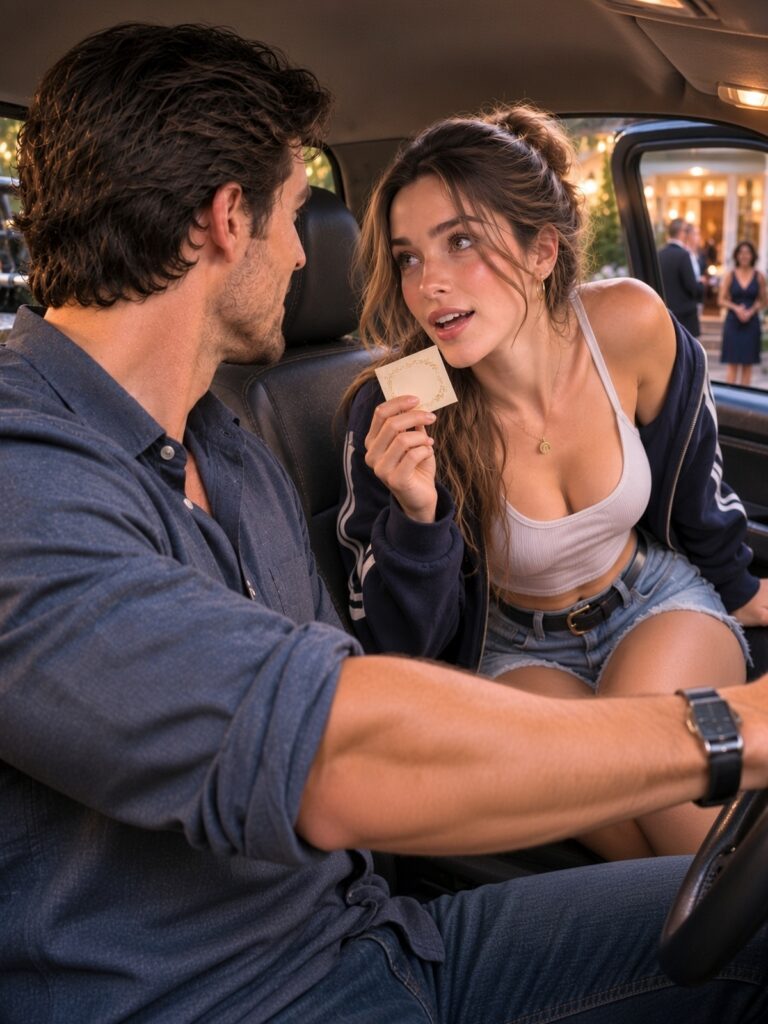
Our Mothers Spent Twenty Years Trying To Make Us Fall In Love—Then She Climbed Into My Truck And Told Me To Run
The woman I thought couldn’t stand me climbed into my truck, ducked below the window, and whispered, “Drive before my mother sees us.”
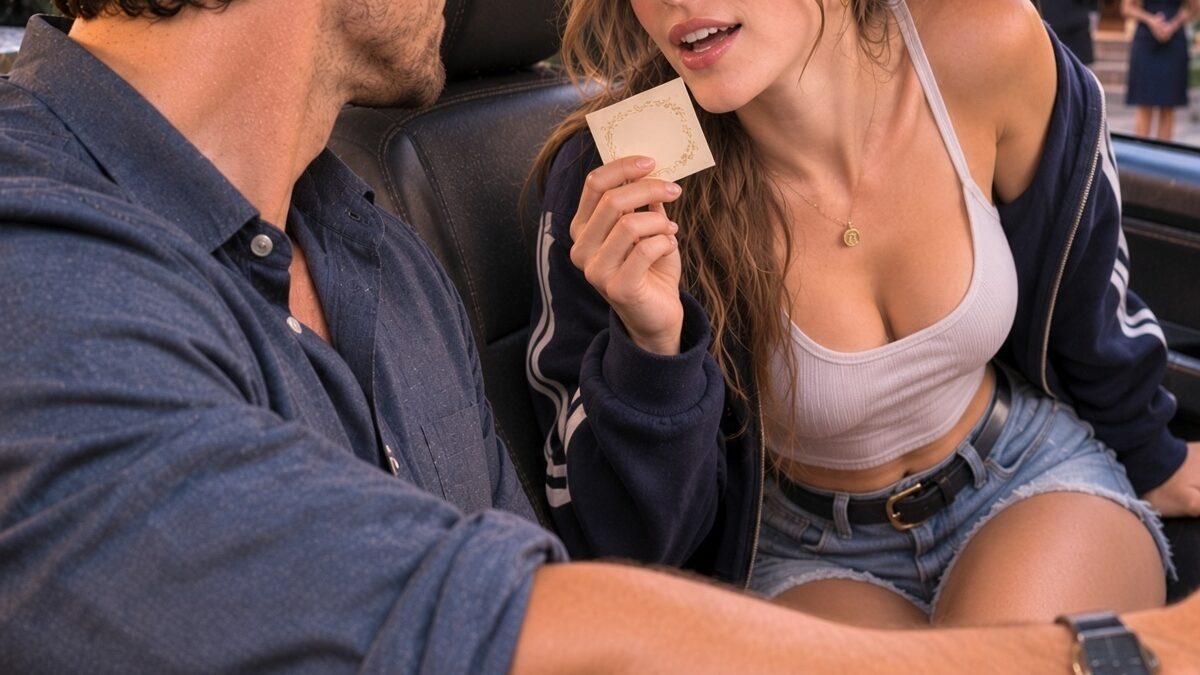
In her hand was a place card with our names written together—and a heart neither of us had asked for.
We escaped the party that night, but the truth waiting between us would be much harder to outrun.
PART 1 — The Woman In My Passenger Seat
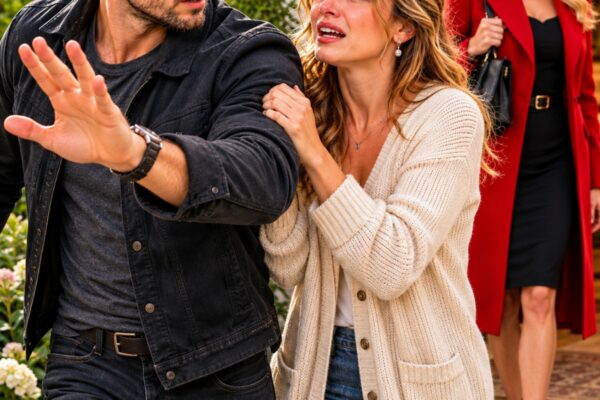
I had my keys in my hand and one foot off the Bouchards’ curb when the passenger door of my truck swung open. Tessa Bouchard climbed in before I could ask what she was doing, pulled the door shut, and slid down until her head disappeared beneath the window. She was wearing a dark blue dress, holding a folded place card, and looking like someone who had just escaped a room filling with smoke. “Drive before my mother sees us,” she whispered. After nearly twenty years of finding reasons to leave rooms she occupied, I understood the request better than I wanted to.
My name is Quentin Ashford, and at thirty-eight, I owned a landscaping business, a truck with a temperamental heater, and more opinions about drainage than anyone had ever requested. What I did not own was the kind of personal life my mother could discuss proudly over a cheese plate. This bothered Paula Ashford with the persistence of a dripping faucet. Tessa, thirty-six, managed a restaurant and possessed an equally inconvenient habit of remaining unmarried. To our mothers, these were two separate problems with one obvious solution.
The trouble had started when we were teenagers, back when their matchmaking still passed for a joke. Someone would say we looked nice standing together, and someone else would mention how convenient it would be if the families officially joined. Over time, the jokes acquired logistics: adjoining seats, shared errands, conspicuously paired invitations. By the time we were adults, neither of us could enter a family gathering without checking the exits. I thought Tessa avoided me because she disliked me, and I had developed enough pride to make sure she never had to do it first.
That evening was the Bouchards’ fortieth wedding anniversary, and both families had assembled to celebrate a marriage that had apparently inspired our mothers to organize another one. I had barely accepted a glass of iced tea when my mother informed me I would be sitting beside Tessa at the head table for the toast. She delivered this information with the satisfaction of someone announcing that a complicated bridge had finally passed inspection. I told her I needed to check a strap on my trimmer rack. She said, “Of course, sweetheart,” in a tone that suggested she was allowing a prisoner five minutes in the yard.
Now the prisoner beside me was whispering for a getaway, and I started the engine. Pulling away casually in a work truck with a rack full of lawn equipment required more restraint than the situation deserved. I resisted the urge to look toward the house, eased past the hydrangeas, and stopped properly at the corner. Tessa lifted her head far enough to inspect the side mirror, then sat upright and released a breath that sounded painfully close to laughter. “Where are we going?” I asked, because she had requested an escape, and that did not automatically make it my decision.
“Anywhere without a table that has your name beside mine,” she said, then closed her eyes. “That sounded awful, and I’m sorry. I mean the table, Quentin, not you.” She held up the card, which bore our names in Elaine Bouchard’s careful handwriting, with a small heart beneath them. I studied it for a second and said, “Well, that settles it—our mothers have progressed from suggestions to official stationery.”
She laughed so suddenly that she covered her mouth afterward, as though the sound had surprised her. I had heard Tessa laugh across crowded rooms, usually while I was deciding whether enough time had passed to leave. Up close, it was lower than I expected, with a rough little edge that made it sound entirely unprepared. She looked down at the heart again, shook her head, and asked whether I thought they had made backup cards. I told her my mother probably had a laminated evacuation plan in case either of us tried sitting somewhere else.
I drove toward Eden Park because it was quiet, close, and offered a view that did not require either of us to explain ourselves. The Ohio River stretched below the overlook in the last light, and the bridge was beginning to gather its evening lamps. We parked between a dusty sedan and a pickup whose owner appeared far more interested in a sandwich than in our family history. I turned off the engine, and silence settled into the cab. For the first time I could remember, we were alone without somebody nearby hoping we would accomplish something.
Tessa turned the card over, examined the blank back, and rested it on her knee. “Did you want to leave too,” she asked, “or did I just turn you into an accessory?” I admitted I had spent twenty minutes trying to invent an errand urgent enough to survive my mother’s questions. The loose strap had been my best effort, and even I knew it lacked conviction. “So you were already escaping,” she said, smiling a little. I told her she had simply brought better timing and evidence.
At first we talked about the party, because the party was safe ground and neither of us knew where to put twenty years of awkwardness. She described the anniversary cake, which had apparently required three calls, two consultations, and a disagreement about buttercream. I told her my father had been instructed to keep his toast under four minutes and had responded by preparing seven pages. Then she mentioned his retirement dinner, and something old and unpleasant shifted inside me. “You left that one early,” I said before I could decide whether it sounded accusatory.
Her expression changed, though not in the way I expected. A line cook had walked out during service that night, she explained, and she had received the call just before the cake was cut. She had found my mother in the kitchen, apologized, and asked her to tell my father she was sorry. I remembered watching Tessa slip through the side door and thinking she could not tolerate another ten minutes near me. “Your mother never told you?” she asked, and I shook my head while a six-year-old certainty quietly fell apart.
That opened a door neither of us had realized was locked. Tessa admitted she had assumed I spent weekends golfing with city councilmen and discussing investments with men named Chip. I stared at her, then held up my right hand, where an argument with a rosebush had left three fresh scratches. “I spent this morning on my knees explaining to a woman why water runs downhill,” I said. She studied my hand, looked genuinely disappointed, and told me she had prepared excellent material about my golf wardrobe.
The more we talked, the stranger our previous versions of each other became. She thought I had criticized her mother’s pot roast; that had been my cousin Dale. I believed she had caused an incident involving a pontoon boat and a bottle of peach schnapps; that honor belonged to her cousin Marie. Tessa accused me of keeping a convenient supply of cousins to absorb responsibility, and I suggested she was hardly operating without resources herself. Within half an hour, we had cleared each other of enough offenses to justify a small courthouse ceremony.
Then we reached the Fourth of July parties, and the jokes slowed down. I said she always disappeared through the garage whenever our mothers tried steering us toward the same conversation. Tessa looked at me with her eyebrows drawn together and said I was the one who left first. I remembered moving toward the garage because she had turned away, while she remembered turning away because she thought I was preparing to move. We sat there with the dashboard dark between us, considering how much life could pass while two people politely misunderstood each other.
“I thought you liked it,” she said at last, rubbing the edge of the card with her thumb. “Being handed somebody because your mother had decided she would fit.” I told her I had assumed she was cooperating because it saved her the trouble of rejecting me herself. She looked out through the windshield, where a barge was moving slowly beneath the bridge. “I wasn’t rejecting you,” she said, and there was enough quiet in the sentence that I believed it before she finished. I told her I hadn’t been rejecting her either, and neither of us tried to make that funny.
Her phone began buzzing against her knee, loud in the stillness. She glanced at the screen, saw her mother’s name, and placed it facedown on the dashboard. I told her I could get her back in ten minutes or drop her a block away, whichever made the rest of the evening easier. She did not owe me another hour simply because I had driven the first one. Tessa studied my face for a moment, then asked, “Have you run out of things to say?” I told her I was beginning to suspect I had twenty years of material.
She tucked one foot beneath her and settled farther into the seat. We talked about restaurant work, about customers who believed a reservation time was an opening offer, and about the strange satisfaction of getting through a terrible dinner service with a good crew. I told her about the first yard I had designed on my own and the client who still mailed me a Christmas card with a photograph of the same redbud. She asked why I never planted maples close to foundations, then argued with the answer because she liked maples. I found myself defending root systems with more enthusiasm than the subject usually inspired.
When I checked the clock, nearly two hours had disappeared. Tessa looked equally startled, which pleased me more than I cared to examine. I started the truck, and neither of us immediately resumed talking, as though turning back toward the party required a small adjustment of gravity. At the bottom of the hill, she smoothed the place card flat across her lap. “I’d like to do this again,” she said, “somewhere without a seating chart or anyone hovering beside a cheese plate.”
I said yes quickly enough to make her grin. We exchanged numbers while idling a block from her parents’ house, and she entered hers into my phone with the concentration of someone signing a document worth reading. “Don’t tell your mother,” she added, handing it back. I told her I had no intention of giving Paula Ashford a reason to investigate my Thursday availability. Tessa laughed, climbed out at the corner, and headed toward the side gate while I circled around to park in front.
My mother found me near the coffee thirty seconds after I returned. She asked whether the strap had been difficult, and I told her it had taken longer than expected. Her eyes stayed on my face a little too long before she handed me a cup. Across the room, Tessa was helping her father cut the anniversary cake, looking composed enough to make our two hours seem imaginary. Then she glanced up, caught my eye, and pressed her lips together to hide a smile, and the entire room felt different.
Monday morning, before I finished my coffee, my phone lit up with her name. “Do you know anywhere with absolutely no cheese plates?” the message asked. I read it twice, which was unnecessary, then once more, which I refused to discuss with myself. Thursday, I wrote back, I had a wholesale nursery pickup across the river in Kentucky, and she could come if she wanted to observe me in my natural habitat. She replied that Thursday morning was her only opening for ten days and that she would bring coffee if I brought whatever men in their natural habitat required.
She was waiting outside her building with two paper cups and work boots that looked borrowed. Her hair was tied back, and the absence of a formal family occasion seemed to have removed an invisible weight from her shoulders. She handed me black coffee without asking how I took it, then said a man so firm about maples probably did not want caramel in his breakfast. At the nursery, she walked between rows of boxwoods and asked why people spent good money on plants that would fail in the wrong yard. I told her half my job involved talking people out of what they pictured and into what would actually live.
“That’s managing a menu,” she said, touching a leaf without damaging it. “Everybody wants something impressive until you explain what keeping it good requires.” We loaded forty-two boxwoods and a pallet of mulch, with Tessa insisting on carrying more than I expected and complaining only about the nursery’s coffee. By the time we headed back toward the bridge, I had stopped pretending I had invited her solely because an extra pair of hands might be useful. I told her I wanted to keep seeing her, whatever time she could fit between deliveries and dinner service.
She turned toward me with a look that was amused until it wasn’t. “You just booked a month while we crossed one bridge,” she said. “I’m still deciding whether this counts as a first date.” I explained that I was telling her what I wanted, and she remained free to want something different. Her expression softened, but she said she needed to reach her own answer without finding it written on a card at her place setting. I told her that was fair, then made myself loosen my grip on the steering wheel.
We stopped at a bakery near the river because she had time before a noon produce delivery. She chose a window booth with a clear view of the room and explained that restaurant people never fully stopped working, even when somebody else was responsible for the forks. At 10:11, an alarm sounded on her phone, and I reached for my keys because I had promised to get her back. Tessa laid a hand on the table, called her assistant manager, and instructed him to count the romaine twice. Then she told him she would be in by two and silenced the phone.
I must have looked too pleased, because she pointed her fork at me. “I’m staying because I want to stay,” she said, and I nodded before answering. I understood what she was giving me: an ordinary decision, freely made, with nobody waiting to claim credit for it. We walked along the river afterward, discussing barges, bad menus, and why every apartment listing described a cramped kitchen as charming. When I dropped her home, she lingered with one hand on the door and asked when I would be free again.
We agreed to keep things private for a little while, though neither of us used the word secret. We wanted time to discover what this was before our mothers started discussing holiday arrangements and inherited china. There was, however, a limit already sitting on the calendar: the large family dinner my mother hosted on the third Sunday of every month. The Bouchards had attended for years, and so had I, which meant we had nineteen days before privacy would require a performance. Tessa counted them on her fingers and called it a deadline; I called it a head start.
Over the next two weeks, we met four times, and each meeting made the old misunderstanding harder to recognize. We ate late dinners, stopped at a lumberyard, and spent two evenings parked above the river with our phones facedown. On the Thursday before the family dinner, my mother texted that Tessa would be bringing her famous potato gratin and that I should wear my blue shirt. Tessa read the message over my shoulder and said she was pleased to learn she had been cast as the potato without an audition. Then she looked at me, stopped smiling, and leaned across the console.
She paused close enough that I could feel the question in the space between us. I lifted my hand to her jaw, and she kissed me with the careful certainty of someone choosing every inch of the distance. When she sat back, her forehead rested briefly against my shoulder, and for a moment all the years behind us seemed almost harmless. Then I asked how she wanted to handle Sunday, and her hand went still on my sleeve. “Before we decide that,” she said, “there’s something I told my mother about you—and you need to hear it from me.”
PART 2 — The Lie That Kept Us Safe
I waited for her to continue while the truck engine ticked softly beneath the hood. We had been sitting there long enough for the windows to gather a faint mist at the edges, and Tessa traced one clear line through it with her fingertip. She did not look at me when she began, which made me listen harder. The Sunday after the anniversary party, her mother had called twice, first to ask why she had vanished and then to ask whether she had vanished because of me. “I said yes,” Tessa admitted, folding her hands tightly in her lap.
At first, I assumed she meant she had told Elaine we had gone somewhere together. Then she swallowed and said, “I told her you still made my teeth hurt, and I’d appreciate it if she would finally leave me alone.” The words landed with an odd, delayed force, partly because I had just kissed her and partly because the sentence sounded so much like the woman I once believed she was. Outside, a car rolled slowly past the overlook, its headlights traveling across her face before disappearing. I looked at the windshield and tried to decide which part of the hurt belonged to now and which part had been waiting for years.
Tessa kept talking before I could answer, explaining that she had said it before our nursery trip, before the bakery, before anything had become something she knew how to name. Elaine had sounded disappointed, then resigned, and for the first time in years had stopped asking questions about me. The silence had felt like relief, and Tessa had allowed herself to keep it. “I wasn’t trying to make you the bad guy,” she said, finally looking at me. “I was trying to make one decision without having her stand over it until it turned into hers.”
I believed her, which did not make the sentence disappear. I understood how it might feel to find the one reliable way to end a conversation and use it before thinking through the cost. I had spent years telling my own mother that I was too busy, too tired, too interested in work, anything that closed the door without requiring a fight. But there was a difference between putting a relationship somewhere quiet and keeping it there by asking someone else to continue believing you disliked the person beside you. I told Tessa that difference mattered to me, even though I was still working out exactly why.
Her eyes filled, though no tears fell, and she looked angry at herself for the possibility. “I know,” she said, so softly I nearly missed it beneath the heater. She explained that every pleasant thing she had ever said about a man had been treated as permission for an investigation, and every hesitation had been interpreted as a problem her mother could solve. Once, after an ordinary second date years earlier, Elaine had asked whether the man’s parents lived close enough to help with future holidays. Tessa had started defending choices she had not even made, and eventually it became easier to make every answer sound final.
I could see the pattern now, stretching farther back than the anniversary party. If Tessa liked somebody, she lost control of the story; if she dismissed him, the questions stopped. Somewhere along the way, she had learned to speak in refusals even when her feelings had become more complicated. I understood that reflex, but hearing myself inside it made my chest ache. For years, I had accepted that she disliked me because it seemed respectful to believe her behavior, and now, after discovering the truth, I was being asked to let the old version stand a little longer.
“I’m not asking you to tell them about us,” I said, choosing the words slowly enough to trust them. “I won’t announce anything, and I won’t tell my mother what you’ve told me tonight.” Tessa nodded, still holding herself very still, and I continued because stopping there would have sounded kinder than the truth. If somebody asked me directly whether she could stand me, I would not agree that she couldn’t. I could give her privacy, but I could not help maintain a story that made being wanted by her sound impossible.
She looked down at my hand resting between us on the seat. A few minutes earlier, she had been leaning into that hand; now there was perhaps six inches of space, and it felt embarrassingly large. “I don’t believe it anymore,” she said, her voice trembling slightly. I told her I knew, because I had been paying attention to the last twenty minutes, and she almost smiled. Then she touched the back of my hand with two fingers, cautiously enough that I understood she was asking whether we were still in the same truck together.
I turned my hand over and held hers, which answered the question without solving everything. We sat like that while the barge below us moved beyond the bridge lights and left a widening black seam in the water. Tessa said she hated that the first thing she had to explain after kissing me was something cruel she had said. I told her I would rather hear it from her now than from somebody laughing over dinner. She nodded, wiped quickly beneath one eye, and asked if I could take her home.
The drive back was quiet, but it was the kind of quiet in which both people were still present. At her building, she unbuckled her seat belt and stayed where she was for a moment, looking at the reflection of the dashboard in the window. “I’ll call you before Sunday,” she said, then leaned over and kissed me once, gently and without any attempt to make the conversation disappear. I told her I would answer, and she let out a small breath before climbing down. I watched her reach the door and wondered how long a person could ask for patience before the person offering it began to feel foolish.
Friday morning, work helped in the practical way work sometimes does. There were measurements to check, soil amendments to spread, and a client in Hyde Park who had decided overnight that symmetrical planting was too predictable. I dealt with those things because they had edges, and because getting a boxwood into the right place required fewer interpretations than getting a relationship there. Still, whenever my phone vibrated, I looked at it too quickly. By late afternoon, I had checked a nursery delivery notification with enough hope to embarrass myself.
Tessa sent a photograph just after five of a soup pot, a clipboard, and a coffee cup balanced on the only clear corner of her desk. “Friday is behaving exactly like Friday,” she wrote, followed by a complaint about a dishwasher who had developed a mysterious allergy to arriving on time. I sent back a photograph of muddy boots and a half-finished walkway, and she replied that my office had better natural light. We exchanged ordinary messages for ten minutes, and the relief of them surprised me. I had been bracing for distance, while she was offering me the small, unpolished details of her day.
That evening, alone in my kitchen, I kept returning to the phrase about her teeth. It was ridiculous, really, because I knew what her mouth had felt like against mine, and there was no uncertainty in that memory. But an old wound does not always understand that the evidence has changed, and I had spent too long treating her apparent dislike as a fact. I realized what I wanted most was not a family announcement or permission to call her my girlfriend. I wanted to know that when I was absent, she would still tell the truth about the man I had been when we were alone.
Saturday morning, I was setting the last of the boxwoods along the Hyde Park walkway when Tessa’s car pulled up across the street. She stepped out in jeans with two coffees and the expression she wore when something in her restaurant required a calm response before it became a fire. I put down my spade and met her near the edge of the lawn. “I went to my mother’s yesterday,” she said, handing me a cup before I could ask anything. Then she sat on the planter wall, and I turned over an empty bucket because apparently this was where we held important meetings now.
Elaine had been peeling potatoes for the gratin when Tessa arrived. The kitchen had smelled of coffee and onion, and for several minutes they had talked about restaurant staffing and whether the weather would hold through Sunday. Then Elaine mentioned that my mother had agreed to seat us by the dining room window because I had been so patient with Tessa over the years. Tessa repeated that sentence with her eyes fixed on the coffee lid, and I felt something tighten in my stomach. Even her resistance had been turned into a story in which I waited politely for her to become sensible.
“So I put my glass down,” she told me, “because I knew if I kept holding it, she’d see my hands shake.” She had told Elaine there would be no more arranged seats, shared errands, or reports passed between the mothers about what she supposedly thought of me. Elaine had started to explain that they only wanted her to be happy, and Tessa had asked her to listen before defending anything. “You don’t know what I think of him,” she had said, “because I haven’t told you, and you don’t get to decide it in either direction.” The kitchen had gone quiet except for water dripping from the colander.
Elaine had asked, very carefully, what Tessa did think of me. It was such a predictable question that Tessa almost laughed telling me about it, though there was no amusement in her face. She had answered that this was exactly the point: her feelings belonged to her, and she was allowed to understand them before presenting a report. Her mother had stared at her for several seconds, then said, “All right,” in a tone that did not sound entirely all right. Tessa had left five minutes later, reached the porch steps, and discovered her legs were shaking.
“I didn’t tell her about us,” she said, looking up at me. “But I didn’t say the other thing again, either.” I told her I understood, and she took a breath deep enough to lift her shoulders. Refusing to repeat the old answer had told Elaine something, she knew, and there was no way to control how much her mother suspected. “For once, though, I said what I meant instead of whatever would get me out of the kitchen,” she added, and I could hear the cost of that small victory.
I was prouder of her than I could have explained without making the moment heavy. She had gone into the room where the pattern began and interrupted it without borrowing another lie. She had defended her own right to choose and, at the same time, stopped using my name as a shield. I told her it sounded like the anniversary escape, only this time she had managed without a truck. She laughed into her coffee, and for a few seconds everything between us loosened.
That should have been enough, and I wish I could tell you I was wise enough to recognize it. Instead, relief made me impatient, which is a problem I had previously disguised as efficiency. I had spent two nights wondering where I stood, and now she had come to tell me she had moved something difficult out of the way. I wanted to know what came next, wanted a solid point on the calendar I could stop thinking beyond. “Do you think we could pick a date to tell them?” I asked, and watched her cup stop halfway to her mouth.
She lowered it slowly, as though setting down something breakable. “A date,” she repeated, and I heard the careful change in her voice before she looked at me. I explained that I did not mean Sunday, or even soon, just a point when we would both know the quiet period ended. Tessa listened, then said she had just left one kitchen where somebody kept a calendar for her and now she was sitting beside another one. My mother had a schedule, Elaine had a schedule, and she could not bear discovering that I had been drawing up a third.
“That isn’t what I mean,” I said, too quickly to have considered what she had actually heard. “I know it isn’t,” she replied, and somehow that hurt more than if she had accused me of doing it deliberately. She knew I was trying to find certainty, but she was trying to discover whether her own decisions could survive being spoken aloud. There was room for both truths, though I had managed to put mine directly on top of hers. I looked down the walkway at forty-two shrubs arranged according to my plan and had the unpleasant experience of recognizing myself.
In my work, uncertainty was usually a problem to solve before it cost somebody money. I measured twice, ordered early, and called customers back because leaving things unresolved made me feel irresponsible. Those were useful habits around retaining walls and less useful when a woman had just crossed a lawn to describe the hardest conversation she had managed in years. I had promised not to press, then dressed pressure in a reasonable question and handed it to her with coffee. Once I saw it clearly, there was no point arguing about what I had intended.
I put my cup down beside the bucket and told her I was taking the question back. She looked at me for a long moment before saying, “You can’t unask it, Quentin.” I told her she was right, but I could stop asking, and I could make sure the answer did not become the price of having an easy afternoon with me. Her arms stayed folded, though the tension in her jaw shifted. I understood then that an apology mattered less for how well I said it than for what happened after she refused to make me feel better.
“There is one thing I need you to know,” I added, and she waited. On Sunday, I would say hello like I was glad to see her, because I would be. I would pass her the rolls, ask how work had gone, and stay in the room instead of manufacturing a reason to leave through the garage. I would not make an announcement, corner her with a question, or perform indifference for the benefit of people who had already wasted enough of our time. She could decide everything she needed to decide, but I was finished pretending her presence was something to escape.
For several seconds, she watched me as though checking for a condition hidden in the offer. Then she asked, “That’s really it?” and I said it was. “That sounds like manners,” she said, and I told her my mother would consider it a supernatural event. Tessa laughed, and this time the sound reached her shoulders. She stood, set her coffee safely on the planter, and picked up one of the remaining boxwoods before I could suggest she ought to protect her jeans.
We finished the walk together, which turned out to be easier than finishing the conversation. She lowered a shrub into the hole I had marked, and when I said it needed shifting slightly, she moved it an inch and gave me a look that discouraged further editorial comment. We passed the spade back and forth, straightened the root balls, and worked soil around the edges until our hands were equally dirty. Nobody asked what any of it meant, and nobody tried to place it on a timeline. When we stepped back to inspect the row, her shoulder rested against mine without either of us arranging it.
At her car, she stopped with one hand on the open door and looked back at me. “If I head toward the garage on Sunday,” she said, “you should assume I’m getting ice.” I told her I would require an announcement and possibly a witness, and she smiled in a way that made the entire difficult morning feel worth having. Then she drove toward the restaurant, where somebody was almost certainly calling her about a problem she had already explained how to solve. I stood beside the finished walkway, holding an empty cup, and felt hopeful enough to be frightened by it.
That afternoon, my mother asked me to bring the extra dining-table leaf up from the basement. I carried it past the family photographs while she stood in the kitchen doorway folding a dish towel into exact thirds. “Elaine says Tessa gave her quite a talking-to,” she announced, and there was unmistakable happiness beneath the concern she was attempting to wear. I stopped beside the table, still holding the leaf, and waited for the rest. “She wouldn’t say what she thinks of you,” my mother continued, smiling now, “which is the best news we’ve had in twenty years.”
I set the leaf down carefully because I suddenly needed both hands free. My mother explained that a woman who refused to discuss a man was usually thinking about him, and that perhaps the anniversary seating had finally accomplished something after all. I looked at her across the open table and understood what Sunday might actually demand from us. Tessa had fought to make one honest decision, and our mothers were already folding that decision into the story they preferred. In less than twenty-four hours, we would have to walk into this room—and find out whether something that belonged to us could survive everybody else claiming it first.
PART 3 — The Door We Finally Walked Through Together
My mother held out the pressed blue shirt as if the conversation had reached its natural conclusion. I took it because refusing a shirt would not have addressed the problem, and because I needed a moment to decide what I could honestly say. “Tessa asked you both to stop arranging things,” I told her, keeping my voice level. “I think you should take that seriously.” My mother’s smile faltered just enough for me to see that she had expected teasing, perhaps embarrassment, but had not expected to be asked to listen.
“We only want you two to be happy,” she said, with the wounded softness parents sometimes use when their intentions are being questioned. I believed her about the happiness, which made everything more difficult than if she had been simply meddlesome for sport. She loved me, loved Elaine, and loved a future in which every holiday fit around one table without anyone having to negotiate. For twenty years, that picture had grown so familiar that she had stopped seeing the two people required to live inside it. I told her wanting something good for us still left us responsible for deciding whether we wanted it ourselves.
She glanced toward the window, where she had already placed two chairs at the end of the table. “I suppose I’m not allowed to be pleased about anything anymore,” she said. I could have argued with the word allowed, could have explained how easily concern became control when it arrived every month carrying a serving dish. Instead, I said she was allowed to feel whatever she felt, and I needed her to let us do the same. Her hands tightened on the dish towel before she nodded once and asked whether the table leaf would fit better from the other side.
I helped her finish setting up because there was no reason honesty had to end in abandonment. We moved chairs, tested the extension, and discussed whether my father had remembered to buy ice. She asked about a drainage job in Oakley, and I answered in enough detail that she eventually regretted changing the subject to something I understood. Still, the room felt altered, with a little less room for assumptions to pass as plans. When I left, she told me the shirt would look nice, and I thanked her without promising anything beyond wearing it.
Outside, I laid it carefully across the passenger seat and sat behind the wheel. That seat had become so familiar with Tessa in it that the blue cotton looked strangely impersonal. I pictured her standing in her mother’s kitchen, hands shaking while she asked for a small piece of adulthood neither of us should have had to request at our age. Then I pictured Sunday, with everybody watching us manage ourselves across the roast. I had promised not to ask for a deadline, and I meant to keep that promise, but I could at least make my own behavior clear.
I called the restaurant and caught her between a prep meeting and somebody misplacing a delivery invoice. Behind her voice came the metallic clatter of pans and the low, constant rush of a working kitchen. I told her I had been at my mother’s, that the table was ready, and that I would arrive at five as myself. I would carry whatever needed carrying, sit wherever there was a chair, and be glad to see her without turning that gladness into a performance. “You don’t have to ride with me,” I added, “and this isn’t a test you’re supposed to know you’re taking.”
Tessa said nothing for long enough that I heard a cooler door slam behind her. Then she asked whether my mother had said something, and I answered carefully that Paula was being Paula, but I had asked her to listen. I did not repeat every word, because it would have felt like handing Tessa a fresh burden and calling it useful information. What mattered was that I would handle my mother, and she would not be required to manage my feelings on top of her own. “If you come by yourself,” I said, “I’ll hold the door for you and the potatoes, and that will be the whole arrangement.”
“That’s the safe version,” she said eventually, and I could hear her moving somewhere quieter. She would drive over, carry in the gratin, and be pleasantly cordial across the table. Nobody could point to any particular moment and say something had changed, and she would retain control over every piece of information. I told her that sounded manageable if it was what she wanted. “It sounds manageable because I get to put you away whenever my mother enters the room,” she answered, and I stopped speaking.
I watched a neighbor across the street attack a hedge with equipment too small for his ambition. Tessa was quiet again, though this time I could hear her thinking rather than withdrawing. She said she had stood in her mother’s kitchen insisting that her feelings belonged to her, then nearly used that principle to justify acting as if those feelings did not exist. She could not stop Elaine from drawing conclusions, and she was exhausted by trying to keep every conclusion several steps behind reality. “I don’t want my life to be organized around making sure she never feels satisfied,” she said.
That sentence settled something for me I had been unable to name. We had spent years resisting a relationship because our mothers wanted it, which was another way of letting them decide its shape. Even now, hiding could become a kind of obedience if every choice still depended on preventing their reaction. Tessa did not owe them a victory, but she did not owe them permanent disappointment either. I told her I thought she deserved to choose something because it made her happy, even if an inconvenient number of people happened to be happy about it too.
“I’m not walking in as half of my mother’s seating chart,” she said, and I told her I understood. “But I’m not going to act like I haven’t spent the last three weeks looking forward to seeing you.” The words reached me with such plainness that I looked down at the steering wheel to give myself somewhere to put my face. I asked what time she wanted to leave, and she said four-thirty, from the back of her building. Her landlord stationed himself near the front on Sundays and had developed strong opinions about where my truck ought to be.
We discussed the details in the practical order she used at work. There would be no announcement, no clinking glasses, and no speech explaining how many times we had met beside the river. If somebody asked a direct question, we would give a direct answer and allow silence to do whatever it needed afterward. We would not deny anything, and we would not spring apart because a relative looked at us with excessive interest. “The garage is permitted for ice only,” she said, and I told her I would have my father issue a written policy.
Then I raised the part I knew would be hardest for me. My mother would probably take credit, perhaps immediately, and I could already feel how much I would resent listening to her claim the hours we had found without help. Tessa exhaled, then said, “She gets to tell a story, Quentin; she doesn’t get to make us live by it.” I considered that while she continued, explaining that we could correct facts without spending the evening cross-examining two women over twenty years of good intentions and poor execution. We could protect what was ours without convincing everybody else to describe it perfectly.
Her own cost was harder to say aloud, and I listened while she worked toward it. By arriving together, she would lose the ability to decide exactly who learned what and when, because information at a family dinner traveled faster than a useful kitchen rumor. She would have to sit through expressions, questions, and possibly relief that she had not invited. “That makes my stomach feel terrible,” she admitted, and I told her she could still change her mind about the ride. She paused, then said she was nervous about the choice she had made, which was different from needing me to make another one for her.
On Sunday afternoon, I put on the blue shirt and resented how well it fit. My father had once told me that marriage required accepting that somebody could be irritating and right about a shirt at the same time. I was beginning to suspect families worked on the same principle, though I hoped the application was limited. I cleaned the passenger-side floorboard, removed a pair of gloves from the seat, and checked the clock twice before leaving. Then I took the longer route because arriving early would have given me too much time to think outside her building.
Tessa stood at the back door in a green dress, holding the gratin in two folded towels. Her hair was pinned up, a loose strand had escaped beside her cheek, and she looked so unlike somebody preparing for a routine family dinner that I forgot the greeting I had planned. She noticed, looked down at herself, and asked whether she had cheese on her dress. I told her she looked beautiful, which made her eyes soften before she said I could still help with the door. I did, and she climbed into the passenger seat with the dish firmly across her lap.
I suggested several possible places for the potatoes, each rejected before I finished describing it. The floorboard was unsafe, the back seat was unacceptable, and the bed of the truck was apparently grounds for immediate reconsideration of my judgment. “If your mother criticizes the cheese, I want to be close enough to defend it,” Tessa explained. I told her my mother would be wise to direct any criticism toward Dale, who had an established record in that department. She laughed, but her fingers kept smoothing a towel that was already perfectly straight.
The dish warmed the space between us as I drove, and for several blocks we talked about things that had nothing to do with dinner. I described a client’s dog attempting to excavate one of our newly planted boxwoods, and she told me a customer had asked whether a steak could taste less like beef. We argued briefly about whether the customer had been searching for chicken without realizing it. At a red light, her hand came off the towel and rested on the seat between us. I placed mine beside it, and she linked two fingers through mine until the light changed.
By the time we reached my mother’s street, she had stopped talking. The maples formed a canopy over the road, their leaves shifting in the late-afternoon sun, and I drove beneath them more slowly than traffic required. Three weeks earlier, I had taken her away from a house full of expectations because she asked me to. Now we were heading toward another one, and I could not offer the same kind of rescue without undoing the reason we had chosen to come. I glanced at her, and she looked at the familiar houses as if she were seeing them from a different road.
There were four cars parked near the driveway, including Elaine’s, and a curtain moved in the dining room window before I turned off the engine. Tessa noticed it too, closed her eyes for one breath, and opened them with something steadier in her expression. “Ready?” I asked, because I could offer the question without choosing the answer. She shifted the dish onto one arm and put her other hand flat on the seat between us. “I am if you are,” she said, and I told her I was ready enough to get out of the truck.
She carried the gratin up the walk herself, and I stayed half a step behind to catch the screen door. Before I reached it, the front door opened, revealing my mother and Elaine standing shoulder to shoulder with the awkward innocence of people who had absolutely been watching the driveway. My mother’s gaze moved from Tessa to me, then back again, and her hand rose to her chest. Elaine looked at the dish as though it might contain additional evidence. Tessa stepped inside and stopped beside me, close enough for our arms to touch, and neither of us moved away.
“Well,” my mother said, already sounding overwhelmed by a future she had apparently completed in the time it took us to walk from the curb. “I knew it, Elaine; I told you that anniversary seating would finally do it.” For one suspended second, I felt Tessa gather herself beside me, and I wondered whether the sentence would send her back toward the door. Instead, she shifted the warm dish and looked directly at my mother. “The seating chart nearly sent us in opposite directions again,” she said, calmly enough that everybody in the hallway could hear her.
My mother blinked, and Tessa continued before anyone could rescue the old version. She explained that she had climbed into my truck to escape the head table, that I had wanted to leave too, and that we had discovered how little we actually knew about each other. We had spent two hours talking because we wanted to, and we had kept meeting for the same reason. There was no anger in her voice now, only the determination of someone placing something fragile on a level surface. I said, “That’s exactly what happened,” and left her account standing on its own.
From the living room, my father suddenly became very interested in asking Dale to help with the carving board. My mother glanced past us, then back at Tessa, and for once appeared to be searching for a response she had not rehearsed. Elaine remained still, her eyes fixed on her daughter. “You told me he made your teeth hurt,” she said quietly. I felt Tessa’s arm press a little more firmly against mine, but she did not look away or ask me to answer for her.
“I did,” Tessa said, and the simplicity of the admission seemed to stop Elaine more effectively than any explanation could have. She said it had been unfair to me and that she had used an old answer because it made an uncomfortable conversation end. Then she turned toward me in the hallway, in front of the two people whose opinions had made the truth feel so difficult. “I’m sorry I let you stand inside that story after I knew it wasn’t true,” she said. I told her I knew, and that she had already done what mattered by changing it.
Elaine looked between us, and something in her expression finally gave way. “For the record, I’ve always thought Quentin was a perfectly nice man,” she said, with a small, uncertain laugh. Tessa smiled, though her voice remained steady when she answered, “I know, Mom, but I needed to find out what I thought.” Elaine lowered her eyes briefly before nodding, and my mother stepped aside to let us pass. It was not a perfect understanding, and nobody burst into enlightened applause, but we were inside the house together with the truth still intact.
My father took the gratin from Tessa as though accepting a valuable contribution to an evening he had wisely decided not to complicate. He told her it smelled excellent, asked me to check the roast, and gave neither of us the meaningful look I had been dreading. In the dining room, the table stood fully extended beneath the light, and the window seats waited exactly where my mother had placed them. Beside one plate lay a card with Tessa’s name and a small heart beneath it. She picked it up, studied the handwriting, and slid it into her purse without a word.
For an instant, I thought she might ask to move the chairs. Instead, she looked out the window at the maple and sat down beside me. “Good view,” she said, as though selecting a table at a restaurant with absolutely no family history attached. I passed her the rolls when they reached me, and she took one without turning the gesture into evidence. Around us, chairs scraped, water glasses filled, and somebody asked whether the Reds had finally found a bullpen. The ordinary noise of dinner resumed, and I discovered that ordinary could feel like an enormous mercy.
My mother lasted perhaps four minutes before beginning, “When you two first—” Elaine touched her arm, and Paula redirected the sentence toward the weather with only moderate success. Tessa kept her eyes on the serving spoon, but her knee rested against mine beneath the tablecloth. I could feel the small pressure whenever somebody’s attention lingered too long, and I answered it without looking down. Nobody had promised us an evening free of opinions, and it turned out we could sit through them. Being seen was uncomfortable; it was also less frightening than managing all the ways we might disappear.
Dale tasted the gratin and announced that it was a little dry. The timing was so remarkable that I put down my fork, and Tessa slowly lifted her eyes to him. “You must be Dale,” she said, in the cordial voice she reserved for customers about to discover that courtesy did not mean surrender. He looked pleased to have been recognized and asked whether we had met before. “I’ve heard a great deal about your work in the field of unsolicited food assessment,” she replied, and my father laughed hard enough to set down the carving knife.
The laughter loosened the room, including parts of it I had not realized were tense. Dale defended himself, Elaine declared the potatoes excellent, and my mother admitted she wished she had asked for the recipe instead of buying a similar dish at Thanksgiving. Tessa explained the cheese ratio while answering a question from my aunt about the restaurant. Nobody discussed rings, venues, or whether our supposed future children would inherit my father’s eyes. When Paula began looking as if she might, I asked about the neighbor’s hedge, and she launched into a subject on which her opinions required no cooperation from me.
Over dinner, Elaine asked Tessa how the restaurant had handled a recent staffing change. It sounded like an ordinary question, but I noticed the care with which she left space afterward, allowing her daughter to decide how much to tell. Tessa answered honestly, describing the assistant manager she was learning to trust and the difficulty of leaving work without assuming everything would collapse. Elaine listened, then asked one more question instead of supplying a solution. Tessa’s shoulders lowered a little as she spoke, and I found myself liking the evening for reasons that had nothing to do with us.
Dessert brought the closest thing to a relapse. My mother told a shortened version of our history in which she and Elaine had always suspected we might be good together and had simply provided a few opportunities. I felt the familiar urge to correct every omission, to list the doors we had used and the years their opportunities had cost us. Then Tessa’s hand found mine beneath the table, warm and steady, and I heard what she had said on the phone. We had already told the truth; we did not have to spend the rest of the meal supervising every retelling of it.
Near the end of dinner, Tessa stood and announced that the ice bucket was empty. She looked at me with just enough seriousness to make my father glance between us in confusion. “I’m going to the garage for ice,” she said, and I offered to carry the bag because the language of our private joke still belonged to us. “That is the authorized purpose,” she reminded me, and I agreed in front of the entire table. My mother opened her mouth, thought better of it, and reached for the coffee pot.
The garage was cool and smelled of motor oil, stored grass clippings, and the unfinished projects my father claimed he was still evaluating. The chest freezer hummed in the corner beside the back door we had both used to escape so many family gatherings. Tessa lifted the lid, took out the ice, and set the bag on top before turning toward me. For a moment, she only looked at the door, then at my face, and shook her head with a smile that carried more sadness than amusement. “All that time,” she said, and I knew she meant much more than the distance between the table and the driveway.
I told her I had once stood in that exact spot waiting for her to leave the kitchen before I went back inside. She said she remembered a summer when she had stayed outside beside the garbage cans until she thought I had finished dessert. We could have made another joke about our efficiency, but neither of us seemed to want one. She laid her hand against my chest and said, “I’m glad you were by the curb that night.” Then she kissed me, briefly at first, and again when neither of us stepped away.
When we returned with the ice, my mother was concentrating on the coffee with exaggerated dedication. My father asked whether the freezer was still making a rattling noise, and I told him it sounded fine. Tessa sat beside me again, picked up her cup, and listened while Dale described a recent encounter with a parking meter. Nobody asked how long ice retrieval usually took, which I considered evidence that a family could occasionally learn. Under the table, Tessa pressed her foot against mine, and I had to look away from her to keep from smiling at absolutely nothing.
We left at nine because she had a produce delivery at six in the morning. She stated this clearly to the room before anybody could suggest cards, and no one tried to negotiate her schedule into something more convenient. My mother hugged her and held on a moment too long, then released her before the embrace became a declaration. Elaine followed us to the porch and asked whether Tessa wanted to have lunch on Wednesday. The last three words came slowly, and Tessa heard them, because she answered, “Yes, I’d like that,” with a warmth that made her mother’s face change.
Back in the truck, Tessa buckled her seat belt and leaned against the headrest as though she had finished an unusually complicated dinner service. The house glowed behind us, and through the window I could see my father stacking plates while our mothers stood together near the table. “You all right?” I asked, starting the engine. She considered it honestly before saying she was tired, relieved, and reasonably sure nobody had secretly booked a church. I told her I could not guarantee what might happen before breakfast, and she laughed without the old edge of dread.
She said I owed her a Thursday, and I asked where she wanted to go. Her apartment, she answered, with dinner in her kitchen and nobody invited who had known either of us in diapers. I offered to bring dessert, but she said I should also bring a plant for the window box she had been meaning to fill for two years. “Something I can keep alive,” she added, and I asked about the light before suggesting anything. She looked over at me and smiled as though the question itself was part of the reason she wanted me there.
I drove the long way past the river, where the bridge lights stretched into the water and a barge moved beneath them at its own patient speed. Tessa rested her hand near mine, and neither of our phones interrupted the quiet. I had spent so much of my life finding reasons to leave rooms she occupied that staying still beside her felt almost like learning a new habit. Thursday was only four days away, and for once, looking forward to something did not feel like drafting a plan somebody else had to accept. It felt like being invited and knowing I wanted to come.
At her building, she stayed in the seat after I parked, searching through her purse. She pulled out the place card from dinner, then another one, softer at the corners, that I recognized from the anniversary party. She laid them side by side on the console and studied the two small hearts with a look I could not immediately read. “Same handwriting,” she said, and I nodded, wondering whether she was about to tear them in half. Instead, she took a pen from her bag and turned the older card over.
I watched her write one sentence across the blank back, then add the date of the evening we had driven to Eden Park. When she handed it to me, the paper was still warm from her fingers. Beneath all the years our mothers had tried to arrange, Tessa had written, **This is the night we finally asked each other.** I tucked the card behind my sun visor and told her I would see her Thursday. She kissed me once before climbing out, then paused on the sidewalk with the smile I had spent twenty years mistaking for something I would never get to know.
“And Quentin?” she said, leaning back toward the open window. “Thursday isn’t another escape, in case you’re wondering.” I told her I wasn’t, though the truth was I still found it remarkable to be wanted so plainly. She tapped the roof of the truck, stepped back, and added, “Good, because there’s something I want to ask you when you get there.” Then she went inside before I could ask what it was—and for the first time in my life, I was happy to wait for an answer.