Husband Sent A Box To His Cheating Wife & AP In The Middle Of The Act & Made Them Panic….

Husband Sent a Box to His Cheating Wife and Her Lover—Right in the Middle of Their Weekend Together
I thought the worst thing a husband could receive was proof that his wife had cheated.
I was wrong.
The worst thing was learning she had built an entire second life—and had planned to keep me inside the first one forever.
Part One — The Envelope That Ended Twelve Years
“I’m sorry, Mr. Walker.”
Private investigator John Michaels placed a thick gray envelope on the desk between us. He did it carefully, almost respectfully, as though it contained the remains of something that had once been alive.
“It’s never easy delivering news like this.”
I stared at the envelope without touching it. My name was written across the front in black ink: JOHN WALKER—CONFIDENTIAL.
“How bad?” I asked.
Michaels leaned back in his chair. He was a broad-shouldered man in his late fifties, with tired eyes and the steady voice of someone who had watched too many marriages collapse from the outside.
“Bad enough that I recommend you speak to an attorney before you confront your wife.”
My fingers finally closed around the envelope. Inside were surveillance reports, hotel receipts, restaurant photographs, and images of my wife, Linda, entering the same homes and hotels as Grant Jacobs, her former boss.
In several pictures, his hand rested against the small of her back.
In another, she was kissing him beside his car.
The date in the corner was three weeks earlier.
“How long?” I asked.
Michaels glanced at his notes.
“We can document the relationship for at least ten years. Based on conversations we recorded, it may have started twelve years ago, around the time Linda was promoted.”
Twelve years.
Our daughter Sophie had been born twelve years ago.
The room seemed to tilt. I pressed both palms against the edge of the desk, afraid that if I let go, I would fall out of my chair.
“You’re certain?”
“I don’t use that word unless I mean it.”
He slid a plastic case toward me. A small data drive rested inside.
“This contains audio and video from the last month. You authorized surveillance inside your home and in areas where your wife had no expectation of privacy. Nothing indicates that Grant entered your house. They met at his property, hotels, and several short-term rentals.”
A ridiculous wave of relief passed through me. At least Grant had never been in our bedroom.
Then I hated myself for being grateful for such a small mercy.
Michaels folded his hands.
“There’s something else. Grant has been involved with other married women. Linda may not know the full extent of it.”
I felt something cold settle beneath my ribs.
“Was he seeing them while he was seeing her?”
“Yes.”
My first thought was not revenge. It was disease.
Linda and I had continued living as husband and wife. She had touched me after touching him, kissed me after lying beside him, and slept peacefully while I carried whatever risks she had brought into our home.
“I’ll need medical testing.”
“That would be wise.”
“And DNA tests for my children.”
Michaels’s expression softened.
“I understand.”
I hated myself again. Aaron was fourteen. Sophie was twelve. I had held them through fevers, packed their lunches, repaired bicycles, attended school plays, and sat beside their beds when nightmares woke them.
They were my children.
Biology should not have mattered.
But after twelve years of deception, certainty had become something I could no longer take for granted.
Michaels turned another page.
“Grant’s sister, Natalie, appears to have known from the beginning. We recorded Linda thanking her for covering for them in the early years. Natalie may have helped arrange business travel and meetings.”
Natalie had attended our barbecues.
Her daughter had slept over at our house.
She had smiled at me across my own dining table while helping her brother sleep with my wife.
“Does her husband know?”
“We found no indication that he does.”
I stared at the photographs again. Linda looked happy in them. Not frightened. Not trapped. Happy.
Michaels placed a business card beside the envelope.
“Lisa Hawkins. Divorce attorney. She’s excellent, especially when marital misconduct overlaps with custody or financial deception.”
“I haven’t spoken to Linda.”
“Don’t. Not until you have a plan.”
He leaned forward.
“You’re angry. You have every right to be angry. But you have two children, a house, retirement accounts, and a future. One reckless confrontation can damage all of that.”
I nodded, though the movement felt distant.
“This is real life,” he continued. “Not a revenge fantasy. Let the lawyers do the damage that needs to be done.”
I paid his bill, placed the envelope in my briefcase, and walked to my car.
For fifteen minutes, I sat behind the steering wheel and cried so hard that my chest hurt.
Then I called Lisa Hawkins.
Her assistant scheduled me for the following afternoon and emailed a list of financial documents I needed to bring.
I should have driven home.
Instead, I stopped at a convenience store and bought cigarettes for the first time since college. Then I sat at the end of a quiet bar with one beer in front of me, turning the glass slowly between my hands.
The bartender watched me light a cigarette.
“You look like a man who just lost something.”
“My marriage,” I said. “I just found out it ended twelve years ago. Nobody bothered to tell me.”
He rested both hands on the bar.
“Another man?”
“My wife’s former boss.”
“For how long?”
“Twelve years.”
He gave a low whistle but did not offer me false comfort.
“My grandfather used to say he complained about having no shoes until he met a man with no feet.”
I stared at him.
“That’s supposed to help?”
“No,” he said. “It’s supposed to remind you that pain can make a man forget everything he still has.”
The faces of Aaron and Sophie appeared in my mind.
“Finish that beer,” the bartender said. “Then go home and handle your life. There are no answers at the bottom of the glass.”
I left him a large tip.
During the drive home, old memories rearranged themselves into evidence.
After Sophie was born, I had undergone a vasectomy. Linda still went back on birth control, claiming it helped regulate her cycle.
When she traveled with Grant, her dresses became tighter, her luggage more expensive, and her evening calls shorter. Sometimes I heard a man’s voice in the background. Once, after she returned from Chicago, Grant’s sharp cedar aftershave clung to the collar of her coat.
After her company was sold, Linda announced her retirement. Yet every Friday she claimed the new owners still needed her “special expertise.”
One afternoon became two.
Two became three.
Then came weekend trips.
All the signs had been there, but I had interpreted them through trust.
Trust had translated every lie into an innocent explanation.
When I pulled into the garage, Linda’s car was already there.
She met me in the hallway wearing jeans and the blue sweater I had bought her the previous Christmas.
Her expression changed when she smelled me.
“You’ve been smoking.”
I removed my coat.
“And drinking. John, what happened?”
“Today was one of the worst days of my life.”
Concern filled her face so naturally that I almost admired the performance.
“Did something happen at work?”
“Something happened.”
She reached for my arm. I stepped back.
“I’m going to spend the evening in my office. I won’t be good company.”
“Can I help?”
No, I thought. You cannot give me twelve years back.
“I don’t think anyone can.”
She watched me for a moment, then drew a careful breath.
“I should tell you now. I have to leave Friday for another business weekend.”
I turned slowly.
“Sophie’s birthday party is Saturday.”
“I know. I feel awful, but this came up unexpectedly.”
“With Grant?”
“He’s coordinating the meetings.”
“Of course he is.”
Her eyebrows tightened.
“What is that supposed to mean?”
“It means you missed Aaron’s birthday last year. You missed our anniversary. Now you’re missing Sophie’s party.”
“John, this is important.”
“So is your daughter.”
“I’ll make it up to her.”
“No. You’ll explain it to her. I’m done covering for you.”
Color rose into Linda’s cheeks.
“You’re being unfair.”
“You supposedly retired four months ago, yet you’re away more now than when you worked full-time. How would you feel if I disappeared with the same woman every weekend?”
Her anger weakened.
“I understand how it looks.”
“Do you?”
“It’s just business.”
Those three words struck me harder than the photographs.
“Is there anything you want to tell me?” I asked.
Her eyes narrowed.
“Are you accusing me of having an affair?”
I held her gaze, wondering how many times she had rehearsed that outrage.
“I’m asking whether there’s something you want to tell me.”
“No.”
The answer came smoothly.
Not even a pause.
I walked into my office, locked the door, and opened the envelope.
For nearly two hours, I read every page.
Then I inserted the data drive and put on my headphones.
The first video showed Linda and Grant sitting close together on a couch in his living room. The images were not graphic, but they were intimate enough to remove every remaining doubt.
Grant poured her a drink.
“We’re still on for this weekend?” he asked.
Linda smiled.
“Of course.”
“What about Sophie’s birthday?”
“John will handle it. He’s always been better with the children.”
The words entered me like a blade.
Grant studied her face.
“You know you’re retired now. How long can you keep inventing reasons to leave?”
“As long as I need to.”
“And if John gets suspicious?”
“He won’t. I’ve never denied him affection. I treat him well. He thinks we have a good marriage.”
Grant laughed quietly.
“You’ve had him fooled for twelve years.”
Linda took the glass from his hand.
“He trusts me.”
“And if he stops?”
Her smile faded, but her answer did not.
“Then I’ll protect myself in the divorce. He won’t risk losing the house or the children.”
Grant placed an arm around her.
“You could stay here.”
“I know.”
“Do you still love him?”
“Yes.”
“More than me?”
She looked away.
“I don’t know anymore.”
Silence filled the recording.
Then Grant asked the question that ended whatever remained of my marriage.
“How long do you want this to continue?”
Linda leaned against him.
“As long as we can manage it. Maybe the rest of our lives.”
I removed the headphones.
My hands were shaking, but my mind had become frighteningly clear.
Linda believed she could keep me as a husband, Grant as a lover, and our children as proof that she had sacrificed nothing.
She had mistaken my trust for weakness.
I reached for Lisa Hawkins’s business card.
Before dialing, I looked once more at the frozen image of my wife in another man’s arms.
Then I whispered to the screen, “You’re about to learn the difference.”
Part Two — The Husband She Thought She Knew
A knock came at the office door.
“The kids are going to bed,” Linda said. “Could you at least tell them good night?”
I shut down the computer and locked the evidence in my briefcase.
Aaron was already under his blanket when I entered his room. At fourteen, he was beginning to resemble me—same dark hair, same serious eyes—but lately he had developed a guarded expression I did not recognize.
“You all right, Dad?” he asked.
“Long day.”
“Mom said you had trouble at work.”
“Something like that.”
He studied me as if he knew I was lying but decided not to challenge me.
Across the hall, Sophie sat in bed with her birthday invitations spread around her.
“Mom really can’t come Saturday?”
“You’ll have to ask her.”
“She said it’s an important meeting.”
My throat tightened.
“It must be.”
Sophie’s excitement dimmed.
“Will you still do the grill?”
“Burgers, hot dogs, the whole thing.”
“And the lights in the backyard?”
“I’ll hang them.”
She smiled and hugged me.
“You always make things good.”
I held her longer than usual.
Downstairs, Linda had kept dinner warm. Pot roast, my favorite.
“I’m not hungry,” I said.
I carried a cup of coffee to the patio and lit a cigarette. A few minutes later, Linda joined me and bent to kiss me.
I turned my head.
Her lips touched my cheek.
She froze.
“John?”
Smoke drifted between us.
“What?”
“You’ve been distant since you came home.”
“I told you. It was a bad day.”
“Let me help.”
“You can’t.”
“You don’t know that.”
I looked at the woman who had shared my bed, raised children with me, and built twelve years of deception behind a face I once believed I could read.
“It’s too late.”
Her body stiffened.
“Too late for what?”
“You’re a smart businesswoman. Figure it out.”
Panic flashed in her eyes before she concealed it.
“Is this about us?”
“Please give me some space.”
She sat opposite me.
“I love you. Whatever is wrong, you can tell me.”
I nearly laughed.
Instead, I extinguished the cigarette.
“Work has been difficult. Maybe I’ll be ready to talk in a few days.”
It was the first deliberate lie I had ever told my wife.
She accepted it because liars often believe everyone else lies as easily as they do.
That night, Linda reached for me beneath the covers. I pushed her hand away.
She tried again.
“John, please.”
“Good night, Linda.”
I turned toward the wall.
Behind me, her breathing became uneven. Eventually, I heard her crying.
Once, that sound would have broken me.
Now all I could hear was her voice on the recording: He trusts me.
The next morning, she stood beside the front door as I prepared to leave.
“Don’t I get a kiss?”
I blew one from a distance.
Her face fell.
“I love you,” she said.
“Have a good day.”
At work, concentration was impossible. I told my boss that my marriage was ending and that I might need flexibility for legal appointments and the children.
He closed his office door.
“My first wife cheated,” he said. “Different circumstances, same damage. Take whatever time you need, but don’t disappear into it. Your kids will be watching how you handle this.”
Everyone seemed to give me the same warning.
Do not become worse because someone had treated you badly.
That afternoon, I sat across from Lisa Hawkins.
She was composed, direct, and less interested in my anger than in what could be proved.
“Your investigator’s work is thorough,” she said. “But family court is not designed to punish adultery. We need to focus on custody, finances, and conduct affecting the children.”
“I’ve been their main caregiver for years.”
“That matters. Keep a record of school appointments, medical visits, extracurricular activities, meals, transportation, and daily routines.”
“She admitted I was the better parent.”
Lisa nodded.
“The recording about missing Sophie’s birthday is useful, particularly if it establishes a pattern. But we will not coach the children or turn them into witnesses unless absolutely necessary.”
“I don’t want them dragged through this.”
“Good.”
She reviewed our finances. Linda had received a substantial payout when her company was sold, along with quarterly dividends from retained shares. Her independent income was comparable to mine.
“That reduces the likelihood of spousal support,” Lisa said. “If you receive primary custody, she may owe child support.”
“What about the house?”
“We request temporary exclusive use because the children live there and you provide their day-to-day care. We will also seek a temporary financial order preventing either of you from draining joint assets.”
“Can we change the locks?”
“After she is served and the temporary occupancy order is in place.”
“And Grant?”
“Your state does not recognize alienation of affection. An emotional-distress claim is possible, but difficult. We would need conduct beyond the affair itself.”
“He threatened to house her and helped her plan to use the divorce against me.”
“Unpleasant, but probably not enough. However, if he contacts, threatens, stalks, or interferes with you after learning about the case, that changes matters.”
“What about Natalie?”
“The same rule applies. Knowing about an affair is not usually enough for liability. Helping conceal assets, falsifying records, or participating in harassment might be.”
I did not like the answer, but I respected it.
Real justice was not the same as emotional satisfaction.
Lisa looked over the medical appointment confirmation and DNA testing forms I had completed.
“You’re moving quickly.”
“I need to know what’s real.”
“Then prepare yourself for every result.”
The divorce petition could be filed Friday. Linda planned to leave that afternoon and remain at Grant’s house until Monday morning.
“I want her served Saturday at five thirty,” I said.
“At Grant’s residence?”
“Yes.”
Lisa watched me carefully.
“You want them together.”
“I want there to be no room for another lie.”
She wrote the time in her notes.
“We can arrange service. But no public spectacle, no threats, and no direct contact.”
“I understand.”
On Wednesday evening, Linda made pot roast again.
She had never prepared my favorite meal twice in one week.
“Feeling better?” she asked.
“A little.”
“Good. I hate when you shut me out.”
The irony nearly made me choke.
She spent dinner describing the supposed weekend meetings. There would be investors, she said, and former board members. Grant needed her because she understood the company’s historical accounts.
I asked where the meetings would be held.
“Several locations.”
“Which hotel?”
“We haven’t decided.”
“What time is the first meeting?”
“Grant is handling the schedule.”
Every answer opened another hole.
After dinner, I locked myself in my office and began searching for a professional moving company that worked on weekends.
I also found a restoration studio that preserved wedding dresses.
Then, after a long pause, I searched for something very different.
By Thursday, the DNA samples had been submitted, my medical tests were complete, and Lisa had prepared the emergency financial motions.
That night, Linda stood in the office doorway wearing a sheer black nightgown.
“Come to bed,” she said softly.
For years, that invitation would have erased every other thought in my mind.
Now I saw strategy.
She had sensed distance and was trying to restore control.
“I have a migraine.”
“You’ve slept in here for two nights.”
“I don’t want you getting sick before your important weekend.”
Her face tightened.
“Are you punishing me for missing the party?”
“No.”
“Then what are you doing?”
I looked directly at her.
“Thinking.”
She wrapped the robe around herself.
“About what?”
“Everything.”
A tear slipped down her cheek. She turned away before I could see whether it was real.
Friday morning, she called me from the road.
“I’m leaving now. My parents will collect the kids after school and bring them home tomorrow.”
“Thank you for telling me.”
“I hope we can reconnect when I return.”
“We’ll talk when the time is right.”
“I love you, John. I hope you believe that.”
I closed my eyes.
“Have a safe trip, Linda.”
After the call, Lisa confirmed that the petition had been filed. The temporary financial restraints and exclusive-use request had been approved pending a hearing.
The process server would arrive at Grant’s house at five thirty Saturday afternoon.
I left work early.
At home, I packed Linda’s clothes, shoes, toiletries, photographs, business files, and personal belongings. I separated anything jointly owned and photographed each item before placing it into boxes.
I did not smash her possessions.
I did not destroy her jewelry.
Anger wanted chaos, but Lisa had taught me to turn anger into documentation.
The wedding dress was different.
It belonged to Linda, so I could not burn it without risking legal consequences. Instead, I removed it from the storage box, placed it inside a garment bag, and sent it to the restoration studio with instructions to package it separately.
Then I prepared the box that would reach her first.
Inside, I placed my wedding ring, a certified copy of our marriage certificate marked with a single black line, copies of the temporary court orders, and a typed letter.
At the bottom, beneath tissue paper, I placed twelve small black envelopes.
One for every year she had lied to me.
Each contained a photograph, receipt, transcript, or dated piece of evidence.
The first envelope showed her entering a hotel with Grant.
The final envelope held the transcript of her saying she wanted their affair to continue for the rest of her life.
At five o’clock, the movers arrived.
When the last box was loaded, I handed the supervisor the smaller package.
“This one goes directly to Linda Walker at five thirty tomorrow. Ask her to open it before the other boxes are unloaded.”
He checked the address.
“That’s where we’re delivering everything?”
“Yes.”
“What if she refuses?”
“Leave the larger boxes in the truck and call me. But make sure the small one reaches her.”
He placed it carefully in the front of the cab.
As the moving truck disappeared down the street, I stood alone in the driveway.
For twelve years, Linda had decided what truth I was allowed to know.
Tomorrow, at exactly five thirty, the truth would arrive at her lover’s front door.
And she would open it while standing beside him.
Part Three — A Birthday With an Empty Chair
Saturday morning began with balloons.
I tied gold and blue ribbons to the backyard fence while Sophie directed me from the patio.
“That one is crooked.”
“They’re balloons, Soph. They don’t understand geometry.”
“They understand presentation.”
She sounded so much like Linda that I had to turn away for a moment.
By noon, George and Rhonda—Linda’s parents—arrived with both children. Rhonda carried trays of food, while George brought folding chairs and a cooler.
Linda had apparently told them she was attending a business retreat.
“I can’t believe she’s missing this,” Rhonda said.
“Neither can I.”
She studied my face.
“Is something happening between you and Linda?”
George stopped beside us.
I considered waiting until after the party. Then I remembered that within hours their daughter would call them in panic.
“Yes,” I said. “I filed for divorce.”
Rhonda nearly dropped the tray.
“What?”
“She has been having an affair with Grant Jacobs.”
George’s expression darkened.
“For how long?”
“Twelve years.”
The silence between us became heavier than shouting.
“Are you certain?” Rhonda whispered.
“I hired a private investigator. There are photographs, hotel records, audio, and video.”
George’s hands curled into fists.
“Where is she now?”
“At Grant’s house.”
Rhonda sat down slowly.
“And Sophie’s birthday?”
“She chose him.”
Tears filled her eyes, but she blinked them away before Sophie could come outside.
George followed me into the office and read part of the investigative report. He stopped at the transcript concerning Sophie’s party.
“That foolish woman,” he muttered.
I expected him to defend his daughter. Instead, he placed the pages down with trembling hands.
“She had everything.”
“I thought so.”
“What are you going to do to Grant?”
“I’ve filed the case. Beyond that, nothing.”
George looked disappointed.
“Nothing?”
“I have children. I’m not going to jail because he deserves a broken jaw.”
He gave a bitter smile.
“That makes one of us.”
“George.”
“I’m not saying I’ll do anything illegal.”
“You were thinking it loudly.”
He exhaled through his nose.
“You’re right. The kids come first.”
By three o’clock, the backyard had transformed into a bright, crowded celebration. Music played softly, hamburgers sizzled on the grill, and Sophie moved between her friends with a smile that almost concealed how often she looked toward the gate.
At four thirty, Natalie arrived with her husband Ralph and their daughter Denise.
For a moment, I could only stare.
Natalie smiled cautiously.
“Happy birthday to Sophie.”
“Thank you.”
Her gaze dropped to my left hand.
“You’re not wearing your ring.”
“I returned it.”
“To Linda?”
“It should reach her soon.”
Natalie’s face changed.
“John, can we talk privately?”
I led her toward the quiet end of the side yard.
“What is happening?”
“You know exactly what is happening.”
“I don’t.”
“Your brother has been sleeping with my wife for twelve years.”
Blood drained from her face.
“John—”
“Do not insult me by pretending.”
She glanced toward the backyard, where our children were laughing together.
“I always hoped it would end.”
“That is not the same as trying to stop it.”
“It began because of the promotion.”
“So you knew from the beginning.”
Natalie closed her eyes.
“Yes.”
The admission hurt more than I expected.
“How many times did you sit in my house knowing?”
“I’m sorry.”
“How many meals did you eat with my family? How many birthdays? How many times did you watch Linda leave with your brother and then smile at me the next day?”
“It wasn’t as simple as you think.”
“Then make it simple.”
She lowered her voice.
“Grant offered her the position. He made it clear that he expected something personal in return. Linda was angry, but she wanted the job. She told herself it would happen once.”
“And you helped?”
“I booked a hotel under a corporate account. I thought it would prevent gossip.”
I stared at her.
“You helped your brother purchase access to my wife, then helped them conceal it.”
“I was trying to protect the company.”
“No. You were protecting Grant.”
“At first, Linda hated him.”
“But she continued for twelve years.”
Natalie looked toward the ground.
“That part was her choice.”
I stepped closer.
“You had twelve years to tell me.”
“I had a family too. Grant controlled the company. If I exposed him, I could have lost everything.”
“So you decided I should lose everything instead.”
Her eyes filled with tears.
“John, Linda still loves you.”
“That sentence means nothing coming from someone who helped her betray me.”
“What are you going to do?”
“I filed for divorce. Grant will receive legal papers today. Your involvement will be reviewed too.”
Fear replaced sorrow.
“Are you suing me?”
“My attorney will determine what claims the evidence supports. At minimum, you will be deposed.”
“Please don’t do this during Sophie’s birthday.”
“You brought your daughter into my house while mine is celebrating without her mother because of the secret you helped protect.”
Natalie flinched.
“I understand.”
“No, you don’t. Take your family and leave.”
She nodded and wiped her face.
As she walked toward the gate, I called her name.
She turned.
“Do not contact Linda until after five thirty.”
Her expression told me she understood why.
Then she pulled out her phone before she had even reached the driveway.
I checked my watch.
Five twenty-two.
At Grant’s house, Linda’s phone buzzed on the nightstand.
She and Grant were upstairs, wrapped in the quiet satisfaction of people who believed the danger remained somewhere far away.
Linda reached for the phone, expecting photographs from Sophie’s party.
Instead, she read Natalie’s message.
John knows. He knows everything. Legal papers are coming.
Linda sat upright.
“Oh, God.”
Grant lifted his head.
“What?”
“Natalie says John knows.”
“All of it?”
“She said everything.”
Linda was already reaching for her clothes.
“I have to go home.”
Grant stood.
“That could be the worst thing you do. If he knows, he may be waiting for you.”
“My children are there.”
“You chose to come here.”
The accusation stopped her.
Before she could answer, the doorbell rang.
Grant moved to the upstairs window.
A dark sedan sat in the driveway.
Behind it was a moving truck.
“Stay here,” he said.
Linda followed him downstairs anyway.
When Grant opened the door, a man in a plain jacket asked him to confirm his identity.
“Grant Jacobs?”
“Yes.”
The man handed him an envelope.
“You have been served.”
Grant stared at the papers.
The server turned to Linda.
“Linda Walker?”
Her mouth had gone dry.
“Yes.”
After confirming her identification, he gave her a separate envelope.
“You have been served with a petition for dissolution of marriage, temporary financial restraints, and an order granting Mr. Walker temporary exclusive use of the marital residence. All communication must occur through counsel except in emergencies concerning the children.”
Linda clutched the documents.
“Where are my children?”
“The order does not prevent lawful contact arranged through counsel. You should speak to your attorney.”
He returned to the sedan.
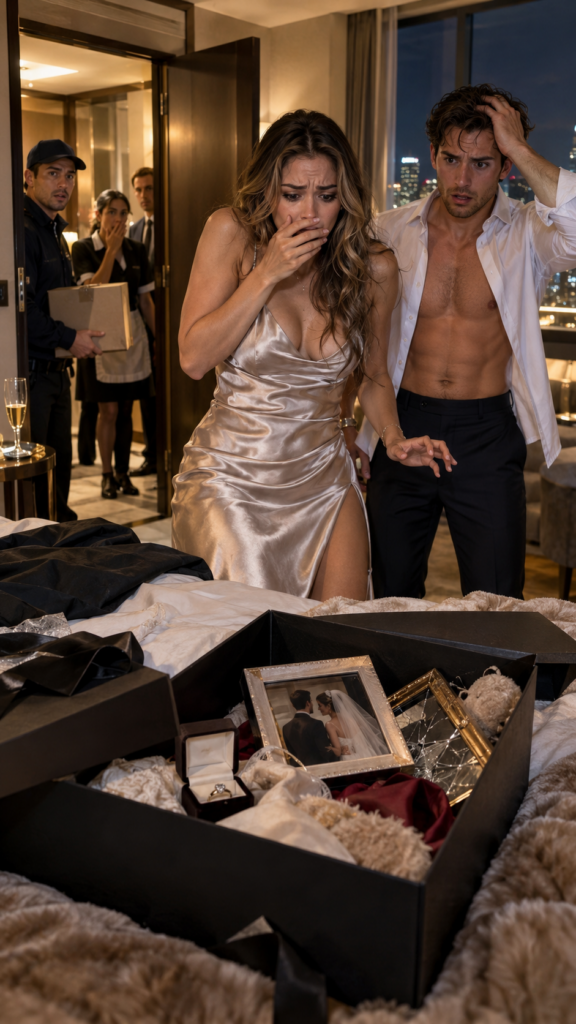
Before Linda could close the door, a man from the moving truck approached carrying a black box.
“Mrs. Walker?”
“Yes.”
“Your husband instructed me to give you this before we unload anything else.”
The box was heavier than it looked.
Grant watched from the doorway as Linda lifted the lid.
Her fingers found John’s wedding ring first.
Then the altered copy of the marriage certificate.
Then the letter.
She unfolded it.
Linda,
I loved you without reservation. I trusted you without conditions. You used both as cover.
Her breath caught.
For twelve years, you told yourself that treating me kindly erased what you did when I could not see you. It did not. Every dinner you cooked after leaving his bed was another lie. Every kiss was another decision. Every time you said “just business,” you reminded yourself that I was too trusting to discover the truth.
Linda’s knees weakened.
Grant took her elbow, but she pulled away.
You said John would handle Sophie’s birthday because he was better with the children. You were right about one thing: I will handle it. I will also handle the school mornings, medical appointments, nightmares, celebrations, and every difficult conversation your choices have forced upon them.
She pressed a hand to her mouth.
Your belongings have been inventoried and packed. They are being delivered to the home where you chose to spend this weekend. Nothing jointly owned has been removed. Your wedding dress remains preserved and is being delivered separately.
Grant glanced toward the truck.
“This is insane.”
Linda kept reading.
The twelve envelopes beneath this letter represent twelve years. Open them in order. Each contains one truth you believed I would never know.
She lifted the first envelope.
A photograph slid into her lap.
Hotel entrance. Chicago. Eleven years earlier.
Her face.
Grant’s hand.
The second envelope contained a restaurant receipt from Atlanta.
The third contained travel records Natalie had arranged.
The fourth held a transcript of Linda lying to John during a telephone call while Grant whispered nearby.
By the eighth, Linda was sobbing.
By the eleventh, Grant had stopped calling John insane.
The twelfth envelope contained one sentence from the recording:
“Maybe we can keep this going for the rest of our lives.”
Beneath it, John had written:
You may still choose that life. It simply will not include me.
The movers began carrying boxes into Grant’s front room.
Linda looked around as dresses, family photographs, shoes, files, and pieces of her former life accumulated inside her lover’s house.
“This can’t be happening,” she whispered.
Grant unfolded the civil complaint included with his papers.
“He wants damages.”
“How much?”
“Five million dollars.”
Linda stared at him.
“Can he do that?”
“He can ask.”
The moving supervisor returned.
“There’s one more item.”
He carried a garment box inside and placed it against the wall.
Linda recognized the preservation company’s label.
Her wedding dress.
Untouched.
Protected more carefully than she had protected the marriage it represented.
That hurt worse than if John had destroyed it.
Her phone rang.
It was Sophie.
Linda stared at the name until the call stopped.
Then another message appeared, this time from Natalie.
He confronted me. He knows I booked the first hotel. Grant, we need lawyers now.
Linda looked at the man she had risked everything to keep.
Grant’s eyes were not on her.
They were fixed on the lawsuit.
And for the first time in twelve years, Linda wondered whether she had mistaken secrecy for love.
Part Four — Children Notice What Adults Ignore
The party ended shortly after seven.
Sophie stood near the gift table while the last parents collected their children. Her smile vanished as soon as the gate closed behind the final guest.
“I wish Mom had been here.”
I wrapped an arm around her.
“I know.”
“Did she see the pictures?”
“I’m not sure.”
Her eyes moved to my empty ring finger.
“Are you and Mom getting divorced?”
Aaron stopped stacking plates.
“Is it because of Grant?”
I looked at him.
“Why would you ask that?”
He shrugged, but his jaw tightened.
“I hear things.”
“What things?”
“Mom talking to him. She doesn’t sound like she’s talking to a former boss.”
Sophie’s face crumpled.
“Can we not do this tonight?” she asked.
I crouched in front of her.
“Tonight is still your birthday. Tomorrow, we’ll talk honestly.”
She nodded, though the promise clearly frightened her.
George and Rhonda stayed to help clean. When they left, George pulled me aside.
“Linda called her mother.”
“What did she say?”
“Mostly crying. She said you sent her belongings to Grant’s.”
“I did.”
“She asked whether she could come here.”
“The temporary order gives me exclusive use of the house.”
“I told her to call her lawyer.”
“Thank you.”
George hesitated.
“She sounded broken.”
“So did I when I saw the evidence.”
“I know.”
There was no accusation in his voice, only exhaustion.
The following afternoon, I sat with Aaron and Sophie in the living room.
“There’s no painless way to say this. Your mother and I are divorcing.”
Neither child looked surprised.
“Because she’s with Grant,” Aaron said.
“Yes.”
“For how long?” Sophie asked.
I had debated how much to reveal. Lisa had advised honesty without unnecessary detail.
“A long time. About twelve years.”
Sophie’s face went blank.
“That’s almost my whole life.”
“I know.”
“Was she with him when I was born?”
“I don’t know exactly when it began.”
She stood and walked to the window.
“So every time she missed something, she was with him?”
“Not every time.”
“But sometimes.”
“Yes.”
Aaron leaned forward, elbows on his knees.
“Did you know she had another phone?”
I turned.
“What phone?”
“She kept it in the laundry room cabinet.”
My heartbeat quickened.
“How do you know?”
“I saw it once. She got mad when I touched it.”
“Is it still there?”
We checked together.
The phone was gone, but a charger remained taped beneath the shelf.
I photographed it and sent the image to Lisa.
Aaron crossed his arms.
“I knew something was wrong. I just thought maybe she was doing secret company stuff.”
Sophie wiped her face angrily.
“I want to stay with you.”
“So do I,” Aaron said.
“You don’t have to choose sides.”
“We’re choosing where we live,” Aaron replied. “That’s different.”
His calmness sounded older than fourteen.
“You’re the one who takes us to school,” he continued. “You know our teachers. You take Sophie to dance and me to practice. Mom sends messages from airports.”
Sophie turned from the window.
“Can she still see us?”
“That depends on what you want and what the court decides. I’m not trying to erase her from your lives.”
“Even after what she did?”
“She hurt me. She also hurt you. But she is still your mother.”
The words were difficult to say, yet necessary.
Hatred might have made me feel powerful for a moment. It would not have made me a better father.
On Monday, Lisa called about the hidden phone charger.
“We can request preservation of all devices and cloud accounts,” she said. “Do not search any account without authorization.”
“What if she destroys evidence?”
“She is under a preservation notice. Destruction after notice can create serious consequences.”
Linda had retained attorney Beth Sawyer, a respected family-law specialist known for disliking adultery cases. Beth and Lisa were already negotiating temporary visitation.
“Linda wants to see the children this weekend,” Lisa said.
“At the house?”
“No. Her parents’ home. Supervised informally by George and Rhonda.”
“Grant cannot be there.”
“Agreed.”
“Natalie either.”
“Agreed.”
The children resisted at first, but I encouraged them to go for one day.
“You don’t have to forgive her,” I said. “You only have to decide what relationship you want with her.”
On Friday, George collected them after school.
I expected the empty house to feel peaceful.
Instead, every room reminded me that my family had once filled it.
Saturday evening, George invited me to the Flatstick Pub. We ate burgers beneath a row of televisions while he updated me.
“Linda arrived this morning,” he said. “The kids were cold at first.”
“Did she pressure them?”
“No. She apologized.”
“For what?”
“For lying and missing important days. She told them the affair was her responsibility.”
I had not expected that.
“She wants to reconcile with you,” George added.
“That isn’t happening.”
“I figured.”
He drank from his beer.
“Her lawyer gave her a severe talk after reading the report. Apparently Beth told her that saying she loved you would not help if her conduct showed contempt for you.”
“That sounds accurate.”
“She also admitted the first encounter happened because Grant tied it to the promotion.”
I set down my glass.
“Did she say she was forced?”
“She said she felt pressured, but she made the choice. Then she kept making it.”
That distinction mattered.
What Grant had done at the beginning might have been workplace coercion. But twelve years of voluntary meetings, secret devices, missed birthdays, and plans to continue forever could not be explained by one corrupt demand.
“John,” George said quietly, “I need you to know something.”
“What?”
“Linda says Grant used company travel money to cover part of the affair. Natalie handled the bookings.”
“That could be fraud.”
“Her lawyer is investigating. The company’s new owners may be notified.”
A new layer of the deception opened.
This was no longer only about my marriage. Grant and Natalie might have used corporate funds to finance hotels, travel, and fabricated consulting meetings.
“Has Lisa heard?”
“Beth planned to contact her Monday.”
A chair scraped behind me.
Before I could turn, something hard struck the side of my head.
Light exploded across my vision.
I fell against the table and heard George shout.
A shoe swung toward my face. I rolled just enough for it to strike my shoulder.
“You ruined my life!” Grant screamed.
He stood above me, wild-eyed, one fist raised.
The lawsuit.
The company records.
The possibility of criminal exposure.
He had not come to confront me.
He had come to silence me.
Grant kicked again, but years earlier my father had taught me one principle about self-defense: when escape is impossible, create distance.
I drove my heel into Grant’s knee.
He staggered.
I pushed myself up, but my left arm buckled beneath me. Grant grabbed a bottle from the table and raised it.
George seized his wrist.
The bottle smashed against a chair.
Grant twisted free and lunged toward me.
This time I met him halfway.
The next seconds came in fragments—his fist, my elbow, a table overturning, customers shouting, security rushing across the room.
Grant fell.
I struck him again before two men pulled me backward.
“Stop!” George shouted. “He’s down!”
I looked at Grant’s motionless body.
Then the room spun, and everything went black.
Part Five — The Devil’s Contract
I woke in a hospital room with my right hand bandaged, my left wrist in a cast, and a headache pulsing behind my eyes.
George sat beside the bed.
“You look terrible,” he said.
“How long?”
“Since last night. It’s Sunday morning.”
“Grant?”
“Alive. Injured, but alive.”
I closed my eyes.
“Did I go too far?”
“Security video shows he attacked you from behind, kicked you while you were down, and reached for a bottle. Witnesses say you stopped responding once they pulled you away.”
“That isn’t what I asked.”
George leaned forward.
“You lost control for several seconds. I’m not going to lie to you. But the police believe you acted in self-defense.”
Two officers entered shortly afterward.
Sergeant Smith questioned me while another officer took notes. I described the attack as clearly as possible, admitting where my memory became uncertain.
“The video supports your account,” Smith said. “Mr. Jacobs also violated the no-contact provisions connected to your civil case.”
“Will I be charged?”
“That decision belongs to the prosecutor. At present, you are considered the victim.”
“Then I want to press charges.”
Smith nodded.
“Mr. Jacobs is under guard at another hospital.”
After the officers left, Rhonda entered with the children.
Linda followed behind them.
My body stiffened.
“The temporary exception to the no-contact arrangement lasts until noon,” she said. “I asked the officers before coming in.”
Sophie reached me first.
“Are you okay?”
“I will be.”
Aaron looked almost impressed.
“Grandpa said Grant jumped you.”
“He did.”
“And you beat him?”
“I defended myself. There is nothing heroic about two men ending up in hospitals.”
His expression became serious.
“I understand.”
Linda remained near the door. She looked older than she had a week earlier. Her hair was tied back without care, and there were dark circles beneath her eyes.
“Could I speak to John alone?”
The children looked at me.
“It’s okay.”
When everyone stepped into the hallway, Linda moved closer to the bed.
“I’m sorry.”
“Which part?”
“All of it.”
“That is a large word for twelve years.”
She lowered her gaze.
“I read every envelope.”
“Good.”
“I deserved the letter.”
“You deserved the truth.”
She sat in the chair George had vacated.
“The first time with Grant happened after he told me the executive position was mine if I proved I could be loyal to him.”
“That is not loyalty. It is exploitation.”
“I know that now.”
“You knew it then.”
Her face tightened.
“Yes.”
“Why didn’t you tell me?”
“Because I wanted the position. I had spent years trying to reach that level. He made me feel as though refusing would prove I wasn’t strong enough to play in his world.”
“So you traded our marriage for a title.”
“I told myself it was one time.”
“But it wasn’t.”
“No.”
“What changed?”
She looked toward the window.
“At first, I hated him. Then he became attentive. He praised me. He made me feel powerful. Every promotion, every successful trip, every secret made me feel as though I had entered a world nobody else could understand.”
“Not even your husband.”
“Especially not you.”
The honesty hurt, but I let her continue.
“You were safe,” she said. “You loved me without making me earn it. Grant’s approval always felt uncertain, so I chased it.”
“You turned my love into something you could take for granted.”
“Yes.”
“And the children?”
Her mouth trembled.
“I convinced myself they were fine because you were there.”
“You used my devotion as permission to abandon your responsibilities.”
“I know.”
“Do you?”
I reached toward the water glass with my uninjured hand.
“You told him you would rather spend Sophie’s birthday with him than deal with her friends.”
Linda covered her face.
“I was performing for him.”
“Your daughter experienced the absence whether you meant the words or not.”
“I failed her.”
“You made a choice.”
She looked at me through tears.
“Do you hate me?”
“I don’t know what I feel.”
“Is there any chance we can fix this?”
“No.”
The answer was calm.
That made it final.
She pressed her lips together as though trying to keep herself from breaking apart.
“I still love you.”
“You loved what I provided—stability, loyalty, children, a respectable home. Love without respect is possession.”
“I respected you.”
“No. You counted on my trust while planning to threaten me if I discovered the truth.”
Her eyes widened.
“You heard that conversation.”
“I heard enough.”
“I never would have taken the children from you.”
“You discussed using them as leverage.”
“I was afraid.”
“You were comfortable enough to say it while lying in another man’s arms.”
She wiped her cheeks.
“I don’t know how to defend myself.”
“Then stop trying.”
Silence settled between us.
“There’s something else,” I said. “The DNA results came back.”
Her face drained.
“You tested them?”
“I had no reason left to assume anything.”
“How could you think I would lie about that?”
“You lied about nearly everything else.”
She looked wounded, then seemed to realize she had no right to be.
“They are mine,” I said. “Both of them.”
Relief passed across her face.
“Thank God.”
“My medical tests were clear too.”
Linda closed her eyes.
“You know about Grant’s other women.”
“Yes.”
“Did you know while you were seeing him?”
“I suspected. I did not ask because asking would have forced me to see what our relationship really was.”
“And what was it?”
“A habit,” she whispered. “A secret that became more important because it was secret.”
I studied her.
“You sacrificed your marriage for a habit.”
“Yes.”
“What happened with company money?”
Her hands tightened.
“Natalie booked some hotels as consulting expenses. Grant approved them. I signed several reimbursement reports.”
“How many?”
“I don’t know.”
“Your lawyer will need to determine that.”
“I’ll cooperate.”
“Why now?”
“Because the box made me understand that you knew everything.”
“No. The box made it impossible for you to control what I knew.”
She flinched.
I leaned back against the pillow.
“Sign the papers, Linda. Get counseling. Build whatever relationship the children are willing to have with you. But stop asking me to return to the person I was before I opened that envelope.”
She nodded.
“I will sign.”
At the doorway, she paused.
“For what it’s worth, when I saw my wedding dress still protected, it hurt more than if you had burned it.”
“That was the point.”
She looked back at me.
“You protected the dress because it wasn’t yours to destroy.”
“Yes.”
“And you refused to destroy me for the same reason.”
I said nothing.
She came close, kissed my cheek, and whispered goodbye.
Hours after I returned home, George called.
His voice was shaking.
“Linda is in the hospital.”
“What happened?”
“Natalie found her unconscious at Grant’s house. Pills and alcohol. There was a note.”
My grip tightened around the phone.
“Is she alive?”
“Yes. The doctors believe she will recover.”
I sat on the edge of my bed.
The anger inside me did not disappear, but something heavier moved beside it.
Grief.
Not for the marriage.
For the woman who had destroyed it and discovered too late that consequences were not the same as escape.
“Are the kids awake?” George asked.
“Yes.”
“Don’t tell them details tonight.”
“I won’t.”
After the call, I stood outside their rooms listening to the quiet sounds of sleep.
I had wanted Linda to understand my pain.
But I had never wanted our children to fear losing their mother.
The next morning, Lisa called with another warning.
“Grant’s attorneys requested an emergency settlement conference.”
“Because of the assault?”
“Because the company’s new owners found the travel records.”
“How bad?”
“Bad enough that Grant and Natalie may be facing more than a divorce-related lawsuit.”
She paused.
“And Linda has offered to provide full cooperation.”
The box had caused them to panic.
The evidence inside it was about to make them turn on one another.
Part Six — When the Conspiracy Began to Collapse
Linda remained in the hospital for four days.
The children were told that she had suffered a serious emotional crisis and was receiving treatment. I refused to describe the pills, the note, or the alcohol.
“They’ll learn some version eventually,” Aaron said.
“They will learn when professionals believe it is safe and useful.”
He crossed his arms.
“You always make everything sound controlled.”
“I’m trying to keep it controlled.”
“Are you scared?”
The question stopped me.
“Yes.”
His expression softened.
“So am I.”
I pulled him into an embrace. At fourteen, he was nearly as tall as I was, but in that moment he felt like the little boy who once climbed into our bed during thunderstorms.
Sophie refused to speak to Linda by phone.
“I’m angry at her,” she said. “And now I’m supposed to feel sorry for her.”
“You are allowed to feel both.”
“What if talking to her makes her do something again?”
“That is not your responsibility. Adults and doctors are responsible for keeping her safe.”
“Are you sure?”
“Yes.”
I hoped I sounded more certain than I felt.
After discharge, Linda moved into her parents’ home under strict outpatient supervision. She signed temporary custody agreements granting me primary physical custody while preserving structured visitation.
Then came the depositions.
Natalie’s testimony revealed that she had booked the first hotel room twelve years earlier. She had also created false meeting calendars whenever Linda and Grant traveled without legitimate company business.
“I thought I was protecting my brother and the company,” she said.
Lisa sat across from her.
“By falsifying corporate records?”
“I did not think of it that way.”
“How did you think of it?”
“As avoiding scandal.”
“Whose scandal?”
Natalie remained silent.
Grant refused to admit that he had conditioned Linda’s promotion on a sexual relationship. He described their affair as mutual from the beginning and claimed the travel expenses had legitimate business purposes.
Then Linda testified.
Beth Sawyer placed a hand beside her client’s notes but did not interrupt.
“Grant told me the promotion depended on whether I understood loyalty,” Linda said. “When I asked what he meant, he gave me a hotel key.”
“Did you believe you could refuse?” Lisa asked.
“I believed refusing would end my career at the company.”
“Did the relationship continue under the same pressure for twelve years?”
“No.”
“When did it become voluntary?”
Linda looked toward me.
“After the first several months.”
Grant’s attorney objected, but the answer was already recorded.
“Why did you continue?”
“Because I wanted to.”
The room became silent.
It was the most painful answer and the most honest.
“Did Mr. Jacobs force you to miss your daughter’s birthday?” Lisa asked.
“No.”
“Did he force you to tell him that you intended to continue the relationship indefinitely?”
“No.”
“Did he force you to conceal the affair from your husband?”
“No.”
“Did you and Mr. Jacobs discuss using the children or financial pressure against your husband if he discovered the relationship?”
“Yes.”
Grant turned toward her.
“Linda.”
His attorney ordered him to remain silent.
Lisa continued.
“Were corporate funds used for hotels, meals, or travel connected primarily to your affair?”
“Yes.”
“How frequently?”
“I cannot provide an exact number. Natalie has the travel records.”
Natalie’s face hardened.
“I booked what Grant approved.”
The alliance between them fractured in front of us.
Grant blamed Natalie for recordkeeping.
Natalie blamed Grant for authorization.
Linda accepted responsibility for signing reimbursements but insisted Grant controlled the system.
Each had protected the secret when the cost belonged to me.
Now that the cost belonged to them, loyalty disappeared.
The new owners of the company launched an internal audit. Their attorneys alleged that Grant, Linda, and Natalie had improperly charged more than three hundred thousand dollars in travel and entertainment expenses over twelve years.
Not every trip was fraudulent. Many included legitimate meetings before or after personal encounters. Separating business from deception required months of forensic accounting.
The uncertainty strengthened settlement pressure.
Grant was also charged in connection with the attack at the pub. Surveillance footage showed him striking me from behind, kicking me while I was on the floor, and attempting to use a glass bottle.
His attorneys argued that he had suffered severe injuries during my defense.
The prosecutor’s answer was simple: he had initiated the assault and continued after I fell.
Meanwhile, the family case moved quietly.
A custody evaluator interviewed me, Linda, both children, teachers, doctors, and our extended families.
I did not call Linda a monster.
I explained the daily routines, missed events, travel patterns, and the emotional effect of discovering that her absences were voluntary.
Linda admitted that I had carried most parenting responsibilities.
When asked why, she answered, “Because I knew he would.”
That sentence did more damage than any insult I could have offered.
Three months after the box arrived, our divorce settlement conference began.
Linda wore a gray suit and no jewelry.
I wore the same dark tie I had worn to Michaels’s office on the day I received the envelope.
Beth Sawyer spoke first.
“Mrs. Walker will not seek primary custody. She requests regular visitation conditioned on her treatment team’s recommendations. She waives spousal support and agrees to maintain health insurance for the children if available through future employment.”
Lisa turned to me.
“That is consistent with our position.”
The house would remain with me until Sophie graduated from high school. Linda would receive her share of equity later, reduced by amounts used to resolve disputed marital expenses.
We would keep our individual retirement accounts.
The company-sale proceeds in Linda’s separate investment account remained hers, but questionable reimbursements would be addressed through the corporate case.
Then Beth placed one final document on the table.
“Mrs. Walker is prepared to sign today.”
Linda looked at me.
For the first time since I had known her, there was no strategy in her expression.
Only loss.
She signed each page.
When she reached the final signature line, her hand began to shake.
“I’m sorry,” she whispered.
I did not tell her it was all right.
It was not.
I simply said, “Take care of yourself for the children.”
She signed her name.
The court would finalize the divorce after the mandatory waiting period.
As we prepared to leave, Lisa received a message.
She read it twice.
“What is it?” I asked.
“Grant’s civil attorneys have made a settlement offer.”
“How much?”
“Enough that they clearly want this resolved before the corporate audit becomes public.”
Across the room, Grant’s attorney was already gathering his files.
Natalie stood alone near the door.
The conspiracy had protected their secret for twelve years.
Now fear was assigning a price to everyone’s silence.
Part Seven — The Cost of Keeping a Secret
Settlement negotiations lasted six weeks.
Grant offered money in exchange for dismissal of the emotional-distress claims, confidentiality concerning certain personal evidence, and a release of future civil claims connected to the affair.
We refused any agreement that interfered with criminal proceedings or the corporate investigation.
Natalie negotiated separately.
Her husband Ralph filed for divorce after learning she had falsified records and hidden Grant’s affair for years. He had not known the full extent of her involvement, and the discovery destroyed his trust as thoroughly as Linda had destroyed mine.
During one mediation, Natalie asked to speak with me.
Lisa remained in the room.
Natalie’s eyes were swollen.
“I’m not asking you to forgive me.”
“Good.”
“I want you to understand why I stayed quiet.”
“You were afraid of Grant.”
“Yes.”
“And losing your position.”
“Yes.”
“And your lifestyle.”
She looked away.
“Yes.”
“Then I understand perfectly.”
“That doesn’t make me evil.”
“No. It makes you someone who decided another family’s pain was an acceptable price for your comfort.”
Her lips trembled.
“I lost my marriage too.”
“You lost it after the truth came out. Mine was being taken from me for twelve years while you watched.”
She nodded slowly.
“I deserve that.”
“No one deserves destruction. But people do become responsible for what they repeatedly choose.”
The final settlement from Grant and Natalie totaled slightly over four million dollars, including compensation tied to documented harassment, the pub attack, legal costs, and disputed financial conduct.
After attorney fees and taxes, approximately three and a half million remained.
I did not buy a sports car.
I did not throw a party.
I placed one million dollars into protected educational trusts for each child. The remainder went into conservative investments, therapy costs, legal reserves, and the mortgage.
Money did not restore twelve years.
It did give the children security that the divorce had threatened.
Grant’s criminal case ended in a plea agreement. He admitted to aggravated assault, violation of a court order, and related offenses. The judge sentenced him to a lengthy prison term, citing the surprise attack, attempted use of a weapon, and his decision to pursue me after being legally ordered to keep his distance.
Before sentencing, Grant addressed the court.
“John Walker tried to destroy my reputation, my company, and my family.”
The judge looked down from the bench.
“Mr. Walker did not create the records, falsify the expenses, conduct the affair, or attack a man from behind in a public establishment. You are describing consequences as though they were weapons used against you.”
Grant’s face hardened.
For once, charm and status could not rescue him.
Linda continued treatment while living with George and Rhonda. She began writing articles for business websites under a shortened version of her name.
At first, the children visited only with their grandparents present.
Sophie sat on the opposite side of the room and answered questions with single words. Aaron asked direct, painful things.
“Did you ever feel guilty when you came home?”
“Yes.”
“Then why did you keep going?”
“Because guilt was easier than giving up what I wanted.”
“Did you love Dad?”
“Yes.”
“Then why wasn’t he enough?”
Linda looked at him for a long moment.
“The problem wasn’t that your father wasn’t enough. The problem was that I believed I should be allowed to have everything.”
Aaron later told me that answer was the first thing she had said that felt true.
Months passed.
Linda attended school events only when the children agreed. She sat far from me and left without trying to speak privately.
At Sophie’s dance recital, I saw her crying during the final performance.
She did not ask me to comfort her.
That restraint was the beginning of the only kind of redemption still available to her.
Not winning me back.
Learning to stop making her pain everyone else’s responsibility.
One year after the envelope, the children and I boarded a Mediterranean cruise.
Sophie stood at the rail as the ship left Barcelona.
“This is better than a birthday party,” she said.
“Do not make me compete with the Mediterranean every year.”
Aaron took photographs while pretending not to enjoy himself.
On the third evening, I met Nikki Bennett at dinner.
She was from British Columbia, recently divorced, and traveling alone while her two children spent part of the summer with their grandparents in Idaho.
Her blonde hair was tied loosely at her shoulders, and she had a habit of ending statements with a gentle upward inflection that made every sentence sound like an invitation to continue.
We spoke about ordinary things first.
Food.
Travel.
Children.
Bad music in elevators.
Only later did we discuss the marriages that had brought us to the same ship.
“My husband did not cheat,” Nikki said. “He simply stopped showing up emotionally. Sometimes abandonment happens while two people still share an address.”
I understood that more than I wanted to.
We walked through ports together and spent long evenings talking beneath the deck lights. I did not promise her a future.
I did not even trust myself to imagine one.
But when she took my hand in Naples, I did not pull away.
Sophie noticed immediately.
“Is Nikki your girlfriend?”
“She is my friend.”
“A friend who looks at you like that?”
“Eat your dessert.”
Nikki laughed so hard she nearly spilled her coffee.
Near the end of the cruise, she and I spent several nights together. There were no secret phones, false itineraries, or spouses waiting at home.
Still, the intimacy frightened me.
One morning, Nikki found me standing on the balcony before sunrise.
“You look like you are preparing to run.”
“I’ve become good at expecting hidden costs.”
“I’m not asking you for a promise.”
“That might be why I want to make one.”
She leaned against the railing beside me.
“Then don’t. Not yet.”
When the cruise ended, we exchanged contact information and agreed to remain honest, even if honesty eventually meant admitting the distance was too much.
Back home, life settled into a new rhythm.
Aaron began driving.
Sophie joined a more advanced dance program.
I learned how to cook more than six reliable meals.
Linda slowly rebuilt contact with both children.
Then George called one evening.
His voice carried the same fear I had heard after her first crisis.
“Linda is back in the hospital.”
I sat down.
“What happened?”
“Sophie sent her photographs from the cruise. One showed you and Nikki at dinner.”
My stomach tightened.
“She hurt herself again?”
“She survived. But the doctors say she needs inpatient psychiatric care for a while. Maybe a long while.”
I closed my eyes.
The old anger did not return.
Neither did satisfaction.
Only sorrow.
Linda had spent twelve years avoiding consequences by dividing her life into separate rooms.
When the walls collapsed, she had no stable sense of who she was without the lies.
“Do the kids know?” I asked.
“Not yet.”
“I’ll tell them with their therapist.”
“Thank you.”
That night, I spoke to Nikki by video call.
“I’m sorry,” she said. “I never intended the photograph to cause anything.”
“You did not cause it.”
“I know that logically.”
“Then believe it emotionally too.”
She smiled sadly.
“You sound like someone who has had practice saying that.”
I had said the same thing to Sophie.
Other people’s choices were not ours to carry forever.
Nikki told me about her home north of Kamloops—a restored log house surrounded by forest, built in the late nineteenth century and set on fifty acres.
“You and the kids should visit,” she said. “No pressure. There are separate rooms, hiking trails, and terrible internet.”
“Terrible internet might convince the children it is a prison.”
“They can leave after splitting firewood.”
I laughed.
It surprised me how natural the sound felt.
Part Eight — What the Box Was Really For
Two summers after the divorce, we drove north.
The road into British Columbia curved through mountains and forests so wide that the old life seemed small by comparison.
Nikki waited outside the log house with her children. Sophie ran ahead to greet them. Aaron tried to act reserved until Nikki’s son showed him an old truck they were restoring in the barn.
I stepped out of the car.
Nikki walked toward me.
“You came.”
“I said I would.”
“You also said long-distance relationships were impractical.”
“They are.”
“And that combining families is complicated.”
“It is.”
“And that Canadian winters are unreasonable.”
“That remains true.”
She smiled.
“So why are you here?”
I looked beyond her at the house, the children, and the open land.
“Because fear is not the same as wisdom.”
She took my hand.
During the visit, we hiked, cooked outdoors, repaired a broken fence, and spent evenings beside a stone fireplace.
No one pretended the future would be easy.
Nikki had children with their own loyalties and wounds. Mine still worried that loving someone new might betray their mother.
One evening, Sophie sat beside me on the porch.
“Do you still love Mom?”
The question no longer hurt in the same way.
“I care about her. She is part of my life because she is your mother and because we shared many years.”
“That isn’t what I asked.”
I looked toward the trees.
“I loved the person I believed she was. Some parts of that person were real. Other parts were not.”
“Do you forgive her?”
“I’m trying to stop needing an answer to that.”
She frowned.
“That doesn’t make sense.”
“Forgiveness is not always a door you walk through once. Sometimes it is deciding, every day, not to let what happened control your next decision.”
“Like coming here.”
“Exactly.”
Sophie leaned against my shoulder.
“Mom is doing better.”
“I know.”
Linda had moved from the hospital to a residential treatment facility. She wrote letters to the children but sent them only through their therapist.
She no longer asked me to take her back.
In one letter addressed to me, she wrote:
I used to believe the box was meant to humiliate me. Now I understand it was the first honest thing that had entered my life in years. You placed every consequence in one container and made me look at it.
I blamed you because looking was unbearable.
I do not ask for forgiveness. I only want you to know that I finally understand the difference between loving someone and using their love as shelter from your own choices.
I had read the letter once and placed it in a drawer.
I did not respond.
Not every truth required a conversation.
On our final night in Canada, rain tapped against the windows while the children played cards near the fireplace.
Nikki and I stood in the kitchen washing dishes.
“You’re quiet,” she said.
“I was thinking about a box.”
“That sounds mysterious.”
“It ended my marriage.”
“Most boxes are less ambitious.”
I smiled.
“I thought I sent it to punish Linda and Grant. I wanted them to panic. I wanted their secret to collapse around them while they were together.”
“Did it?”
“Yes.”
“And did it make you feel better?”
“For a few minutes.”
She waited.
“What did it really do?”
I looked into the next room.
Aaron was laughing with Nikki’s son. Sophie was showing her daughter photographs from the trip.
“It forced me to stop waiting for Linda to become honest before I could move forward.”
Nikki dried her hands.
“That sounds less like revenge.”
“It began as revenge.”
“And ended?”
“As a boundary.”
She stepped closer.
“The best boundaries usually look like closed doors to people who benefited from walking through them.”
I kissed her.
There were no vows that night.
No dramatic promises.
Only two adults choosing honesty in a quiet kitchen while their children laughed nearby.
Months later, Nikki and I began discussing how we might live in the same country. It would involve lawyers, schools, work, and many difficult conversations.
Nothing about it was effortless.
That was how I knew it was real.
Linda continued improving. She eventually moved into supervised housing and began rebuilding a limited but meaningful relationship with Aaron and Sophie.
Grant remained incarcerated.
Natalie completed probation connected to the falsified records and rebuilt her life after her divorce. She sent me one final apology through our attorneys.
I accepted the letter without reopening the relationship.
The house where Linda and I had raised our children no longer felt haunted. I repainted the master bedroom, replaced the patio furniture, and removed the cabinet where she had hidden the second-phone charger.
I kept one object from the investigation.
The empty black box.
Not the photographs.
Not the transcripts.
Not the ring.
Only the box.
For years, I stored it on the highest shelf of my office closet.
Then, on the morning Aaron left for college, I brought it down.
He saw it on the desk.
“Is that the box?”
“Yes.”
“What are you doing with it?”
“Getting rid of it.”
I carried it to the recycling bin.
Sophie stood in the driveway beside him.
“You kept it all this time?”
“I thought it reminded me never to be fooled again.”
“What does it remind you of now?” she asked.
I looked at my children.
Aaron was taller than I was. Sophie wore the confident expression of a young woman no longer waiting for absent people to choose her.
“It reminds me that discovering the truth is not the same as healing from it.”
I placed the box into the bin and closed the lid.
Linda had believed she could keep two lives forever.
Grant had believed power could protect him from consequences.
Natalie had believed silence made her innocent.
And I had once believed revenge would return what they had taken.
We had all been wrong.
Nothing could restore those twelve years.
But they no longer owned the years ahead.
As Aaron loaded the final suitcase into his car, Nikki called from Canada. Her face appeared on my phone, smiling beneath the soft morning light.
“Are you ready?” she asked.
“For what?”
“The next part.”
I looked at the empty space where the box had been.
Then I looked at my children, my home, and the road stretching beyond the driveway.
For the first time, the unknown did not feel like a threat.
It felt like freedom.
“I’m ready,” I said.
And this time, when I trusted someone, it was not because I had failed to see the risks.
It was because I had finally learned that a life without trust was only another kind of prison.ed