My wife came home after having an affair and put divorce papers on the table to threaten me. I signed them, and she…
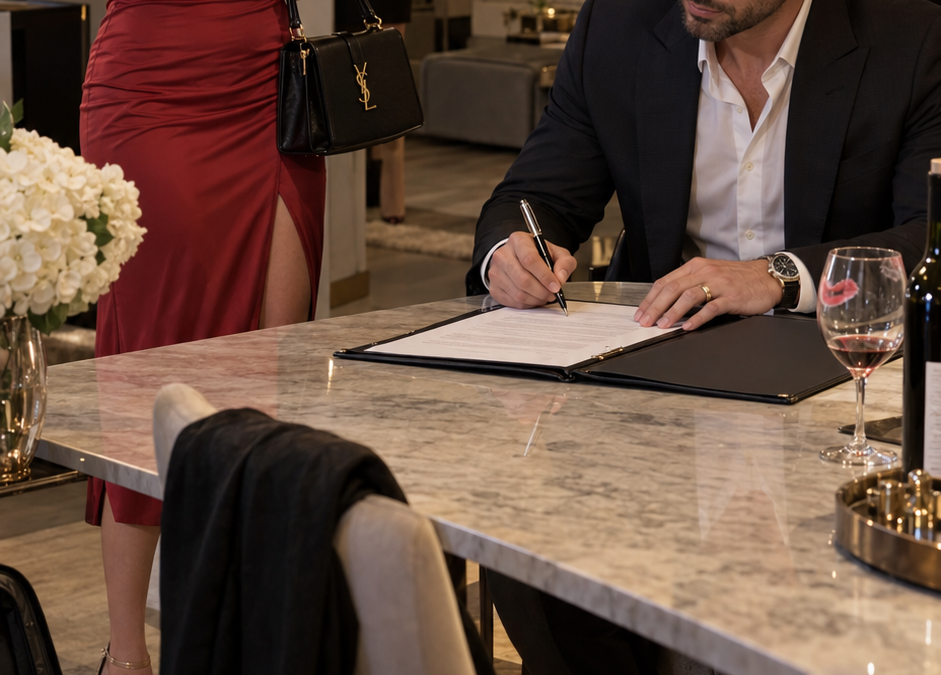
THE NIGHT MY WIFE BROUGHT HOME DIVORCE PAPERS AFTER CHEATING — AND REALIZED I WAS DONE BEGGING
She thought the papers would scare me.
She thought I would fold.
She forgot I had already spent years breaking quietly.

PART 1: THE JOKE THAT STOPPED BEING FUNNY
It started on a Thursday night, high above downtown, where my firm had rented the rooftop of a hotel for a client mixer. The city glittered below us like someone had spilled a jewelry box across black velvet. Glass walls reflected expensive suits, careful smiles, and women in heels balancing cocktails under strings of warm lights.
Amber stood beside me with a margarita in one hand and her other hand tucked through my arm like she was claiming a prize she did not respect.
I should have known by the way she laughed too loudly before anyone said anything funny.
“You know what Brian needs?” she announced to a small circle of my coworkers.
I looked at her, already feeling the skin tighten at the back of my neck.
“A little chaos,” she said, grinning like she had just delivered a brilliant line. “He’s like a walking instruction manual.”
A few people laughed. Not because it was hilarious, but because nobody knew what else to do.
That was Amber’s gift. She could turn a room into an audience before anyone realized they had bought a ticket.
I smiled politely and tried to guide the conversation back toward safer ground. “Amber’s had one strong margarita,” I said lightly.
She pressed one red fingernail into my chest.
“Come on,” she said. “Show them you have a pulse.”
The laughter became thinner.
I looked around the table. Mark from accounting suddenly became fascinated with his drink. Julia from compliance looked at the floor. My boss’s wife gave me a small, sympathetic smile that somehow felt worse than laughter.
I put my glass down.
“Amber,” I said quietly, “don’t do that.”
She blinked, then laughed harder. “Oh, relax. I’m teasing. Everyone knows that.”
But they did not know that.
They knew what people always know in a room like that. They knew something private had just become public. They knew a wife had put her husband on display and dared him to object. They knew if I smiled, I would be agreeing to my own humiliation, and if I did not smile, I would be accused of ruining the mood.
I had spent seven years making that choice.
That night, I chose differently.
“Jokes are fine,” I said, calm enough that my own voice surprised me. “Until they start costing respect. Knock it off.”
The laughter stopped.
Amber’s smile froze in place, then shifted into something sharper.
“See?” she said, lifting her eyebrows at the group. “That’s what I mean. Too serious. Always too serious.”
“You’re crossing a line,” I said.
Her face changed. Not much. Just enough.
Amber liked pushing. She liked testing doors to see which ones were locked. But she did not like discovering one had a deadbolt.
I stood.
“Enjoy the night,” I said. “I’m leaving.”
Her mouth fell open. “Wait. You’re leaving me here?”
“I’m leaving the behavior,” I said. “You can ride home with Mia or call a cab.”
The last thing I saw before walking toward the elevator was her expression, caught between embarrassment and rage.
Not heartbreak.
Rage.
Because for the first time, I had refused to stay in my assigned role.
At home, the silence hit like a clean white wall.
I changed out of my suit, folded it over the chair, and stood in the kitchen with the refrigerator humming behind me. My hand rested on the counter where Amber usually dropped her keys, her purse, her phone, her mood, and expected the whole house to rearrange itself around her.
When she came in around midnight, the front door opened softly.
Then closed harder than necessary.
Her heels clicked down the hallway. She appeared in the kitchen doorway with her makeup still perfect, her hair still glossy, and her eyes bright with the kind of anger people save for moments when they feel publicly exposed.
“You embarrassed me,” she said.
I looked at her. “No. I stopped you from embarrassing me.”
Her laugh was short. “You really think that was some brave little moment, don’t you?”
“I think it was overdue.”
She stared at me like I had spoken in another language.
Then she shook her head, walked past me, and went upstairs.
I heard drawers opening. A bracelet hitting the dresser. Water running in the bathroom. The sounds of a woman refusing to apologize because apology would mean admitting there was something beneath the joke.
I did not follow her.
That night, I lay awake beside the empty space she left between us even when she was in the same bed.
And I realized something important.
When someone laughs at you long enough, they stop seeing you.
And when they stop seeing you, you either stay invisible or you stand up.
I had just done the second.
The next evening, Amber acted like nothing had happened.
That was another one of her gifts. She could create a wound, step over the blood, and ask why the floor looked dirty.
She came into the kitchen wearing my old college sweatshirt and opened a bottle of wine.
“You really made a scene last night,” she said.
I was rinsing a plate at the sink. “People were talking because you made me a joke.”
“Oh, come on.” She poured wine into a glass and leaned against the island. “It was fun. Everyone knows I tease you because you’re too serious.”
I dried my hands slowly.
“Teasing is fine when it stays kind,” I said. “What you did wasn’t teasing. It was disrespect.”
She rolled her eyes.
That small gesture used to make me shrink. It was a tiny thing, almost nothing, but in our marriage it had become a door slamming in my face.
“So now I can’t even joke with my husband?” she asked.
“You can joke. You just can’t mock. There’s a difference.”
Amber crossed her arms. “You sound like a policy manual already.”
“Then let me make it clear.” I turned fully toward her. “No more public digs. No jokes at my expense. No posting me online without my permission. No eye rolls when I’m talking. If you start, I’ll end the conversation or walk away.”
Her expression tightened.
“Rules now?”
“Boundaries.”
She laughed once. “Same thing.”
“No,” I said. “Rules control other people. Boundaries tell people what I’ll do to protect myself.”
For a second, something flickered in her eyes. Not understanding. Calculation.
Then she picked up her wine.
“You really can’t take a joke, can you?” she said. “I’m just trying to bring you to life a little.”
“Peace doesn’t mean lifeless,” I said. “It means I can breathe.”
The kitchen went quiet.
Outside, a car passed slowly, headlights sliding across the cabinets like a searchlight.
Amber looked away first.
“We have dinner with the Millers on Saturday,” she said. “Don’t make it awkward.”
“I won’t,” I said. “As long as you don’t make me a prop again.”
Her jaw flexed.
“You’re unbelievable.”
I picked up my jacket from the back of the chair.
“Maybe,” I said. “But I’m done being the entertainment.”
I left before she could decide whether she wanted to cry, yell, or laugh.
That was the thing about Amber.
She had mastered every performance except honesty.
By Monday, the house had become polite.
Polite is dangerous in a marriage because it can look like peace from a distance. We spoke about groceries, bills, weather, the broken cabinet hinge, the dry cleaner, the dog’s vet appointment. Nothing that had teeth. Nothing that could draw blood.
Then at lunch, my phone buzzed.
A coworker had tagged me in a post.
Amber had uploaded a short video of me at my desk the night before, tapping away on my laptop, glasses low on my nose, sleeves rolled, tired but focused.
The caption read:
Life with a spreadsheet. Wish me luck.
The comments were predictable.
Spice him up, girl.
Take him dancing.
Looks like a robot, but cute.
Amber had liked every single one.
I stared at the screen while my sandwich sat untouched beside my keyboard.
There are betrayals that come with hotel rooms and lipstick stains.
There are others that come with laughter.
That night, Amber was chopping vegetables when I walked in. She looked casual, almost cheerful, as if she had been waiting to see how angry I would be.
“Nice post,” I said.
She smiled without looking up. “It was funny. People loved it.”
“They loved watching my privacy turned into a punchline.”
She set the knife down. “Brian, it was harmless.”
“No,” I said. “It was another version of the rooftop. Same crowd. Bigger audience.”
Her mouth tightened. “You take yourself way too seriously.”
“I take respect seriously.”
She leaned against the counter, impatience flashing across her face. “So what now? Another speech?”
“No,” I said. “A change.”
That caught her.
“What change?”
“We’re separating finances.”
Amber stared at me as if I had slapped her.
“I opened a new account,” I continued. “I’ll transfer my share for the bills and mortgage. Anything extra, you handle yours and I handle mine.”
“That’s ridiculous,” she snapped. “We’re married.”
“Then start acting like it.”
Her face colored.
“You’re punishing me.”
“I’m protecting myself,” I said. “If you want to test me, pay for the experiments yourself.”
For the first time, she did not answer immediately.
That should have told me everything.
Because Amber could argue almost anything. She could twist an apology into an accusation, a boundary into cruelty, a wound into proof you were too sensitive. But money made things real, and real things made her uncomfortable.
Her fingers curled around the wineglass.
“You think this will last?” she asked.
“I think I’m done negotiating for basic respect.”
Her eyes flicked to the floor.
It was the first time I saw fear pass through her face.
Not fear of losing me.
Fear of losing control over me.
The next morning, she left without saying goodbye.
By the weekend, I had started spending more time at Leonard’s garage.
Leonard was not the kind of man people noticed immediately. He was broad-shouldered, quiet, and always seemed to be wiping his hands on a rag even when they were already clean. He owned a small repair shop on the edge of town where the air smelled like motor oil, rubber, and coffee burned too long on a hot plate.
Working there after hours felt cleaner than any conversation at home.
Engines made sense. If something rattled, there was a reason. If a line leaked, you found the break. If a part failed, you replaced it. Machines did not smile at you while slowly taking you apart.
Saturday evening, I was helping Leonard replace a brake line on an old pickup when Amber’s car rolled into the lot.
She stepped out in heels and perfume, too polished for the oil-stained floor. Her coat swung behind her like she was entering a restaurant instead of a garage.
“There you are,” she called.
Leonard glanced at me but said nothing.
Amber looked around the shop with theatrical disgust.
“Fixing cars now?” she asked. “Trying to feel manly?”
I straightened, wiping my hands. “I’m helping a friend.”
“You’re avoiding your wife.”
“I’m avoiding fights.”
She smiled, but it had no warmth. “You can’t run away every time someone teases you.”
Leonard’s voice cut through the air.
“Maybe stop teasing then.”
Amber turned slowly. “Excuse me?”
He shrugged. “You keep poking him. Don’t act surprised when he steps back.”
Her eyes narrowed. “Wow. You’ve got everyone believing you’re the calm hero now.”
“We’re not doing this here,” I said.
She stepped closer, lowering her voice just enough to make it uglier.
“You know what your problem is, Brian? You think being steady makes you superior. But it just makes you predictable.”
“Predictable kept the mortgage paid,” I said.
Her smile vanished.
Leonard looked down at the wrench in his hand as if he wanted to disappear into it.
Amber folded her arms. “You’re really choosing this dusty garage over me?”
“I’m choosing peace.”
Something cracked in her expression.
Just a hairline fracture.
Then she covered it with a smile.
“Fine,” she said. “Enjoy your peace.”
She turned and walked out.
The bell above the office door jingled behind her.
Leonard waited until her car pulled away before speaking.
“You okay?”
I exhaled.
“Yeah.”
He nodded. “She’s losing the audience.”
I looked at the empty doorway.
“Maybe that’s all I ever was.”
That night, Amber’s car was in the driveway when I got home, but she was not waiting in the kitchen.
She had stopped performing concern.
That should have felt like progress.
Instead, it felt like the house had inhaled and was holding its breath.
PART 2: THE MAN SHE SAID WAS JUST A FRIEND
The first sign was her phone.
Amber had always been careless with it before. She would leave it on the counter while she showered, faceup beside the coffee machine, buzzing with group chats, shopping alerts, and messages from women whose names I knew only because they existed as notifications.
Now she carried it like evidence.
Into the bathroom. Into the laundry room. Under her pillow at night.
One morning, I walked into the bedroom as she was getting dressed, and she flipped it facedown so quickly the motion made her look guilty before I even knew what she was hiding.
“Everything okay?” I asked.
She tugged an earring into place. “Why wouldn’t it be?”
“I don’t know. You tell me.”
Her eyes flashed in the mirror. “Don’t start interrogating me because you’re bored.”
There it was again.
The little turn.
The insult disguised as exhaustion.
I said nothing. I picked up my watch from the dresser and left the room.
At work, I tried to focus on quarterly projections, vendor reports, client calls. Numbers normally comforted me. Numbers did not pretend. They either balanced or they did not.
But my mind kept returning to Amber’s face in the mirror.
Not because I was jealous.
Because I was tired of being asked to ignore what I could clearly see.
Two days later, Mia called me.
Mia had been Amber’s closest friend since college, the kind of friend who knew where all the bodies were buried and which ones were still breathing. She had never liked me much, but she respected me in the distant way a person respects a locked door.
“Brian,” she said when I answered. “Do you have a minute?”
Her voice was wrong.
I stepped out of the conference room and into the hallway.
“What is it?”
A pause.
“I probably shouldn’t be calling.”
“Then why are you?”
Another pause.
“Because this is getting ugly, and I don’t think you know how ugly.”
My hand tightened around the phone.
I looked through the glass wall at my coworkers laughing around a tray of sandwiches. The office lights were too bright, the hallway too quiet.
“What are you talking about?” I asked.
Mia exhaled. “Amber’s been spending time with someone.”
The word someone landed softly and still managed to split something open.
“Who?”
“Ethan Cole.”
I knew the name. Ethan worked in commercial real estate, the kind of man who appeared at charity events with a watch too large for his wrist and stories too polished to be true. He had been at the rooftop mixer.
He had laughed the loudest.
“How long?” I asked.
“I don’t know exactly.”
“Mia.”
“I don’t know,” she said, softer now. “But it isn’t new.”
My eyes fixed on the carpet.
The pattern blurred.
“Why are you telling me?”
“Because last night she showed up at my apartment crying, but not because she felt guilty. Because Ethan told her she needed to decide what she wanted.” Mia’s voice tightened. “And Brian, she said something that made me sick.”
“What?”
“She said maybe if she scared you with divorce, you’d finally become the kind of man who fought for her.”
For a moment, I could not speak.
The office hallway seemed to tilt. Not dramatically. Just enough to make me put one hand against the wall.
“She said that?”
“Yes.”
“Anything else?”
Mia was quiet.
Then she said, “She said she knew you’d never sign.”
That was when the pain changed shape.
It stopped being shock and became clarity.
I thanked Mia and hung up.
Then I returned to the conference room, sat down, and finished the meeting.
People think betrayal announces itself with shouting, broken plates, a dramatic confrontation in the rain.
Sometimes betrayal sits quietly in a swivel chair and takes notes on vendor pricing while something inside you goes cold.
That evening, Amber came home late.
She smelled like rain and expensive cologne that was not mine.
I was sitting at the kitchen table with a mug of tea I had not touched.
She paused when she saw me.
“Long day?” I asked.
Her face tightened. “Don’t start.”
“I asked a question.”
“And I heard the tone.”
“What tone?”
“The one where you pretend you’re calm so you can feel superior.”
I studied her.
Her lipstick was a little faded at the center. Her hair had been brushed recently, but a loose strand clung to her cheek. She looked beautiful in the way a fire looks beautiful when it is still far enough away not to burn you.
“Where were you?” I asked.
“With Mia.”
I let the silence sit.
Amber blinked once.
Then I said, “Mia called me.”
The blood drained from her face so quickly that no performance could hide it.
“What did she say?”
I did not answer.
Amber’s hand tightened around her purse strap.
“She has always been dramatic,” she said.
“She said you’ve been seeing Ethan.”
Amber laughed.
It was a terrible sound. Too quick. Too high.
“Seeing him? God, Brian. We had coffee a few times. You’re really going to turn coffee into a crime?”
“You came home smelling like him.”
Her face hardened.
“You’re ridiculous.”
“No,” I said. “I’m late.”
That stopped her.
“What does that mean?”
“It means I should have stopped explaining myself to someone who kept making my pain into proof that I was boring.”
Amber tossed her purse onto the counter.
“You pushed me away.”
There it was.
Not denial.
A strategy.
“You humiliated me in public,” I said. “Posted me online. Mocked me in front of my coworkers. Crossed every boundary I gave you. And somehow, in your version, I pushed you away?”
Her eyes brightened with anger.
“You were never there emotionally.”
“I was there every day.”
“You were present,” she snapped. “That’s not the same.”
I laughed once, quietly.
Not because anything was funny.
Because I finally understood the game.
“You wanted chaos,” I said. “You found a man who sold it to you in better packaging.”
She looked away.
That small movement told me more than any confession.
I stood.
“Did you sleep with him?”
Her jaw worked.
“Brian—”
“Did you?”
She stared at me. Her eyes were wet now, but no tears fell.
“It wasn’t like that,” she whispered.
The room went so still I could hear the refrigerator kick on behind me.
“That’s not an answer.”
“It happened once.”
I looked down at the table.
There was a tiny scratch in the wood near my hand. I remembered making it years earlier while assembling a bookshelf Amber had ordered online. She had laughed then too, but warmly. She had kissed my shoulder and said, “My steady man.”
I wondered when steady had become an insult.
“When?” I asked.
Her lips parted.
“After the rooftop.”
I nodded slowly.
Of course.
Not before the humiliation.
After the boundary.
After I left the stage.
“You had an affair because I stopped letting you mock me?” I said.
She flinched. “Don’t make it sound simple.”
“It is simple.”
“No, it isn’t.” Her voice rose. “You don’t understand what it’s like to feel married to a wall.”
“I was not a wall, Amber. I was the roof.”
She went silent.
I stepped back from the table.
“I need air.”
“You’re leaving again?”
“I’m sleeping at Leonard’s.”
Panic flashed across her face. “Brian, wait.”
I walked to the hallway closet and pulled out my jacket.
She followed me.
“It was a mistake,” she said. “A stupid mistake. I felt lonely. I felt unseen.”
I turned.
“You felt unseen, so you made sure everyone saw me as small.”
Her mouth trembled.
“I don’t know how to fix this.”
I believed that.
For the first time all night, I believed her completely.
She did not know how to fix it because fixing it would require her to stop protecting the version of herself where she was always the woman trying to wake up a boring husband.
It would require admitting she had not been neglected.
She had been cruel.
“I don’t either,” I said.
Then I left.
At Leonard’s, I slept on a worn leather couch that smelled faintly of motor oil and old coffee. The garage apartment above his shop was small, drafty, and quiet. Leonard did not ask questions. He gave me a blanket, pointed at the bathroom, and said, “Coffee’s in the cabinet.”
At three in the morning, my phone lit up.
Amber.
I watched it buzz until it stopped.
Then came a text.
I messed up.
Then another.
Please come home.
Then another.
It wasn’t about him.
I stared at that one for a long time.
Because maybe she believed it.
Maybe Ethan had never been the point. Maybe he was just a weapon she picked up because my silence had stopped being available for target practice.
But the wound did not care whether the knife was symbolic.
It still knew it had been cut.
By morning, I had twelve texts and one voicemail.
I listened to the voicemail while standing beside Leonard’s coffee maker, the mug warming my hands.
Amber’s voice cracked through the speaker.
“Brian, I don’t know what’s wrong with me. I just wanted you to fight. I wanted you to care enough to get angry. I know that sounds insane. I know. But you’re always so calm, and I thought maybe if I pushed you far enough, you’d finally show me something. Please call me. Please.”
Leonard came in halfway through and stopped in the doorway.
I ended the voicemail.
He looked at my face.
“She cheated?” he asked.
I nodded.
He said nothing for a while.
Then he poured coffee into a chipped mug and placed it in front of me.
“Some people light a match and call the fire proof of passion,” he said.
I looked at him.
He shrugged. “My ex-wife did pottery. I learned things.”
I almost smiled.
Almost.
At work that day, I called an attorney.
Not because I had decided to divorce her.
Not yet.
Because I had decided to stop being unprepared.
Her name was Elaine Porter, and she had the calm, precise manner of someone who had watched people destroy their lives in conference rooms and learned not to blink.
I told her the basic facts.
Public humiliation. Separate finances. Affair. Possible divorce threat.
She listened without interrupting.
Then she said, “Do not move money beyond your own income. Do not delete messages. Do not confront the affair partner. Do not make threats. Document everything. If she uses divorce as leverage, treat it as real.”
“Even if she says it’s a joke?”
Elaine’s voice was dry. “Especially then.”
When I hung up, I sat in my car for a long time before driving home.
Amber was at the kitchen table when I arrived.
Her eyes were swollen. She had no makeup on. The house smelled faintly of lavender cleaner, like she had scrubbed surfaces to avoid touching the truth.
“I ended it,” she said immediately.
I set my keys down.
“With Ethan?”
She nodded.
“When?”
“This morning.”
“After I found out.”
Her face twisted. “Does that matter?”
“Yes.”
“Brian—”
“It matters because remorse and consequences are not the same thing.”
She looked down.
On the table between us sat two mugs of tea. Mine had honey in it. She remembered that when she wanted to.
“I’ll do counseling,” she said. “Whatever you want.”
“What I wanted was respect before the affair.”
Her hands folded around her mug.
“I know.”
“No,” I said. “You know now.”
Her eyes filled.
I sat across from her.
For a moment, we looked like a husband and wife having a hard conversation. The kind people survive. The kind where there is still enough love left to build something from the wreckage.
Then her phone buzzed.
She flinched.
I looked at it.
She did too.
The screen was facedown.
Neither of us moved.
“Turn it over,” I said.
Her breathing changed.
“Brian.”
“Turn it over.”
Slowly, she flipped the phone.
A message from Ethan glowed on the screen.
You don’t have to play dead wife forever. He’ll cave.
Amber closed her eyes.
And just like that, the room stopped pretending.
PART 3: THE PAPERS ON THE TABLE
I did not touch the phone.
I did not yell.
That seemed to frighten her more.
Amber grabbed it and opened the message with shaking hands. “I didn’t respond.”
“But he knows enough to think there’s a game.”
“He’s angry because I ended it.”
I looked at her.
“Did you?”
Her mouth opened.
Then closed.
That was the second confession.
I stood, and the chair scraped softly behind me.
“Brian, please.”
“I’m going upstairs.”
“Don’t walk away from me.”
I turned back. “You mistake walking away for weakness because you’ve never understood restraint.”
Her face crumpled.
I went upstairs and packed a bag.
Not dramatically. Shirts. Socks. Work clothes. Charger. Toiletries. The small framed photo from our trip to Maine, not because I wanted to keep the memory, but because I wanted to remember I had once been happy without having to lie about the ending.
Amber stood in the doorway.
“I was going to tell you,” she said.
“No, you weren’t.”
“I was.”
“You were going to tell me when the truth became less dangerous than hiding it.”
She gripped the doorframe.
“I don’t want him.”
“But you kept him.”
The words landed hard.
Her lips trembled.
I zipped the bag.
“I’m staying somewhere else for a while.”
“No.” She stepped forward. “No, Brian. We can’t fix this if you leave.”
“We can’t fix this while you’re still trying to manage what I know.”
She looked suddenly young.
That hurt more than I expected.
Because part of me still remembered the woman I married. Amber at twenty-six, dancing barefoot in our first apartment after we painted the living room badly. Amber crying when our old dog got sick. Amber pressing her forehead to mine in the hospital after my father died and whispering, “You don’t have to be strong with me.”
I had been strong with her anyway.
Then she had grown bored of the strength.
I walked past her.
She followed me down the stairs, barefoot and desperate.
“At least talk to me.”
“I have talked.”
“You’ve judged.”
“I have listened to you call your cruelty loneliness.”
She stopped on the stairs.
That one hit.
I left through the front door.
This time, I did look back.
Not at Amber.
At the house.
The porch light was warm. The maple tree in the front yard moved softly in the wind. The living room curtains glowed gold. Everything looked like a home from the outside.
That was the worst part.
Some things look whole right up until the moment you stop standing inside them.
For the next week, Amber began her campaign.
It started with gentle texts.
Hope you ate breakfast.
I miss your face.
The dog keeps looking for you.
Then came photos.
Our kitchen at sunrise. My coffee mug beside the sink. A picture from a trip to Savannah where we stood under Spanish moss, both of us smiling like people who had not yet learned how much damage could happen quietly.
By Friday, she was waiting in the lobby of my office building with a paper bag in her hand.
“Lunch,” she said brightly.
The receptionist looked between us.
Amber had chosen the audience carefully.
I stopped near the security desk. “I have meetings.”
“Five minutes.” She lifted the bag. “Turkey on sourdough. No tomato. I remembered.”
“You don’t fix disrespect with sandwiches.”
Her smile faltered.
“Brian, I’m trying.”
“No,” I said quietly. “You’re performing.”
Her eyes flashed.
That was the problem with telling the truth to a performer. They heard it as an attack on the show.
She glanced toward the receptionist and gave a soft, embarrassed laugh.
“He’s always this serious,” she said.
The words were small.
But they opened the entire wound again.
I looked at her.
“Lunch is over.”
Her face went pale.
“Brian—”
I walked to the elevator.
Behind me, she whispered my name, but I did not turn around.
That night, I ignored three calls.
The fourth came as a voicemail.
She was crying.
Not the sharp crying she used when anger could not get what it wanted. This was quieter, broken around the edges.
“I ruined everything,” she said. “I know I did. I keep thinking about how you looked at me in the kitchen. I keep thinking maybe I trained you not to react and then punished you for surviving it. Please don’t hate me. I don’t know who I am without you.”
I sat in my rented apartment with the lights off, listening to her voice fill a room she had never entered.
The apartment was temporary, furnished with a gray couch, one cheap floor lamp, and a dining table that wobbled if I leaned too hard on it. Outside, traffic whispered against wet pavement.
I listened to the voicemail twice.
Then I deleted it.
Not because I hated her.
Because I knew myself.
I knew if I kept it, I would replay it on nights when loneliness dressed itself up as mercy.
The next day, Amber sent a photo of the kitchen table.
Empty now.
The caption read:
Can we start over?
I did not answer.
By the end of the month, the tone changed.
She came by my apartment one evening just as the sun was setting. No makeup. Hair tied back. A gray sweater hanging loose from one shoulder. She looked tired in a way I had never seen before, as if sleep had stopped trusting her.
I opened the door but did not invite her in.
“I can’t sleep,” she said.
I leaned against the doorframe. “I’m sorry.”
“I keep hearing the quiet.”
“Quiet’s what you said you wanted to wake me from.”
Her eyes reddened.
“I didn’t know what that meant.”
“You didn’t ask.”
“I thought if I pushed, you’d show more.”
“I did show more,” I said. “You called it overreacting.”
She swallowed.
The hallway smelled like carpet cleaner and someone’s dinner cooking two doors down. Ordinary life moving around us while ours stood bleeding in place.
“I ended it with Ethan,” she said.
I waited.
“For real,” she added.
“That should have happened before you touched him.”
She flinched.
“I know.”
“Do you?”
Her eyes searched my face.
“I do now.”
“Now is expensive.”
Tears finally fell. Two clean lines down her cheeks.
“I don’t love him,” she whispered.
I believed her.
That was the strange thing.
I believed she did not love him. I believed he had been a mirror that told her she was exciting, desired, dangerous, alive. I believed she had confused attention with rescue and cruelty with hunger.
But belief did not repair what belief had broken.
“I don’t know how to be married to you anymore,” I said.
She covered her mouth.
For a moment, she looked as if she might collapse against the wall.
Then she nodded once, like someone accepting a sentence she still intended to appeal.
“Can we at least try counseling?”
I looked at her hands. No ring. She must have taken it off in the car, or maybe earlier, to see how freedom felt before it came with consequences.
“Maybe,” I said.
Her head lifted.
“But not while you’re still hiding anything.”
“I’m not.”
The answer came too fast.
We both heard it.
I stepped back.
“Good night, Amber.”
“Brian, please.”
“Good night.”
I closed the door gently.
The next morning, she sent me a screenshot.
A confirmation email from a marriage counselor.
Session booked for Wednesday.
I stared at it for a long time.
Then I forwarded it to Elaine, my attorney, with one question.
Can counseling hurt me legally?
Elaine responded within ten minutes.
No. But do not sign anything informal. Do not agree verbally to financial terms. Bring notes if needed. Continue documenting.
That Wednesday, Amber and I sat on opposite ends of a beige couch in an office full of plants, framed degrees, and soft lighting designed to make people confess without feeling cornered.
The counselor, Dr. Reeves, was a woman in her fifties with silver hair and calm eyes.
“Why are you here?” she asked.
Amber looked at me.
I looked at the carpet.
Then Amber said, “I had an affair.”
The honesty hit harder than the hiding.
Dr. Reeves nodded slowly. “And what led to that?”
Amber’s hands twisted in her lap.
“I felt invisible,” she said.
I almost laughed.
Not because it was funny.
Because the word belonged to me.
Dr. Reeves looked at me. “Brian?”
I took a breath.
“She felt invisible because I stopped clapping when she humiliated me.”
Amber closed her eyes.
Dr. Reeves waited.
So I told the story.
The rooftop. The post. The garage. Ethan’s message. The way every boundary became a challenge. I did not exaggerate. I did not perform pain. I simply placed the facts on the table one by one.
Amber cried quietly through most of it.
When I finished, Dr. Reeves turned to her.
“Amber, when Brian asked for respect, what did you hear?”
Amber wiped her cheek.
“I heard rejection.”
“Why?”
Amber’s mouth trembled.
“Because if he didn’t let me joke, then I didn’t know how to be close to him.”
The room went still.
Dr. Reeves leaned forward slightly. “Was it joking, or was it control?”
Amber looked at her.
Then at me.
Something in her face resisted, then broke.
“Control,” she whispered.
The word did not heal me.
But it clarified the wound.
For two weeks, we went to counseling.
Amber said the right things. Sometimes, she even meant them. She admitted she had used embarrassment to feel powerful. She admitted Ethan made her feel reckless and admired. She admitted she had mistaken my steadiness for something she could spend endlessly without replenishing.
But truth has a rhythm.
When someone is telling the whole truth, the room breathes differently.
With Amber, the room still held its breath.
On the third session, Dr. Reeves asked if there had been any contact with Ethan since the affair ended.
Amber said no.
Her voice did not shake.
But her thumb moved across her palm, rubbing once, twice, three times.
A habit I knew.
A tell from poker nights with friends years ago.
I said nothing in the session.
Afterward, in the parking lot, I asked for her phone.
She stared at me.
“What?”
“Your phone.”
“That’s invasive.”
“So is another man in my marriage.”
She looked away.
“Brian, we talked about this. Trust has to be rebuilt.”
“Trust doesn’t rebuild in locked rooms.”
Her face hardened, and for a second, the old Amber returned. Beautiful. Cornered. Dangerous.
“You’re not my probation officer.”
“No,” I said. “I’m your husband. For now.”
The words landed between us.
For now.
Her eyes filled, but her hand stayed wrapped around her purse.
She did not give me the phone.
That evening, when I returned to the rental, there was an envelope sitting outside my door.
No stamp.
No return address.
Inside were printed divorce papers.
Not official.
A template from a legal website.
Half the blanks were empty. My name was spelled correctly, but our address was missing one digit. The page numbers were out of order.
On top was a note in Amber’s looping handwriting.
Maybe this will wake you up.
I stood in the hallway reading those words.
Then I laughed once.
Quietly.
Not because it was funny.
Because after everything, she still thought fear was the same as love.
I carried the envelope inside, placed it on the wobbly table, and read every page.
Then I took a pen from the drawer.
And signed where my name belonged.
PART 4: THE SIGNATURE SHE NEVER EXPECTED
Amber arrived twenty minutes later.
I knew it was her from the sound of her knock. Three quick taps, one pause, then two softer ones. A rhythm from our early marriage, back when she used to come home with takeout and pretend she had forgotten her keys just to make me open the door.
I opened it with the papers in my hand.
She smiled at first, nervous but triumphant.
Then she saw the signature.
Her face changed so completely it was like watching a mask fall from a balcony.
“What are you doing?” she asked.
“Finishing what you started.”
I held out the papers.
She took them slowly, looked down, and blinked.
Then she laughed.
Too high.
Too forced.
“Brian, stop. It was a joke.”
“You used divorce papers as a joke.”
Her eyes snapped up. “You really thought I was serious?”
“You brought them to my door.”
“I wanted a reaction.”
“This is one.”
She stared at me.
For the first time since I had known her, Amber looked truly unsure of the next line.
“You can’t just sign them,” she said.
“I did.”
“They’re not even real.”
“Then get real ones.”
Her mouth opened.
Nothing came out.
I stepped back into the apartment and picked up my overnight bag from beside the couch. I had packed it before she arrived, because some part of me knew she would come to watch me panic.
Instead, she watched me leave again.
“Where are you going?” she asked.
“To Leonard’s tonight. Tomorrow I’ll find something longer term.”
“You already have a place.”
“A temporary place. I need a life.”
She flinched.
“You’re being dramatic.”
“No,” I said. “I’m being clear. You wanted to see what would happen if you put divorce on the table.”
I tapped the papers in her hand.
“That happened.”
Her eyes widened.
“You’re not really leaving me.”
“I already did.”
She stepped toward me, grabbing my sleeve.
“Brian, please. I didn’t mean it.”
“You meant to scare me.”
Her grip tightened.
“And it worked,” I said. “Just not the way you planned.”
Her face crumpled.
“I wanted you to fight for us.”
“I did,” I said. “For years. You called it boring.”
She shook her head. “No. No, that’s not fair.”
“It’s honest.”
The hallway light behind her flickered, buzzing softly. She looked suddenly small under it, holding fake divorce papers like a child caught with a loaded gun she thought was a toy.
“I’ll give you my phone,” she whispered. “Right now. You can look.”
I looked at her.
“Too late.”
“No, it’s not.”
“Amber, you didn’t offer transparency when I needed truth. You offered it when consequences arrived.”
Tears spilled down her face.
“Don’t do this.”
“I’m not doing this to you.”
“Then what is this?”
I picked up my keys.
“This is me believing you.”
She froze.
I walked past her into the hall.
She followed me to the elevator, barefoot inside her flats, breath shaking.
“Brian.”
I pressed the button.
“Brian, look at me.”
I did.
Her mascara had smudged. Her lower lip trembled. She looked like the woman who had once cried during a dog food commercial and then denied it for three days.
A piece of me still loved her.
That was the hardest part.
Leaving someone you no longer love is painful.
Leaving someone you still love, because staying would destroy your dignity, feels like performing surgery on yourself while awake.
“I’m sorry,” she said.
“I know.”
“Doesn’t that matter?”
“It matters,” I said. “It just doesn’t erase.”
The elevator doors opened.
I stepped inside.
She put one hand against the door to stop it.
“What if I change?”
“Then change.”
“For you?”
“For yourself,” I said. “Because I can’t be your consequence forever.”
Her hand fell.
The doors slid closed between us.
For a second, through the narrowing gap, I saw her standing in the hallway with the papers pressed to her chest.
Then she was gone.
The next morning, I met Elaine Porter in her office.
Her building smelled like polished wood, printer toner, and money people had already fought over. She looked at the signed template, then at me.
“She gave you these?”
“Yes.”
“As a threat?”
“Yes.”
Elaine removed her glasses.
“Do you want to proceed?”
I stared at the fake papers on her desk.
A week earlier, I might have said I did not know.
But something about signing them had changed me. Not because ink on a bad template meant anything legally, but because my hand had moved before fear could stop it.
“Yes,” I said.
Elaine nodded. “Then we do this properly.”
She opened a folder.
“We file with clean paperwork. We protect your separate account. We document the affair only if it becomes relevant. Since you have no children, this can be straightforward if she cooperates.”
“She won’t.”
Elaine gave me a look that was almost kind.
“They rarely do at first.”
By noon, I had a list.
Documents. Account statements. Mortgage records. Retirement plans. Vehicle titles. Insurance. Tax returns. Proof of debt. Proof of separate income after the financial split.
Marriage, when it ends, becomes inventory.
The life you built turns into rows, dates, initials, signatures.
That should have made me sad.
Instead, it made me focused.
That evening, Amber called eleven times.
I answered the twelfth.
Her voice rushed through the phone.
“Brian, please don’t do anything legal. Please. I panicked. I was stupid. I know that. But we don’t have to turn a bad month into the end of our marriage.”
“A bad month?” I asked.
She went quiet.
“The affair was not a month, was it?”
Her breath caught.
I closed my eyes.
There it was.
The third confession, hidden inside silence.
“How long?” I asked.
“Brian—”
“How long?”
She whispered, “Since April.”
It was October.
Six months.
Six months of jokes. Posts. Eye rolls. Late nights. Perfume. Locked phones. Boundary tests. Six months of me trying to repair a marriage she had already opened to someone else.
I sat down slowly.
“Say that again.”
“Please don’t make me.”
“Say it.”
“Since April,” she said, crying now. “But it wasn’t physical the whole time.”
I laughed once.
A small, dead sound.
“Oh, good. There were categories.”
“I know how it sounds.”
“No, you don’t.”
“I ended it.”
“When?”
She did not answer.
“Amber.”
“After you signed.”
I looked at the wall.
A crack ran from the corner of the window toward the ceiling, thin as a vein.
“You ended your affair after I accepted your divorce threat.”
“I was scared.”
“Of losing me?”
“Yes.”
“No,” I said. “You were scared of losing both.”
She cried harder.
I did not soften.
Something inside me had gone quiet, but not cold. Cold would have been easier. This was clearer than cold. It was the calm that comes after a doctor finally names the illness.
“I’m filing,” I said.
“Brian, don’t.”
“I am.”
“I’ll tell everyone you abandoned me.”
“Then I’ll tell the truth.”
That stopped her crying.
“You wouldn’t.”
There it was again.
Not grief.
Control.
“I would,” I said. “Not to punish you. To protect myself.”
Her voice lowered.
“You’d humiliate me?”
“No,” I said. “That was your department.”
I hung up.
For the first time in months, I slept through the night.
PART 5: WHEN THE STORY STOPPED BELONGING TO HER
Amber did exactly what she said she would do.
By the end of the week, I began hearing versions of myself that I did not recognize.
Brian left because he couldn’t handle conflict.
Brian was emotionally unavailable.
Brian punished her for making one mistake.
Brian walked out instead of fighting for his marriage.
Stories travel fastest when they make one person simple.
I became simple.
Cold husband.
Rigid man.
Emotionally absent.
Too serious.
The same word she had used at the rooftop became the headline she handed to everyone else.
At first, I said nothing.
Silence had protected me for years, but it had also helped her edit me.
Then Mark from accounting pulled me aside after a meeting.
“Hey,” he said awkwardly. “I don’t want to get in your business.”
“That sentence always means business is coming.”
He winced. “Amber messaged my wife.”
I looked at him.
“She said you left her after she asked for counseling. Said you were trying to financially punish her.”
My jaw tightened.
Mark lowered his voice. “I know what happened at the rooftop. I saw enough. But people are talking.”
“Let them.”
He studied me.
“Brian, people don’t just talk. They decide.”
That stayed with me.
That night, I called Elaine.
“She’s shaping the narrative,” I said.
“Then we document yours.”
“I don’t want drama.”
“You don’t need drama,” Elaine replied. “You need records.”
The next morning, I sent Amber one email.
No emotion.
No insults.
Amber,
Since there are now conversations involving friends, coworkers, and spouses, I want to clarify in writing:
I left the marital home after repeated public humiliation, unauthorized social media posts, violation of stated boundaries, and your admission of an affair with Ethan Cole beginning in April.
You gave me printed divorce papers as a threat and wrote, “Maybe this will wake you up.” I signed them because I accepted that divorce had been placed into our marriage as leverage.
I am proceeding legally through counsel. Please direct all financial and divorce-related communication to Elaine Porter.
Brian
I read it twice.
Then I sent it.
Amber called within three minutes.
I did not answer.
Then came the texts.
How dare you put that in writing.
You’re making me sound horrible.
You know it wasn’t that simple.
Please delete that email.
Then the final one.
If you send this to anyone, I’ll never forgive you.
I stared at that line.
She still believed forgiveness was a prize she could withhold.
I forwarded the entire thread to Elaine.
Two days later, Ethan called me.
I almost did not recognize the number, but something in me knew.
I answered while sitting in my car outside the gym.
“Brian,” he said. “It’s Ethan.”
His voice was smoother than I expected. Confident. Irritated beneath the polish.
“What do you want?”
“I think we should talk man to man.”
I looked through the windshield at people coming and going under fluorescent lights, carrying water bottles, gym bags, ordinary lives.
“We’re not men in the same situation,” I said. “Say what you need to say.”
He laughed softly. “Look, Amber is confused. She loves attention. You know that. But you shouldn’t blow up your marriage because your pride got bruised.”
“My wife had an affair with you for six months.”
“She told you that?”
“She did.”
A pause.
Then his tone shifted.
“Then you should know she came to me because she was unhappy.”
There it was.
The same script.
A selfish act wrapped in therapeutic language.
“Ethan,” I said, “I’m not calling your wife. I’m not showing up at your office. I’m not threatening you. I’m not interested in a scene.”
“That’s good.”
“But if you contact me again, I’ll have my attorney document it. If Amber tries to distort the timeline, your name and messages become part of the record.”
Silence.
Then, colder, “You’re making this bigger than it needs to be.”
“No,” I said. “I’m making it accurate.”
I ended the call.
My hands were shaking.
Not from fear.
From the effort of not becoming the man they wanted me to be.
Because that was the final trap. Push a calm person long enough, then call the explosion proof that they were unstable all along.
I refused to give them that gift.
The next Sunday, Leonard helped me move the rest of my things from the house.
He showed up with his truck, two coffees, and no questions. That was Leonard’s form of love.
The house was quiet when we arrived.
Amber’s car was in the driveway.
Inside, the living room looked staged. Pillows arranged perfectly. Candles lit. A soft playlist drifting from the kitchen speaker. She had dressed the house like an apology.
Amber appeared at the bottom of the stairs wearing a cream sweater and jeans, her hair loose around her shoulders.
For a second, my chest hurt.
She had chosen the version of herself I missed most.
“Hi,” she said.
Leonard gave her a polite nod and went toward the garage.
I kept my voice even. “We’ll be quick.”
She looked at the boxes in my hands.
“You brought help.”
“Yes.”
“Because you’re afraid to be alone with me?”
“Because I’m done confusing privacy with safety.”
Her eyes filled.
“That’s cruel.”
“No,” I said. “That’s what you taught me.”
We moved through the house room by room.
Books from the office. Tools from the garage. My father’s watch from the bedroom drawer. Winter coats. Tax files. The cast-iron skillet my mother gave me when we married because she said every man should know how to cook one good meal in one good pan.
Amber followed at a distance.
Not helping.
Not stopping us.
Just watching her life become portable.
When I carried the last box into the hallway, she stepped in front of me.
“If you walk out with that, that’s it,” she said.
“I know.”
“Then say something.”
I looked at her.
For years, I had swallowed sentences to keep rooms peaceful.
Now, standing in the doorway of the house we had painted, repaired, refinanced, decorated, fought in, slept in, survived in, I finally let one sentence come out whole.
“You had a good man, Amber. You just wanted proof he could break.”
She froze.
“That’s not fair.”
“It’s honest.”
Her face twisted. “I loved you.”
“I know.”
“Then why isn’t that enough?”
“Because you loved me like a possession you could test.”
Her breath hitched.
Leonard came up behind me carrying the last toolbox. He did not look at her too long. He just gave a small nod, the kind people give at funerals when there are no useful words.
Amber looked from him to me.
“You’re really going to let him watch you leave me?”
I almost smiled.
Not with amusement.
With recognition.
Even then, she wanted an audience.
“No,” I said. “He’s watching me leave the version of myself that stayed.”
Then I walked out.
No slammed door.
No final fight.
Just the soft click of a lock behind me.
And the sound of something finished.
PART 6: THE FINAL SIGNATURE
The official papers arrived two weeks later.
Not a template.
Not a threat.
Not a performance.
Real documents from a real law office, printed on heavy paper with Elaine’s neat sticky notes showing me where to sign.
Amber had already retained counsel by then. Her first response claimed she wanted reconciliation and that I had abandoned the marriage without giving counseling a fair chance.
Elaine read it across from me, her expression flat.
“Standard positioning,” she said.
“She’s lying.”
“She’s framing.”
“What’s the difference?”
“Lying is emotional. Framing is legal.” She tapped the page. “We respond with dates.”
So we did.
April: affair began.
Thursday rooftop mixer: public humiliation in front of coworkers.
Monday: unauthorized social media post.
Following week: financial separation after repeated boundary violations.
October: admission of affair.
Same month: divorce template delivered as threat.
Attached: screenshot of her note. Texts. Email. Ethan’s message. Counseling attendance. Timeline.
I did not enjoy gathering evidence.
That surprised me.
Some part of me thought revenge would feel hot, satisfying, sharp. But evidence was not revenge. It was grief organized into folders.
Each screenshot was a small funeral.
Each date reminded me of the man I had been that day, still hoping there was an explanation kinder than the truth.
Amber’s tone changed after her attorney saw the timeline.
The accusations softened.
The demand for spousal support disappeared.
The request for me to cover her credit card debt was withdrawn after Elaine pointed out several hotel charges, restaurant bills, and rideshare receipts connected to the months of her affair.
The house would be sold.
Savings divided.
Retirement protected.
Furniture split.
Dog custody negotiated with more emotion than the mortgage.
Marriage, in the end, came down to signatures, passwords, appraisals, and who got the couch.
We met once in person at the attorney’s office.
Amber wore black like it was a funeral.
Maybe it was.
Her hair was pinned back. Her makeup was minimal. On her left hand, the pale indentation where her wedding ring used to be looked more intimate than the ring itself.
I sat across from her at the conference table.
Elaine sat beside me.
Amber’s attorney, a young man with tired eyes, reviewed the agreement.
Amber barely listened.
She kept looking at me.
Finally, while the attorneys discussed closing timelines for the house sale, she spoke.
“This isn’t what I wanted, Brian.”
The room went quiet.
I looked at her.
“You put the papers on the table,” I said. “I just signed them.”
Her lip trembled.
“That was different.”
“Yes,” I said. “You thought they were a weapon. I treated them like a door.”
She looked down.
“I thought you’d fight for us.”
“I did.”
“When?”
I almost laughed.
Not because she was cruel this time.
Because she truly did not know.
“When I stayed quiet instead of shaming you back,” I said. “When I asked for boundaries instead of revenge. When I went to counseling after your affair. When I gave you the chance to tell the whole truth. When I didn’t call Ethan’s wife. When I didn’t expose you publicly. When I kept choosing restraint while you kept mistaking it for weakness.”
Her eyes filled.
Elaine’s pen paused against her notepad.
Amber whispered, “I didn’t know.”
“That was the problem,” I said. “You never wanted to know what it cost me.”
She wiped her cheek.
The attorneys looked away, giving us the privacy of pretending not to hear.
“I’m sorry,” she said.
This time, the words sounded different.
Smaller.
Less useful.
More real.
I nodded.
“I believe you.”
Her face lifted with fragile hope.
Then I said, “But I’m still signing.”
The hope broke quietly.
No drama.
Just a woman realizing that remorse can arrive too late to be currency.
We signed page by page.
The pen felt heavier than it should have.
When it was done, Amber remained seated while I stood.
Outside in the parking lot, she followed me.
The sky was gray, not stormy, just flat and cold. The kind of weather that makes everything honest.
“You’re choosing emptiness over love,” she said.
I turned.
“No. I’m choosing peace over performance.”
Her eyes shone.
“You’ll regret this.”
“Maybe,” I said. “But I would rather regret leaving than keep regretting staying.”
She crossed her arms around herself.
For once, she had no comeback.
I walked to my car.
As I opened the door, she said my name one last time.
Not sharply.
Not dramatically.
Just my name.
I looked back.
She stood near the curb, black coat moving in the wind, face pale, hands empty.
“I did love you,” she said.
I nodded.
“I know.”
Then I got in my car and drove away.
The divorce was finalized three months later.
No courtroom explosion.
No screaming match.
No dramatic collapse.
Just an email from Elaine with a stamped document attached.
Final decree entered.
I read it while sitting on the balcony of my new apartment.
The city moved below me in quiet lines of traffic and light. Somewhere, someone laughed from another balcony. Somewhere, a dog barked. Somewhere, a couple argued with a window open, their voices rising and falling like a language I no longer had to speak.
I printed the decree the next morning and placed it in a folder.
Then I went for a run.
At dawn, the air was cold enough to burn my lungs. My feet hit the pavement in a steady rhythm. No audience. No jokes. No one waiting to twist my quiet into failure.
Just breath.
For a while, Amber kept reaching out.
Long emails at midnight.
Short texts in the morning.
Photos of our dog.
A picture of the empty kitchen table with the words, I understand now.
I did not respond to most of them.
Once, weeks after the final decree, she wrote:
I wish I had known your calm was love.
I stared at that line for a long time.
Then I typed:
So do I.
I did not send it.
Some truths do not need delivery.
Leonard came over that weekend with a six-pack and a box of tools.
“You need shelves,” he said, looking around my apartment.
“I need a lot of things.”
“Shelves first.”
We spent the afternoon drilling brackets into the wall. The first shelf came out crooked. Leonard blamed the wall. I blamed his measuring. He told me my divorce had made me mouthy.
For the first time in months, I laughed without checking who might use it against me.
That evening, after he left, I cooked dinner in my mother’s cast-iron skillet.
Steak. Potatoes. Green beans.
Nothing fancy.
Just a meal prepared in silence that did not punish me.
I ate at the small table by the window. The table did not wobble anymore; I had fixed it with a washer and a piece of patience. Outside, rain began to fall softly against the glass.
I thought about the rooftop.
Amber’s fingernail against my chest.
The laughter that stopped when I finally stood up.
I thought about the fake divorce papers in her handwriting.
Maybe this will wake you up.
She had been right about one thing.
They had.
Just not in the way she planned.
I woke up from the belief that endurance was the same as devotion.
I woke up from the habit of shrinking to keep someone else comfortable.
I woke up from a marriage where love had become a stage and I had been cast as the man who would never leave.
Now the quiet is not heavy.
It is earned.
I go to work. I come home. I cook my meals. I sleep through the night.
I do not replay every insult, every post, every eye roll, every lie.
Some days, I still miss who Amber was before she started confusing cruelty with excitement.
But missing someone is not an instruction.
It is only proof that something once mattered.
She wanted chaos.
I chose calm.
And I learned that peace does not need witnesses.
Just a man who finally stops volunteering for the fire.