Cowboy Found an Obese Girl Crying in His Kitchen—Her Secret Changed Everything
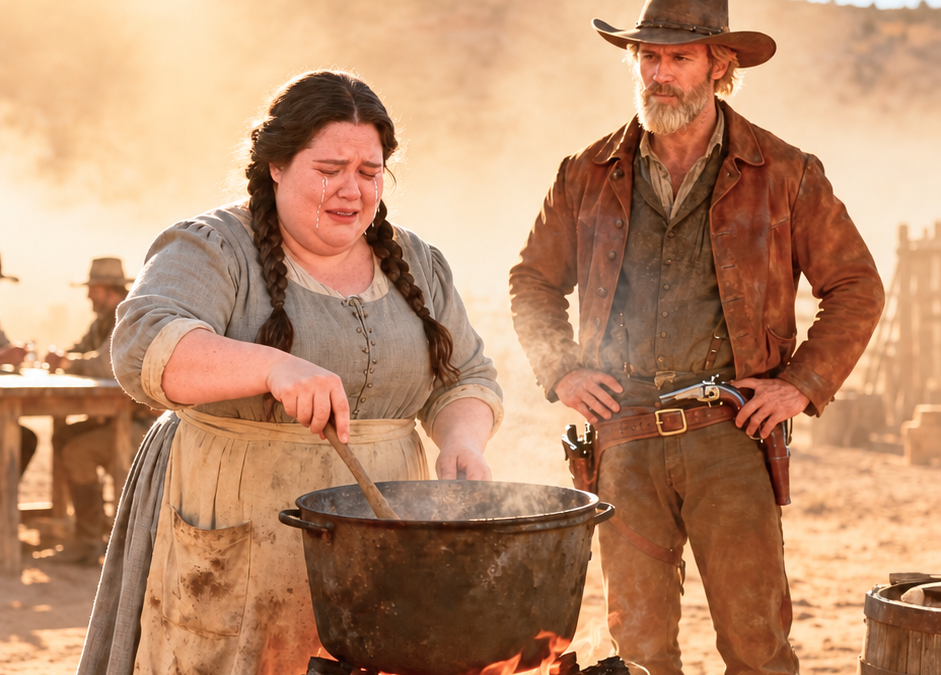
COWBOY FOUND AN OBESE GIRL CRYING IN HIS KITCHEN—HER SECRET CHANGED EVERYTHING
Cole Mercer had seen men bleed without making a sound.
But he had never seen anyone cry as if even the tears needed permission.
Then he noticed what the frightened woman had hidden beneath his kitchen table—and understood why someone might kill to get her back.
PART ONE — THE WOMAN WHO CRIED WITHOUT A SOUND
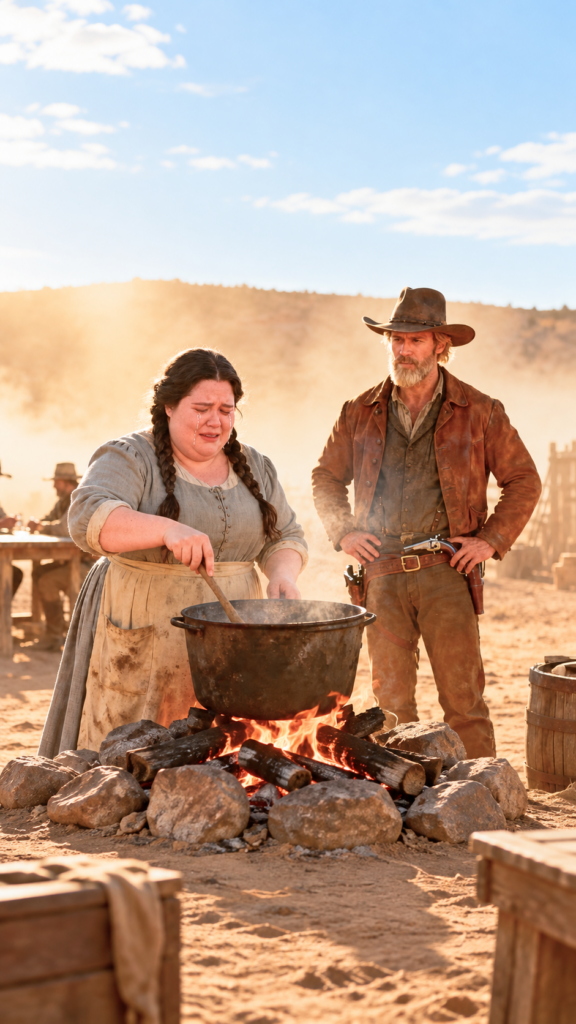
The first time Cole Mercer saw Margaret Hale cry, she was standing over a pot of venison stew in his kitchen.
Her broad back was turned toward him, one hand gripping a wooden spoon, the other pressed against the edge of the stove. Her shoulders trembled beneath the brown wool dress she wore almost every day. Tears slid down her round cheeks and dropped soundlessly onto her apron, yet she made no sob, no sniff, no noise at all.
Cole stopped in the doorway with snow melting from his boots.
For four years, silence had been the only thing he trusted.
Now, suddenly, hers frightened him.
“Maggie?”
She stiffened.
The spoon stopped moving.
Cole almost regretted speaking. He was forty-two, a widower, a rancher, and a man who could mend a broken gate in a blizzard but had no idea what to do with a crying woman.
“You burn yourself?”
She shook her head without turning.
“Something happen?”
Another shake.
Cole set his gloves on the table. “Then why are you crying?”
The question was foolish the moment it left him. Maggie had not spoken a word since Pastor Henshaw brought her to the ranch six weeks earlier.
Maybe she couldn’t.
Maybe she wouldn’t.
Nobody seemed to know.
Pastor Henshaw had arrived one gray October afternoon with Maggie sitting stiffly on a mule and a canvas bag containing everything she owned. He had said she needed somewhere safe for winter. Cole had said no before the pastor finished asking.
Cole had stopped taking in strays after Sarah died.
People, horses, hope—it all ended badly.
But the pastor had persisted. Maggie could cook, clean, mend clothing, and work harder than most hired men. More importantly, she had nowhere else to go before the mountain road became impassable.
Cole had finally agreed to one winter.
Room and board.
No promises.
No complications.
Then Maggie stepped down from the mule.
She was twenty-nine, though fear made her seem both younger and older. She was short and unusually heavy, thick through her waist and hips, with strong arms and a soft, round face that people in town would later describe with words meant to wound her.
Cole noticed something else.
She looked at him the way beaten horses looked at raised hands.
Not angry.
Not distrustful.
Prepared.
Prepared to be hurt.
That bothered him more than her size ever could.
During her first week on the ranch, Maggie moved like someone apologizing for occupying space. She ate after Cole finished. She stepped aside whenever he entered a room. If he reached too quickly for something near her, she flinched.
The first time she broke a jar of peaches, she dropped to her knees and began gathering glass with her bare fingers.
“Stop.”
She moved faster.
“Maggie.”
Her breathing became shallow.
Cole caught her wrist before she grabbed another shard.
She froze so completely that he released her immediately.
“I’m not going to hit you.”
Her eyes lifted to his for less than a second.
That second stayed with him.
There was no relief in them.
Only disbelief.
Cole swept up the glass himself.
The next morning, a note waited beside his coffee.
Sorry about the peaches. I will replace them.
Cole turned the paper over and wrote beneath her sentence.
They were peaches. Not gold.
The note disappeared.
That evening, it returned.
Beneath his words, Maggie had written:
Some men treat broken things as permission.
Cole read that sentence three times.
He never asked what she meant.
He told himself it was because he respected privacy.
The truth was uglier.
He was afraid of the answer.
Now, weeks later, he watched her wipe tears from her face before turning around.
“I’m not angry,” he said.
Maggie nodded quickly.
“Did I do something?”
She shook her head.
Cole looked at the stew, then at her trembling fingers. “You want me to leave?”
Another pause.
Then a small nod.
“All right.”
He turned toward the hallway.
Something brushed his boot.
Paper.
Cole looked down.
A folded square had fallen beneath the kitchen table, probably from the pocket of Maggie’s apron. He bent and picked it up before realizing she had spun toward him.
Her expression changed instantly.
Fear.
Not embarrassment.
Not grief.
Terror.
She lunged for the paper.
Cole stepped back automatically.
“Maggie?”
She reached again.
“Hold on.”
Her chest rose and fell rapidly.
Cole unfolded the sheet.
Numbers.
Names.
Dates.
At first he assumed it was a household list.
Then he saw the headings.
Harlan Webb — original debt: $48. Recorded balance: $212.
Samuel Price — original debt: $31. Recorded balance: $190.
Rebecca Dunn — no original debt located. Contract entered: $275.
Beside several names were short notations.
deceased
transferred
escaped
returned
Cole’s eyes moved farther down.
Then he saw a name he recognized.
Frank Dockery — $150
The sheriff.
Below that:
Judge Amos Morrison — $300
Cole slowly looked up.
Maggie had backed against the stove.
“Where did you get this?”
She shook her head violently.
“This looks like an account book.”
She held out her hand.
Cole did not return it.
“Maggie, why is the sheriff’s name on here?”
She pressed both hands to her mouth.
“Who is Richard Talbot?”
The color vanished from her face.
Cole knew he had struck something because Maggie’s knees seemed to weaken beneath her.
She grabbed the edge of the counter.
Cole had never heard the name before.
It had been written repeatedly down the margin.
R. Talbot authorization.
R. Talbot adjustment.
R. Talbot collection.
Cole lowered his voice.
“You know him.”
Maggie stared at the floor.
“Does he know you have this?”
Her head snapped up.
That answered him.
Cole folded the paper carefully. “Sit down.”
She did not.
“Maggie, sit before you fall.”
She reached for the drawer where they kept pencils, took one, then pulled a scrap of flour wrapping from the counter.
Her hand shook so badly she had to start twice.
Finally she pushed the message toward him.
Please burn it.
Cole looked at her.
“No.”
Her eyes widened.
“If somebody hurt you because of this, burning it protects him, not you.”
She wrote again.
You don’t understand.
“Then help me understand.”
Another sentence.
People died because of those numbers.
The kitchen suddenly felt colder despite the fire.
Cole looked again at the sheet.
Rebecca Dunn.
Samuel Price.
Harlan Webb.
Some names had crosses beside them.
Some had the word deceased.
Others had no notation at all.
“Were you working for Talbot?”
Maggie stood completely still.
Then she nodded.
“What did you do?”
Her pencil hovered.
For a long time, she seemed unable to make herself write.
Finally:
Books. Accounts. Contracts.
Cole felt the first hard turn of suspicion in his stomach.
“You kept his records?”
A nod.
“Then these numbers are real?”
Another nod.
“Why do they look wrong?”
Maggie closed her eyes.
When she opened them again, something had changed. Fear remained, but beneath it lived exhaustion—the exhaustion of someone who had carried a secret until the secret had become heavier than she was.
She wrote slowly.
Because the debts were changed after people signed.
Cole stared at her.
“What?”
A man borrowed $40. Mr. Talbot made it $140. Food became debt. Beds became debt. Medicine became debt. Every month the balance grew. Nobody could finish paying.
Cole read the words twice.
“That’s fraud.”
Maggie gave him a sad look.
It was almost a smile.
Almost.
She wrote:
Fraud matters only if the honest people control the courthouse.
Cole glanced again at Sheriff Dockery’s name.
Then Judge Morrison’s.
His mouth went dry.
“You copied this?”
Maggie nodded.
“How much?”
She did not answer.
“Maggie.”
She reached beneath the collar of her dress and pulled out a small brass key on a cord.
Cole had seen the cord before.
He had assumed it held a cross.
Instead, it held a key.
She placed it on the table.
Then she wrote six words.
This opens the box they want.
Cole stared at the key.
“What box?”
Maggie’s pencil broke.
For the first time since arriving at the ranch, she tried to force sound through her throat.
Nothing came at first.
Then a torn whisper.
“Ledger.”
Cole forgot to breathe.
Maggie clapped both hands over her mouth as though she had betrayed herself.
Outside, the wind rattled the windows.
A horse whinnied in the barn.
Then another sound came from beyond the house.
Distant.
Rhythmic.
Hoofbeats.
Cole crossed to the window.
A single rider was coming up the valley trail.
Black horse.
Dark coat.
Moving fast.
When Cole turned back, Maggie had already seen him.
Her face collapsed.
The pencil slipped from her fingers.
She wrote one final sentence and pushed it across the table.
If Richard Talbot finds me here, do not believe anything he says about why I belong to him.
Then someone knocked on the front door.
Three slow knocks.
Not the knock of a lost traveler.
The knock of a man who expected to be obeyed.
And from the other side came a calm voice.
“Mr. Mercer? I believe you have something of mine.”
PART TWO — THE MAN WITH THE PAPER
Cole opened the door but did not step aside.
The stranger stood beneath the porch roof brushing snow from an expensive black coat. He was tall, narrow-faced, clean-shaven, and dressed better than any man who had ridden that far into the mountains had reason to be.
His eyes moved past Cole toward the kitchen.
“Cole Mercer?”
“Who wants to know?”
“Richard Talbot.”
Behind Cole, a chair scraped.
Talbot smiled.
There was no warmth in it.
“So Margaret is here.”
Cole stepped fully into the doorway. “What do you want?”
“My employee.”
“She doesn’t work for me.”
“No.” Talbot removed a folded document from inside his coat. “She works for me.”
Cole did not take the paper.
Talbot extended it farther.
“Five-year debt-labor contract. Margaret Hale received room, food, transportation, medical care, and an advance against future wages. She abandoned the agreement with three years remaining.”
“Abandoned?”
“Ran.”
Cole finally took the document.
The language was dense and official-looking. Signatures filled the bottom. A county seal had been pressed into red wax.
Margaret Hale’s name appeared there.
So did Judge Morrison’s.
Cole’s jaw hardened.
“You expect me to hand over a woman because a piece of paper says she owes you money?”
“I expect you not to interfere with a lawful contract.”
Cole looked at the amount.
“Six hundred and twelve dollars?”
“Accumulated expenses.”
“For what?”
Talbot shrugged. “You would have to ask our bookkeeper.”
The smile returned.
Cole understood the insult.
Maggie appeared at the kitchen entrance.
Talbot’s expression changed almost imperceptibly.
Not affection.
Possession.
“There you are.”
Maggie stopped.
Talbot looked over her worn dress, her flour-dusted hands, the hair escaping from her bun.
“You’ve gained weight.”
Cole felt his fingers curl.
Maggie’s eyes dropped.
Talbot continued as though discussing livestock. “You always did eat when nervous.”
“That’s enough,” Cole said.
Talbot glanced at him.
“I wasn’t speaking to you.”
“You are on my porch.”
“And the woman behind you is bound by contract to me.”
“She says those debts were altered.”
For the first time, Talbot lost his smile.
Only for a second.
But Cole saw it.
Talbot looked at Maggie.
“You’ve been telling stories?”
Maggie shook her head.
Cole watched him carefully. “She didn’t need to. I found something.”
Maggie’s eyes flashed toward Cole.
Wrong move.
Talbot’s entire posture sharpened.
“What?”
“Nothing you need to worry about.”
Talbot stepped closer.
“Mr. Mercer, I came here prepared to solve a simple problem peacefully. I suggest you allow me to.”
“And if I don’t?”
Talbot reached beneath his coat.
The pistol appeared so smoothly Cole understood this was not the first time Richard Talbot had used one to settle a disagreement.
The muzzle pointed at Cole’s chest.
Maggie made a sound behind him.
Not a word.
A strangled breath.
Talbot spoke quietly.
“I return with the sheriff. You are charged with harboring a contract fugitive and stealing company property. Your ranch gets searched. Your finances get examined. Perhaps your late wife’s estate becomes complicated.”
Cole went still.
“How do you know about Sarah?”
“I know about people before I visit them.”
That frightened Cole more than the pistol.
Talbot had not ridden into the mountains hoping to find Maggie.
He had known where she was.
Known Cole lived alone.
Known Sarah was dead.
Maybe known far more.
Maggie suddenly moved between them.
Cole caught her shoulder gently.
“No.”
She looked at him.
For months she had avoided direct eye contact.
Now she held his gaze.
There was terror in hers.
But there was also a decision.
She pulled paper from her apron and wrote against the wall.
If I stay, he destroys you too.
Cole shook his head.
“That’s my decision.”
She wrote again.
No. That is what he wants.
Talbot watched with open amusement.
“Touching.”
Cole ignored him.
“Maggie, you walk out that door with him, and what happens?”
Her hand stopped.
He knew the answer from her scars.
From the way she slept with furniture against her bedroom door during storms.
From the way a broken jar had once made her prepare for a beating.
Cole lowered his voice. “You don’t owe me work. You don’t owe me food. You don’t owe me gratitude. But you don’t have to go because you think keeping me safe is another debt.”
Maggie’s eyes filled.
Talbot sighed.
“Margaret.”
She flinched at her full name.
“Enough.”
Maggie slowly removed the brass key from around her neck.
Cole thought she was going to hand it to Talbot.
Instead she closed it inside Cole’s fist.
Talbot did not see.
Her hand lingered for one second.
Then she wrote:
Keep the lamp lit.
Cole looked at her sharply.
Talbot stepped off the porch. “Get your belongings.”
Maggie packed one canvas bag.
The same bag she had brought months earlier.
Before leaving the kitchen, she touched the flour jar, the stove, the back of the chair where she had sat exactly three times since arriving.
Then she looked at Cole.
Her lips moved.
No sound.
Cole knew the words anyway.
I’m sorry.
Talbot put her behind him on the black horse.
Cole stood helplessly on the porch.
Every instinct demanded that he draw his rifle.
But killing Talbot would bring the sheriff.
Maggie would still be trapped in whatever system protected him.
And Cole would hang or spend the rest of his life behind stone walls.
Talbot turned the horse.
“Smart choice, Mercer.”
Cole said nothing.
The horse began descending the trail.
Maggie never looked back.
Not once.
That hurt more than if she had.
Cole remained on the porch until darkness swallowed them.
Then he returned to the kitchen.
Her half-kneaded bread sat beneath a cloth.
The stew had gone cold.
Her apron still hung from a peg.
Cole placed the brass key on the table.
Beside it lay the copied account sheet.
He read every name.
At the bottom, in writing so faint he had missed it before, Maggie had added another line.
Original ledger stored in Talbot Denver office. Black iron box. Second floor. Key with M.H.
Cole closed his hand around the brass key.
Then he noticed something beneath the breadboard.
Another note.
Maggie must have hidden it while packing.
Cole, the page you found is not the secret. It is only one page. I copied enough to destroy him.
Cole’s pulse quickened.
The note continued.
Talbot thinks I escaped because I was afraid of him. I escaped because I learned he planned to move the ledger and kill the workers who knew it existed.
Cole stopped reading.
There was one final sentence.
If anything happens to me, find Elizabeth Brennan in Denver and tell her Margaret Hale finally found the evidence her sister died trying to find.
Cole stared at the name.
Elizabeth Brennan.
He did not know her.
But Maggie clearly did.
And that meant the silent woman who had spent months pretending she barely existed had not wandered into his ranch by accident.
She had been carrying a mission.
A key.
And evidence powerful enough to terrify a man who owned judges.
Cole walked to the window.
He lit an oil lamp and set it on the sill.
A light for Maggie.
A promise.
Then he saddled his horse.
Because for the first time since Sarah died, Cole Mercer was more afraid of doing nothing than he was of losing everything.
PART THREE — THE LIGHT IN THE WINDOW
Sheriff Frank Dockery listened without interrupting.
That should have warned Cole.
They sat inside the cramped Timber Ridge sheriff’s office while sleet tapped against the glass. Dockery’s boots rested on his desk, and a week-old newspaper lay open beside his coffee.
Cole placed the copied account page between them.
Dockery glanced down.
His expression barely changed.
“Where’d you get this?”
“That’s what concerns you?”
“I asked a question.”
“So did I.”
Dockery leaned back.
Cole pointed to the page. “Your name is there.”
“A lot of men named Dockery.”
“It says Frank.”
The sheriff’s jaw tightened.
“Could be forged.”
“Then help me prove it.”
Dockery slid the sheet back across the desk.
“You have no idea what you’re involved in.”
“I know Talbot holds people under debts they can never repay.”
“You know what a frightened woman wrote on paper.”
“She kept his books.”
“According to her.”
“She barely speaks.”
“Convenient.”
Cole stood.
Dockery’s hand moved toward the revolver on his desk.
“Sit down.”
Cole did not.
“You going to arrest me?”
“No. I’m giving you advice.” Dockery’s voice lowered. “Go home. Forget Margaret Hale. Burn that page.”
“That sounds less like advice than fear.”
The sheriff’s eyes hardened.
“You lost a wife once, Mercer. You know what grief does to a man. Don’t go looking for another funeral.”
Cole left before anger made the decision for him.
Pastor Henshaw knew nothing about Elizabeth Brennan.
Mary Hutchins at the general store did.
“She’s in Denver,” Mary said, lowering her voice. “Legal advocate. Helps women and laborers who sign contracts they don’t understand.”
“You know her?”
“No. But I know Talbot hates her.”
That was enough.
Cole bought flour, coffee, ammunition, and lamp oil.
The last item made Mary stare.
“You expecting a long winter?”
“Expecting someone to need a light.”
Three nights later, Cole awoke to horses screaming.
He ran outside barefoot with his rifle.
The barn roof glowed orange.
Fire climbed the south wall.
For one suspended second, Cole saw Sarah’s final winter again—the white storm, the empty road, the horse returning without her.
Then instinct took over.
He kicked open the barn door.
Smoke swallowed him.
Molly, the bay mare Maggie had learned to ride, reared against her stall. Cole covered his mouth with his sleeve, released her, then went back for the others.
The roof groaned.
Burning timber fell behind him.
He dragged the final gelding outside seconds before part of the structure collapsed.
By dawn, the barn was gone.
The horses lived.
Most of the stored feed did not.
Neither did the tack, tools, seed, and equipment Cole had spent years collecting.
He found the message after sunrise.
A scrap of paper pinned to the fence with a horseshoe nail.
Some lights should be allowed to die.
Cole read it once.
Then he walked into the house.
The lamp still burned in the window.
He turned the wick higher.
Six days later, he began the ride to Denver.
The journey took nearly a week.
Rain replaced snow in the lower country, transforming roads into brown rivers of mud. Cole slept beneath wagons, in barns, and once under an overhang while lightning split the sky across the plains.
Elizabeth Brennan’s office occupied the second floor of a narrow brick building wedged between a printer and a boardinghouse.
Cole climbed the stairs looking like a man dragged behind his own horse.
A young clerk tried to stop him.
“I need to see Miss Brennan.”
“Do you have an appointment?”
“No.”
“Then—”
“Tell her Margaret Hale sent me.”
The clerk disappeared.
The door reopened less than a minute later.
A woman stood there.
Mid-thirties. Gray dress. Dark hair pinned tightly back. Wire spectacles. Ink on her fingers.
“What did you say?”
“Margaret Hale.”
Elizabeth Brennan pulled him inside.
“Where is she?”
“With Richard Talbot.”
Elizabeth closed her eyes.
For the first time, her professional calm cracked.
“No.”
“You know her?”
Elizabeth looked at him.
“Sit down.”
Cole remained standing.
“She said to tell you she found evidence your sister died looking for.”
Elizabeth’s face went white.
The room became silent.
Finally she asked, “What evidence?”
Cole placed the copied ledger page on her desk.
Elizabeth read it.
Her eyes stopped at Judge Morrison.
Then Dockery.
Then several names Cole did not recognize.
“Dear God.”
“That good or bad?”
“Both.”
Elizabeth sank into her chair.
“My sister Lucy worked for Talbot seven years ago. She believed he was altering labor debts and bribing local officials. She tried to obtain the books.”
“What happened?”
“Talbot accused her of theft. Nobody believed her. She was sent away under another contract.”
Elizabeth swallowed.
“She died before I found her.”
Cole thought of Maggie’s scars.
“She knew Lucy?”
“Yes. Maggie was a kitchen worker then. Talbot discovered she could read numbers better than his clerk, so he moved her into the office.” Elizabeth looked at the paper again. “If Maggie copied the books, she did what Lucy couldn’t.”
“She says there’s more.”
“How much?”
“I don’t know.”
“Where?”
“Neither do I.”
Cole placed the brass key on the desk.
Elizabeth stared at it.
“The original ledger is in an iron box at Talbot’s Denver office.”
Elizabeth’s eyes lifted.
“That changes things.”
“Can you get Maggie out?”
“Maybe.”
Cole hated that word immediately.
Elizabeth continued. “A copied sheet proves very little by itself. The original ledger could establish a pattern. If we combine it with testimony from former workers, forged contracts, payments to officials—”
“How long?”
“Cole—”
“How long?”
“Weeks. Possibly months.”
“She doesn’t have months.”
Elizabeth stood.
“I understand your urgency. But Talbot wants you angry. Angry men make mistakes that powerful men turn into convictions.”
“So I sit here?”
“You find witnesses.”
They began with Peter Grant.
Peter had spent two years under Talbot’s contracts.
He drank too much, slept badly, and wanted no part of the fight.
Then Cole showed him the page.
Peter found his own name.
Original debt: $60.
Recorded debt: $411.
His hands began shaking.
“That son of a…”
“Will you testify?”
Peter’s first answer was no.
His second answer came after twenty minutes of silence.
“Yes.”
The Denver newspaper assigned a reporter named Thomas Webb.
A story began forming.
Talbot employed workers under debts that rose instead of fell.
Former laborers described locked bunkhouses.
Dockery and Morrison’s names appeared on accounting sheets.
But Elizabeth still needed Maggie.
“Her statement connects the system to the person who kept the records,” she told Cole. “Without her, Talbot says everything was bookkeeping error.”
So Cole did the thing Elizabeth expressly forbade.
He went to Talbot’s estate.
At night.
From a ridge, he studied the property.
Main house.
Two bunkhouses.
Four guards.
Dogs.
Fences.
He did not intend to rescue Maggie that night.
He wanted only to reach her.
Near midnight, he crawled through wet grass to the women’s bunkhouse and whispered through a gap near the foundation.
“Maggie.”
Nothing.
“Maggie Hale.”
Movement inside.
A woman whispered back.
“Who is that?”
“Cole Mercer.”
A sharp intake of breath.
“Is Maggie there?”
Silence.
Then: “She can’t come to you.”
Cole’s chest tightened.
“Why?”
“She’s hurt.”
His vision narrowed.
“What happened?”
Before the woman answered, boots approached.
Cole pressed himself into the mud.
A guard passed within feet of him.
When the footsteps faded, the woman pushed something through the gap.
A folded note.
Cole grabbed it and retreated.
He did not open it until he reached the ridge.
Even in moonlight, he recognized Maggie’s handwriting.
Cole, do not try to take me out. Take the book.
Below that:
He moved the iron box. The key is useless now.
Cole’s hope collapsed.
Then he read the next line.
But I lied to him. The original ledger was never in the box.
Cole sat perfectly still.
Another sentence.
I hid it where a man like Richard Talbot would never look.
And beneath that:
In the kitchen.
Cole almost laughed at the cruelty of it.
The woman Talbot mocked for her size.
The servant he assumed cared only about food.
The silent cook nobody noticed.
Maggie had hidden the document capable of destroying his empire in the one room wealthy men entered without seeing the people who worked there.
Cole turned the note over.
One final instruction had been written on the back.
Blue flour barrel. False bottom. Hurry. He is moving us in two days.
Then a lantern flared behind Cole.
“Don’t move!”
Three rifles aimed at him from the darkness.
Sheriff’s deputies.
One stepped forward carrying irons.
“Cole Mercer, you’re under arrest.”
Cole looked toward the bunkhouse.
Two days.
Maggie had given him the location of the ledger.
And Talbot had just made sure Cole would be in jail when she disappeared.
PART FOUR — THIRTY DAYS BEHIND STONE
The jail cell had no window.
Cole discovered that mattered more than he expected.
At the ranch, even grief had sky above it. In Denver’s jail, eight feet of stone separated him from daylight, horses, weather, work—and Maggie.
Talbot charged him with trespassing, vandalism, attempted theft, and threatening employees.
Half of it was invented.
It did not matter.
Judge Morrison presided.
The same Morrison whose name appeared on Maggie’s copied ledger.
Elizabeth objected immediately.
Morrison refused to recuse himself.
“Unverified scribblings do not constitute evidence,” he announced.
Talbot sat in the courtroom wearing a black suit and the expression of a man attending routine business.
Cole received thirty days.
Elizabeth found him afterward gripping the bars of his cell.
“You knew this would happen,” she said.
“I knew something would.”
“You could have been killed.”
“Maggie’s being moved.”
“I know.”
“How?”
“The newspaper received an anonymous message.”
Cole stared at her.
“What message?”
Elizabeth unfolded a note.
Ask Richard Talbot why seven women disappeared from his Kansas property last winter. Ask where Annie Ferris is.
“Who sent it?”
“We don’t know.”
A voice came from the next cell.
“I do.”
Cole turned.
The man behind the bars was younger, scarred from eyebrow to jaw, with the hard stare of someone who had learned not to expect good endings.
“My name’s Jack Ferris.”
Elizabeth stepped closer.
“Annie Ferris?”
“My sister.”
He explained.
Annie had taken a factory advance after their father died.
Twenty dollars.
Within six months, Talbot claimed she owed more than three hundred.
Jack protested.
He was arrested for assault after striking one of Talbot’s collectors.
“Last letter she sent came from Kansas,” he said. “Then nothing.”
Cole felt the pieces connecting.
Maggie’s ledger.
The hidden book.
The Kansas property.
Lucy Brennan.
Talbot had not built one operation.
He had built a network.
Elizabeth began sending telegrams.
Thomas Webb published the first article.
DEBT WORKERS HELD BEHIND LOCKED DOORS
Then another.
LOCAL OFFICIALS NAMED IN PRIVATE LABOR ACCOUNTS
Sheriff Dockery called the accusations lies.
Judge Morrison threatened contempt actions.
Talbot issued a public statement portraying himself as a businessman helping impoverished people repay legitimate debts.
Then Peter Grant agreed to speak publicly.
Cole saw the article inside jail.
Peter described sleeping fifteen men to a room.
Guards locking doors after sunset.
Workers charged for broken tools they never touched.
Medical fees entered into accounts when no doctor had visited.
His final quote occupied half a column.
“The debt wasn’t what you owed. The debt was how they kept you.”
Two days later, Peter Grant disappeared.
Cole knew before Elizabeth said anything.
He saw it in her face.
“Where?”
“Alley behind a boardinghouse.”
“Dead?”
Elizabeth nodded.
Officially, robbery.
Neither of them believed it.
Cole sat on his cot.
His hands rested quietly on his knees.
The stillness frightened Elizabeth more than rage would have.
“This is what Talbot wants,” she said. “He wants everyone afraid.”
“He killed Peter.”
“We cannot prove that.”
“Everybody keeps saying that.”
“Because proof matters.”
“So does staying alive long enough to testify.”
Elizabeth stepped closer to the bars.
“And that is exactly why I need you not to turn this into vengeance.”
Cole looked at her.
“It stopped being about vengeance the day Maggie put that key in my hand.”
His sentence ended after thirty days.
By then Talbot’s name had become known far beyond Denver.
Three former workers had come forward.
Then six.
Then eleven.
Jack Ferris was released on an old charge after Elizabeth found procedural violations in his case.
He joined the effort immediately.
On Cole’s first morning free, Elizabeth met him outside the jail.
“Go home.”
“No.”
“Your ranch has been unattended for a month.”
“Neighbors are watching it.”
“You have done enough.”
“Maggie is still there.”
Elizabeth looked exhausted.
“We believe Talbot moved her from the main estate.”
“Where?”
“We don’t know.”
Cole’s jaw tightened.
Elizabeth caught his arm.
“Listen. Something else happened.”
She led him to her office.
On the desk lay an envelope.
No return address.
Inside was a small piece of cloth.
Brown wool.
Maggie’s dress.
Wrapped inside the cloth was a scrap of paper.
Only four words.
The kitchen still remembers.
Cole stared.
Elizabeth said, “You told me she hid the ledger in a blue flour barrel.”
“Yes.”
“We searched property inventories. Talbot’s main estate kitchen was remodeled last year. The old equipment was transferred.”
“Where?”
Elizabeth unfolded a purchase record.
“Kansas.”
Cole looked at her.
The ledger had moved without Talbot knowing what it was.
The blue flour barrel had been shipped with kitchen supplies to his second property.
So had the evidence.
And possibly Maggie.
Jack Ferris was waiting downstairs.
When Cole told him, Jack’s face changed.
“My sister’s there.”
“Maybe.”
“I’m coming.”
“No.”
Jack stepped forward.
“You don’t get to tell me no.”
Cole saw himself in the younger man.
Same anger.
Same refusal.
Same willingness to walk into hell because someone inside mattered more than the cost.
He nodded once.
Elizabeth appeared in the doorway holding a folder.
“I hate both of you.”
Cole almost smiled.
She placed the folder on the desk.
“Property records. Kansas location. Names of registered workers. Building sketch from a former delivery driver.”
Cole looked at her.
“I thought you wanted us home.”
“I want evidence.”
“That all?”
Elizabeth held his gaze.
“No.”
She turned toward the window.
“When I failed to save Lucy, I promised myself I would never confuse legal caution with morality again.”
She faced them.
“Bring those people back alive.”
Cole collected the documents.
At the bottom of the worker list he found a familiar name.
Margaret Hale.
Beside it, in different handwriting, someone had added:
Special transfer. Do not allow kitchen access.
Cole felt cold.
Talbot had finally understood.
Maggie’s secret was not simply that she had copied his ledger.
Talbot had realized she had hidden it.
And wherever Maggie was now, Richard Talbot was trying to make her tell him where.
PART FIVE — THE BLUE FLOUR BARREL
Kansas looked endless.
Flat fields stretched toward a horizon that seemed farther away every hour. Cole missed the mountains immediately, missed having ridges to judge distance against, missed the feeling that the land had edges.
Jack Ferris rode beside him in silence.
They reached Talbot’s property near Wichita after sunset on the fourth day.
From a low rise they could see a main house, two bunkhouses, sheds, a stable, and fenced fields.
Cole used field glasses.
Women crossed the yard carrying laundry.
Men hauled timber.
Armed guards watched both groups.
Then Jack grabbed Cole’s sleeve.
“There.”
A red-haired woman carried two buckets toward a pump.
Jack’s breath broke.
“Annie.”
Cole stopped him from standing.
“You go now, you get her killed.”
Jack’s jaw trembled.
“I’ve been looking for her eighteen months.”
“Then you can wait one more night.”
They spent hours studying guard rotations.
Cole had no intention of starting a gunfight.
He needed people alive.
He needed witnesses.
And he needed the blue barrel.
Near midnight, confusion erupted near the horse enclosure after several animals broke loose. Whether a rotten fence rail failed or someone helped it fail was something Cole never later explained in detail.
Guards ran toward the noise.
Cole and Jack moved toward the women’s building.
Annie recognized her brother before he spoke.
For one second she simply stared.
Then she covered her mouth.
Jack touched his forehead to hers through the partially opened door.
“We’re getting you out.”
Annie shook her head.
“Not just me.”
Seven women stood behind her.
Some were barefoot.
One held a baby wrapped in a blanket.
Another was old enough to be Cole’s mother.
Cole looked at them.
“All of you.”
Annie caught his sleeve.
“There’s another woman.”
“Maggie?”
Annie’s eyes sharpened.
“You’re Cole.”
“How do you know?”
“She told us about the lamp.”
His chest tightened.
“Where is she?”
“Main house cellar.”
Jack swore.
“Why?”
“Talbot came three days ago. He knows she hid something.”
Cole looked toward the white house.
“Blue flour barrel?”
Annie nodded slowly.
“Maggie kept asking about it.”
“Where is it?”
“Kitchen pantry.”
Cole handed Jack the keys he had taken from the outer lock.
“Get them toward the eastern tree line.”
“You’re going inside?”
“Yes.”
“Alone?”
“Less noise.”
Jack grabbed his arm.
“Don’t be stupid.”
“Little late for that.”
Cole reached the rear porch of the house while shouting continued near the horses.
The kitchen door was unlocked.
He entered.
Moonlight fell across counters, pots, shelves.
A row of barrels stood inside the pantry.
White.
Brown.
Blue.
Cole knelt before the blue one.
Flour filled the top.
He removed several scoops with shaking hands until his fingers struck wood.
False bottom.
He pried it loose.
Wrapped oilcloth lay beneath.
Inside was a ledger.
Thick.
Black.
Cole opened it.
Names filled page after page.
Debts.
Payments.
Transfers.
Bribes.
Deaths.
Judge Morrison appeared repeatedly.
Sheriff Dockery.
County clerks.
Freight operators.
A state legislator.
Then Cole found a section written in Maggie’s hand.
Not accounting.
Notes.
Rebecca Dunn arrived with no debt. Talbot created contract after husband died.
Joseph Lane worked eleven months without wages. Balance increased $97.
Annie Ferris original advance $20. Current claimed balance $364.
Page after page.
Maggie had not merely copied numbers.
She had documented people.
Their real stories.
Their original agreements.
Their injuries.
Their disappearances.
Cole understood.
Everyone else had seen figures in Talbot’s books.
Maggie had seen human beings.
That was her secret.
That was why Talbot feared her.
A floorboard creaked behind him.
Cole turned.
Richard Talbot stood in the kitchen doorway holding a pistol.
“I knew you’d come.”
Cole rose slowly.
Ledger in hand.
Talbot’s eyes went to it.
For the first time since Cole met him, genuine fear crossed his face.
“Put that down.”
“No.”
“You have no idea what you’re holding.”
“Looks like your future.”
Talbot raised the pistol.
Cole did not move.
“You think one book destroys me?”
“I think you’re scared enough to point a gun at it.”
Talbot smiled, but sweat shone at his temples.
“You came all this way for a woman who barely talks and looks like she ate the rest of my workforce.”
Cole’s face went still.
Talbot continued because cruel men often mistook silence for weakness.
“I chose Margaret for the accounts because nobody noticed her. Men looked through her. Women pitied her. She could carry papers from room to room and nobody remembered she’d been there.”
“That was your mistake.”
“Yes.”
Talbot’s smile disappeared.
“It was.”
A sound came from below.
Three knocks.
Pause.
Three more.
Cole looked toward the cellar door.
Maggie.
Talbot saw the glance.
“Forget her.”
“No.”
“You’re a rancher, Mercer. I can make you wealthy. Give me the book.”
Cole almost laughed.
“You burned my barn.”
“I can build ten.”
“You took Maggie.”
“She was never yours.”
Cole’s eyes hardened.
“That’s the first true thing you’ve said.”
Maggie belonged to nobody.
That was the entire point.
Talbot cocked the pistol.
“Book.”
A crash sounded outside.
Then shouting.
Jack.
The women had been discovered.
Talbot glanced toward the window.
Cole moved.
The gun fired.
The bullet struck the pantry frame.
Cole hit Talbot hard enough to drive both men into the table.
The pistol slid across the floor.
Talbot clawed for it.
Cole kicked it away.
For several seconds there was no law, no ledger, no philosophy.
Only two exhausted men fighting across a kitchen floor.
Talbot reached for a knife.
Cole slammed his wrist against the table until it dropped.
Then he had both hands around Talbot’s coat.
One more blow might have ended it.
Cole wanted to.
Peter Grant flashed through his mind.
Maggie’s scars.
Sarah frozen beneath snow.
The burning barn.
Talbot smiled through blood on his lip.
“Do it.”
Cole stopped.
That was what Talbot wanted.
A dead businessman.
A violent rancher.
A ledger nobody could authenticate.
Cole released him.
“No.”
Talbot looked confused.
Cole picked up the ledger.
“I’m going to make you listen while every person you treated like property tells the world what you did.”
He locked Talbot inside the pantry.
Then he opened the cellar.
Maggie sat against the wall.
Her cheek was bruised.
One wrist was bandaged.
But she was alive.
For a heartbeat, neither moved.
Then she saw the ledger.
Her entire face changed.
Cole crouched.
“Found your kitchen.”
Maggie began crying.
Silent tears again.
But this time she did not turn away.
She reached for him.
Cole stopped just before touching her.
“Can I?”
Maggie nodded.
He put his arms around her.
She held on with surprising strength.
Outside, Jack shouted that riders were coming.
They had minutes.
Cole helped Maggie stand.
She took two steps, then stopped.
There were papers on Talbot’s desk.
She pointed urgently.
“What?”
Maggie grabbed a pencil.
Her fingers flew.
Those are transfer orders. He is moving thirty-four workers tomorrow.
Cole looked at the papers.
Three destinations.
Three states.
Talbot’s network was larger than even Elizabeth believed.
Maggie wrote again.
The ledger is enough to save me.
Then another line.
Those papers may save everyone else.
Cole gathered every document he could carry.
They left the house together.
But as the freed workers reached the tree line, a shot cracked behind them.
Jack dropped.
Annie screamed.
And Richard Talbot stepped onto the porch with a second pistol in his hand.
PART SIX — WHAT MAGGIE DID WITH HER SILENCE
Jack was alive.
The bullet had torn through the upper part of his arm instead of his chest, but blood soaked his sleeve.
Annie dragged him behind a wagon.
Talbot fired again.
Cole pushed Maggie down behind a watering trough.
Workers scattered.
Then something happened Talbot had not expected.
They stopped running.
One by one, men and women who had spent years lowering their eyes turned around.
A farmhand picked up a shovel.
Another man took a fence post.
Annie seized a dropped rifle.
An elderly woman stood in the middle of the yard holding nothing at all.
Talbot stared.
“You people return to your quarters.”
Nobody moved.
His authority had depended on each person believing he or she stood alone.
Now there were witnesses.
Names.
A ledger.
And more than twenty people looking at one another and realizing fear had been shared.
Maggie rose beside Cole.
He tried to pull her down.
She resisted.
Talbot’s pistol shifted toward her.
“Margaret.”
Maggie stepped into view.
Her body trembled.
Cole could feel it through the hand she had placed on his arm.
Talbot smiled.
“You know how this ends.”
Maggie looked at him.
Then, painfully, she spoke.
The sound was rough.
Small.
But unmistakable.
“No.”
One word.
Every person in the yard heard it.
Talbot’s face changed.
Maggie took another breath.
“No.”
Louder.
Talbot aimed.
Annie raised the rifle.
Cole stepped between them.
Then horses thundered from the western road.
Not Talbot’s guards.
Federal marshals.
Elizabeth Brennan rode with them in a borrowed wagon, white-knuckled and furious.
Behind her came reporter Thomas Webb.
Later, Elizabeth would say she had followed because she knew Cole’s version of “bring evidence” would somehow involve standing in front of a gun.
The marshals arrested Talbot.
Not because Elizabeth had suddenly made the world just.
Because while Cole and Jack were riding to Kansas, Thomas Webb’s articles had triggered an investigation into forced debt labor across state lines.
Peter Grant’s death had made federal authorities nervous.
Maggie’s copied sheet had provided names.
And Elizabeth had convinced one honest judge outside Talbot’s circle to sign warrants.
The ledger transformed suspicion into something else.
Evidence.
Back in Denver, Maggie spent three days writing her statement.
Eighty-seven pages.
She did not describe Talbot as a monster.
That would have been easier.
She described a system.
How a twenty-dollar advance became two hundred.
How workers were charged for rooms they were forbidden to leave.
How medicine never delivered appeared as debt.
How officials received payments shortly before challenges were dismissed.
How people who finished contracts were presented with new charges.
She described Lucy Brennan.
Lucy had arrived asking questions.
She had discovered altered ledgers.
Maggie had secretly helped her.
When Talbot learned someone was leaking information, Lucy was removed.
Maggie never saw her again.
Years later, Elizabeth finally learned where her sister died.
Maggie had carried the knowledge ever since.
Her statement also contained something Cole had never known.
She had not stopped speaking because Talbot injured her throat.
He had never physically taken her voice.
The silence began after another worker named Ruth Bell collapsed from illness.
Ruth begged Maggie to tell a visiting official what conditions were like.
Maggie tried.
Talbot stood beside the official.
Smiling.
Maggie told the truth.
The official laughed.
Talbot said, “Look at her. A hysterical fat kitchen girl. She’ll say anything for attention.”
Nobody listened.
Ruth died four days later.
Maggie wrote:
That was when I understood speech did not guarantee a voice.
After that, she stopped.
At first from shock.
Then from choice.
Silence became one thing Talbot could not command.
He could order her to cook.
Work.
Copy numbers.
Stand.
Sit.
Move.
But he could not make her speak.
While men underestimated her, Maggie began copying records.
She learned every debt.
Every payment.
Every official Talbot bought.
When she escaped, she carried only one copied sheet and the key to an empty iron box.
The key had always been misdirection.
If captured, Talbot would search for a box.
He would never search the flour barrel.
Her plan had been to reach Elizabeth Brennan eventually.
Instead a winter storm, illness, and fear carried her to Pastor Henshaw.
Then to Cole.
“Why didn’t you tell me?” Cole asked one evening.
They sat in Elizabeth’s office after everyone else left.
Maggie wrote for several minutes.
Because people had been kind before. Kindness can be temporary. Some men are kind until you become inconvenient. Some are kind until you say no. Some are kind because they want gratitude.
Cole swallowed.
She continued.
I needed to know what your kindness cost.
“And?”
She looked at him.
Her pencil moved.
Nothing. That scared me more.
Cole gave a short laugh that almost became a sob.
Maggie wrote again.
Then you apologized when you touched me without asking.
Cole remembered the riding lesson.
His hands on her waist.
Her panic.
He had thought the moment insignificant compared with everything that came later.
Maggie had not.
No man had apologized to me for frightening me before.
Cole looked away.
He did not want her gratitude.
Gratitude created another kind of debt.
“You don’t owe me anything.”
Maggie wrote:
I know.
Then:
That is why I trust you.
The trial began six weeks later.
Talbot’s attorneys attacked everyone.
Peter was a drunk.
Jack was a criminal.
Annie was unstable.
Elizabeth was pursuing revenge for her sister.
Cole was an obsessed widower.
Maggie, they argued, was mentally disturbed.
They repeatedly referred to her weight.
Her silence.
Her dependence on others.
Talbot’s lawyer finally asked her in open court, “Miss Hale, are we honestly expected to believe a woman who refuses to speak somehow orchestrated the copying and concealment of thousands of financial records?”
Maggie sat at the witness table.
She lifted her pencil.
Elizabeth stopped her.
“Your Honor, may my client answer another way?”
The judge nodded.
Maggie looked directly at Talbot.
Then she spoke.
Five words.
Slow.
Painful.
Clear.
“I kept every single name.”
The courtroom became absolutely silent.
Talbot’s face lost its color.
Because the ledger documented money.
Maggie remembered people.
And now she began writing their names for the court.
Rebecca Dunn.
Samuel Price.
Harlan Webb.
Lucy Brennan.
Ruth Bell.
Peter Grant.
Annie Ferris.
Dozens more.
By afternoon, Richard Talbot’s empire had stopped looking like a business dispute.
It looked like what it was.
A machine designed to turn desperation into permanent captivity.
And for the first time, the machine had to answer to the people it had tried to erase.
PART SEVEN — THE DAY THE COURTROOM TURNED
Judge Morrison never presided over Talbot’s final trial.
The ledger ended his career before proceedings began.
Payments bearing his initials matched deposits in his personal accounts. Sheriff Dockery resigned the morning federal investigators arrived, then attempted to leave town before being detained for questioning.
Talbot’s attorneys called it coincidence.
Then a bank clerk testified.
The room shifted.
That was how the case moved—one layer at a time.
A former guard admitted workers were locked inside bunkhouses.
A physician testified Talbot billed laborers for treatment they never received.
A clerk from Wichita identified forged signatures.
Annie Ferris produced her father’s original twenty-dollar advance note.
Talbot’s ledger claimed $364.
Maggie’s notes documented every invented charge between them.
Talbot sat at the defense table becoming smaller with each witness.
Cole attended every day but never sat beside Maggie unless she asked.
That mattered.
People treated her differently now.
Reporters called her courageous.
Reform groups called her a symbol.
Strangers wanted to touch her hand.
Some apologized for having judged her appearance.
Maggie hated all of it.
One afternoon she wrote to Cole:
Before, people looked through me. Now they stare. Neither feels like being seen.
Cole folded the note.
“Then let them look somewhere else.”
He stood between her and the reporters as they left the courthouse.
Not like an owner.
Like a door.
A door she could choose to stand behind.
Talbot testified on the ninth day.
It was a mistake.
His arrogance had served him so long he mistook it for intelligence.
He described workers as irresponsible people who required discipline.
He characterized increased debts as legitimate administrative expenses.
Elizabeth rose for cross-examination.
“Mr. Talbot, did Margaret Hale maintain financial records for you?”
“Yes.”
“Was she competent?”
“When supervised.”
“Did you trust her with private accounts?”
“I trusted no employee entirely.”
“Yet she had access?”
“Yes.”
Elizabeth held up the ledger.
“Is this yours?”
“No.”
“You’re certain?”
“Yes.”
She opened the cover.
“What is your full legal name?”
“Richard Alexander Talbot.”
Elizabeth turned the ledger toward the jury.
Embossed inside the leather were the initials R.A.T.
A ripple moved through the room.
Talbot dismissed it.
“Anyone could have placed those letters there.”
Elizabeth nodded.
“Certainly.”
She turned a page.
“Can anyone reproduce your private banking code?”
Talbot stopped.
Elizabeth read six numbers.
His attorney stood.
“Objection.”
Too late.
Everyone saw Talbot’s reaction.
Maggie watched him from the gallery.
Cole watched Maggie.
Not Talbot.
He saw the moment she realized the man she had feared for years was no longer larger than the room.
He was simply a defendant at a table.
The verdict took less than a day.
Fraud.
Conspiracy.
Unlawful restraint.
Bribery.
Federal labor violations.
Additional charges remained pending in Kansas and elsewhere.
Talbot was led away in handcuffs.
He passed Maggie.
For a heartbeat he slowed.
“You think this makes you somebody?”
Cole tensed.
Maggie did not.
She reached into her bag.
Paper.
Pencil.
She wrote one sentence and held it where Talbot could see.
I was somebody before you met me.
Talbot looked away first.
Maggie’s hands started shaking only after he disappeared through the door.
Cole moved toward her.
Then stopped.
“Can I?”
She nodded.
He held her.
Not tightly.
Not rescuing.
Just there.
Elizabeth stood a few feet away crying without bothering to hide it.
The court voided Maggie’s contract.
Then Annie’s.
Then dozens of others.
Investigations spread.
Properties were seized.
Workers received documents declaring debts fraudulent or unenforceable.
For some, freedom came with nowhere to go.
Cole understood that problem.
Freedom and safety were not the same thing.
A month later, he returned to his ranch.
Maggie rode beside him on Molly.
Nobody had asked her to come.
Cole had deliberately avoided asking.
Three days before departure, Maggie had handed him a note.
Is my room still there?
He had answered:
“Unless the house burned too.”
She smiled.
It was the first joke he had ever seen reach her eyes.
The ranch looked wounded when they arrived.
The barn was a black skeleton.
Fence posts leaned.
Grass had grown around abandoned tools.
Inside, dust covered the table.
But the lamp remained beside the window.
Pastor Henshaw had kept it filled.
Maggie touched the glass.
Then looked at Cole.
“I… saw…”
He turned.
She fought for the words.
Her voice remained rough.
“I saw… light.”
Cole’s throat tightened.
“From the road?”
She nodded.
“When Talbot brought you away?”
Another nod.
Maggie looked toward the valley trail.
Then wrote:
I did not look back because I knew if I saw you, I would jump from the horse.
Cole stared at the sentence.
She added:
But at the first bend I turned my head. The lamp was there.
For months Cole had believed she never looked back.
That small misunderstanding had hurt him more than bullets or jail.
Now he laughed softly.
“You could have mentioned that sooner.”
Maggie raised one eyebrow.
He glanced at her stack of paper.
“Fair point.”
They rebuilt the barn.
Not quickly.
Not romantically.
Life did not transform into happiness because the villain went to prison.
Maggie woke from nightmares.
Sometimes she locked her bedroom door for days.
Crowded rooms frightened her.
Men speaking sharply could make her hands go numb.
Cole had his own ghosts.
The smell of sudden snow still brought Sarah back.
He occasionally withdrew for hours without explanation.
Maggie learned not to chase him.
Cole learned not to mistake her silence for rejection.
They argued.
Once over money.
Once over a horse.
Once because Cole told a neighbor Maggie “needed rest,” and Maggie furiously wrote that she could decide what she needed herself.
“You’re right,” he said.
That made her angrier.
She scribbled:
Stop agreeing so calmly.
Cole read it.
“Want me to yell?”
She considered.
Then wrote:
No. But look properly miserable.
He tried.
Maggie laughed.
The sound startled both of them.
It was small.
Breathy.
Unpracticed.
But it filled the kitchen.
The same kitchen where Cole had once found her crying without making a sound.
And for several seconds, neither dared move.
Because sometimes healing arrived so quietly you could frighten it away by celebrating too soon.
PART EIGHT — SHE DID NOT NEED TO BE SAVED
By autumn, the ranch felt different.
Not restored.
Changed.
There was a new barn where the old one had burned. Maggie insisted the doors be wider and the stalls arranged differently because the previous layout had been “foolish.”
Cole objected.
Maggie produced measurements.
Cole lost.
She planted vegetables behind the house.
She became unexpectedly good with horses.
Molly followed her everywhere, perhaps because Maggie always carried apple pieces in her apron.
People from Timber Ridge began visiting.
That caused problems.
Some came from kindness.
Some came from curiosity.
They wanted to see “the silent woman who brought down Talbot.”
Maggie despised that description.
One newspaper called her The Heavyset Heroine of the Rockies.
Cole nearly rode to Denver to personally educate the editor on manners.
Maggie stopped him with a note.
If I survived Richard Talbot, I can survive bad adjectives.
Then beneath it:
But you may cancel our subscription.
Winter returned.
On the first night of heavy snow, Cole found Maggie in the kitchen.
For one awful moment, the scene looked exactly like the previous year.
Pot on the stove.
Shoulders shaking.
Tears on her face.
Cole’s heart lurched.
“Maggie?”
She turned.
She was smiling.
“Onion,” she managed.
Cole looked at the chopped onions on the table.
Then he sat down and laughed until his eyes watered too.
Maggie laughed with him.
The sound remained uneven.
Some weeks she spoke several sentences.
Other weeks none.
Nobody forced it.
Her voice belonged to her.
In February, exactly one year after Talbot took her from the ranch, Cole drove into town with Maggie beside him.
They stopped at the cemetery.
Sarah’s grave lay beneath snow.
Cole had not brought anyone there since the funeral.
He brushed snow from the stone.
Maggie stood several paces away.
“This is Sarah.”
Maggie nodded.
Cole looked at the carved name.
“She would have liked you.”
He expected guilt to follow.
It always had before whenever he imagined caring about another woman.
This time it did not.
Grief remained.
Love remained.
But they no longer felt like chains.
Maggie approached.
She placed a sprig of winter pine beside the stone.
Then she stepped away.
She did not try to replace Sarah.
That was precisely why Cole understood he loved her.
Not because she repaired his life.
Not because she cooked.
Not because he had rescued her.
Because she had never asked him to erase what hurt.
She simply stood beside it without looking away.
That evening, Cole tried to tell her.
He failed badly.
“Maggie.”
She looked up from a shirt she was mending.
“I’ve been thinking.”
One eyebrow rose.
“That dangerous?”
She smiled.
Cole rubbed his beard.
“I don’t want you to misunderstand what I’m about to say.”
Maggie set down the shirt.
“Which makes it sound worse.”
Her smile widened.
Cole exhaled.
“I love you.”
The smile vanished.
Not because she was unhappy.
Because fear returned.
Cole saw it and immediately continued.
“You don’t owe me an answer.”
Maggie’s eyes filled.
“You don’t owe me the same feeling. You don’t owe me marriage. You don’t owe me staying here. If you leave tomorrow, the ranch is still partly yours as far as I’m concerned because you built half of what’s standing.”
Maggie reached for her pencil.
Cole stopped.
“Wait. I need to finish before I lose my nerve.”
She folded her hands.
“I spent four years believing loving Sarah was the reason losing her destroyed me. So I decided the smart solution was not loving anyone again.”
He glanced toward the lamp.
“Turns out that wasn’t living. It was just surviving very efficiently.”
Maggie wiped her cheek.
“You showed up here frightened of every sound. I thought you needed saving.”
He shook his head.
“You didn’t. You needed somewhere no one demanded anything from you long enough to remember you could save yourself.”
Maggie stared at him.
Cole continued.
“You found that ledger. You remembered those names. You took Talbot down. I just happened to own a horse.”
A laugh escaped her.
Cole smiled.
“I love you. That is my feeling. You can do anything you want with it.”
Maggie wrote for nearly five minutes.
Cole waited.
Finally she passed him the paper.
I have spent most of my life believing love meant someone gained rights over me. The right to judge my body. The right to demand gratitude. The right to decide where I slept, worked, ate, spoke, or stayed silent.
Cole read slowly.
You are the first man who loved me by giving me choices.
His vision blurred.
The final line read:
I love you too. But ask me again in spring. I want to know I can leave before I promise to stay.
Cole folded the note.
“Spring.”
Maggie nodded.
When spring arrived, the roads opened.
Maggie packed her canvas bag.
Cole helped tie it to Molly.
Neither spoke.
She rode away alone.
Cole watched from the porch until the valley swallowed her.
He did not follow.
It was the hardest promise he ever kept.
Maggie traveled for six weeks.
Denver first.
Then Kansas.
She visited Annie Ferris.
She met women whose names she had written in Talbot’s ledger.
She testified before a legislative committee considering reforms to debt-labor contracts.
She stood in rooms full of men and sometimes spoke.
When words failed, she wrote.
Nobody laughed now.
More importantly, Maggie discovered she did not need their respect to know her own worth.
At the end of six weeks she returned to Timber Ridge.
Cole was repairing a fence when he saw Molly coming up the road.
He did not run toward her.
He wanted to.
Instead he waited.
Maggie dismounted.
She walked up to him.
Her canvas bag remained tied to the saddle.
Cole looked at it.
“You staying?”
Maggie nodded.
“Sure?”
Another nod.
“Why?”
She spoke slowly.
“Because… I left.”
Cole swallowed.
Maggie continued.
“And… came… back.”
Choice.
That was the difference.
Cole smiled.
“Then I suppose I should ask you something.”
Maggie reached into her pocket.
She produced a folded note already prepared.
Cole opened it.
Yes.
He looked up.
“I haven’t asked yet.”
She shrugged.
Six weeks later they married beneath a cottonwood tree beside the ranch house.
No ballroom.
No expensive dress.
No speeches about rescue.
Elizabeth Brennan came from Denver.
Jack and Annie came from Kansas.
Pastor Henshaw performed the ceremony.
When he asked Maggie whether she took Cole Mercer as her husband, she could have nodded.
Everyone knew that.
Instead she looked directly at Cole.
Her voice shook.
“I choose him.”
Cole cried.
He did not bother pretending otherwise.
PART NINE — THE LIGHT THAT NEVER WENT OUT
Marriage did not cure them.
That became one of the great comforts of their life together.
Maggie remained frightened by certain doors locking behind her.
Cole still became silent whenever February storms crossed the mountains.
Some scars softened.
Others simply became familiar.
They learned the geography of each other’s wounds.
Years passed.
The ranch expanded.
Maggie became a better shot than Cole, a fact he denied publicly and admitted privately.
Her vegetable garden became famous throughout the valley.
Cole rebuilt the house twice.
They never had biological children.
Maggie suffered two pregnancies that did not last.
The second loss almost reopened every door they had spent years closing.
For days she said nothing.
Neither did Cole.
He did not tell her to be grateful for what they had.
He did not say everything happened for a reason.
He sat beside her on the kitchen floor one night while she cried against his shoulder.
Sometimes love had no useful sentence.
Years later they began fostering children who needed temporary homes.
Runaways.
Orphans.
Children from families broken by poverty, violence, illness, or simple bad luck.
Cole taught them horses.
Maggie taught them cooking, mathematics, and something harder to explain.
She taught them that help should not create debt.
Every child who arrived heard the same rule.
“You work because you are part of the household,” Cole would say. “Not because you owe us your food.”
And Maggie would add, sometimes aloud and sometimes on paper:
Nobody earns the right to exist. You already have it.
Elizabeth Brennan visited often.
Labor reforms spread.
Talbot’s case became known in legal journals.
Limits were placed on debt contracts.
Inspection requirements changed.
Several officials went to prison.
Others simply disappeared into private life and pretended they had never known Richard Talbot.
Cole hated that part.
Maggie understood it better.
“Justice,” she once told him slowly, “is not… clean.”
“No.”
“Still worth… doing.”
“Yeah.”
Peter Grant’s name remained written inside the family Bible.
So did Lucy Brennan’s.
Ruth Bell.
Rebecca Dunn.
Samuel Price.
Every name Maggie could recover.
The original ledger eventually went to a state archive.
Before surrendering it, Maggie copied the list of workers one final time.
She did not want history to remember only Talbot.
Villains took up too much space in stories already.
The people who survived mattered more.
When Cole was sixty-eight and Maggie fifty-five, a young reporter traveled from New York to interview them.
He expected legends.
He found Maggie kneading bread.
Cole repairing a chair.
The reporter asked about the famous rescue in Kansas.
Cole corrected him.
“Wasn’t a rescue.”
“But you freed—”
“Maggie freed herself long before I got there.”
The reporter frowned.
“How?”
Cole pointed toward the kitchen.
“She kept the evidence when everybody told her she was too frightened to matter.”
Maggie smiled without looking up.
The reporter turned to her.
“Mrs. Mercer, why did you hide the ledger in a flour barrel?”
Maggie wiped her hands.
Her speech had improved over the years, but writing remained easier.
She took a pencil.
Because Mr. Talbot believed my body told him everything he needed to know about me.
The reporter read silently.
She continued.
He saw a heavy woman and decided I must care most about food. He saw a servant and decided I was stupid. He saw silence and decided I had nothing to say. He saw fear and decided I was weak.
Another line.
Every assumption helped me hide what I was doing.
The reporter looked at Cole.
“And you? When she first arrived, what did you see?”
Cole considered.
“A complication.”
Maggie laughed.
“At first,” he added quickly.
The reporter smiled.
“And later?”
Cole looked at his wife.
The flour on her arms.
Silver beginning in her dark hair.
The same brown eyes that once never lifted from the floor.
“A whole person.”
Maggie stopped kneading.
Cole continued.
“That sounds obvious. It wasn’t. Most cruelty starts when somebody decides another person is only one thing. A worker. A debtor. A widow. A fat woman. A criminal. A broken man.”
He touched the scar on his hand.
“Maggie taught me people are always more than the worst thing that happened to them.”
The reporter glanced at the lamp in the window.
It was afternoon.
Still, the lamp was filled.
“What’s that?”
Cole smiled.
“Promise.”
“What kind?”
“The kind you keep even after nobody needs it anymore.”
Maggie walked to the window.
She touched the lamp.
Then she wrote something and passed it to the reporter.
When Talbot took me away, I believed Cole had failed because he let me go. Later I understood he respected the choice I was trying to make, even though it hurt him. Then he lit this lamp so I would know there was somewhere I could return without owing anything.
She paused.
People talk about the day he came for me.
Another sentence.
The truth is, the light mattered first.
That sentence became the title of the reporter’s article.
Not The Cowboy Who Saved the Silent Woman.
Not The Obese Girl Who Destroyed a Labor Empire.
Maggie would have hated both.
The article was called:
THE LIGHT THAT STAYED ON
Cole died at seventy-eight.
Peacefully.
Winter.
Maggie woke before sunrise and knew before touching his shoulder.
For several minutes she lay beside him, holding the rough hand that had built fences, held reins, fought fires, gripped jail bars, and once stopped inches from touching her because he had remembered to ask permission.
She cried.
Not silently.
Her grief filled the room.
The sound was terrible.
And beautiful.
Because nobody had taught her to hide it anymore.
She buried Cole beside Sarah.
Some people found that strange.
Maggie did not.
Love had never required erasing what came before.
She lived another seven years.
Former foster children returned to help with the ranch.
Annie visited every summer.
Elizabeth, older and slower, still brought documents and news.
Maggie kept writing names in the Bible whenever one of Talbot’s former workers contacted her.
And every evening, she lit the lamp.
Even when storms rolled down from the mountains.
Even when nobody was expected.
On her final winter night, one of the foster sons—now a grown man with children of his own—found Maggie asleep in the chair beside the kitchen window.
The lamp burned next to her.
A sheet of paper rested on her lap.
On it she had written one last message.
Do not remember me because I suffered.
Below it:
Remember that I was still here after.
And beneath that:
That is the part they never think broken people will manage.
The lamp burned until morning.
The ranch still stood decades later.
The valley changed.
Roads widened.
Telephone lines arrived.
Timber Ridge grew.
The old bunkhouses on Talbot’s properties disappeared.
Court records yellowed.
Names that once terrified entire counties became paragraphs in history books.
But the Mercer ranch remained.
And travelers passing the mountain road sometimes asked why an old oil lamp sat permanently in the front window.
The families who knew the story would explain.
Once, a widowed cowboy believed his life had ended because the woman he loved died in a snowstorm.
Then another woman came to his house carrying wounds he could not understand and a secret she was terrified to reveal.
She was mocked because of her body.
Dismissed because of her silence.
Controlled because powerful men believed desperation made her disposable.
But while everyone underestimated her, Margaret Hale memorized their crimes.
She saved names.
She copied numbers.
She preserved evidence.
And when the moment finally came, she used the very invisibility forced upon her as a weapon against the people who had made her invisible.
Cole did not give Maggie a voice.
She had always possessed one.
He simply became the first person who understood that listening did not require sound.
And Maggie did not repair Cole’s broken heart.
She showed him something more difficult.
Broken things did not always need to be restored to what they had been.
Sometimes they became something new.
The last surviving foster daughter told the story best.
She was ninety when someone asked what Cole and Maggie had taught her.
The old woman smiled.
“Mr. Mercer taught us that home was where the door stayed unlocked.”
She looked toward the mountain.
“And Mrs. Mercer taught us why the lamp was there.”
The interviewer waited.
The woman’s smile softened.
“So anyone still lost in the dark would know there was somewhere they could come back to.”
And that was the secret that changed everything.
Not the ledger.
Not the key.
Not even the evidence that brought Richard Talbot down.
It was the truth Maggie had spent years learning:
A person does not become worthy when someone finally chooses to love them.
They were worthy before anyone noticed.
And sometimes the greatest act of love is not rescuing someone from the darkness.
It is leaving a light on—
until they are ready to walk home by themselves.