My Wife Brought a Man to Our Bed Saying, I’m Opening Our Marriage
MY WIFE BROUGHT HER FINANCIAL ADVISER INTO OUR BED AND TOLD ME TO LEAVE. THREE DAYS LATER, HE WAS SPEAKING FOR HER.
My wife was holding a champagne glass in our bed when she told me I could either accept the man beside her or get out.
I drove toward Mount Hood before dawn with a duffel bag and a framed photograph of our daughter.
Three days later, Valerie was unconscious in intensive care, and the man who’d been in our bed was on the news telling Portland why I’d left.
PART 1 — YOU KNOW WHERE THE EXIT IS
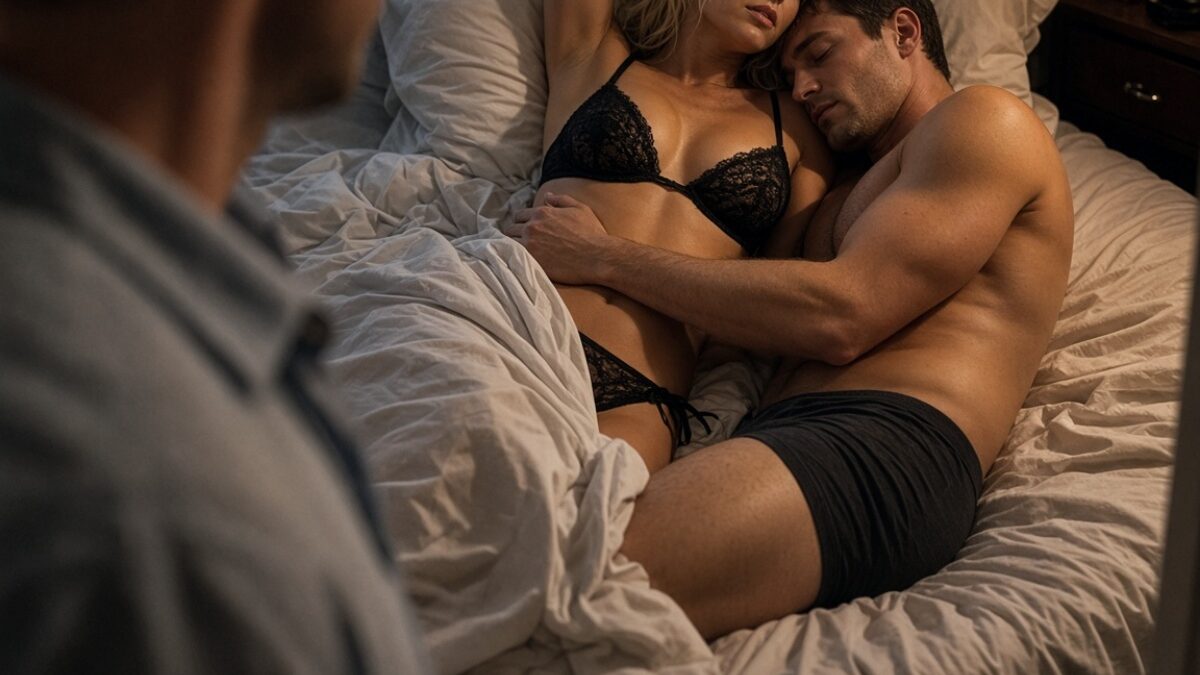
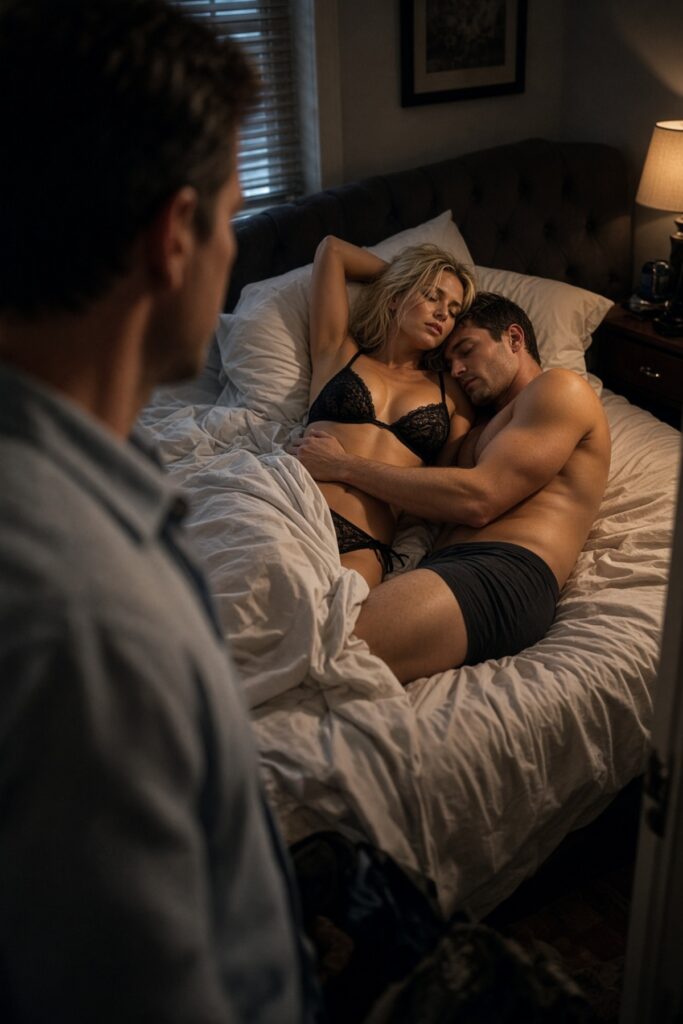
At two in the morning, I found my wife in bed with a man who tried to shake my hand. He leaned across my side of the mattress to do it, keeping the sheet tucked over his waist with his other hand. Valerie had one knee drawn up under her silk robe and a champagne flute balanced between two fingers. The little lamp we’d bought on our tenth anniversary was still on. I remember looking at that lamp longer than I looked at either of them.
For most of the drive from the airport, I’d been thinking about waking her up to show her a picture. I’d spent three weeks in Alaska’s Denali National Park, and on my final assignment day, a grizzly had come across a wolf pack in a stretch of open ground I’d been watching for hours. I’d gotten the frame I wanted and finished early enough to catch a different flight. Valerie was expecting me the following afternoon, and I’d decided to surprise her. The whole trip home, I kept hearing the little gasp she made when a photograph showed her something I hadn’t known was there.
There was a car I didn’t recognize in the driveway, but I figured a friend had stayed late and gone to sleep in the guest room. I dropped my big gear case inside the front door, took a beer from the fridge, and headed toward my office with my camera bag still on my shoulder. I always backed up my cards before I went to bed, even after a long flight. Then I heard Valerie laugh from behind our bedroom door. I hadn’t heard her sound that unguarded in months.
A man answered her too quietly for me to catch the words. I set my beer and bag down in the hall, arranging them so the bottle couldn’t tip onto the canvas if somebody brushed past. It seems absurd that I cared about that. But I’d spent most of my working life learning what to do with my hands when something happened too quickly to understand. There on the carpet, taking care of a bottle gave me one more second before I had to turn the handle.
“Mitch,” Valerie said when I came in. Her eyes went wide before she looked at the clock, and embarrassment gave way to irritation so quickly I almost doubted I’d seen it. “You weren’t supposed to be home until tomorrow.” The man had neatly trimmed hair, the smooth face of somebody in his late thirties, and the confidence to hold his hand out after several seconds had gone by. “Curtis Blackwell,” he said. “I’m a financial adviser.”
I asked him to get out of my house, and he withdrew his hand as though I’d been rude at a reception. Valerie put her glass on the nightstand and straightened the lapel of her robe. “Curtis isn’t just leaving. We need to talk, and I’ve been trying to find the time for months.” I glanced at the two glasses and wondered when she’d taken the second one out of the cabinet.
My name is Mitchell Coleman, although almost everyone calls me Mitch. I’m forty-seven, and I own a wildlife photography gallery in Portland, Oregon, the kind of place where locals bring their out-of-town guests when it’s raining. My work has taken me to six continents, appeared in National Geographic, and been recognized by Wildlife Photographer of the Year. I met Valerie Harrison at a conservation auction where one of my prints was up for bidding. The first thing she asked me was why I’d left so much empty ground beside the animal.
I told her the animal had been looking toward something outside the frame. She studied the print for a while, then said, “You could’ve just made it bigger. I’m glad you didn’t.” Within a year we were married, and for twenty years I took versions of that conversation with me wherever I went. Valerie paid attention to the edges of things, an overlooked corner of a room, a doorway somebody had blocked with a piece of furniture. I thought I knew what it meant when she started rearranging our life without asking me.
Across the bed, she reached for Curtis’s hand. “I’m opening our marriage, Mitch. Curtis and I have been seeing each other for almost a year, and I’m done hiding it.” She paused long enough for me to hear the hum of the bedside lamp. Then she tipped her chin toward the hall and said, “If you have a problem with that, you know where the exit is.”
I waited for her to look at me and see what she’d just said. She looked at Curtis first, and he seemed to take that as his cue. “Valerie and I believe traditional monogamy is outdated,” he said. “A lot of couples are exploring different relationship models.” He delivered it in the tone of a man explaining why I ought to move my retirement savings.
“You’ve been with him for a year, and you’re telling me now, with him in our bed,” I said. I could hear how measured my voice was, which was strange, because I had my fingers against the doorframe to keep them still. Curtis reached down for his pants. Before he could get them, a voice behind me said, “Dad, what’s going on?”
I knew the sound of Alyssa’s wheelchair moving over the threshold from wood to carpet. Usually I heard it as part of the house, like the old stairs settling or the fridge coming on in the middle of the night. This time I remembered the bedroom door was wide open and stepped sideways to block her view. My daughter took one look at my face and moved around me.
Valerie pulled her robe closed. “Alyssa, go back to your room. This doesn’t concern you.” Alyssa looked at her mother, then directly at Curtis, who had both feet on the floor and his shirt balled in one hand. “It concerns the family,” she said. “I’m in the family.”
When Alyssa’s biological father walked out, she was ten. After Valerie and I married, I legally adopted her, and on the day we made it official, she tucked the paperwork into a plastic sleeve because it had started to rain and she didn’t want the ink to run. At sixteen, a rock-climbing accident left her paralyzed from the waist down. Now she was twenty-four, a Paralympic wheelchair racing champion training for another Games, and she still had the signed adoption papers tucked away somewhere safer than any document I owned.
Curtis said we were overreacting. I told him he had thirty seconds to get dressed and leave before I put him out the window. The second I said it, I saw Alyssa glance at my hands, and I let them fall open at my sides. Curtis got his shirt on with a button in the wrong hole, took his shoes by the heels, and slipped past us without making eye contact. A moment later, his tires squealed on the street I’d driven down so carefully because our neighbors would be asleep.
“I’m sorry you saw that,” I told Alyssa. She still had her eyes on her mother. “You don’t owe me an apology, Dad,” she said, and Valerie’s face changed in a way it hadn’t when I walked through the door. For a second, I saw her realize that there were two people in that hallway she might lose.
She recovered enough to tell me we could talk as adults and that this didn’t have to end anything. I asked Alyssa if she’d give us a moment, and she gripped both wheels and stayed where she was. “Whatever you have to say to Mom, you can say in front of me.” She was breathing hard, but she spoke in the same level voice she used when an interviewer asked her about the accident before asking her about the race she’d just won.
Valerie said she’d known I would turn it into a melodrama instead of seeing an opportunity. When I asked what opportunity she meant, she said Curtis understood how lonely she’d been and how often I was away. “You’re always chasing the next shot, Mitch. Even when you’re home, half the time you’re thinking about where you’re going next.” That hurt because I could think of whole dinners during which I’d been at our table and, in my head, somewhere else.
Then Alyssa said, “He built you that studio. He got on planes from places I couldn’t find on a map to be home for your anniversary.” Valerie answered, “You always take his side,” and Alyssa’s mouth opened slightly. She looked as if she’d gone into the conversation ready to defend her father and had discovered her mother thought of the two of us as a side. I wanted to reach for her shoulder, but I knew she’d hate being handled in that moment.
The studio had taken me most of two summers. Valerie had stood out in the garden one June evening with a yardstick and two coffee mugs, showing me how the light would cross the floor if we moved a window eighteen inches. Between assignments, I’d cut boards or paint trim, and she’d bring out whatever she’d made for lunch. In bed with Curtis, she’d talked about being stuck at home. Standing there, I understood she could have meant it, and I could still remember how happy she’d been when the first window went in.
I pulled my expedition duffel from the closet and laid it on the bench, because I couldn’t bring myself to put it on the bed. Valerie asked what I was doing, then asked where on earth I could go at that hour. I told her I was going to my cabin on Mount Hood. By the time I’d packed clothes, my hard drives, and the photograph of Alyssa receiving her first Paralympic medal, Valerie had come around to my side of the room and was standing close enough to touch me.
“We should work through this,” she said. She sounded less certain than she had with Curtis beside her, but she still talked as if I’d misunderstood the offer. “You made your choice almost a year ago,” I said, sliding the frame between two shirts. “I made mine tonight.” I zipped the bag shut and found Valerie looking at the space on the dresser where the photograph had been.
Alyssa said she was coming with me. I reminded her she had training in the morning, and she made the impatient little sound she’d made since she was a kid whenever I said something true at the wrong time. Finally, she said she’d come up for the weekend. I gave her a hug from the side, careful of the armrest, and felt her grip the back of my jacket once before letting go.
At the front door, I said I’d come back for the rest of my things when Curtis was gone. Valerie called after me that I was overreacting, but there was so little force behind it that I almost turned around. “Twenty years, Val,” I told her with my hand on the knob. “You could’ve given me one conversation before you brought him into our bed.” I waited a beat, then stepped out into the cold.
By three, I was driving east out of Portland. I stopped at a red light beside a delivery truck and watched a man in a reflective vest eat a sandwich in the passenger seat. The light changed, and he folded the wrapper neatly over the half he’d saved. I’d spent an hour watching my marriage come apart, and people were halfway through shifts they’d started the night before. Seeing that someone had remembered to pack a sandwich nearly did me in.
The cabin sat on ten wooded acres with a view of Mount Hood and a ramp I’d built so Alyssa could come and go on her own. I’d bought it years earlier as a base for Pacific Northwest assignments. Over time I’d brought out a decent coffee grinder, a second set of boots, and a table big enough to lay out a whole series of prints. By the time I pulled up, there was enough light to see the mountain above the trees. I got a fire going in the stone hearth and left the camera zipped inside its bag.
Valerie called seventeen times and left nine messages. I played the first while I waited for water to boil. “Mitch, this is childish,” she said, and then, in a softer voice, “Come home so we can discuss this like adults. Curtis won’t be back tonight. I promise.” I deleted the message, turned the phone face down, and let the water boil until the lid started jumping.
I called Sarah, who’d been running my gallery with me for eight years. She asked if something had happened in Alaska, and when I told her I was at the cabin and needed a few days, she said she’d take care of everything before she asked if I was okay. I told her some of it, just enough for her to hear me clearly when I asked her to keep my whereabouts private if Valerie came in. Then I silenced the phone. It was the kind of decision that felt completely ordinary while I made it and would later be turned into a piece of evidence about the sort of man I was.
For two days, I did things with obvious stopping points. A log split, a kettle boiled, a trail ended at a washed-out crossing and I turned back. At night I poured a whiskey, sat close to the fire, and tried to place each memory of the past year on one side or the other of the night Valerie had apparently met Curtis. Every so often I came across one I couldn’t bear to put anywhere. Once, while I was stuck overnight on an airport floor, she’d stayed on the phone until the coffee stand opened because she knew I wouldn’t get any sleep.
On the third morning I woke to the engine of Alyssa’s adapted van. By the time I got to the porch, she was already down the van’s lift with a paper bag tucked in her lap, looking at me as though she’d caught me coming downstairs in front of company without a shirt. “You look terrible,” she said. Then she handed me a cup of real coffee and a blueberry scone from Pinewood Bakery, which was too warm for her to have picked it up anywhere near Portland.
We sat on the porch while mist lifted slowly from the valley. Alyssa told me her mother had called everybody she could think of to find me. “Let her worry,” I said, and heard a hard note in my voice that was beginning to seem like something I could get used to. Alyssa ran her thumb around the seam of her cup. “I came because I care about you, Dad. You can let me do that.”
I told her I was okay, and she gave me a look that made all the effort I’d put into sounding normal feel a little embarrassing. “You will be,” she said. Then she set down her cup without taking a drink and took out her phone. I thought maybe she’d found a photograph of Curtis and Valerie, something that would tell me how often he’d been in a house where my daughter slept down the hall.
What she showed me was a local news headline about a wildlife photographer’s wife in critical condition after a suspected suicide attempt. It took me a moment to recognize our house in the picture beneath it, because the porch light was on and a reflection in the front window hid the wreath Valerie had left up too long after winter. Somebody had found her unconscious the evening before. Valerie was in intensive care at Portland Memorial, and the hospital had been trying to get hold of me.
I asked who’d found her, still looking at the picture of the house as if an answer might be standing somewhere in the yard. Alyssa said, “Curtis,” and scrolled down to a video with a little white triangle over his face. He was wearing a jacket now, and every one of his buttons was in the right hole. Before she even pressed play, I could read the words beneath the video. Curtis Blackwell had gone on television to tell Portland that my wife was dying because I’d walked out on her.
PART 2 — THE MAN IN THE WAITING ROOM
Alyssa played the clip once. Curtis said he’d gone to the house as a friend, found Valerie unconscious, and called 911. Then he looked just past the reporter’s shoulder and said I’d walked out on a woman who was desperate for help. The reporter asked whether I’d known how desperate she was, and Curtis dropped his eyes and took a breath. He’d learned how to leave an accusation in the air so somebody else would finish it for him.
“The hospital called me last night,” Alyssa said, turning the screen off. They’d been unable to reach me, and she’d spent part of the night waiting for someone to tell her whether her mother would still be alive in the morning. I asked why she hadn’t just led with that. She looked out at the trees and said, “I wanted you to get one sip of your coffee.” It was such a small thing to have saved for me after the night she’d had.
I left my coffee on the porch and grabbed my keys. On the drive back to Portland, Alyssa called our family lawyer and rearranged her training with her coach, which took more effort than she let me hear. At one point she said, very politely, “I understand what this does to the schedule.” Then she hung up and opened the map to see how far we were from the hospital. All I’d had to do when my life came apart was put a bag in a truck. She’d been making arrangements for everyone since before daylight.
Somewhere outside the city I asked Alyssa if her mother had said anything that ought to have made us worry. She took a long time to answer, and I realized she’d already gone looking through her memories the same way I was looking through mine. “She was mad,” she said at last. “Mostly she wanted you to answer the phone.” I kept both hands on the wheel, thinking how many times Valerie must have heard my recorded voice say I’d call back.
News vans were already parked outside Portland Memorial. A reporter recognized my truck and asked whether our argument had triggered Valerie’s suspected suicide attempt before I’d even shut my door. Alyssa positioned her chair between me and the microphone. “My father came as soon as he learned my mother was in the hospital,” she said. “The family is asking for privacy, and the claim that he abandoned her is false.” The reporter took one step back, which gave us just enough room to get around him.
On the fourth floor, Curtis was sitting with a small group of Valerie’s friends. One of them had brought a tote bag with a sweater sticking out, and another was holding a paper cup from a machine downstairs. I knew both women, and I could see them trying to decide what expression to have when they saw me. Curtis rose before I reached the chairs and said, “You have a lot of nerve showing up here.”
I took a step in his direction. Alyssa caught the sleeve of my jacket and said, low enough for only me to hear, “Mom needs you. Keep walking.” Curtis looked ready for me to say something he could repeat later. I remembered his hand stretched out across the bed, stepped around an empty chair, and walked straight to the nurses’ station.
The ICU nurse asked whether I was family. I said I was Valerie Coleman’s husband, and she looked from me to Curtis. He’d been identifying himself as Valerie’s partner, and there was enough confusion among the people who’d been there overnight that the nurse had paused before letting me through. Alyssa rolled up beside me and said, “Mitchell Coleman is her legal husband of twenty years. I’m their daughter. Please tell us what you need to see so he can go in.”
I’d been angry enough to imagine all sorts of things I’d say the next time I saw Valerie. Walking into her room, I found myself wanting to tell her that the paint on the ceiling above her was a dreadful color and she’d have picked something better. She’d looked tired before I left for Alaska, and in the bedroom I’d thought she looked younger than she had in months. Here, with the hospital white around her and her auburn hair tangled at her temple, she looked small enough that I instinctively lowered my voice.
The nurse told me the doctor would be in, and I sat down and took Valerie’s hand. It was cold, except where the side of it had been tucked under the sheet. “I’m here, Val,” I said. Her eyelids moved briefly, and for the next hour I watched for that movement to happen again. Every time a wheel squeaked in the hallway, I hoped it meant somebody was coming to tell me she was about to wake up.
Dr. Meyers came in and said Valerie was stable for the moment, although they were watching for possible liver damage. I asked her if she thought Valerie had intended to die. She chose her words carefully and said the timeline they’d been given suggested Valerie may have expected someone to find her, but she’d need to speak to Valerie directly when she woke. A psychiatric evaluation was part of the plan. In the meantime, everybody in that room was working with a timeline supplied in large part by Curtis Blackwell.
Alyssa came to get me when Detective Santos arrived. He was a compact man with an unobtrusive notebook, and he asked if I’d walk with him far enough from the waiting area to speak privately. The department needed to rule out foul play and consider whether somebody had staged what appeared to be an overdose for publicity or financial gain. Then he told me Curtis had described a marital argument in which Valerie had proposed counseling and I had refused.
For a second I just looked at him. Counseling sounded so specific and reasonable, like something Valerie might have suggested at a kitchen table with both of us fully dressed. I told him where I’d found them, what Valerie had said about opening the marriage, and what Curtis had been wearing when he introduced himself. At the last detail, the detective looked up from his notebook. He asked me to repeat Curtis’s words as closely as I could.
Alyssa had waited at the other end of the hallway until I finished. Then she said, “Detective, I was awake. I heard my mother tell my father he could leave, and I saw Curtis gathering his clothes. He’s lying about what happened.” Santos turned his notebook to a fresh page. I heard him ask whether she’d be willing to give her account separately, and I realized how badly I’d needed somebody besides me to hear her say it out loud.
Curtis tried to visit twice over the next twenty-four hours, and both times hospital security turned him away. Alyssa brought me fresh coffee and dealt with calls from people who always began by saying they didn’t want to intrude. I stayed beside Valerie, getting up to stretch when a nurse came in and sitting right back down when the door closed. Late that first night, a friend sent me a screenshot of the news story with a message saying he knew it couldn’t be true. In his screenshot, my face had replaced the photograph of the house.
I put the phone away and told Valerie about the wolf pack in Denali. To her I could always admit how much of a photograph was waiting and luck, so I told her about the cramp I’d gotten in one leg and the moment I’d nearly packed up because the grizzly seemed to be moving off. By the time I finished, she was still unconscious, and I had my thumb resting on the pale indentation where someone had removed her wedding ring. I hadn’t checked for the ring when I came in. Once I noticed it was gone, I kept checking.
The next morning she opened her eyes and whispered my name. Her voice was raw from the breathing tube, and for a minute she looked confused by the distance between the person she’d expected to see and the person sitting beside her. “Why are you here after what I did?” she asked. I told her she was still my wife, and I saw tears collect against her lower lashes. There were a dozen things I could’ve meant by that sentence, but all I could give her right then was the one that had brought me back.
“I never meant for any of this to happen,” she said. I asked her which part, more sharply than I’d intended. She turned her face toward the window and said Curtis hadn’t been who she thought he was. I waited for her to look back, then asked about the alcohol and medication. She said, very quietly, “I didn’t do it on purpose.”
Curtis had brought wine, she said, and offered her something for anxiety, telling her she’d be able to get some sleep. She remembered talking with him and then waking up in the hospital. “Are you saying he gave you something you didn’t know you were taking?” I asked. She shut her eyes to think, and for a terrible second I thought she’d slipped away again. Then she opened them and said, “I don’t know, but after you left, he started asking about the gallery.”
He wanted to know who could authorize payments, she said, and whether it would be possible to borrow against the property. At first she’d thought he was offering to handle some practical things while we fought. Then he got angry when she told him he couldn’t touch anything that belonged to me. She was studying my face now, looking for whichever word had been the one too many. I was thinking about Sarah opening the gallery by herself every morning while Curtis tried to find a way into its accounts.
Santos came to see Valerie that morning. I started to get up, but Valerie took hold of two of my fingers and asked me to stay. She told the detective about the wine, the anxiety medication, and the way Curtis had returned to the subject of money each time she tried to talk about what had happened between us. Her voice gave out once, and we sat quietly while she took a sip of water. When she put the cup down, she said, “I want you to hear the rest before I get too tired.”
Santos had been looking into Curtis since Valerie’s admission. He told us the man had a history of becoming personally involved with wealthy women whose financial affairs he then tried to access. Several had reported unexplained medical episodes. Valerie asked if he thought Curtis had tried to kill her. Santos said he had a warrant to test her blood samples for anything beyond what she recalled taking, and the answer would have to wait for evidence.
Once he’d gone, Valerie said she’d destroyed everything for a man who’d been using her. I could see how badly she wanted a different version of that sentence to be true. I wanted to give her one for a few seconds, even after the bedroom and even after the drive. Instead I handed her the cup again, because she was reaching for it and it was just beyond where her hand could comfortably go.
By evening, the tests had found levels of sedatives far above what her account of the night could explain. Santos had also reviewed footage from a home security camera. While Valerie was out of the room, Curtis had added something to her wine. I asked if she’d understood what the police had found, and he said he’d told her himself. He was preparing an arrest warrant.
He’d also found papers at Curtis’s apartment relating to a possible declaration that Valerie was temporarily unable to manage her affairs. The publicity made awful sense with that information in front of me. The closer Curtis could get to being the person who spoke on her behalf, the easier it would be to reach her money and possibly some of mine through her. Santos said investigators already had records linking him to three women in similar circumstances. My eyes went back to the waiting room, to the chairs where Valerie’s friends had been listening to him.
Alyssa was beside her mother when I returned to the room. A photograph on her phone showed our garden studio and a string of paper decorations she’d bought for Valerie’s birthday surprise. She’d apparently been telling Valerie how long she’d worked on it, down to where she planned to hang things so her mother wouldn’t see from the kitchen. “I could still tell you what cake I ordered,” she said, tapping the screen dark, “but I think I’m done talking about the cake for today.” She squeezed Valerie’s hand and left us alone.
I told Valerie the police were going to arrest him. She said she knew and pressed her lips together, then tried again to say what she’d been holding back. “I got used to being angry every time you left. With Curtis, I got to talk about it as if the anger was all there was.” She looked down at the taped line on her arm, and when she spoke again her voice was thinner. “You and Alyssa deserved better from me.”
I asked whether Curtis had mentioned anything beyond the gallery. She said the police had found detailed notes about my accounts and my life insurance policy, and she was worried that he would have gone after Alyssa and me sooner or later. I thought of my daughter alone in the house before she came to the cabin, getting the hospital call, having no reason yet to believe she should be afraid of the man who’d made it. I told Valerie I needed to call Sarah.
Sarah picked up before the first ring finished. “Mitch, thank God. Somebody tried to move nearly two hundred thousand dollars from the gallery account this morning.” The bank had flagged the wire when it couldn’t get the required second authorization, and the money was still there. I asked Sarah to walk me through what she’d been told, and as she talked, I watched a nurse approach Valerie’s room carrying a little paper tray with two cups on it.
Nearly two hundred thousand dollars was payroll, commitments to artists, the rent, promises I had made to people whose livelihoods depended on the gallery staying open. I hadn’t been available when the bank first tried to reach me, but I hadn’t approved anything either, and that second required authorization had held. I gave Sarah Detective Santos’s number and told her who the police were investigating. We took a moment to make sure she’d written it down correctly. Hearing her read it back, digit by digit, made the rest of the day feel slightly less impossible to act on.
Alyssa was waiting by the window at the end of the hallway. She handed me her tablet with Curtis’s Instagram account open to a photograph of me arriving at the hospital. It had gone up thirty minutes earlier, and the caption read, “The man who abandoned his wife returns for the cameras. Too little, too late.” In the photograph, I was still holding the truck door partly open. Alyssa’s hand was visible at the bottom, reaching toward me from out of frame.
The wire transfer had been attempted that morning. By evening Curtis knew enough about my movements to show strangers the moment I stepped onto the hospital pavement, and the police still hadn’t taken him into custody. I handed the tablet back and reached for my phone to call Santos again. Then Alyssa looked past my shoulder, toward the elevators, and asked the question I’d been putting off since I saw the time on the post. “Dad, do we know where he is right now?”
PART 3 — THE CALL I ANSWERED
Santos called back before either of us moved away from the window. He asked me to send him the post and said his team was handling the arrest. Alyssa waited until I’d hung up to ask what that meant, and I told her it meant we could go back to her mother’s room. She looked at my phone in my hand, then at the elevators one more time. Until I saw her shoulders drop a little, I hadn’t understood how long she’d been waiting for somebody else to take over.
The arrest made national news. The new headline identified Valerie as one of the victims of a man accused of preying on women for money, and some of the same outlets that had run Curtis’s interview used the same footage to tell a different story. There I was again, one hand on the open truck door, only now people were explaining that I was a loyal husband who’d hurried home to the woman who’d betrayed him. I muted the television in Valerie’s room before I could find out what part Alyssa had been assigned.
James Miller, the gallery’s public relations consultant, called to tell me what a statement could do for my profile. He offered to put together a few lines about how grateful we were and said we could use an image from the Denali assignment. I pictured the grizzly coming out of the willows, doing what it had always done, indifferent to whether I was there to see it. Then I pictured Valerie tugging at the neck of her hospital gown because it didn’t fit. “Her worst night stays out of our marketing,” I told him, and asked him to move on to the next show.
Sarah called later to say she’d spoken to Santos and gathered what the bank had requested. I thanked her, and when she said, “Of course,” there was an edge to it I’d heard before from people doing difficult work somebody else was going to be credited for. I asked if there was anything else I needed to hear. She said there were two artists waiting for me to approve something and she’d appreciate it if I’d quit apologizing for being at the hospital and open my email whenever I had ten minutes. I loved her for giving me something ordinary to do.
Valerie got stronger over the following week. The doctors eventually told her there was no permanent physical damage, and on the day she got that news, she cut a piece of toast into tiny squares and ate every one of them. I visited daily at first, and our conversations shifted as the hours between updates from Santos grew longer. One afternoon, with the television off and her tray pushed aside, Valerie said she’d resented my success. She got through the whole sentence while looking at me.
She talked about the days when the studio stayed dark because she couldn’t think of anything worth starting, and when people asked how I was doing before they asked how she was. “Curtis asked what I was working on,” she said. “He waited for the whole answer.” I remembered the plans she’d shown me for opening one side of a small dining room into a kitchen, how she’d traced the path a guest would take with both hands full. I could also remember asking if she’d seen my spare batteries before I’d told her what I thought of the plans.
I told her I should have noticed how lonely she’d become. There were anniversaries I’d crossed oceans to make and ordinary Tuesdays when she’d waited for me to shut a laptop, give her a decent answer, and come outside with her. She’d made a choice about the man she brought home, and I had choices of my own to reckon with. For the first time since Alaska, we could sit with both of those things in the room. Eventually Valerie asked if I could open the blinds a little, and I did.
Alyssa kept traveling between the hospital and my cabin, where I’d gone back to get away from the reporters. She came for dinner one evening and started peeling the loose paper off a bottle of hot sauce while I put food on the table. I asked how she was doing and waited through a pause long enough that I nearly asked something easier. “Better than I expected,” she said eventually. “Three weeks ago I thought I knew everything I needed to know about Mom from watching her in that bedroom.”
Alyssa said she’d sat through enough appointments after her accident to know what it was like to have people talk about her while she was in the room. At the hospital she’d caught herself answering one of the nurses on Valerie’s behalf, and her mother had looked at her with an expression Alyssa knew from the inside. “So I stopped,” she said. “I let her take however long she needed to say it.” She pressed a loose piece of the label back down and added, “I’m still angry about my birthday surprise for her.”
I asked what she thought about my continuing to see Valerie. A piece of me still worried that doing anything kind would make Alyssa think I’d accepted what her mother had done, the same way a piece of me worried that leaving the room meant I was repeating the night in the bedroom. She put the bottle down and said, “When someone you care about needs help, you show up. I watched you do it for years before any of this happened.” Then she picked up her fork and said, “You’re also allowed to go home when visiting hours end.”
The investigation uncovered at least five other women Curtis had targeted. He had drawn them close enough to make money sound like a private matter they could trust him with, and two who’d grown suspicious had suffered overdoses originally treated as accidents. Once he faced multiple felony charges, he was held without bail because of the risk he’d flee. I heard how many women there were from Santos and wrote the number on a piece of paper I’d been using for a grocery list. Then I sat staring at it, thinking how many times those families must have gone back over their own phone calls.
Valerie gave Santos a full statement and offered to testify. She knew anyone defending Curtis would have questions about the affair, and she knew people would hear details she’d spent the better part of a year keeping from me. “If it helps stop him, I’ll answer them,” she told me. I could see that she was frightened and that it had finally occurred to her she could say so plainly. I was grateful the other women would have someone willing to stand beside them in public.
The quieter things took longer. We’d got through the emergency by asking each other what needed doing by the end of the day. Once there were fewer calls and no more hospital trays to clear, we sat across from each other and had to talk about where we wanted to wake up six months later. Valerie ran the edge of a folded napkin between her fingers while I said I couldn’t see myself coming back to the house. She folded it once more and said she’d known since I took the photograph of Alyssa.
We filed for divorce. Given how the marriage ended, the proceedings were remarkably amicable, partly because we’d spent enough time in public by then to value a conversation nobody else would get to repeat. One day Valerie called to ask whether I wanted the Christmas ornaments with my initials on them. She remembered that my mother had stitched them, and she wrapped each one separately. I could grieve over a box like that and still know I wanted the divorce.
By the time three months had passed since Curtis’s arrest, Sarah had the Portland gallery running well enough for me to spend six weeks in Yellowstone. I got there in time to work on a series about the wilderness coming into spring, when patches of winter stayed in the shade long after the valleys had changed. One afternoon I sat waiting for a scene to develop, then looked at my watch and realized Alyssa was between two training sessions. I packed up and drove until I got a signal. When I called, she asked if I’d accidentally taken a picture of my own boot again.
Critics called the Yellowstone series my most intimate work, which surprised me because so many of the images had been made from a distance. At the gallery, I watched a woman step closer to one of the prints and point out a detail to the person beside her. Before, I would have wondered whether I should have printed it larger so they could see. That evening I stayed a little longer and listened while people told me what they’d found in it.
Valerie moved to Seattle to be near her sister and started a small interior design business. Just before she left, she stopped by the gallery with a cardboard box of mine she’d found while packing. She also had two fabric samples in her bag and showed them to me when I asked about her first client. One would work better with the light in the client’s front room, she explained, and I listened until she’d told me how the room was used on an ordinary afternoon.
“Thank you for not hating me,” she said when it was time to go. “I don’t think I would have been as forgiving.” I told her hatred took more energy than I cared to give it. She adjusted the strap of her bag and nodded, then went out to the street. In the box, under an old sweatshirt and a tangle of camera straps, she’d put a clean copy of the adoption paperwork Alyssa had been so afraid of getting wet.
I never went back inside the old house. We sold it, and I donated half the proceeds to organizations that help people who’ve experienced financial abuse. The cabin became my permanent home, which meant getting things I’d put off for years done properly, starting with a porch light that used to cut out in the cold. Alyssa held the box of new bulbs while I changed it. Then she rolled down the ramp and made me go back up the path to see how far the light reached.
Curtis eventually pleaded guilty to multiple felonies and accepted a twenty-year sentence rather than face trial. His victims, including Valerie, received some financial restitution. I’d expected to feel the news in my body the way I’d felt it when I first saw him sitting with Valerie’s friends, but I was making lunch when the call came, and afterward I went right back to slicing a tomato. A while later, I noticed I’d taken out two plates although I was alone. I left the second one on the counter until Alyssa got there that evening.
Alyssa and I started a foundation that offers photography workshops for kids with disabilities. We used to talk about the idea in the car coming home from her appointments, when she was sixteen and tired of every plan anybody had for her being about recovery. At the first workshop, I went around adjusting chairs and moving things a few inches before she sent me to check that we had enough memory cards. When I got back, the kids had already decided which tables worked for them and who wanted to share a camera.
A boy in one class spent a whole session trying to capture the shadow one of his wheels cast across the floor. Every time somebody walked by, the light changed, and I offered to ask the other kids to use a different doorway. He told me to wait and wheeled back until the shadow touched the bottom of the frame. Then he shot the photograph with a girl’s bright red sneaker coming into the top corner. It was the one he asked us to print.
Later Alyssa and I spread the students’ photographs across a table to choose which ones to hang. I started to reach for one, and she said, “Hang on. That’s upside down.” She was right, and when I turned it I was able to see a little girl’s face reflected in the glass of a door. A few minutes later, Alyssa said I seemed more present lately. I asked her to tell me what she meant, and she sat back and told me.
On the anniversary of the night I left Portland, we sat on the cabin porch as the sun went down behind Mount Hood. Alyssa brought out two steaming mugs, holding both in her lap until I could take mine. She asked if I regretted how things had turned out. I told her I regretted the pain, especially what she’d gone through in that house and in the hospital. After a while, I told her I was glad about the life we had now.
“Mom called yesterday,” she said. “She wants to contribute to the foundation. She said working on something for other people is helping her figure out what to do next.” I asked if Alyssa wanted to take her up on it, and she took a sip before answering. “I think I do. Some things are worth salvaging.”
Below us the light left the valley in patches. Inside the cabin, the picture of Alyssa with her first medal was on a shelf above the table where I looked at prints, still in the frame I’d wrapped in two shirts. For months I’d thought of it as the one thing I’d taken to remind me what I had left. Sitting with her on the porch, I realized how much of her life I’d still be missing if I spent all my time trying to get the picture right.
I took out my phone and sent Valerie a message asking what she had in mind for the foundation. I left it at one sentence, which was harder than it sounds after twenty years of trying to guess what the other person was about to say. A minute later, the screen lit up with her name. Alyssa saw it and stayed beside me, her mug warming both hands. This time I answered before the phone could ring again.