Single Dad Bought an Old Bakery after Losing Everything—Then the CEO Who Fired Him Walked In
She Fired a Single Dad. Six Months Later, She Ordered a Croissant and Told Him She Was Tearing Down His Bakery
The woman who fired Owen asked for a croissant before she told him she was going to tear down his daughter’s home.
Six months earlier, she’d called ten years of work a redundancy and had security walk him out.
This time, there was a glass counter between them and nine dollars in change.
Part 1 — Nine Dollars in Change
At 3:15 in the morning, the alarm clock rattled so hard it walked to the edge of the nightstand. Owen caught it without opening his eyes, a trick he’d learned in the six months since he bought it at a pharmacy two days after the eviction. The first time it had gone off in the apartment above the bakery, he’d reached automatically across the bed for his wife. These days his hand went straight to the clock, and he considered that progress of a kind.
The air in the hall smelled of burnt sugar and yeast, and the floor was cold through his socks. He nudged open Chloe’s door and found her curled around the stuffed rabbit she’d had since she was a baby, one arm over the place where its left ear used to be. The chipped plastic moon in the outlet gave off just enough light to show her breathing. At six, she’d already lost her mother to an aneurysm, and at the beginning of summer she’d lost her house, her school, and the swing her dad used to push with one hand while making work calls with the other. Owen had promised her the rabbit would come with them wherever they went, and so far it was the one promise he could check on every morning and know he’d kept.
Downstairs, he pulled the chain on the kitchen lights and waited for the tubes to stop flickering. The Daily Bread was written in peeling gold across the front window, a name he’d inherited from the previous owner and had neither the money nor the nerve to change. In the cold kitchen he set a steel bowl on the scale, measured flour, added water, and felt some of the tension leave his jaw. His job for the next few minutes was to get the dough right, and the dough would tell him, plainly and without a meeting, whether he had.
A sheet of paper beside the scale held the timings for the morning’s bake, revised in three colors because the main oven’s thermostat ran hot when it felt like it. The kitchen was damp enough that he’d already cut a little water from the usual mix. He’d learned to make that adjustment at two in the morning with a video paused on his phone and an expensive mound of glue stuck to his fingers. There’d been nobody standing next to him to say it was fine to start again, and a bag of flour was money he could count, so he’d scraped the bowl clean and tried to figure out what he’d done.
Six months ago, he’d been senior director of operations for Vanguard Logistics, with custom shirts and an office overlooking the harbor. The work crossed two oceans and involved millions of dollars in freight, though most of his day had amounted to working out which person on a loading dock knew something the people in a meeting didn’t. Years before he had the corner office, he’d been the guy who answered on Saturdays, and two years before his firing he’d helped keep freight moving when Vanguard was on the brink of bankruptcy. Some of the same executives who’d congratulated him for keeping the company upright had stopped making eye contact after Sloane Gallagher took over.
It had been raining the Tuesday he was called to the executive floor. He brought the quarterly numbers, with a sticky note on the page about the routes his division had brought back under budget, because an assistant had told him to expect a review. A woman from HR was already in the conference room, seated beside a sealed packet on the mahogany table. Sloane, Vanguard’s newly appointed CEO, stood at the window in a five-thousand-dollar suit, checking her watch while the woman delivered the news.
“Effective today,” the woman said, touching the packet with her fingertips. Owen held his own folder a little tighter and asked what part of his division would be left to handle the accounts they’d just renewed. When she said the whole division was being eliminated, he looked right at Sloane and started to explain where the quarterly numbers sat. He was halfway through a sentence about freight volume before he understood that nobody there had brought a pen.
He got as far as telling Sloane he’d given Vanguard ten years and had a little girl at home. He heard himself bring up his wife, which was something he’d done so rarely in the office that a couple of his newer coworkers didn’t even know she’d died. Three years after the aneurysm, he could still remember the noise the mail made coming through the slot at home during those first weeks, each fall of paper a fresh set of charges addressed to a woman who was gone. All he wanted in that conference room was time to find another paycheck before the things he’d kept afloat came due together.
Sloane turned from the rain-streaked glass and looked at him. “Your personal tragedies are tragic, Owen, but Vanguard is not a charity,” she said, as though she’d already set aside the appropriate amount of time for sympathy. “Your division is a fiscal weight. I’m cutting it loose, all of it. The severance is generous. Take it and build something else.”
A security guard he’d known for years walked him downstairs. At the lobby desk, Owen remembered that Chloe’s homemade Father’s Day card was still propped against his monitor and asked to go back for it. The guard looked embarrassed and told him somebody would box up his things. They stood there in silence until Owen unclipped his badge and set it on the counter himself, sparing both of them the moment when the guard would have to ask.
The severance had done just enough to keep him out of bankruptcy. His wife’s medical bills had emptied most of the savings that once made their mortgage feel manageable, and the payments he missed after the layoff settled the rest. The bank took the house, and on their last day Chloe made him push her on the swing until the moving van pulled up. She asked if the next family would like it when it squeaked, and he told her the next family might oil it. She gave that some thought and asked him to leave it squeaky.
He put his remaining money into a foreclosed bakery business on the edge of the city, taking over its equipment and leasing the building from a company that gave him a mailing address and billed him every month. The advertisement had described the neighborhood as up-and-coming, which, from the corner of his block, meant that a couple of recently renovated apartments stood several doors down from businesses with cardboard over broken panes. He’d signed for the bakery because the little apartment upstairs came with it, and because the man from the bank needed an answer while Chloe still had a place to finish first grade. He could see, even at the time, how panic had narrowed his idea of a good investment. He signed anyway.
He made bread good enough to sell before he figured out how to produce a whole morning’s worth on purpose. Then came the weeks of burnt bottoms and pale tops, the November dough that took forever to rise compared with the dough in July, and the discovery that a woman who bought six rolls every Saturday cared more about whether they were ready at eight than she did about how pretty they looked on Instagram. By six most mornings, the smell of fresh bread made it to the corner before he turned the sign around. On awful weeks he could still think about that hour without feeling entirely cheated.
A floorboard creaked above him that morning, and Chloe appeared at the top of the stairs in enormous pajamas printed with cartoon dogs. “Dad, the radiator’s doing the knocking thing,” she said. He promised he’d bleed it later, and she came down and perched on a stool beside the prep counter while he poured her milk. He’d saved her the first blueberry muffin, the one whose topping had baked sideways into a brown, crisp ledge. She always ate that part first.
“Are we going to be busy today?” she asked, pinching off a piece. Owen looked toward the window, where the light had a gray cast that made ten in the morning look like the end of the day. “Depends if the rain holds off,” he said, giving her the answer he’d been giving himself since the summer. She took a bite and said, “It’s really good, Dad,” and he bent to check the oven so the sudden rush of feeling could pass without becoming something she had to manage.
They walked to school with twenty minutes to spare. At the crossing, she asked if he could bring a loaf home that night instead of putting all of them out for sale, because she wanted to make the toast her mom used to cut into little squares. He said he’d save the end piece for her, and she said she wanted the middle because the edges scratched the roof of her mouth. He’d remembered how his wife liked hers and forgotten to ask how his daughter liked hers, and the correction stayed with him all the way back to the bakery.
By ten he’d sold three coffees, a loaf of rye, and two scones to Mrs. Gable, who counted quarters into his hand and apologized when she lost track halfway through. She’d lived down the street long enough to remember when the bakery had a different name and the bus stopped directly outside it. Owen set the paid pile aside while she started again, and she gave him an approving look when she reached the right total. After she left, he wiped the brass espresso machine a fourth time and saw his face clearly enough in the casing to notice how much older than thirty-six he looked.
His checking account showed $412.18. The business account held $1,200, and he owed the flour supplier $950 on Friday. He could spend the rest of the morning calling restaurants about the dinner rolls he’d been developing for wholesale, so long as he left his phone plugged in and angled the cracked glass where he could read the contact names. He’d given himself two more months before the bank came looking for this place, too, though on bad days he suspected the bank had arrived at a shorter number.
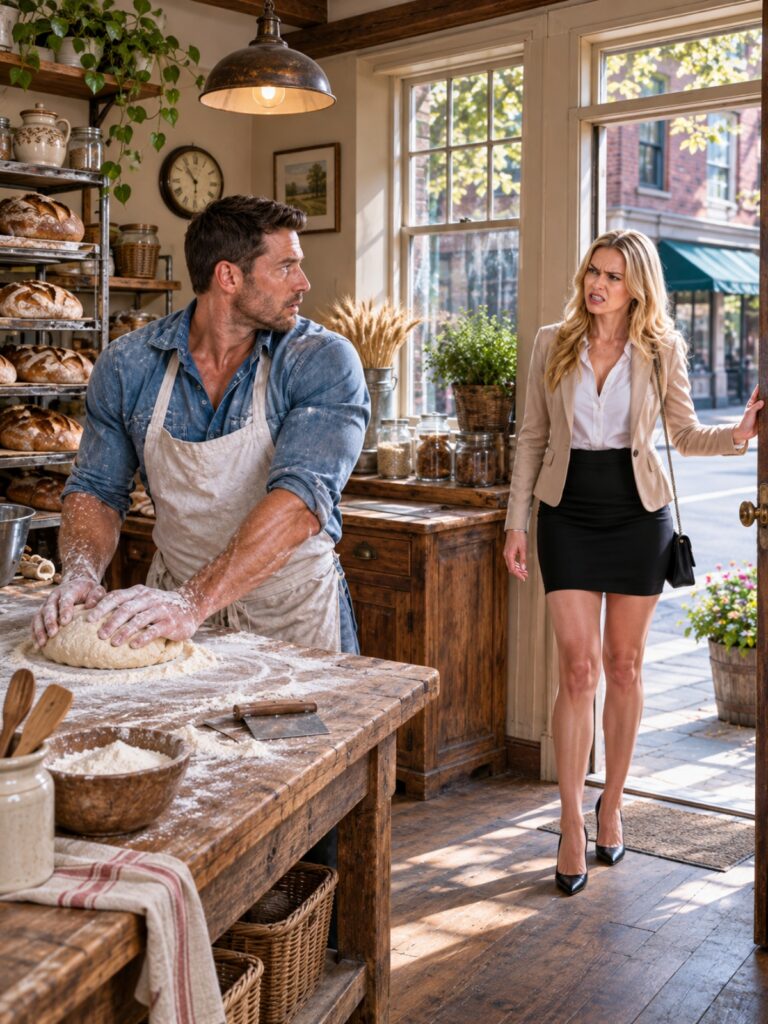
The brass bell over the door jingled just as the sky opened. A woman shook rain from a sleek black umbrella and came in wearing a charcoal trench coat over a white silk blouse, a leather portfolio tucked beneath one arm. She looked around at the scuffed linoleum and the peeling paint with the attentive frown of someone who expected to put a dollar figure on everything she saw. Owen started on his usual “Morning, what can I get you?” and got as far as “Morning” before he recognized Sloane Gallagher.
She was thirty-four and looked exactly as he remembered from the conference room, down to the severe twist in her dark hair. “Two black coffees,” she said, reading something on her phone. “And the freshest croissant you have. In a box, please.” When he made no move toward the machine, she looked up, and her eyes narrowed by a fraction as she took in his apron and the flour streaked along his forearms.
“Owen,” she said. He gave her back a flat “Sloane,” and watched her take a second look at the shop, from the ceiling down to the handwritten labels in the pastry case. “I didn’t know you owned this place,” she said, and he answered, “I doubt you know much about the ZIP code at all. What are you doing here?”
Sloane shifted the portfolio onto the counter so she could open it. Vanguard Real Estate Holdings was acquiring the commercial properties on the block, she told him, and she was surveying street-level retail before the final offers went out the following week. She slid a map toward herself to check the parcel numbers, and Owen could see a heavy outline crossing the back of the bakery, the kitchen, and the narrow alley where he took out the trash. He waited for her to describe what would happen to the businesses inside that line. Instead, she told him about the residential tower going in above them.
“You’re bulldozing the block,” he said. Sloane explained that the zoning had changed and the property was underused, so the purchase made sense. Landlords would handle the standard relocation stipends for existing tenants, she added, with the same brisk certainty he remembered from the day she’d walked him out. Her finger was still resting on the map, and Owen knew enough about the building’s footprint to tell just about where she was pointing. The radiator was on that wall upstairs.
His lease had a demolition clause. He’d read it before signing, had even underlined the words that gave him thirty days to vacate if the building was sold for redevelopment, and then he’d pictured the same failing storefront sitting on the same forgotten street for years. Sloane closed the portfolio with the map inside. “It’s just business, Owen,” she said, and he remembered Chloe on the swing, dragging a shoe through the mulch because he’d told her it was time to get in the truck.
He put the best-looking butter croissant in a white cardboard box, partly because his hands needed something to do and partly because letting her watch him ruin a pastry he’d worked hard to get right felt like giving her too much. He folded the lid down, made two coffees, and set everything on the counter. “Eleven dollars,” he said, looking at the numbers on the register while she reached for her wallet. She laid down a twenty and told him to keep the change.
In his apron pocket were the quarters Mrs. Gable had counted out and the dimes and nickels he’d been picking up all week from people who knew what a dollar bought. Owen counted nine dollars into his palm, then brought his hand down hard against the glass. Coins went spinning under the coffee cups and a couple hit the floor. “I don’t need your charity,” he said, and Sloane’s eyes lifted to his as he added, “Take your change, take your coffee, and get the hell out of my shop.”
For the first time since he’d met her, he’d surprised her enough to make her pause before she spoke. Her thumb rubbed the crease of the cardboard box, and for an instant he thought she might set it back down. Instead, she balanced it on the two coffees, told him the paperwork would go to his landlord, and walked out without touching the coins. The bell gave the same bright little jingle it had when she came in.
That afternoon a carrier brought in a thick cream envelope by certified mail and asked him to sign for it. The embossed Vanguard logo was the first thing Owen saw, followed by the name of a lawyer he’d never met and the address he’d just taught Chloe to write. While Sloane had been standing at his counter talking about future offers, his landlord’s agreement had already been far enough along for somebody to put a notice in the mail. He read through the zoning references twice before he let himself look at the single line that mattered.
The sale had been accepted, the demolition clause had been invoked, and Owen had thirty days to get out. He counted them forward on the calendar hanging beside the register, until his finger reached the little blue star Chloe had drawn to mark the night they were supposed to make French toast for dinner. On the line above the signature block were the words “including any persons occupying the premises.” It was the first time he’d ever seen anyone refer to his daughter without even needing to know her name.
Part 2 — The Last Light on the Block
The rain let up around midnight, and Owen took a beer out to the alley and sat on an upside-down milk crate. Through the wall he could hear the metal of the oven ticking as it cooled, a sound that usually told him the working part of his day was over. He held the bottle against his palm without taking a drink and watched condensation drip onto his boots. The night Chloe was born, he’d sat outside the hospital long after visiting hours, too keyed up to drive even though his wife had told him to go home and sleep. Back then he’d been afraid of just about everything that came with being somebody’s father, and even that fear had felt like something he could bring home and discuss.
He went inside and looked again at the rental ads he’d bookmarked while Chloe was in the bath. A one-bedroom near her new school wanted the equivalent of three months’ rent up front, and the listing showed a bed wedged under a window overlooking a concrete wall. The cheaper apartments would put her on another bus and put him far enough away that most mornings he would have to choose between getting her there and being around to open a bakery, if he ever had a bakery to open again. At the bottom of the listings he opened a job ad for a logistics coordinator and recognized a set of duties he’d once handed to interns. He left the tab up in case he needed it in the morning.
Before he could make himself go upstairs, he measured out yeast and set about preparing the next day’s dough. His hand shook so hard the scale display changed twice while he was trying to read it. He tipped the excess back into the jar, weighed it again, and kept going until his fingers settled enough to grip the measuring spoon. There were people who’d be in at seven expecting to see bread, and for that night those people could have his attention.
By Tuesday, orange spray paint ran in streaks along the sidewalk and around the drains. Mrs. Gable came in for her scones with her coat buttoned crooked, bringing a letter she’d folded around its envelope so she could take it out without laying it flat. She’d been in her apartment forty years and had checked what it would cost to get another one, she told him. The relocation money wouldn’t cover first and last month’s rent anywhere she’d called within fifty miles. “They told me on the phone it was a standard amount,” she said, and gathered her quarters into little stacks of four. “I asked the girl what it was supposed to cover. She read me the amount again.”
Owen slid two scones into a bag and waited while she lined up the final coins. She asked where everybody was supposed to go, and he could tell she’d been holding off on asking him until she could do it when the shop was empty. “I don’t know, Mrs. Gable,” he said, watching her try to fold the letter along its old crease. “I honestly don’t know.” She tucked it back into her coat and then asked for a second bag so she could keep one scone for tomorrow without getting crumbs all over her purse.
Thursday morning the brass bell rang while Owen was wiping the pastry case. Sloane had traded the trench coat for a navy suit, and in the pale morning light he could see a faint scrape on one of her shoes. He’d spent an unreasonable amount of time since her first visit imagining the next thing he’d say to her. When the moment came, all he got out was, “I don’t serve demolition crews.”
She put a slim black folder on the glass above the muffins. A snag with next quarter’s municipal water permits had moved up the schedule, she told him, and Vanguard needed to break ground in fourteen days. “I have thirty,” Owen said, and she answered that she was there to buy the difference. He looked toward the door, expecting an attorney or a building manager to follow her in with a form, but she’d come alone.
Inside the folder was a check for three times the standard relocation stipend and an additional $40,000 to buy his equipment outright. He could be out by next Friday with enough to settle his immediate obligations and get his daughter into a decent apartment, Sloane said, and Vanguard would take the ovens, the refrigerators, and the rest. She ran a finger along the edge of the folder until it lined up neatly with the pastry case. There wasn’t a supplier calling her every other day, and she’d never tried to make one kid’s school schedule fit around four hours of sleep. Still, she knew exactly what that amount would look like to him.
For a moment Owen pictured the apartment advertisement differently. He could afford two bedrooms if he went a little farther out, and Chloe could be the one who chose which room was hers. He could order pizza on moving day and give her time to eat it before he got out the lease and checked what he’d just agreed to. A coat hung by a front door, a kitchen counter he could leave without wiping flour from it, a whole evening when the only call he took was from the school asking if he’d send glue sticks. He wanted it badly enough to lay his palm on the folder before he asked Sloane what she was paying him to give up.
“The money’s for a voluntary early exit,” she said. “You know how to run the numbers, Owen. Your foot traffic’s terrible. This bakery is losing money every time you open the doors.” He could smell cinnamon from the rolls he’d just glazed, which would go stale whether he signed or stayed, and he almost made himself listen to the rest. Then she told him to take the money and start over somewhere else.
“I already started over,” he said, and the volume of his own voice made him set both hands down on the glass. “I started over when you threw me out of a ten-year career in five minutes. I started over when I had to tell my daughter we were losing our house. What do you think I’ve been doing in here since then?” He looked down as he said it and saw a streak of water his rag had left across the pastry case, with flour dust starting to cling to it.
Sloane’s gaze shifted past him. Chloe was standing at the kitchen doorway, holding a blue crayon with the wrapper mostly peeled off. She still had on the cartoon-dog pajamas, and one bare foot had come down on top of the other as if she’d been waiting a while for him to notice her. Sloane opened her mouth, then closed it, and for a moment all she did was look at the little girl. Chloe moved toward Owen’s leg, the same way she used to when a stranger leaned too far into the stroller.
“Back upstairs, bug. I’ll be up in a minute,” he said, stepping between them. Chloe turned the crayon in her fingers and went without saying anything, though he heard her stop once on the stairs before she kept going. He looked at the folder again and understood that if he took the offer, he’d need to explain why the woman she’d just heard him yelling at had been the one to decide when they left. He also knew that fear of having the conversation was a terrible reason to turn down forty thousand dollars. The two thoughts sat alongside each other while he slid the folder back.
“I have thirty days,” he told Sloane. “You’re going to have to wait for the clock to run out.” She held still for long enough that he thought she might raise the offer, and he wondered with a pit in his stomach what number would make him reach for the folder again. When she said it was an incredibly stupid decision, he told her to get out. He watched her leave with the check and felt his hands begin to shake the instant the door closed.
Upstairs, Chloe had been coloring over the roof of a house on the back of a grocery flyer. The crayon was leaving bits of blue wax on the table because she was pressing too hard. “Were you mad at me for coming down?” she asked, and he pulled out a chair beside her and told her she could always come find him. When she asked if the woman was his boss, he said she used to be. He wanted to give Chloe something more precise than that, but she set the crayon down and asked him to sit with her until the radiator started knocking again.
After a little while she handed him the crayon and showed him how to draw a window without coloring over the lines. He drew one in the empty space beside the front door, and she told him to add a second one low enough for a kid to look out of. He understood then that she was drawing a house she could live in now, with her own ideas about where things ought to go. He’d been so busy missing the old one on her behalf that it hadn’t occurred to him to let her show him what she wanted next.
Vanguard’s offers worked on most of the block. The dry cleaner boarded his windows on a Tuesday, and when Owen passed with Chloe that afternoon she read the numbers he’d left on a note telling people where to collect their coats. By Thursday, the bodega across the street was locked, with faded ads for phone cards still taped to the inside of the glass. Chain-link panels went up near the curb, and on the way to Chloe’s school one morning Owen had to help Chloe turn sideways to squeeze past two people coming the other way. She apologized to them before he could, as though everybody on the block had agreed that taking up space here required permission.
The Daily Bread was the only shop that still turned on its lights before sunrise. Owen filled racks with baguettes, sourdough boules, and cinnamon rolls until you could open the door and smell breakfast out on the sidewalk. Some days he sold a handful of things, and on others he knew how much cash he’d be taking upstairs before the first customer walked in. The bank called twice about the loan, and on the second call he gave an honest answer when they asked how much longer he expected to operate at the current address. His checking account had fallen into double digits by then, and he sat for a while with the phone in his hand after the man on the other end stopped using his first name.
Every evening he boxed up what hadn’t sold and carried it to the local shelter. The woman who took the boxes asked him how many loaves he wanted on the donation receipt, and he said she could skip the receipt, so she wrote him one anyway. One night there were two men at a table by the intake desk, and he saw one of them pinch a crust off a loaf and give it to the other while they waited for dinner. He thought about that after he got home. He could still be useful to somebody on a day when the register made him feel foolish for opening the shop.
Chloe began asking to stick the donated boxes shut with tape because she liked tearing it with the little metal teeth. She drew a blue door on the first box she did herself and put a crooked number six beside it. Owen asked if anybody lived behind the door, and she said the person who opened the box would get to decide. He took it downstairs and put it on the top of the stack where it wouldn’t get crushed.
It was raining again on the Tuesday when the oven failed, with two weeks left before the eviction. Owen had loaded a dozen heavy sourdough loaves into the big commercial oven and turned to the workbench to prepare the croissants for his next batch. The first smell he noticed was sharp enough to make his eyes sting, and he’d barely turned around when gray smoke started coming from the side vents. Something in the back made a grinding noise, then came a pop that killed the overhead lights and left the kitchen barely visible in the light coming through the front of the shop.
When he got the iron door open, the rush of heat caught him across the face. The loaves were already black, and he heard one of the baking stones crack while he reached for the extinguisher. The spray hit the oven with a hard hiss, sending up enough smoke and dust that he had to turn his head to breathe. When the noise stopped, he got the back door open and called up the stairs for Chloe. She answered through the closed door at the top, sleepy and irritated at being woken, and the sound of that irritation was the first reassuring thing he’d heard since the breaker tripped.
The repair estimate he’d been given the last time the thermostat acted up was three thousand dollars if the heating array went with it. As the smoke began to thin toward the open door, Owen stood looking at the ruined loaves and tried to work out how much he had left without taking out his phone. The answer was eighty-six dollars, and some fraction of that already belonged to somebody else. He’d been counting down the days until Vanguard could make him close. The oven had settled the matter with two weeks still on the calendar.
He lowered himself to the kitchen floor with his back against the stainless steel prep counter. When he put his face in his hands, he could smell yeast under the bitter chemical residue on his fingers. He thought about the first morning after his wife died, when somebody had made Chloe breakfast and he’d spent twenty minutes rinsing one mug because it was the only thing he could finish without having to speak. The same awful uselessness caught him now. All his body could seem to do was shake, and he let it, grateful that the floor was cold enough to feel through his pants.
The bell rang at the front, and footsteps crossed the linoleum and stopped at the kitchen doorway. “Are you trying to burn the block down before we can demolish it?” Sloane asked, coughing once into her fist. She was wearing a gray wool coat, with rain darkening her hair at the temples and a folded Vanguard umbrella at her side. Owen stared at her for a long second, waiting for some of the previous Thursday’s rage to return, and found he had just enough energy to tell her the thermostat had blown. “Congratulations,” he said. “You win. I’ll pack up the apartment this weekend.”
She set her umbrella against the wall and walked past him to the cooling racks, where the earlier batch of powdered croissants still held a little warmth. “Why did you turn down the forty thousand?” she asked. Her voice was quieter this time, pitched for a room where there was nobody else to persuade. Owen tipped his head back and looked at the cracked ceiling while he told her he’d wanted to show his daughter that when somebody bigger decided you didn’t matter, you could stay on your feet and make them deal with you. “Turns out you just get crushed,” he said, feeling the steel behind his shoulders.
Sloane picked up a croissant and took a bite. A few flakes dropped onto the floor, and she held her palm underneath to catch the rest, which he would remember later because it was the first thing he saw her do in the shop without appearing to think about it. She looked down at the pastry, tasted it again, then read the whiteboard above the sink. Her eyes went from the flour deliveries on the left to the dough temperatures, bake times, and rack assignments he’d written on the right.
“You built this supply chain yourself,” she said. Owen was sitting nearly level with one of her shoes, and for a second he honestly thought the smoke had made him hear her wrong. He told her it was bread, and she said, “It’s execution,” without taking her eyes off the board. Then she put the rest of the croissant down on the rack and told him to get up.
“I said I’ll be out by Monday,” he told her. The old sharpness came back into her voice when she answered, but she was looking at the oven, not at him. “I heard you, Owen. Get up. We have a problem to fix.” Then she pulled a milk crate out from under the workbench and sat down on it, still in her coat. “I came here to find out when you’d leave,” she said. “Now I need to know what it would take to bring you back.”
Part 3 — Whose Name Goes on the Door
From the floor, Owen could see gray powder creeping along the seam where the tile met the bottom of a cabinet. It would be in the grooves for weeks, assuming anybody bothered to clean them before the building came down. He looked at Sloane sitting on a milk crate, with a dusting of powdered sugar across one knee of a coat he doubted had ever seen the inside of a neighborhood dry cleaner. “If you’ve got a job you’re trying to fill out of pity, call me from the office,” he said. “You won’t have to sit in this, and I can hang up.”
“I don’t do pity,” she said, and waited just long enough for him to remember all the evidence he had to support her claim. She put both feet flat on the floor. “Vanguard is putting eighty million dollars into this block. There’ll be two hundred apartments in that building, and our estimates for the ground-floor retail are coming in low.” Owen looked at her hands while she spoke, because he was still shaky and it helped to see somebody hold still.
A national coffee chain would happily take the corner, she said. The problem was they’d also take the equivalent corner in any building Vanguard put up in any city, and it was hard to charge extra for an address when downstairs felt like somewhere the buyer already knew. The highest-priced apartments needed a neighborhood people could imagine living in, with a reason to come down to the street on a Saturday. She’d walked the block twice the day she ordered the two coffees, and his was the only door where she’d seen somebody stop on the sidewalk and go in for a second purchase.
“You could have kept those people here,” Owen said. “You’ve got a woman down the street who’s lived here forty years, and the money she’s getting won’t get her into another apartment.” Sloane looked down at the croissant wrapper somebody had kicked against the leg of the workbench. “I heard you,” she said, and he had the distinct impression she understood there was very little those words could buy with him. He wondered whether Mrs. Gable would text him from whatever apartment she ended up in, and if he’d still have the same number when she got around to it.
He asked what any of this had to do with bringing him back, because the office would still be there on Monday and the shop would still be gone in two weeks. Sloane nodded toward the whiteboard and read him the order he’d written down for dealing with the flour delivery, the second proof, and the first school bell. She wanted to know how he’d managed when a delivery came during the walk to school. He told her the driver was also a father, and that after the second time Owen had to choose between being here and getting Chloe across the big intersection, the two of them worked out a drop-off the driver could fit in before his first stop.
“Where’s the agreement?” she asked, looking for the answer on the board. “In his phone. He calls if the truck’s running late,” Owen said, then pointed to the extra time he’d built in before the first things went into the oven. The store that once stood next to the bodega used to take the delivery when he needed help, and the first morning it closed he’d added a little slack to the schedule. Sloane followed his finger along the numbers. He remembered sending her office reports about shipping schedules where changes like that had been buried in the notes, as though a business ran more smoothly if the people reading the numbers were spared the work behind them.
“I cut a division that was bleeding capital,” she said. “Put the same statements on my desk and I’d still cut the division.” She paused, looking past him to the steel trays stacked beneath the counter. “I thought I understood what I was giving up when I let you go. That part I got wrong.” Owen had spent six months imagining something warmer coming out of her mouth, but when she said it, he wanted her to finish.
She told him Vanguard’s regional cold-storage operation was losing money and the vice president in charge kept making changes that looked good at the corporate level and created problems at the docks. Drivers were missing scheduled unloads and then spending paid hours waiting for another opening. Meanwhile the reports showed an efficient routing plan, because closing the gap between what it said and what happened was everybody’s problem as soon as the trucks left the warehouse. Sloane had tried asking for different reports, and she knew from the look Owen gave her exactly how much he thought those reports would accomplish.
“You had people who knew the work,” he said. “Some of them spent ten years figuring out which dock supervisors would pick up at four in the morning. After the cuts, anybody could have told your VP to call them, if they still had their numbers.” Sloane rolled a silver pen between her fingers, and Owen braced for her to defend herself as soon as he stopped. She surprised him by asking what he’d look at first, and he told her to put a driver’s time sheet next to the schedule the office thought the driver was following. From the floor, still too tired to stand up, he found himself explaining the problem in exactly the voice he used to bring to work.
Then he caught himself and let his head rest against the counter again. “You want me back at Vanguard after you took my job and bought the dirt under my feet?” he said. Sloane turned the pen once more and capped it, a small click in the quiet kitchen. She said she wanted him on the same corner he was already on.
The building would still come down in two weeks. Eighteen months later, the tower was due to open, and the four-thousand-square-foot corner space would have glass wrapping around both sides and industrial ventilation designed into the shell. Sloane could put The Daily Bread in it, with a kitchen laid out the way Owen wanted, room for real staff, and ovens that could run a whole day without anybody listening for a change in the sound. She described the space in the present tense, and Owen let her get through it before pointing out that his total available capital was still eighty-six dollars.
“Vanguard Development builds the kitchen,” she said. “Two years of operating capital, and the storefront comes rent-free for those two years. We take thirty percent of the bakery’s LLC.” She let him sit with that for a breath, then told him she’d draw up a separate agreement for him to work as a senior logistics consultant, twenty hours a week, remote. He’d fix the cold-storage operation while the building went up and keep the consulting work going when the bakery opened. He could schedule around the school walk, provided he did the work.
The apartment upstairs came to mind before the ovens did. The radiator was knocking again, and the sound reached the kitchen through a pipe behind the wall, a little duller every time it traveled down a floor. Owen wanted to know when the consulting money would start because the buildout could take eighteen months and the movers wanted a deposit in two weeks. “You start Monday,” Sloane told him. She went through the timing plainly enough that he could picture a paycheck arriving while he still had the address he’d have to change it from.
He pressed a palm to the floor and got himself upright. His left forearm stung where he’d burned it the week before, and when he brushed off his apron he sent a streak of flour and extinguisher residue across the fabric. From this height he could see through the front window to the bodega, its lights off and its old opening hours still posted in the glass. For the first time that morning he had enough strength to look at the shop he was losing and imagine something of his making opening on that corner again.
He asked if Vanguard wanted its name on the cups. Sloane said the company would own its share, and some people would want to make sure the building’s website talked about the bakery. The last version of Owen would have thanked her for the investment and tried to handle the cups later. He knew what later sounded like in an office like hers, where one person would say the artwork was approved and somebody in a different building would tell you they’d already sent all ten thousand cups to the printer.
“Three years rent-free,” he said. “Vanguard gets twenty percent. I retain full creative control over the product, and your logo stays off the bakery and everything we sell.” Sloane tipped her head a little as he went on. “My consulting rate is double what I made an hour before. You’re hiring me for the hours you need, and I’m putting a price on what I can do in those hours.”
He’d done the calculation while she was talking about the rent. The old salary had bought Vanguard Saturdays, late calls, and the right to find him during his daughter’s bedtime if a ship was late. At twenty hours a week he could give them his attention, and the rate he’d asked for would let him keep the rest of the week for what he was building. When Sloane touched the cap of her pen again, the reflex to come down on his own price was so strong he had to press his tongue against a back tooth to wait it out.
She glanced at the whiteboard again, then at the scorched oven behind him. Owen saw her take in the ruins the way she’d taken in the whole block on her first visit, measuring the parts that could still pay off and the ones that had run their course. He couldn’t make her feel what the loss of this kitchen meant, and for the first time all morning he had something he wanted from her more than that. He waited for her answer without filling in the silence.
“Twenty-five percent,” Sloane said. “Three years rent-free, two years of operating capital, and you keep control of the bread and the name. Double your old rate, and you start Monday.” The corner of her mouth moved just a little, and Owen thought she looked closer to pleased now than she had when she offered him forty thousand dollars and assumed he’d take it. She’d finally named a price for the work she wanted from him, and this time both of them knew he was listening to the whole offer.
He asked for the terms in both contracts, with the equity spelled out in the bakery agreement and the consulting pay in its own paperwork. Sloane pushed herself off the crate and smoothed the front of her coat. She offered him her hand, clean and dry except for a trace of powdered sugar near her thumb. He looked at it and remembered setting his badge on the lobby counter, when the only thing he’d been allowed to decide for himself was whether to take it off before somebody asked.
This time he was the one who reached out. He shook her hand, leaving a smudge on the side of it that she glanced at once and let stand. “Draw up the contracts,” he said, and she told him he’d have them in his inbox by noon. He’d have the same bank balance and the same demolition notice until she did, and the knowledge kept his feet on the ground after she let go of his hand.
At the front door, Sloane paused with her fingers on the brass handle. “Clean up your kitchen, Owen,” she said. “You have bread to bake.” The bell sounded when she left, and through the glass he saw her open the Vanguard umbrella with her other hand. She passed the strip of orange paint on the sidewalk and carried on toward the corner without looking back.
He stood in the quiet for a few seconds, listening for Chloe, and then called her name from the bottom of the stairs. She peered over the railing with the rabbit under her chin and asked if the mean lady was gone. He went up two steps at a time, and as soon as he reached the landing, he knelt and put his arms around her. Her pajamas smelled of laundry detergent, and there was a warm patch on the back of her head where she’d been lying against the pillow. “Yeah, bug,” he whispered. “She’s gone. And we’re not going anywhere.”
Chloe leaned away just enough to look at him, and he could see her trying to decide what he meant by anywhere. He told her they’d still need a place to live while the new building went up. The bakery could come back to this corner, though, and he thought he’d found work he could do in the meantime without missing the walk to school. She gave him the rabbit to hold while she rubbed an eye, then asked if a new oven could make the same bread. “I’ll have to get used to it,” he said, and when she rested her forehead against his, he let himself close his eyes.
Before he came to get her breakfast, he took down the calendar and carried it upstairs. The blue star was still there beside the day he’d counted to when the notice arrived. He asked Chloe if she wanted to move French toast night up, seeing as there was half a loaf in the bread box, and she shook her head and pressed a small finger squarely onto the star. She liked knowing something good was coming far enough ahead that she could think about it for a while.
Downstairs, Owen turned the sign to CLOSED so Mrs. Gable wouldn’t worry when she passed and found the door locked. He set the old notice beside his phone, where he could see the raised letters of the Vanguard logo while he waited for his inbox to refresh. At noon, Sloane Gallagher was due to send him another set of papers with the same name at the top. This time, the first thing Owen intended to look for was what she’d left out.