The Mafia Boss Never Laughed In 8 Years — Until His Maid Did The Unthinkable

A Maid Made Manhattan’s Most Feared Mafia Boss Laugh—Then His Guards Found $5,000 Under Her Mattress
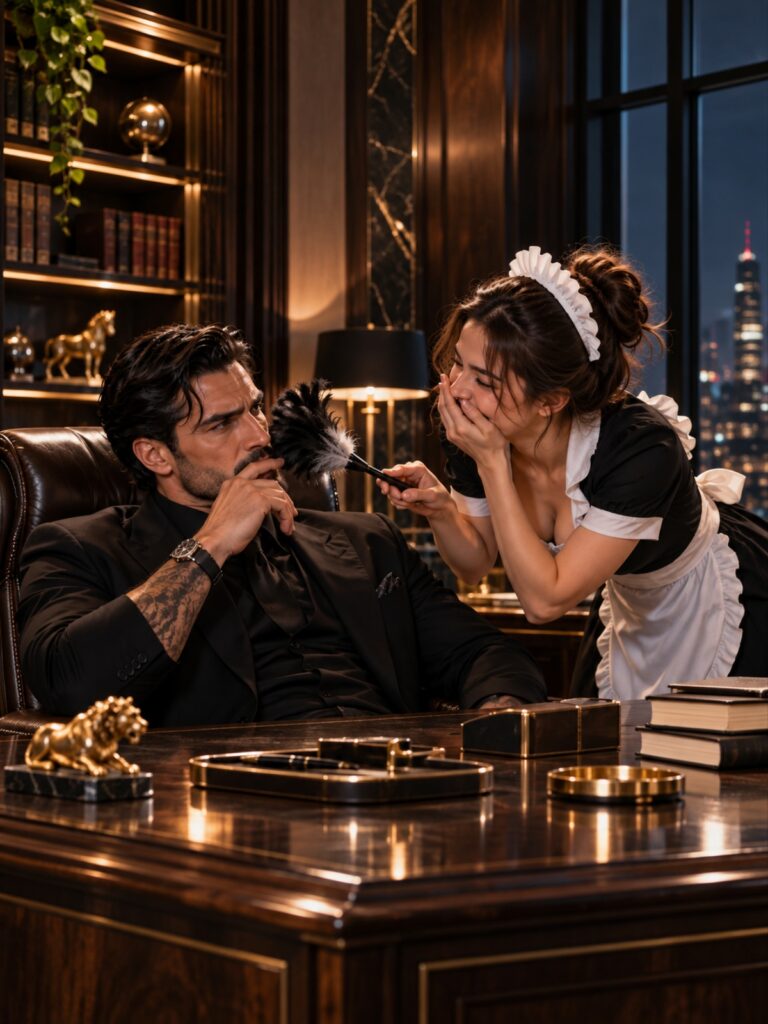
On her eleventh day as a maid, Emma Carter accidentally crowned a mafia boss with a feather duster.
Adrian Moretti laughed for the first time in eight years, then saw his dead sister’s torn photograph in a drawer he’d locked himself.
By nightfall, his guards had a key, a stack of cash, and every reason to blame Emma.
Part 1 — The Drawer That Was Supposed to Be Locked
Adrian Moretti sneezed three times, and the three men who guarded him looked at Emma Carter as though she’d just signed her own death warrant. She stood beside his desk with a black feather duster at the exact height of his nose, trying to understand how the chair she’d thought was empty had produced a six-foot-three man in a black suit. He set down his pen and looked up at her. A little gray feather drifted onto his tie, where it seemed to settle in for the afternoon.
“Mr. Moretti,” she said, lowering the duster behind her leg, “I can explain.” She’d been working her way around the study windows, watching the first rain wash down the glass, when she’d turned and swept the duster toward what she remembered as an empty chair. In the time it had taken her to finish one windowsill, the owner of the penthouse had returned two hours early, sat down, and opened a contract. “Can you?” he asked, with the genuine interest of a man who had all the time in the world to hear her try.
At thirty-eight, Adrian had the kind of face that made people explain themselves before he asked a question. The thin scar near his jaw looked pale against the dark collar of his shirt, and Emma had watched businessmen twice her age lower their voices when he passed them in the hall. On her first day, one of the kitchen staff had told her that the people who called him a businessman were generally the people who did business with him. Everyone else in Manhattan knew which family he ran.
Mrs. Bell, the head of the household staff, appeared in the doorway behind the guards and looked straight at the duster. “Apologize properly, Emma,” she said in the same voice she used when a table had been set with the wrong glasses. Mrs. Bell had been the only person to grant Emma an interview after calling her last employer, and Emma could still remember how long the older woman had let her sit in silence after asking about the missing bracelet. Most people heard the accusation and ended the conversation there.
The bracelet had turned up in the employer’s daughter’s bedroom eleven days after Emma lost her job. She knew because the daughter texted her a picture of it on the dresser, with a little purple heart and a message saying she felt awful about the mix-up. When Emma asked whether she could come in and speak to her father, the girl stopped replying. Two weeks after the firing, Emma’s fiancé packed his winter coats and told her he couldn’t build a life with someone who was always bringing trouble home.
Emma was twenty-seven, owed rent on a Queens apartment whose radiator banged for an hour before giving off any heat, and sent part of every paycheck to her mother in Ohio. She’d done the math on the train that morning and figured she could make it through December if she kept this job and bought her groceries at the discount place on Northern Boulevard. After Mrs. Bell spoke, she opened her mouth to apologize like a woman who needed every dollar she was about to earn. Then she looked at the feather and reached for it.
All three guards shifted when her fingers neared Adrian’s collar. Adrian himself held still, and Emma plucked the feather from his tie with the same care she would have used on a loose thread. “There,” she said under her breath. “Now you look terrifying again.” Mrs. Bell shut her eyes, and Emma added, with the desperate good manners of someone who could hear exactly what she’d just said, “Professional. You look professional again.”
She intended to leave with whatever dignity she had left, but the edge of the rug caught the toe of her shoe. Her left hand shot out and found Adrian’s shoulder, while her right sent the duster up into the air. It came down sideways across his dark hair, with the handle hanging past one ear and the feathers spread over the other. One of the guards tilted his face toward the ceiling, apparently having decided that whatever happened next would be easier to explain if he could honestly say he hadn’t seen it.
A rough, startled sound escaped Adrian. Emma had just opened her mouth to ask if he was choking when he leaned back in his chair, caught the falling duster, and laughed. The sound went on long enough for Mrs. Bell to take a step into the study and then stop again, one hand pressed against the doorframe. Later, Emma would learn that eight years had passed since anyone on the staff had heard him laugh that way, and that Mrs. Bell had recognized the sound before she could bring herself to believe it.
“Oh my God,” Emma whispered. “You do know how.” Adrian looked up at her, still holding the duster, and for a second she could see how young he must have looked before he learned to keep his face so still. His gaze dropped to the open drawer beside her hip, and the last trace of amusement disappeared so quickly that she turned to see what had taken it.
A photograph lay faceup in the drawer. Emma could see a younger Adrian standing outdoors, smiling in the middle of whatever someone had said before the picture was taken, with a woman’s shoulder pressed against his. The part where her face should have been was gone, leaving a ragged gap above the collar of a pale blue coat. Adrian covered the photograph with his palm and asked Emma where she’d found it. She looked from the picture to his hand and said she’d never seen it before.
“Everyone out,” he said, and the doorway emptied. Emma stayed beside the desk because he hadn’t dismissed her by name and because the hand she’d used to catch herself had begun to shake. As he set the photograph down, he showed her a splinter of fresh wood inside the drawer, close enough to the catch that it would have been invisible when the drawer was closed. He’d locked it himself before leaving that morning, he told her, and someone had forced it open while he was gone.
“I didn’t open it,” she said, and he answered, “I know,” so promptly that she forgot what she’d meant to say next. He turned the photograph over, holding it by the corners, and a message in black ink came into the light. There were only four words, written across the back in broad, uneven strokes. *You still owe me.* Adrian read them twice, then set both hands on the desk as if he needed a moment to decide which question would get him the farthest.
When he asked who had been inside the study, Emma said no one had come in while she was cleaning. “That wasn’t my question,” he said, and she felt a familiar pressure to make herself agreeable to the man who had the power to send her home. She’d been agreeable all the way through the last accusation, right down to thanking someone for bringing her coat. “Then ask me what you actually want to know,” she said, and waited to find out what speaking plainly would cost her this time.
Adrian took a moment before asking a different question. “Who did you see near this room today?” Emma thought of a delivery man she’d passed around noon, a man in his forties with a brown jacket and a baseball cap. She’d seen him first near the vase outside the service corridor, where he’d nearly knocked it off a stand with his box and caught it with his left hand. A thin scar crossed one of his knuckles, and he favored his right leg so heavily that she’d offered to get him a cart.
“Deliveries don’t come upstairs,” Adrian said. Emma remembered stepping out of the stranger’s way and taking care to sound pleasant when he brushed off her offer, because she’d assumed he was another person who knew the house better than she did. “Then you have a problem,” she told Adrian. He called Marco, the man who handled his security, and asked him to find out who had brought the visitor up and check the recordings from noon to one.
“You notice details,” Adrian said after ending the call. Emma thought of the little bottle of nail polish Mrs. Bell carried for touching up scratches on the red lacquer table, and how long the household had been blaming those scratches on a particular housekeeper when they appeared precisely where a visitor set his briefcase every Tuesday. “Cleaning teaches you where people leave things they don’t want noticed,” she said. Adrian was looking at her with an attention that had nothing to do with the duster now, and the fact that he seemed to be listening made it harder, somehow, to hold his gaze.
His eyes dropped to the purple mark visible beneath the cuff of her uniform. “Who did that?” he asked, and Emma glanced down at the bruise, which she’d earned catching a box of cleaning cloths against a steel shelf that morning. “A storage rack,” she said, and when his expression suggested he’d have preferred a name, she added, “You could ask it yourself, but I doubt it’ll talk.” He raised a hand toward her sleeve, seemed to consider the distance between them, and asked if he could look.
Emma nodded, surprised to find that the question mattered as much as it did. A man who could get a room emptied with two words had waited for her permission to move a strip of fabric an inch. He looked at the bruise, saw the straight line left by the edge of the shelf, and let the cuff fall back over it. “The next time you’re moving something heavy, there’s a cart by the freight elevator,” he said, which she took as an admission that the storage rack had been telling the truth.
Marco came in with a tablet and footage showing the stranger entering with a box and leaving twenty-three minutes later without it. Emma recognized the jacket before she could make out the face, but she also caught a little flash near the man’s collar when he turned toward the lobby camera. She asked Marco to stop there and enlarge the image. The bright spot turned into a silver pin with a crest, and Adrian drew a breath so quietly that Emma might have missed it if she hadn’t been standing beside him.
“Belucci,” Marco said, before she had time to ask. She’d heard the name in the kitchen once, when an older housekeeper told a younger one to leave a stack of holiday cards unopened until Mrs. Bell came down. All the young woman had done was read the return address aloud, and the kitchen had gone quiet. Now Adrian told Marco to check every room and keep everyone inside until he knew who had let the stranger upstairs.
“Including the staff?” Emma asked. “Especially the staff,” he said, and there was no way for him to know that her last employer had used almost the same words when he called a meeting after the bracelet went missing. She folded her hands in front of her so he wouldn’t see what they were doing. “Then I suppose you’d better start with me,” she said, and the anger in her own voice embarrassed her less than the instinct to apologize for it.
Adrian had started to turn away, but he turned back. “Emma, you told me about a man you could have claimed you never saw,” he said, lowering his voice so only she and Marco could hear. “I believe you.” She wanted to tell him there was a difference between believing someone in a quiet room and believing them when other people were listening, but she didn’t know him well enough to say it without giving away how much she wanted him to mean it. Before she could settle on an answer, Marco looked down at his ringing phone and swore.
The call was from the security desk downstairs, where someone had received an image of a box beside a red digital countdown. Emma recognized a dented corner and a blue shipping sticker from the package the man in the baseball cap had carried upstairs. The sender had set the counter at twenty-nine minutes, and the number on the image Marco opened was already lower. From where she stood, the worst part was how ordinary the cardboard looked, as if the person who’d brought it could have been delivering glasses after all.
Adrian sent word for the staff to leave the east wing quietly and for the building’s emergency team to meet Marco downstairs. Then he looked at Emma and told her to go with Mrs. Bell. “I saw where he took the box,” she said, and when he opened his mouth to repeat himself, she pointed to the blue sticker. The kitchen’s glassware was late, she explained, and she’d thought the man was taking the shipment toward the freight elevator when she saw him again by the laundry.
They left the study together and found the corridor lit as warmly as it had been an hour earlier, with fresh flowers in their vases and rain ticking against the windows. The people moving downstairs had put on their coats over their uniforms, and a cook walked past with a container of soup he must have taken off the stove on his way out. Emma could hear Mrs. Bell asking him gently to leave it on a table. The ordinariness of the exchange scared her more than the sight of the guards.
Near the laundry, Emma stopped because there was something wrong with the order in which she remembered seeing the delivery man. The first time, he’d limped badly enough for her to offer help, but when she saw him from behind he’d lifted the heavy box in one hand, pushed through a door with his shoulder, and walked off without favoring either leg. “He wanted someone to remember the limp,” she said. Adrian looked down the hallway, where the same man had apparently thought a maid carrying folded pillowcases was beyond his need to perform.
Marco’s men had looked along the route to the elevator and found nothing. Emma asked about the linen closet and learned they’d opened the door and checked over the shelves, which was how a person searched that closet if they didn’t have to use it for work. She went to the doorway and pointed to the bottom shelf, where a stack of folded towels hid the gap Mrs. Bell kept meaning to have repaired. A faint light was flickering there, reflected in the side of a metal bucket.
Adrian caught Emma by the shoulder as she bent to look and said, “Don’t touch it.” He let go as soon as she straightened, and Marco’s people took over, sending both of them back until they had a better look at what was there. When Marco finally came out, he told them the object in the closet was a small transmitter in a plastic case. By the time Emma had thought to ask what it was transmitting, a phone began ringing behind the clean towels.
It took Marco a moment to find the cheap phone attached to the back of the shelf. He handed it to Adrian, and a man spoke as soon as Adrian answered, with the ease of someone calling to confirm a dinner reservation. “Eight years, Moretti,” he said. “I wondered how long it would take before somebody made you smile again.” Emma could still see the feather duster lying across Adrian’s hair, and it chilled her to think that a stranger already knew about a moment she’d come within seconds of keeping to herself.
Adrian said Belucci’s name so quietly that Emma had to lean in to hear it. “You’ve been inside my home,” he said, and Luca Belucci laughed softly before telling him that the person who’d been inside was somebody much closer. Adrian’s gaze went past Emma to the last of the staff waiting for an elevator. For a second she could see the terrible efficiency of the call, how a man could make a room full of familiar people look like strangers with five words.
“What do you want?” Adrian asked, and Belucci said he wanted the same thing he’d wanted eight years before. “For you to remember what happens when you care about somebody,” he added, his voice dropping on the last word. Adrian looked at Emma and said to leave her out of it. Belucci let the silence hold long enough for her to hear a woman’s shoes clicking down the corridor, then said, “Too late,” and hung up.
Adrian dropped the phone and crushed it beneath his shoe. Emma watched the screen go black and realized that the worst part of being named by a stranger was how badly she wanted to disappear into the group at the elevator, where she could have done so an hour before without anyone wondering what it meant. “You keep telling people to get me out of the way,” she said to Adrian. “If there’s a reason he thinks hurting me will get to you, I deserve to know what it is.”
Before Adrian could answer, Marco called them over to see another recording. A person in the household’s uniform was opening a secured door for the delivery man, keeping just far enough behind it for the camera to miss her face. When Marco enlarged the image, Emma saw a silver bracelet with a little oval clasp on the hand that pushed the door. She had polished a bracelet like that for Mrs. Bell that morning and put it back herself beside the bottles of hand cream the older woman kept by her desk.
Adrian was still looking at the image when one of his guards came up carrying a small velvet pouch. He had found it in the staff room Emma used for overnight shifts, tucked so far beneath her mattress that he’d had to lift it. Marco emptied it onto a side table, and a duplicate service key, five thousand dollars in cash, and a pin bearing the Belucci crest slid onto the polished wood. Emma watched the cash spread and remembered, absurdly, how she’d spent ten minutes in a grocery aisle returning things to the shelves so she could pay for what was left in her basket.
The guard waited for Adrian to tell him what to do with her. Emma could feel every face turned in her direction, and she remembered how, the first time she’d been in a room like this, she’d apologized just to give herself something to say. “You told me you believed me,” she said to Adrian, keeping her eyes on his even as the guard stepped closer. Before he could answer, the private telephone in his study began to ring, and he looked more frightened by that familiar sound than he had by the countdown.
Part 2 — The Voice on the Private Line
“Nobody touches her,” Adrian said. The guard stopped with his hand halfway to Emma’s elbow, and Adrian stepped between them, leaving her room to move. “That pouch was planted.” Emma could still hear the study phone ringing when she asked how he could possibly know that. He looked over his shoulder at her, and the answer came as simply as it had the first time. “I know you.”
Eleven days was all he had to go on. Emma’s former employer had known her for two years, and he’d still asked her to empty her pockets on his kitchen table. She had spent weeks trying to decide which little thing she should have said differently that morning, as if the right sentence might have got her an apology. Now this man had offered her something in front of the people who mattered, and he’d done it before she could think of a single word.
They went back into the study with Marco, and Adrian put the call on speaker. “Still trusting the maid?” Belucci asked, before any of them had spoken. Emma stared at the door they’d just come through, suddenly aware of how little distance there was between something said in this house and that voice knowing it. Adrian leaned a hand on the desk. “You made a mistake with the money.”
Belucci laughed and asked which part he’d got wrong. “You thought five thousand dollars would be enough to tell me everything about her,” Adrian said. “She sends money to her mother every Friday, and she keeps the receipts in an envelope in the kitchen because she wants to account for every dollar she earns here.” He turned toward Emma. Mrs. Bell had asked him to approve a Friday payment during Emma’s first week so the money could reach Ohio before the weekend.
“Does that sound like someone who’d leave five thousand dollars beneath a mattress for the first person to find?” Adrian asked. Belucci said a woman who needed money had every reason to take it, and Emma winced at the ugliness of hearing her life reduced to that. Adrian watched her face for half a second before saying, “You never even bothered to learn her name.” Then he hung up.
Emma was still looking at the telephone when she thought of Mrs. Bell reaching for her hand cream that morning. “The bracelet is on the wrong wrist,” she said, turning to Marco. He brought up the footage again, and she touched the screen near the hand on the door. Mrs. Bell wore her bracelet on the left, where she could take it off herself when the arthritis in her right hand bothered her.
“She couldn’t have opened that door one-handed, either,” Emma said. She’d seen Mrs. Bell brace it with her hip whenever her hands were bad, and she’d learned to walk ahead whenever they were carrying linens together. Then she remembered where Mrs. Bell had been at noon. “Ask the florist,” she told Marco. “They were arguing in the dining room when a vase fell over, and Mrs. Bell said it was because the table leaned.”
A different camera caught someone entering the service hall in Mrs. Bell’s uniform at twelve fourteen. Seven minutes later, the figure stepped beyond the last camera that covered the hall. Marco stopped the recording and asked who could get a spare uniform with the right jacket and trim. The household management office kept them, Emma said, along with the laundry and the tailor.
“Daniel Cross runs that office,” Marco said. Adrian stared at the person on the screen for so long that Emma thought he might recognize the way she walked. Then he told her Daniel had worked for his family for fifteen years. She could hear him calculating how much of his life those years covered, because when he finally looked away, his eyes went straight to the photograph.
“Her name was Sophia,” Adrian said when he saw Emma looking at it. “She was my younger sister.” Eight years earlier, he’d learned that someone Sophia trusted had given her location to Belucci. As he told Emma that his sister had died that night, he turned the photograph so it lay between them, and Emma noticed how carefully he kept his thumb away from the torn edge.
She’d wondered earlier what it took to make a room go quiet around one man’s laugh. Now she thought of coming home to her apartment the first week after her fiancé left and setting out two forks by habit, then stopping with one still in her hand. Eight years of small surprises like that seemed harder to imagine than the night itself. “What was she like?” she asked, and Adrian looked at her as though it was a question someone should have thought to ask him years ago.
“She talked through movies,” he said. He almost smiled when he added that Sophia always knew who the killer was, usually twenty minutes before he did, and that she’d sit there visibly suffering while she tried to let him catch up. Emma could see the younger man in the photograph as he spoke, the one who’d leaned toward his sister before the picture was taken. Then Marco’s phone lit up, and Adrian straightened.
Daniel had left the building six minutes earlier. Adrian said he must have realized they were getting close, but Emma thought of the money and the uniform and how quickly every clue had pointed them toward a person they were ready to suspect. “If you were Daniel and you knew what Belucci had done to Sophia, whose company would you want right now?” she asked. Thirty floors below, headlights were beginning to come on along the wet avenue, and Emma looked down at them and wondered where he was.
When she picked up the photograph again, she saw something she’d missed because the missing face had drawn her eye. A man’s hand rested on Sophia’s far shoulder, just where the torn paper curled, with the edge of a heavy signet ring caught in the light. Adrian looked at the ring for a long moment. “That belonged to my father,” he said.
“Was your father there the night she died?” Emma asked. Adrian opened his mouth, but Marco’s phone rang before he said anything, and this time the screen showed Daniel Cross’s name. Marco handed it to Adrian, who said, “Daniel, tell me where you are.” A ragged breath came through the speaker, followed by a sound like something falling hard against a car door.
“Adrian, listen to me,” Daniel said. “Belucci isn’t the one who betrayed Sophia.” He stopped to catch his breath, and when he spoke again, he was speaking so fast Emma had to bend toward the phone. “The traitor is still inside your family.” Something interrupted him before he could say a name, and Adrian stayed bent over the speaker for several seconds after the line went dead.
Marco was the first to speak. “Your father is expected here tonight,” he said, looking toward the private elevator. Adrian was holding the photograph again, his fingers pressed close to the hand on Sophia’s shoulder. From the other side of the study door came the low, steady sound of the elevator rising, and by the time Adrian looked up, it had already passed the twenty-ninth floor.
Part 3 — What Sophia Left Behind
The elevator chimed, and every man near the study door reached inside his jacket except Adrian, who moved quietly between Emma and the hallway. Emma looked at the back of his shoulders and remembered the moment in the corridor when he’d placed himself between her and a guard. She was grateful for what he’d done then, and she could see how much easier it would be for him if she let him do it again. “You trusted me when you had every reason to doubt me,” she said, low enough that the others couldn’t hear. “Let me return the favor.”
For a second she thought he was going to tell her this was family business. She could almost hear the words from all the times she’d stepped out of rooms because somebody had decided the conversation had grown too important for her. Adrian looked at her over his shoulder and moved half a step sideways. It was a small movement, and it put her close enough to see his father’s face when the elevator opened.
Vittorio Moretti stepped out in a charcoal overcoat with two guards behind him. He was seventy, silver-haired and straight-backed, and he took off his wet gloves one finger at a time as he looked at the open doors and the empty hall. “Why does my home look like a war zone?” he asked. Emma glanced at Adrian, wondering how long he’d lived in a home his father still called his own.
“Someone broke into it,” Adrian said as Vittorio entered the study. He laid the torn photograph beneath the green desk lamp and stood back just far enough for his father to see it. Vittorio’s gaze went straight to the edge of the picture, where his ring showed on the hand resting against Sophia’s coat. He had made it through the corridor without so much as blinking at the armed men stationed there, but the sight of his own hand made him grip the back of a chair.
“Where did you find that?” Vittorio asked. “In my locked drawer,” Adrian said, and his father told him to destroy it. Adrian folded his arms and waited long enough for Vittorio to hear his own words in the quiet study. The older man released the chair and said, almost gently, that some memories were better buried. Emma watched Adrian’s eyes go to the jagged space where his sister’s face should have been.
“Sophia was your daughter,” Adrian said. Vittorio turned at the sound of Emma breathing and asked who she was, so Adrian introduced her by her full name. “The maid?” Vittorio said, and Emma recognized how easy the word made it for him to dismiss anyone who might have heard him order his own child’s photograph destroyed. Adrian looked him in the eye and said, “Use her name.”
From the doorway, Marco glanced down at the floor. Emma had spent eleven days learning what sounded like a hundred household rules, and Mrs. Bell often finished an explanation by saying it was how Vittorio liked things done. Now Adrian was telling his father where to stand so he could see a security image Emma had helped make sense of. He explained what she had recognized in the delivery man’s walk, what she knew about Mrs. Bell’s wrist, and what she had found in the photograph.
“Then she knows too much,” Vittorio said. Adrian took a step toward him, and the older man set his gloves down with the deliberate care of someone accustomed to making other people wait. “Sophia died because you believed that loyalty was a permanent thing,” he told his son. “You were young enough to think it would hold just because you needed it to.” He cast a quick look at Emma before adding, “Do you want to learn that lesson again over a servant?”
“She earned my trust,” Adrian said. His voice stayed level, although Emma could see how white his fingers had gone where they rested on the edge of the desk. “You’re here because you’re my father, and I’m giving you one chance to tell me what happened to my sister.” Vittorio’s lips parted slightly, and for the first time since he’d entered the room, he seemed to consider sitting down.
Then Marco’s phone buzzed, and he excused himself long enough to read the whole message before interrupting. Police had found Daniel’s car abandoned near the East River, and there was word he’d been seen alive afterward. The last thing Daniel sent before his phone went dark was a location in Red Hook, a warehouse identified on the map as number seventeen. “Belucci’s men are there now,” Marco said as Adrian turned to get his coat.
Emma caught the edge of Adrian’s sleeve just above the wrist. “Think about the order,” she said, and he stopped with the coat halfway off its hook. “Daniel tells you somebody in the family betrayed Sophia, and a minute later there’s a place you can go where you know you’ll find Belucci. If you hurry out that door, you can put off hearing what your father has to say for another eight years.”
Adrian let the coat fall back onto the hook. “You think Belucci wanted me to bring him here,” Vittorio said, still looking at the photograph, and Emma waited until he looked up. “I think he knew you were coming,” she said. She remembered the phone in the closet, the promise that someone close had let the stranger inside, and the sound of the elevator at almost the exact moment Daniel’s voice went dead. “What would he want Adrian to hear from you before he got there?”
For a long time, Emma thought Vittorio might walk out. He was standing close enough to the door to do it, and the two men who’d come up with him had made no move to separate themselves from him. Then he pulled out the chair he’d spent most of the conversation gripping and sat down. He looked older when he told Adrian that eight years ago, Luca Belucci had wanted control over the docks.
“Somebody was giving him our shipping routes,” Vittorio said. Sophia had found duplicate records and followed the money, starting with payments small enough to look ordinary in a month with dozens of legitimate bills. Adrian asked who had sold the routes, and Vittorio looked at the rain on the window before he answered. “I did.”
Adrian stayed where he was, and Emma watched him struggle to hear the words in his father’s ordinary voice. Vittorio said he’d made the deal to prevent a war he believed the family would lose. He’d handed over shipping routes and made regular payments in return for Belucci’s promise to leave the docks alone. Sophia found out anyway, and she told Vittorio she had the records and would turn them over if he wouldn’t stop. “She told me what she was doing because she believed I still had time to do something decent,” he said. “I used that time to call Belucci.”
Adrian asked if he had told Belucci where she was going to be. Vittorio said yes, and then began saying that he’d thought the other man would speak to her, that he’d called back when he realized she might be in danger, that he’d gone looking for her himself. Each detail seemed to make him sound smaller in the chair. Out in the hall, a member of the staff came back for a coat, saw the men at the door, and left without it.
Eight years earlier, Adrian had sat beside his father and tried to remember whether he’d told anybody where Sophia planned to go that night. He’d gone through the calls he’d made, the cars he’d sent, even the question a longtime employee had asked him about dinner, trying to come up with the one harmless piece of information he might have let slip. His father had brought him a glass of water while he did it. Now Adrian looked at Vittorio’s hands and could remember how steady they’d been setting that glass down.
“You let me hunt for someone inside the organization,” Adrian said, and Vittorio answered that he thought it would keep his son from destroying himself. He waited, then admitted what both of them could hear was missing from that sentence. “I knew what you’d think of me if I told you.” Adrian started around the desk, and Emma stepped into the space between the two men before she’d fully considered how close together they were.
“Make him answer for it,” she said, catching Adrian’s eye. “Start by making him say the whole thing while he can still choose to say it.” He was breathing carefully through his nose, and Emma could feel how badly he wanted a kind of answer that none of the people in that room could give him. Then he looked over her shoulder at his father and asked, in a voice she almost didn’t recognize, whether Sophia had suffered. Vittorio said he didn’t know, and this time Adrian believed him.
Marco’s update gave them twelve minutes before Belucci’s people were expected to leave the warehouse. Emma went over to the side table where the velvet pouch had been left and picked up the duplicate service key. Before she put it in her pocket, she took a picture of the cash and pin where the guard had left them. She’d seen other keys like it in Mrs. Bell’s office, from the old Moretti properties that once shared building services with the penthouse. When she asked whether Warehouse Seventeen had been one of them, Adrian said yes, then looked at the key and realized she meant to come with him.
“Belucci’s spent all afternoon counting on you to send me away,” she told him. He said that he’d rather have her safe, and she believed him enough to hear the difference between that and a command. But she also knew who had noticed the coat, the delivery man’s walk, the bracelet, and the ring, and she was tired of giving people with titles the final word on whether she’d been paying attention. “You can ask me to stay,” she said. “You have to give me a chance to answer.”
By the time the black SUV crossed into Brooklyn, the rain was coming down hard enough to make the wipers seem slow. Emma wore a coat Mrs. Bell had pressed into her hands downstairs, and inside one of its pockets she found a peppermint in a crumpled wrapper. She was trying to unwrap it without tearing the paper when Adrian put his hand palm up on the seat beside her. She took it, and for a few seconds they both looked through the windshield without speaking.
“When this is over,” she said, “you’re going to have to learn how to laugh without scaring everybody who works for you.” His thumb moved once against hers, and she was watching the corner of his mouth change when Marco’s voice came over the radio. Belucci had let the car that came for him leave empty. He was still inside the warehouse, and Daniel was there too, tied to a chair. In his hand Belucci held a ledger that, from its description, sounded like the original record Sophia had assembled.
Adrian released Emma’s hand and asked how much time they had. “Eight minutes before they move him,” Marco said, and Emma looked out as the waterfront came into view through the rain. She thought about how different eight minutes felt when a stranger wrote the number on a screen and when there was a man waiting under a light to find out whether anyone was coming. By the time the SUV stopped, she had put the peppermint back in Mrs. Bell’s pocket and wrapped her hand around the key.
“Stay close to me,” Adrian said as he opened his door. Emma came around from the other side and reached him where the rain was pattering into a puddle between the tires. “You stay close to me,” she said. He stood beside her a moment, getting as wet as she was, then matched her pace toward the warehouse.
The side door was set back from the loading area, under a light so dim Emma could barely read the number on the brick. She recognized the old service lock and let Adrian see what she was thinking before she tried the key. When it turned, he looked down at the very thing someone had hidden under her bed to ruin her life. “That’s almost funny,” he murmured, and Emma said, “Careful. People might think you have a personality.”
Inside, it smelled of salt, wet boards, and the oil tracked in from the loading floor. A single hanging light showed Daniel sitting with his wrists bound and one eye swelling shut, and Emma could tell he was conscious because he tried to sit straighter when he saw Adrian. Luca Belucci waited across from him with the ledger tucked against his ribs. He looked almost relaxed until he noticed Emma, and then he glanced quickly toward the door she’d opened.
“The grieving prince finally knows who killed his sister,” Belucci said, looking back at Adrian. Adrian said, “You did,” and the two words seemed to take some of the pleasure out of the greeting. Belucci lifted the ledger high enough for them to see its bent corners. “Your father made the deal,” he said, and told Adrian there was still a balance after Vittorio stopped paying. “You can read what he gave me before you decide how much of this you want to lay at my feet.”
Adrian took a step, and Emma touched his sleeve the way she’d done in the study. She felt him stop, and this time she walked forward with him, far enough into the light for Daniel to see her too. Belucci smiled again and said he recognized the maid who’d made Adrian Moretti human. Emma held up her phone, where she’d saved the image of the planted money alongside the two images of the uniforms, and asked him how it felt to have spent the whole afternoon being noticed by somebody he thought was furniture.
“You needed him to come here believing everybody had betrayed him,” she said when Belucci glanced down at the phone. Every move he’d made that day had been directed at that one result, right down to telling a man with a house full of staff that no one in it could be trusted. “You gave him the same story somebody gave him eight years ago,” Emma said. Daniel lifted his head, and Belucci’s eyes flicked toward the bound man before Emma finished speaking.
Marco appeared at the far end of the warehouse, where two of Belucci’s men had been watching the loading doors. More people came into view behind him, and a door closed with a sound that carried across the damp floor. Emma stood quite still, hoping Daniel understood there were people close enough to reach him now. “It’s all in there,” he said, his voice cracking on the effort it took to raise it. “She copied every payment your father made.”
Belucci turned toward Daniel with the ledger in his hand. Emma saw a loose metal cart beside her and kicked it into his path before she had time to wonder whether it would move. It rolled a few feet, struck him below the knees, and sent the ledger skidding across the floor. By the time it came to a stop, Adrian had taken Belucci’s gun away and pinned him against a crate.
Emma heard Daniel say Adrian’s name, but she had never seen anyone look quite as far away as Adrian looked then. Belucci was still trying to talk, telling him that the father he’d come there wanting to defend had made a bargain like any other man in their business. Adrian held him against the crate and watched his mouth move. The thought that he could make it stop was plain enough on his face that Marco took a step forward and then stopped himself.
“Adrian,” Emma said. He turned toward her, and she saw the man who’d just told her about a sister who couldn’t keep quiet through a movie she already understood. Emma thought Sophia must have spent her last days hoping someone in her family would do an honest thing while it still mattered to her. “Don’t let him decide what kind of man you become,” she said, and waited where she was so Adrian could decide what to do with his own hands.
One of his fingers lifted from Belucci’s coat, and then the others followed. He took a step back, let Marco take over, and walked across the room to where Daniel was still sitting under the light. As someone got the restraints off, Daniel reached for Adrian’s sleeve and tried to explain why he’d left the building. Belucci had told him he had Sophia’s ledger and would burn it unless Daniel came alone, and Daniel had thought he could bring it back before Adrian ever had to see the man who’d killed her.
“You called me when it counted,” Adrian told him. Daniel looked down and turned his freed wrists over in his lap, as if he couldn’t quite believe he could do that yet. Emma picked up Sophia’s ledger near the crate and saw handwriting on the first page, a date circled twice, and a small corrected sum written neatly above a crossed-out number. She closed it carefully and held it out to Adrian, who took it with both hands.
Before sunrise, Vittorio came before the family council and told the whole story with the ledger open in front of him. Marco had turned Belucci over to the authorities, and the records would follow, along with a statement Vittorio agreed to give and an accounting of the docks he surrendered. When two men at the council table offered Vittorio a gentler way to describe what he’d done, he looked across at Adrian and said again that he had told Belucci where to find Sophia. Adrian sat through the rest of the confession without speaking.
In the days that followed, Marco learned who’d worn Mrs. Bell’s uniform and who’d put the pouch under Emma’s mattress. The same person had been doing temporary work in the house and had passed details to Belucci throughout the day, including the one about the laugh. The countdown had run out without anything going off, exactly as Belucci had intended, after it sent a house full of frightened people looking for a threat they could understand. Adrian made sure the staff heard the truth about Emma and Mrs. Bell from him directly, in the same rooms where they’d heard the accusations.
Three weeks later, Emma was dusting the study when Adrian walked in with a cup of coffee in each hand. She’d opened the blinds to let in the late-afternoon sun, and the light had picked out a few gray spots she could already see on the top shelf. Adrian set both cups on the desk and said, with a perfectly straight face, “You missed a spot.” Emma turned slowly and looked from him to the feather duster in her hand.
“Don’t you dare,” he said, but he was already smiling before she’d taken a step. She brushed the feathers across his nose, and he sneezed once before he gave in and laughed, warm and helpless, one hand braced against the desk. A housekeeper passing the door looked in, smiled when she saw them, and continued down the hall. Emma realized she was laughing too, and that both of them were loud enough for the people at the other end of the corridor to hear.
Adrian offered her one of the cups, and Emma set it down by the window before taking the hand he’d left open between them. He told her that in the first few seconds after he’d seen her beside the drawer, he’d thought she might be the most dangerous person in the house. “And now?” Emma asked, looking through the glass at a delivery truck stopped below. Adrian squeezed her hand and said, “Now I know who kept me from doing a thing I’d have spent the rest of my life hearing in my head.”
Months later, Emma signed her last household timesheet and went to work for the foundation they’d set up in Sophia’s name. She made sure it could help people who’d been falsely accused at work or suddenly lost their jobs, including people whose former employers had quietly made it impossible for them to find another one. On the first day, she brought the text message with the photograph of the bracelet in case anyone asked why a single piece of evidence mattered. By the end of the morning she’d put it away, because the first woman through the door had a story of her own.
Adrian stopped by the foundation that evening with two coffees and found Emma reading a letter she’d helped the woman write. Emma had spent most of the day replacing phrases that sounded like apologies with clear statements about what had happened, and when she told him that, he asked if the woman had liked the result. “She read it out loud twice,” Emma said, and pushed her papers into a neat pile. Adrian put the coffee beside her and stayed standing with his hands empty, which was how she knew he’d come to ask her something.
“Would you have dinner with me on Friday?” he said. “You pick the place, preferably somewhere nobody keeps a table empty because they know my name.” Emma looked up and found him watching her with the same unguarded hope she’d seen for a second in the study on her eleventh day. She told him he might want to sit down before she gave him her answer, and for once Adrian Moretti looked genuinely nervous.
[The_Maid_Who_Made_Moretti_Laugh.txt](https://chatgpt.com/library?file_id=libfile_39b5e889cf6c8191af2b00d0c9581971&account_id=personal)