A Single Mom Smelled the Mafia Boss’s Wrist in Front of His Guards—Then Exposed His Fiancée’s Gift

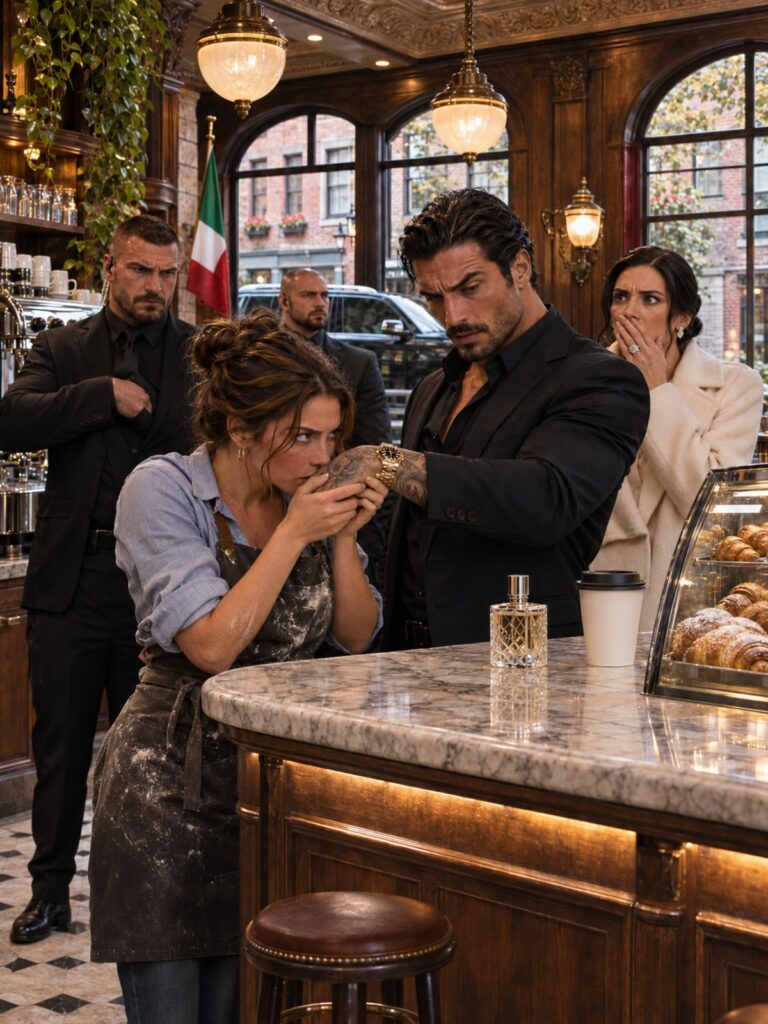
Boston’s Most Feared Man Asked Her Name 143 Times—Then She Found Out Who Was Making Him Forget
The 143rd time Luca Marchetti asked Grace Holloway her name, she took his wrist and told him to stop wearing the cologne his fiancée had given him.
For four years, Boston’s most feared man had been told that he was losing his mind.
Now his wedding was on the calendar, and the people arranging it were counting on him to forget why he should be afraid.
Part 1 — The Barista Who Remembered for Him
The man by the door had one hand inside his coat before Grace realized she was still holding Luca’s wrist. Behind her, milk boiled over in a stainless-steel pitcher, and nobody at Rosa’s Corner moved to turn off the steam. The small diamond on Serena Castellano’s hand caught the light as she rested her fingers on Luca’s sleeve. “Is the barista giving my fiancé grooming advice?” she asked, smiling toward the customers as if she expected them to laugh with her.
Grace could smell bergamot, cedar, and the warm finish of a cologne that cost more than she made in a week. Beneath it was a green bitterness she had spent half the night trying to place, a smell she had last encountered in a New York laboratory seven years earlier. Luca studied her face with the concentration she’d seen him use on mornings when a familiar word refused to come. “Why should I stop wearing it?” he asked. Grace loosened her fingers and said, “Because I think someone put something in it that’s making you forget.”
Five months earlier, at five in the morning, Grace had been braiding her daughter’s hair by the light of an open refrigerator. The kitchen fixture in their East Boston apartment had flickered for three weeks, and the electrician’s estimate was still under a magnet beside Lily’s kindergarten calendar. When Lily asked why the light kept going out, Grace told her that old things got tired. “Like you?” Lily asked, and Grace laughed hard enough to lose her grip on the braid. She tied it off again with a yellow ribbon and kissed the crown of a head that smelled of strawberry shampoo.
There had been a time when people paid Grace to notice things like that. At twenty-two, she was the youngest apprentice at a fragrance house in New York, the girl from Maine who could smell a crowded formula and pick out what the person who made it had tried to bury. Julian Ashford, the perfumer who hired her, used to bring buyers to the laboratory and make a show of covering the labels before he handed her a sample. Afterward, when the buyers had gone, he’d ask her to stay late and write down exactly what she thought was missing.
The formula that made him famous had taken Grace eleven months. She remembered one Tuesday when he picked up the sample beside the terrible vending-machine coffee she’d left on her bench and said, “There it is.” She’d finally found the dry, almost toasted note she wanted. At the launch, she stood behind a curtain holding his spare jacket while he told a room full of people how he’d developed the fragrance over a lonely Christmas. She’d spent that Christmas at the lab and had called her mother from the loading dock because it was the only place she got a signal.
Dr. Ruth Abrams, the house chemist, believed her and offered to say so. Julian’s lawyers called Grace’s notebook an unreliable record, and two job interviews disappeared from her calendar in the same week. Six months later she was pregnant, and Lily’s father left before the second ultrasound. When Rosa offered her the early shift and a stool behind the bakery case where Lily could eat breakfast before school, Grace understood the value of the offer down to the penny. She learned to pull an espresso so well that two men on Hanover Street once argued over which of them had taught her.
Luca walked in for the first time at ten past seven. Grace remembered the time because Lily’s school was opening late that morning and Rosa was letting the girl finish a drawing in the back. The men by the window stopped in the middle of an argument about parking, and Rosa carried a tray of perfectly good pastries into the kitchen. The newcomer ordered a double espresso without sugar, then hesitated when Grace asked for a name for the cup. For one brief second, she had the strange impression that he was searching for his own.
“Luca,” he said at last, and she wrote it above her own name. He turned the cup in his hand and read the lower line aloud, a question in his voice. “Grace,” she said. “So you know who to complain to.” He asked if people often complained, and she told him they rarely complained about anything she was willing to fix. The corner of his mouth lifted before he dropped a hundred into the tip jar and stepped back outside to the two men waiting on the sidewalk.
Rosa watched through the window until his car left, then looked at the bill in the jar with the expression she usually reserved for a suspiciously quiet delivery driver. She told Grace that the Marchettis had spent three generations making money in shipping, construction, and restaurants, and a good deal of other money nobody on Hanover Street discussed at full volume. Luca had inherited the whole operation at twenty-nine. “Men who met him once twenty years ago swear he remembers their names,” Rosa said. “When he comes in again, give him his coffee and let him decide what else he wants.”
He came in the next day at the same minute with the same order. Grace smiled in recognition, and he returned the perfectly courteous smile of a man greeting a stranger. When he noticed her name on the cup and asked whether that was what she went by, she said yes. Then she watched him move aside to give a customer room, a smooth little sidestep he had made in exactly the same place the day before. It was hard to explain what unsettled her about that.
By the third week, she’d noticed he sometimes checked the street sign before he left. One morning he called the man at the door by the wrong name and went quiet when the man corrected him. Another morning he took out his phone to check something, set it down beside the register, and came back in after ten minutes to ask if he’d left it anywhere. Every time Grace handed him something he’d misplaced, she did it the way she handed everybody else their change. A few weeks later, he began coming straight to her end of the counter even when Rosa was free.
Serena started joining him in the second month. She knew his schedule by heart, could charm a room full of people before she’d taken off her white coat, and asked Grace after one snowy morning whether the pipes in the café had thawed. Then Luca forgot the name of a restaurant he’d owned for a decade, and Serena said it for him with the smile she used on the room. “That’s what I’m here for, darling.” Grace watched Luca fold the edge of a napkin into smaller and smaller squares while his fiancée explained to Rosa that he got confused now.
The worst morning came when Serena stepped outside to take a call. Luca watched her through the glass before turning back to Grace, and for a moment she thought he wanted to order something he’d been told he couldn’t have. “Do I come here often?” he asked. He kept his gaze on the saucer of spare change by the register as she told him he came every morning at seven ten, ordered a double without sugar, and insisted on tipping more than anyone should. When she added that he always held the door for whoever was behind him, he raised his eyes.
“Why do you write your name?” he asked, looking down at the cup. Grace could have said it was a habit, which was true by then, or made another joke so he wouldn’t have to stand there feeling embarrassed. “I thought one day you might remember it,” she said. He turned the cup once in both hands and repeated her name in an ordinary voice, as if they had all the time in the world. By the time Serena came back inside, he had placed his thumb squarely over the place where Grace had written it.
He left a folded square of paper on the counter that morning. Grace opened it expecting a receipt and found a list in small, square handwriting. There was a phone number for Teddy, a reminder to call his sister, and, halfway down, the words Hanover Street, Rosa’s, seven ten. She caught up with him at the door and handed it back folded the way she’d found it. He slipped it into his coat and murmured, “You’re very good at returning things,” with a little embarrassment that made her think he knew she’d read it.
Grace started watching for the things he could still do with ease. She saw him work out the change for a tourist who had tipped in the wrong currency and listened through the open door one morning as he talked Teddy through a neighborhood detour he remembered from childhood. Then he came in ten minutes later, looked straight at her, and asked his question again. On the back of the day’s receipt roll she drew another mark, the way she’d done since she’d first begun trying to understand how often it happened. She had intended to stop counting when he remembered.
The bitter smell had bothered her since his first visit. At first, she’d blamed the espresso machine, and she pulled everything off the shelf underneath it and scrubbed the back wall during a slow afternoon. The following day Luca slid his empty cup toward her for a refill, and as the cuff of his coat shifted, the bitterness rose from his wrist again. Grace spent the next several weeks catching it in small, maddening intervals, every time thinking she was about to remember where she knew it from.
On the night it finally came to her, she had opened her old leather notebook to a page that still held a coffee stain in the shape of a thumbprint. During her apprenticeship, a supplier had once sent the laboratory a batch of botanical extract that Ruth ordered pulled from the lab. Julian had gathered the apprentices and taught them to recognize the bitter odor, and Grace remembered him waiting until the last person stopped smiling before he spoke. “If you smell that in a finished product, stop,” he’d told them. Later, Ruth had told Grace why they were taking it so seriously. The batch could cause confusion and problems with memory.
Grace shut the notebook and listened to the refrigerator click on. The logical thing, she told herself, was to wait for a quiet moment and ask Luca whether he could have the cologne checked. In five months of watching him, she’d had perhaps three minutes alone with him, and she had seen Serena take a ringing phone out of his hand on the grounds that he’d get the details wrong. When Grace went into Lily’s room to lay out a sweater for school, a little hand reached from under the quilt and caught hers in sleep. She stood there until Lily let go, then went back to the kitchen and called Ruth’s number just to see if it was still in service.
That was how she wound up holding Luca’s wrist in the café, saying something she knew everyone would repeat before lunch. Serena asked if Grace seriously thought she knew more than the neurologists who’d been treating him. Luca turned his wrist palm up and looked at his own skin for a moment. “Who gave me the cologne?” he asked. Serena gripped his sleeve a little higher, as if he were about to step off a curb.
“I did,” she said, in a voice warm enough for the whole room to hear. “It’s custom-made in New York. I have a new bottle sent every month because you said it was your favorite.” Luca looked at her for several seconds, and Grace realized he was giving himself time to see if any part of the conversation Serena described would come back to him. “I don’t remember saying that,” he said.
The old men at the window had stopped pretending to read their papers. Luca reached into his overcoat and set a small crystal bottle with a silver cap on the counter. He asked Grace how sure she was, and she told him she was sure enough to ask him to stop wearing it and find a qualified person to test it. She thought he might ask her to do it discreetly, then realized that leaving the bottle right there in front of Serena was a decision he had made while she was talking. “Find out,” he said, and for the first time since she’d walked around the counter, Serena’s smile was gone.
After they left, Rosa came over and turned off the steam. Grace began apologizing for the mess and the customers, and Rosa handed her a dry towel and waited for her to run out of things to apologize for. Then she sent her home early and offered to take Lily to school, explaining that she’d been meaning to see the yellow ribbon Lily insisted she knew how to tie herself. Grace understood what it cost Rosa to speak so casually with half the street watching. She took the towel into the kitchen and held it against her mouth until she could breathe evenly.
Ruth picked up that afternoon in a small laboratory in Providence. “Grace Holloway,” she said, giving the name the drawn-out welcome of somebody who’d been waiting years to use it again. Grace told her about the bottle, the bitter smell, and the man whose memory seemed to be going piece by piece. She waited for Ruth to ask whether she might be remembering the old smell wrong. Instead, Ruth wanted to know when she could get the bottle and whether Luca had a doctor he’d chosen for himself.
Luca’s driver, Teddy, took the bottle to Providence. Before leaving Rosa’s, he wrapped it in the clean towel Grace handed him with the careful attention of a man who’d handled a great many important things without being told why they mattered. Luca wrote his private number on the back of a cup and gave it to her before she left work. On her side of the cup she wrote her name, as she’d done on the other 142, and both of them stood looking at it for a moment before she saved the number and handed it back to him.
The wait took four full days. Grace worked her shifts, signed a permission slip for Lily, and went to bed each night with her phone turned up loud enough to wake her through the wall. On the fifth morning, Ruth called to say she’d found the compound that had no business being in a cologne. From the results, she believed somebody had deliberately added it. She wanted a doctor to assess what the exposure had done, but yes, she said, it could help explain why Luca was forgetting things.
Grace called the number on the cup from the alley behind the café. Luca answered on the first ring and said, “My mother’s birthday is March second.” He’d been sitting in the car that morning, he told her, watching a woman try to tuck a bouquet into the basket of a bicycle. His mother used to buy herself daffodils on her birthday, and while he watched that woman, the date came to him without a calendar or a person supplying it. He had spent the rest of the drive saying it to himself, afraid it might go away if he stopped.
They met that evening near the back of St. Leonard’s, where Luca’s grandmother had lit candles every Sunday. He had arrived early and chosen a pew from which he could see the door, but when Grace sat beside him, he turned his back to the aisle. The headaches had started four years ago, he told her, then the missing names and the blank stretches of conversation. He’d missed his sister’s wedding after telling her twice that he would walk her down the aisle. He remembered her forgiving him over the phone and had spent a long time wondering whether he’d even earned that.
A doctor recommended by Aldo Castellano had told him the symptoms pointed to early-onset dementia. As the appointments went on, Aldo began handling meetings, then contracts, then the calls Luca used to take from his own sister. He had been his father’s adviser and stood beside Luca at the grave when there were things the younger man couldn’t bring himself to say. “He told me that someday I’d have to let somebody help me,” Luca said. “I waited too long to ask myself who I was helping.”
Grace asked when Serena had started buying the cologne. It took Luca a few seconds, and then he rubbed a hand hard across his mouth. The first bottle came four years earlier, when Serena had brought dinner to his apartment after a week of exhausting meetings. He could picture her putting the little box down next to his plate and insisting he open it before the food got cold. “She said she wanted to give me something I’d use every day,” he said.
There was a court hearing in six weeks, Luca told her. Aldo had petitioned for someone else to manage Luca’s affairs, and the papers recommended Serena, who by then was supposed to be his wife. Their wedding was in five weeks, a week before the hearing, with a guest list Aldo had been personally reviewing. Grace understood why she’d seen Serena answer questions for him in public, and why she’d done it with such patience in front of people who might someday be asked what they had witnessed. “I signed papers I can’t remember reading,” Luca said, staring at the pew in front of him. “What else did I help them do?”
For a while, neither of them spoke. Then Luca asked why she’d risked walking out from behind the counter when she knew what people said about him. Grace told him about the fragrance Julian had taken and the meetings where she’d been invited to discuss her future, only to find somebody from human resources already in the room. She’d begun doubting the sentences she remembered hearing when enough people repeated a different version. “I recognized the way you looked at your own hands whenever Serena finished a sentence for you,” Grace said. “I know how long it can take to trust yourself again.”
Luca asked her mentor’s name, and Grace said it aloud without stumbling. The silence that followed was long enough for her to hear someone strike a match at the other end of the church. Luca took out his phone, scrolled through the invoices he’d found that afternoon, and handed her the one for the latest bottle. At the top of the screen was a Fifth Avenue address she could still have written from memory. And under it, in the same gold lettering that had been on the invitation to the night he stole her work, was the name Julian Ashford.
Part 2 — The Photograph With the Yellow Ribbon
Luca kept the bottles and chose his own doctors at Massachusetts General. They found that the exposure had hurt him and that his thinking was already improving. Some of the lost time might stay lost, they told him, and his next clear morning could still be followed by a bad one. At Rosa’s the next day, Serena ordered for him as usual, and Luca made himself ask Grace her name. She heard how much effort it took to make the question sound easy now that he knew the answer.
For three weeks, he handed Aldo meeting folders he could finally read without getting lost. He let Serena tell a room full of people that he’d lost track of a conversation he remembered word for word. At the café, Grace kept writing both names on the cups, and his thumb found hers as soon as she handed them over. On the rare mornings he came alone, he’d bring her one small thing he remembered, as if he’d been carrying it carefully all the way from home.
One afternoon Teddy ordered a cappuccino and stood at the counter turning his hat in his hands. “He used to put the cups in the glove box,” he told her. “Every morning, even when he couldn’t tell me where he’d got the coffee.” Teddy had finally moved the older cups to a box in the trunk, and he knew there were 143 because Luca had asked him to count them. Once, Teddy had offered to throw one away, and Luca had taken it back with both hands.
The next morning Grace wrote, *I know about the glove box*, under Luca’s name. He read it and looked up with the startled embarrassment of someone whose private affection had just been made visible. “Teddy talks too much,” he said. Grace suggested Teddy ought to get a raise, and Luca laughed so openly that the men by the window looked over their newspapers. Serena was waiting at the door, and by the time Grace saw her face, the laugh had already carried across the room.
Two days later, a brick came through the café window with a photograph taped to it. Grace recognized the yellow ribbon before she recognized the brick wall outside Lily’s kindergarten. The picture had caught her daughter turning to wave at somebody, one mitten already halfway off. On the back, in block letters that looked as if they’d been written slowly, were two words. **STAY QUIET.**
When Luca arrived, Grace was kneeling in broken glass, staring at the picture. She told him Lily was in class and Rosa’s sister had gone to pick her up, then heard herself asking whether it was really Monday, whether she’d really walked her daughter to school that morning and missed somebody standing there. Luca called Teddy and asked him to meet Rosa’s sister at the school. Then he put the phone down and waited until Grace looked up. She expected him to be furious and saw, with a shock that quieted her, that he was as afraid as she was.
The phone rang again, and Teddy put Lily on. Lily wanted to know if she could finish the apple she’d started before she had to put on her coat. Grace said of course she could, then asked if she’d kept both mittens this time, because she needed one more question to keep her daughter talking. There was a rustle as Lily checked, followed by the proud announcement that she could find three. Grace managed to laugh before she told her she’d see her soon.
“I laughed,” he said. “I let Serena see.” Grace thought of all the mornings he’d had to swallow every sign of feeling better, and of how young he’d looked for that one unguarded second. “You remembered a joke,” she said, struggling to keep her voice level. Then she asked him where they could go that night, because there would be time later to decide what to call the arrangement and she needed to know where her child was going to sleep.
They moved into a guest apartment in a Commercial Street brownstone before dark. Grace took Lily’s school shoes out of their bag and left them by the door out of habit, then had to sit down when she pictured setting them there again the following morning. Lily, who’d been told they were sleeping somewhere special while Rosa’s window was fixed, ran down the hall to announce that the bathtub had feet. A man on the stairs had given her a cookie and assured her that the snake tattooed on his arm was friendly. Grace listened to the details until the shaking in her hands stopped.
At nine, Luca knocked with a paper bag that held six picture books, crayons, a stuffed rabbit, and a moon-shaped nightlight. Lily came out from behind Grace’s leg and asked if he was the coffee man. “I am,” he said, crouching so they were eye to eye. Lily told him her mother wrote her name on his cup so he’d remember her. Grace could feel herself blushing, but what held her still was the care with which he considered his reply.
“I used to forget a lot of things,” he told Lily. “I kept every one of those cups.” Lily asked if that meant he remembered her mama now, and Luca said yes in a voice Grace could barely hear from where she stood. Then Lily held up the moon and asked if he’d plug it in because she didn’t like the dark. “Neither do I,” he said, taking it from her, and Grace reached for the doorframe so she’d have something to hold on to.
After Lily fell asleep, Grace found Luca looking out at the harbor from the kitchen. He told her how he used to feel when he walked into Rosa’s and saw her behind the counter, even on mornings he couldn’t remember a single conversation they’d had. He’d know where to stand, and he’d know that if it took him a few seconds to get a sentence out, someone was going to let him finish it. “For five minutes a day, I knew I was all right,” he said. Grace could see his reflection in the dark window, and she knew he was looking at hers because his eyes moved when hers did.
On his worst mornings, Luca said, he’d gone home to a stack of messages about decisions he’d supposedly made. He used to sit in the car outside his building with the empty cup between his hands and try to hold on to the one thing from the day that made sense. Grace finally understood why he’d kept the cups when she’d been throwing out dozens just like them every evening. “You were leaving yourself a way back,” she said. He rubbed his thumb across his palm, and she knew the exact spot he’d have been touching if he’d had a cup in his hand.
She told him she’d been scared to open her notebook the night she recognized the cologne. She’d spent years believing that if she tried making perfume again, somebody would get to decide whether she was good at it, and she couldn’t bear to hear their answer. Luca turned around and asked if she ever thought about what she’d make first. “Something that smells like opening the café early,” she said, surprised that she knew. His hand lifted slowly to brush a strand of hair away from her cheek, and she leaned into it before she could find a reason to hesitate.
His phone vibrated on the counter. Grace stepped back while he read the message, and she heard the heat come on in the silence between them. Aldo’s lawyer had moved the hearing to Friday and was asking the judge to put Aldo in charge immediately. Serena had sent out a new date for the wedding, too. Saturday. Luca handed Grace the phone, and she saw there were four days left before a judge could hand him over to the man who’d spent four years making him forget.
Part 3 — The Morning He Took His Name Back
The first witness Aldo planned to call was a man Luca had once trusted with a key to his home. According to his statement, Luca had walked out to get the mail one winter afternoon and come back to the wrong door. Luca told his lawyer that the man was telling the truth. He’d stood on a neighbor’s steps in his shirtsleeves while it snowed, trying to remember when he’d hung a Christmas wreath on the door.
There were records from his former doctors and statements from employees who had seen him at his worst. There were documents he’d signed granting Aldo authority over properties and accounts, with initials down the side of each page. The signatures embarrassed him in a way the medical records didn’t. He recognized the hard hook at the end of his last name and knew exactly how he held the pen to produce it, but he could spend a whole afternoon looking at a signature and get no closer to the conversation that had come before it.
His attorney expected Aldo’s lawyer to challenge the bottle Ruth had tested. Even with her report and fresh medical evaluations, the other side could argue that anyone might have put something in one container after it left the shop. Luca had kept several old bottles and knew when each one arrived, but he’d been alone when he saved them, sometimes without being sure himself why he wanted to. Grace looked at the simple, devastating question Luca’s lawyer had written on the top of his pad. Who could testify about what was in the cologne when it left New York?
It was Wednesday night when Grace closed her notebook and said, “Julian made it himself.” He used to insist that custom orders for important clients never left his hands, because the point of paying so much was to be able to tell your friends he’d made it for you. Grace knew the way his face changed when he thought he was about to be blamed for somebody else’s work. She’d seen it on mornings when an apprentice got credit for an idea he wished he’d had. “He might tell me who’s really responsible,” she said. “He’ll expect me to understand why he didn’t think he had a choice.”
“He destroyed your career the last time you walked into his shop,” Luca said. Grace looked around the borrowed kitchen, at the bag of clothes she had packed without knowing when she’d go home, and at Lily’s drawing held to the refrigerator with a magnet from a place they’d never visited. She told him she’d already spent one night wondering whether Julian would ever let her see the inside of a laboratory again. This time she got to decide what she wanted from him. Luca sat down across from her and asked what she’d need to feel safe enough to go.
His lawyer had brought Ruth’s report and the records they’d gathered to federal investigators. They had questions of their own about Aldo’s business and agreed to arrange a chance for Grace to speak with Julian while they listened. Luca told her he would go to New York and wait close enough to see her leave. That night, when Grace went to check on Lily, she found three mismatched mittens arranged on the dresser beneath the moon. She left them exactly where they were and went to the other room to lay out the only good dress she’d brought.
Ashford Parfums occupied the ground floor of a limestone building on Fifth Avenue. In the showroom window was the fragrance that had made Julian famous, displayed on a stand with a light aimed directly at his signature. Grace stopped on the sidewalk long enough to look at it. She could remember scalding her fingers on the coffee she’d set down beside that first sample, and the little sound Ruth had made when she smelled it and realized Grace had got it right. Then the wind off the avenue caught her coat, and she went inside.
Julian had gone silver at the temples, and he still paused a beat after saying someone’s name so they’d have time to be pleased that he remembered it. “Grace Holloway,” he said, from behind a black marble counter. “I heard you were pouring coffee in Boston.” Grace said she was, and he tilted his head, waiting for her to explain what she’d done to deserve a better job. The first time she’d stood there, just out of training and in clothes she’d bought for the interview, she had spent twenty minutes trying to make that man like her.
She told him a customer had come in wearing one of his fragrances. “I recognized the cedar,” she said, and watched him glance down at her hands as if she might set a bottle on the counter. Then she told him she’d recognized the bitter note underneath it, too. He smoothed a piece of paper beside the register and asked whether she’d come all the way from Boston to tell him she disliked his work. “You taught me that smell,” she said, and something in the room changed when he stopped touching the paper.
Julian said suppliers made mistakes. Grace reminded him that he’d personally taught her what to do when that smell turned up in a product, and asked if he still made his custom orders by hand. She knew he would rather answer a different question than let her think he paid someone else to make them. He looked past her toward the door and finally asked what she wanted. “I want to know what Aldo Castellano paid you to keep Luca Marchetti sick,” she said.
His laugh came out short and flat. “He owns the building I’m standing in,” he said. “He owns my debts, and he owns the ones my son thinks I don’t know about.” Grace waited, the way she’d waited those mornings at Rosa’s when Luca was trying to get a sentence out. Julian leaned closer and said that a man who could put your family out on the street never had to tell you what he wanted a favor for.
“But you knew what it would do,” Grace said. Julian’s face changed at the word *knew*, as though she’d gotten hold of a part of the story he preferred to tell himself in a different order. “I knew it would make him forgetful,” he said at last. “Slower. Easier to manage.” He told her nobody had been supposed to die, then looked her over and said nobody would have known if a little coffee girl had stayed behind her counter.
Grace thanked him. It unsettled Julian more than anything else she had said, perhaps because she sounded exactly as she used to sound when he handed her back a sample he wanted adjusted. Two federal agents came through the door, and Luca walked in behind them. His gaze went straight to Grace. Before either of the agents had finished introducing themselves, she saw Julian look from Luca’s face to her collar and understand that other people had heard his voice.
She’d imagined this man finally hearing what she thought of him a hundred different ways. Now Julian kept both hands flat on the black marble while an agent asked whether he would answer a few questions. Grace thought of all the women who had made her coffee in airports and gas stations while she traveled to interviews she was sure would change her life. She wished she could go back and thank every one of them for getting her through the morning. Then she walked out and left Julian standing under his signature.
Luca found her outside a few doors down, where somebody had set two metal chairs beside a flower stall. Grace told him she thought she’d feel different when it was over. He sat beside her and waited while she decided what she meant, until she admitted that for seven years she’d been afraid the perfume Julian stole might turn out to be the best thing she could ever make. Luca asked who had recognized what was in his cologne before anybody else had thought to look. Grace thought of a smudged notebook, a name on a cup, and all the days she’d paid attention while everybody else went on with their lives. “I did,” she said finally, and she let herself believe it.
At nine forty-five on Friday, Serena sat down beside Aldo in a Boston courtroom wearing cream silk and the pearls he’d given her when she graduated. Grace watched from the third row, a few seats down from the federal prosecutor she’d met the day before. She knew about the pearls because Serena had once opened a clasp at Rosa’s and asked Grace to help her fasten it. She’d told her then that it was the only piece of jewelry her father had ever picked out by himself. Looking at her now, Grace remembered how still Serena had stood while she fixed the clasp, trusting a stranger to get it right.
Luca came in ten minutes later with his hand on Teddy’s arm. The night before, he’d told Grace to expect him to look like the man Aldo had brought to meetings for the past four years. When Aldo’s lawyer greeted him, Luca asked if they had met, and Aldo lowered his eyes to hide the satisfied expression Grace knew from Rosa’s. Only Grace saw what Luca did with his free hand as he lowered himself into his chair. He rested it on the table, thumb curved, the way he held a coffee cup when he was waiting to be served.
For forty minutes, Aldo’s lawyer told the judge about a man who could no longer understand the size of the decisions he made. He described missed appointments, muddled instructions, and the time a neighbor walked Luca home in the snow. He spoke of Serena’s devotion and of the wedding she was prepared to go through with even now. A few people in the benches behind Grace made small, sympathetic sounds. Grace could hear exactly why an honest person sitting there might find it easy to believe what they’d just been told.
When the judge asked whether Luca wanted to address the court, he stood up without Teddy. “My name is Luca Marchetti,” he said. “I’m thirty-nine years old, and today is Friday the fourteenth.” He gave the date of his mother’s birthday and said Aldo Castellano had advised his family for eleven years. Then he turned far enough to see Serena and told the judge that the woman who had been buying him a bottle of cologne every month had been sending him something that was making him sick.
Serena whispered that it was a lie, and the judge asked her to let Luca finish. His attorney played the recording from New York. At the moment Julian said he knew it would make Luca forgetful, the woman who’d murmured her sympathy behind Grace stopped moving her pen. Then came Ruth’s findings, the independent doctors’ observations, and the records the lawyers and investigators had pieced together showing regular transfers from a company Aldo controlled to Julian. The payments had gone out three days before each new bottle was delivered, month after month for four years.
Aldo’s lawyer said genuine memory loss could still leave Luca unable to manage his affairs, and Luca agreed that he still forgot things. He explained which contracts he’d been able to review that week, where he’d found mistakes, and what remained unclear to him. When the judge asked how he handled a decision on a bad day, Luca said he asked for time and wanted his own lawyer sitting beside him while he took it. He had gotten better at saying that in the last month. He hoped he’d get better still.
Then Serena leaned toward Luca and said, almost too quietly for Grace to hear, “I took care of you.” He looked at her for long enough that Grace thought she could see him remembering a much younger Serena setting a gift next to his dinner plate. “You told me my sister got married on a day I’d already checked off my calendar,” he said. “I asked you to tell me if I’d been there, and you said I should stop making myself upset.” Serena’s hand went to her pearls, and her fingers stayed there.
Aldo rose with the slow confidence of somebody accustomed to being given the floor. He called Luca son in the soft, fatherly voice Grace had heard on more than one visit to the café. “You’re confused,” he began, and Luca said, “Sit down, Aldo.” His voice carried exactly as far as it needed to. For eleven years, Aldo had been the man who told him what could wait and what it was time to do, and when Aldo sat down, Luca turned back to the judge and kept speaking.
The judge denied the petition before noon. By two, federal agents had arrested Aldo and Julian, and by evening Serena had been taken in for questioning. Teddy told Luca outside the brownstone that she was still wearing her pearls and had said she’d followed her father’s instructions. Luca listened with his window cracked, letting in the noise of a delivery truck and somebody’s keys on the steps. He’d expected to feel lighter as the names came through, and what he wanted, suddenly and fiercely, was to ask Aldo whether any of the good days had been real.
Aldo had taught him chess at a table with a chipped corner. He’d stood at his father’s grave when there were things Luca couldn’t say, and he’d known when to drive everybody else home so the boy he’d once taught chess could have a minute alone. Luca sat a long time with those memories, which had stayed when so much else had gone. Then he asked Teddy to hand him the box of cups. He put it on his knees and drew out the one on which Grace had made the G so large it touched the line above it.
“You all right, boss?” Teddy asked, watching him through the rearview mirror. Luca told him he was going to be, which felt more accurate than anything he could say about how he felt right then. He put the cup back and asked Teddy if he’d ever gotten a good answer about that raise. Teddy stared straight ahead for a moment before saying no, sir, he had not. Luca heard himself laugh and sat there for an extra second while the sound finished, with nobody coming along to make it a mistake.
Grace opened the apartment door before he knocked. She’d been in the kitchen listening to Lily explain why the rabbit needed its own cereal bowl and wiping her eyes whenever Lily looked down. Luca told her the judge had denied the petition and there would be no wedding on Saturday. She put her arms around him in the doorway and felt the moment his body stopped bracing for a conversation he’d have to get through.
“I was afraid you’d forget me again,” she said into his shoulder. She’d kept that fear to herself through all the weeks he’d been getting better, because she knew how afraid he was of disappointing people who thought he could choose what to remember. Luca drew back far enough to see her face and said, “Grace.” Then he said it again, softly, with the wonder in it she remembered from the first time he read it on a cup. “Even when I couldn’t tell you my own address,” he said, “I kept taking your name home with me.”
He waited until she closed the small distance between them. They had barely kissed when a sleepy voice from the bedroom asked if the coffee man was there. Grace said he was, and Lily wanted him to know that the moon was still working. Luca let his forehead come to rest against Grace’s and closed his eyes for a second longer. “Tell her I’m glad,” he said, and then he went to tell her himself.
Six months later, Grace opened Second Note two doors down from Rosa’s Corner. In front, she served coffee, and behind a glass wall at the back, she made perfume. Rosa sent over a dozen cannoli on opening day and charged her for twelve empty plates she’d lent her in the weeks before, at a penny a plate. Ruth came up from Providence twice a month to help and always stayed long enough to finish one more thing. The first time Grace handed her a finished bottle, Ruth set it down and turned the label so Grace Holloway faced the room.
Her first fragrance sold out in nine days. She’d called it *Remember*, and a woman who came back for a second bottle told Grace she’d opened the first to find that it smelled a little like the kitchen where her father used to make coffee. Grace carried that sentence around for the rest of the afternoon. When she got home, she wrote it in her old notebook on a page where she’d once made a list of the people who might offer her another job. In the morning, she went back to work on a second fragrance with the notebook open beside her.
Luca still came in at seven ten for a double without sugar. He still reached for a cup with her name on it, and on mornings when a word took longer than he wanted it to, Grace waited while he found it. He had begun selling portions of the family business, closing others, and meeting with people he used to send Aldo to speak for him. One day he spent forty minutes listening to a foreman explain what would happen to his crew if a warehouse changed hands. Then he carried a cup across the street at lunchtime to finish the conversation himself.
On the first warm morning of spring, Grace arrived to find that Rosa had used her spare key to let Luca and Lily into the shop. Lily was standing on a stool beside him, gripping the edge so hard the bow of her yellow ribbon quivered with every word. She announced that nothing was happening and that Luca had come in for a special coffee. Luca, who’d had enough time to prepare a reply, asked for a double espresso without sugar in a voice Grace would have believed if she’d been looking anywhere except at his hands.
She reached for the marker and asked what name he wanted on the cup. “Mine’s already on it,” he said, sliding a paper cup toward her. Then he told her to look at the bottom. She turned it over and saw five words in the same careful handwriting she remembered from the slip of paper she’d returned to him months ago. *Grace, will you marry me?*
When she looked up, Luca was on one knee on the black-and-white tile. He held a plain gold ring with a small stone that caught the morning light, and she could see the moment he gave up trying to keep his hand steady. “I can’t remember the first time you wrote your name,” he said. “I’ve tried so hard to get that morning back.” He swallowed, looked up at Lily, then told Grace he wanted all the days that came after this one, the good ones and the slow ones, with both of them.
“Say yes, Mama,” Lily whispered at the volume she used when she needed an entire room to hear her. Grace said yes, and Luca was still getting the ring over her knuckle when Rosa came through the door with half of Hanover Street behind her. Somebody started singing in Italian, somebody knocked a chair over reaching for a hug, and Lily put both arms around Luca’s neck and hung on until he stood up with her. Grace watched him shift the girl to his hip and realized that all the things she wanted to remember about this minute were already getting in each other’s way.
Later, when the shop had emptied, Grace found Luca turning a bottle of *Remember* in his hand. He asked what was in it, and she told him bergamot and cedar, coffee bean, and a little vanilla because Lily had been allowed to choose one thing. He set the bottle down beside the one with Grace’s name facing the room. “For four years somebody tried to make me forget who I was,” he said, taking her hand. “When I think about getting through it, there’s one thing I’m so glad I kept.”
“What’s that?” Grace asked. “Your name,” Luca said, and kissed her in the middle of the shop, with the afternoon sun warming the tiles where he’d knelt that morning. When he opened his eyes, Lily was standing on the other side of the counter with a cup she’d been holding behind her back. She said she had a question, too, and turned the cup over before she could change her mind. On the bottom, where Luca had taught her to put a question she was nervous about asking out loud, she had written, **“Can I call you Dad?”**
—
:chatgpt-content-reference{index=”0″}[The-Name-He-Kept.txt](sandbox:/workspace/scratch/abeb5cd23b8b/The-Name-He-Kept.txt)