The Mafia Boss Was Dancing With His Wife—Then He Felt Something Wet Beneath Her Dress
The Mafia Boss Found Blood on His Wife’s Gown — Then She Begged Him to Keep Dancing
By the time Rocco Valenti took his wife’s hand for a waltz, she had already stitched her own knife wound shut.
“Keep dancing,” Nora whispered, smiling for the cameras. “He’s watching us.”
The man who had put a knife in her that morning was close enough to offer them champagne.
PART 1 — The Waltz She Couldn’t Finish
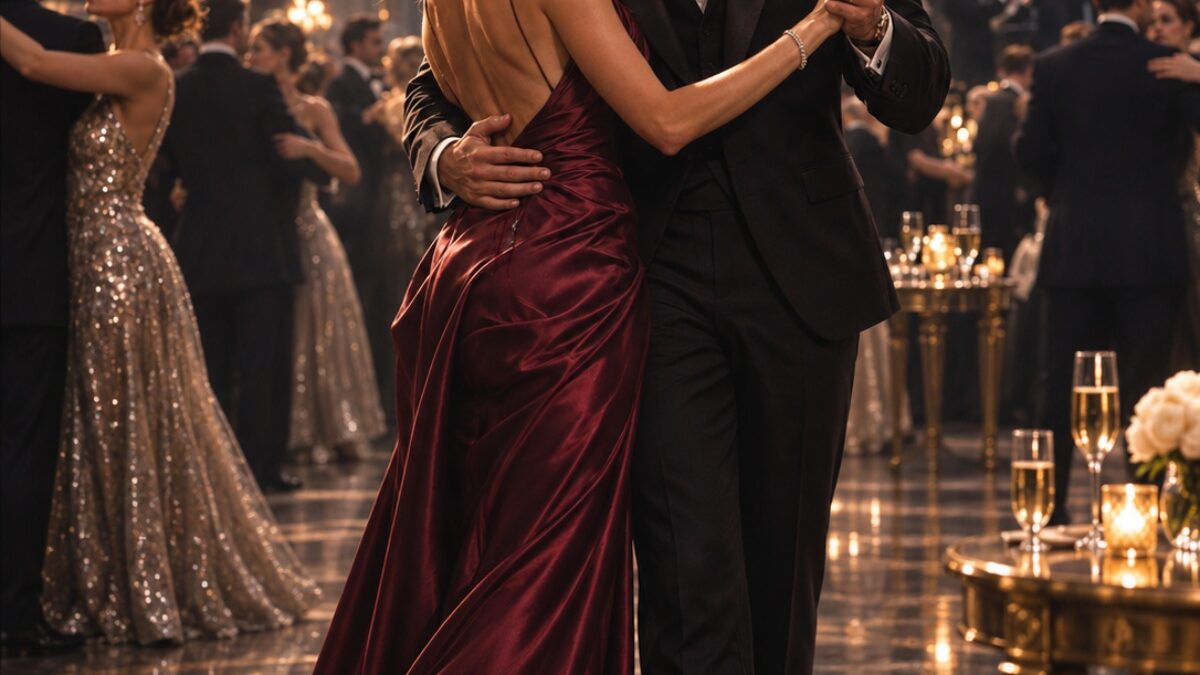
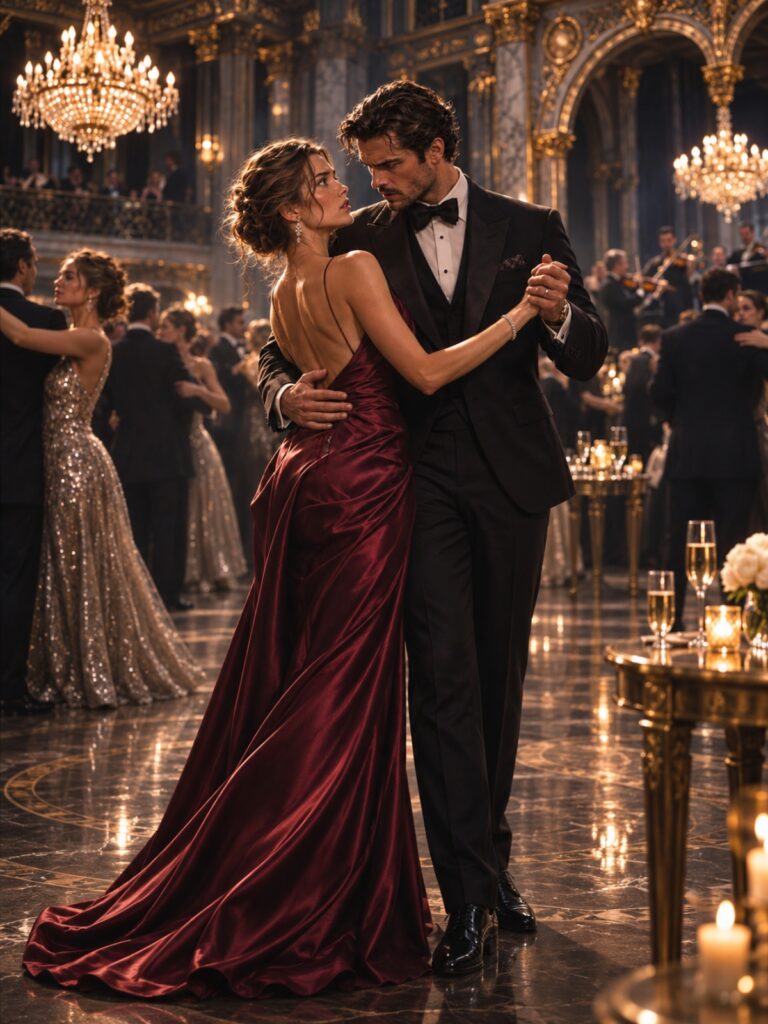
On the third turn, Rocco took his hand off his wife’s back and saw blood shining between his fingers. Nora kept smiling at him with the same tenderness she’d shown when he walked into the Crystal Room, as though he’d come home from a long trip and they finally had four minutes to themselves. Then he felt how hard she was hanging on to his shoulder. A photographer at the edge of the dance floor lowered his camera, checked the picture he’d just taken, and raised it again.
Snow was coming down beyond the tall windows of the Hartwell Hotel on Michigan Avenue, thick enough to make the city disappear a block at a time. Inside, three hundred and twenty guests had come to hear that they’d raised two million dollars for the burn unit at Mercy Children’s Hospital. Nora had spent the evening thanking people who’d paid for equipment, promising to pass on questions she already knew the answers to, and quietly shifting her weight whenever she felt the dressing beneath her burgundy gown grow warm. She’d been on her feet for four hours. Every chair in the ballroom had a name card, and she’d have given a great deal to sit in the one with hers.
Rocco had landed at O’Hare three hours earlier, fresh from burying his uncle in Palermo. At the funeral he’d held a candle through a cold church service and tried to think of something to say about a man he had loved, feared, and eventually succeeded. He’d slept forty minutes on the flight, then gotten into a car with Aldo Ferraro and listened to a stream of gala arrangements, trucking figures, and apologies for the snow delay. One glance at Nora at the foot of the hotel stairs had brought him more relief than anything anybody had said to him all day.
She was twenty-seven, sixteen years younger than her husband, with gray eyes and auburn hair she’d had to pin up twice because her fingers kept slipping. She’d chosen the gown that morning when she realized which color could hide a spreading stain under warm ballroom lights. Rocco had always liked it for the way the silk moved when she turned. Now his hand found a stiff ridge beneath it, low on her left side, and her grip on his shoulder tightened until he could feel the pressure through his jacket.
“Keep dancing,” she murmured. “He’s watching us.” She asked Rocco to laugh as though she’d said something sweet and give her ten minutes to get him out of the room. He looked from the color on his hand to a line of cracked foundation beneath her lipstick and said, “You’re bleeding,” which earned him a look of faint exasperation. “I’m a nurse, Rocco. I know.”
He managed one more step, which gave him a view of the tables behind her. Aldo Ferraro stood near the band with a club soda, silver-haired and well dressed, the closest adviser Rocco had had in twelve years of running the Valenti organization. By a column near the east doors, Sal Brandy, Rocco’s driver since he was nineteen, wore a rented tuxedo with sleeves a little too short for him. A lean waiter held a tray of champagne near the tables closest to the stage. People kept stepping in front of him, so Rocco saw only the white jacket and the raised tray.
Rocco had spent twelve years learning how to get a frightened person out of a room without letting anyone see the trouble. A hand at the elbow, a word about the heat, a door held open at the appropriate moment. He’d done it for a judge with tremors, an alderman who thought his arrest was imminent, and a colleague whose wife had come to a dinner intending to ask a question in front of witnesses. He tried to think which exit he could reach with Nora still on her feet. She went heavy against him, and he understood that she’d been upright for the last few steps because he was holding her there.
He raised his right hand and made one short motion toward the orchestra. The conductor, who’d played Valenti weddings and funerals for twenty years, saw Rocco’s fingers and brought his baton down in the middle of a measure. The cellist finished the note the violins had abandoned, then let his bow fall. Three hundred and twenty people looked toward the dance floor, including a city councilman who still had his fork raised.
“Oh, Rocco,” Nora said against his collar as he bent to lift her. “You great idiot.” He felt the small catch in her breathing as his arm took her weight, and for a second he thought he’d hurt her worse. Then she tucked her face into his shoulder, sparing herself the sight of everyone looking.
“Mrs. Valenti is unwell,” Rocco told the room. His voice carried all the way to the tables by the windows, where the last of the champagne was still being poured. “Dinner will be served, and the bar is open. Thank you for coming out in the snow.” A woman near the door backed into a chair in her hurry to let him through, and nobody thought to pick it up.
Nora looked over his shoulder and saw the waiter set down his tray. She’d spotted him earlier, when he had looked up from pouring water and she’d caught sight of the flesh-colored bandage above his right eyebrow. Seeing him in that uniform had told her two things. Somebody had known where to look for her after the clinic, and somebody had arranged for him to walk past nearly every important person in Chicago without anyone asking his name. “The waiter,” she got out, but the next words went away with the floor.
Rocco carried her into a private parlor off the east corridor and set her down on a velvet couch with worn arms. Sal arrived behind him, breathing hard from taking the long way around the crush at the ballroom doors. Rocco asked him to shut the door and keep everyone in the hall, specifically naming Aldo because he knew Sal would otherwise make an exception for him. For a second Sal seemed to be waiting for a reason. Then the latch clicked, and Rocco knelt beside the couch.
Nora tried to pull herself upright when he asked to see the wound. “The man with the bandage just left through the service corridor,” she said, keeping her voice low. “If you can get somebody to the dock, do it quietly, because the second he knows I recognized him, he’ll tell whoever brought him here.” Rocco said her name, and she heard how scared he was by the care he’d taken to pronounce both syllables evenly. “He did this,” she told him, and reached behind her for the dress fastening.
A broad white dressing lay above her hip, its center dark enough that Rocco could see how much it had absorbed before the blood reached the silk. At the edge, where the tape had lifted, there were small, beautifully even black stitches. Nora told him there had been fourteen that morning, and the waltz had pulled three loose. He put his fingertips against the clean edge of the tape and asked which hospital she’d gone to.
“I closed it in the bathroom at Halsted,” she said. “There’s a mirror by the hand dryer, and the little light above it flickers when the heat comes on.” A brief smile moved across her face as she recalled getting furious with the light at a moment when anger was the one thing she could still summon. “I’d been awake a day and a half, and when I finished, I sat on the floor and promised myself that I could cry as much as I wanted once I got everybody through the day.”
Rocco rested his head briefly against her knee. He could remember lifting his candle to protect it from a draft each time someone opened the church door in Palermo, and how proud he’d been of getting through the entire service without his hand shaking. Now Nora put her palm on the back of his neck, and his shoulders gave a single violent shudder. “I should’ve been there,” he said, and she stroked his hair once before asking him to look at her. “I need you here now, listening.”
She’d opened the Halsted Street free clinic at five-thirty, as she did on Fridays for the night-shift workers who couldn’t make the regular hours. There was a man on the steps with snow piled in the folds of his coat and one hand pressed tight against his ribs. The wind had put out the cigarette between his fingers, and he was still holding it as carefully as though he planned to finish it. He called her Mrs. Valenti before she’d gotten close enough to see his face. When she told him to put his weight on her, he apologized twice for getting blood on her coat.
His name was Eli Brandt, and he kept the books on the trucking side of Rocco’s business, in the department Aldo ran. Rocco knew the name from reports on his desk and could picture the narrow, blotched signature at the bottom of a monthly statement. He had to work harder to remember the man’s face. Nora said Eli had brought a small drive to the clinic and asked her to keep it safe before he even let her look at his wound.
Money had been moving in ways he couldn’t square with legitimate invoices, and shipment information had been sold to the Sartori family out of Newark. Eli had told two people inside the organization that he wanted to talk to Rocco as soon as he landed. Within hours, somebody had fired through his window, and the shot had grazed his ribs as he went down. He’d made it out the back of his apartment with the drive and spent part of the night deciding whom he could approach without leading his pursuer straight to somebody else.
“Did he give you two names?” Rocco asked, though he could see from her face that she would have started with those if she’d had them. “He wanted to be across a table from you when he said them,” Nora told him. “He thought one of the men had tried to help him, and he was scared you’d go after the wrong one before he could explain.” Eli had held on to her sleeve as she worked and said something she could still hear in the exact break of his voice. “The man at your husband’s right hand will look everywhere except at his wife.”
Rocco let out a slow breath and turned his head toward the door. In public, that description belonged to Aldo, who negotiated on his behalf and knew what was in the books before they reached his desk. In private it fit Sal just as well, the man who drove him home from dinners and knew which family calls he returned from the car. One of them had picked him up at the airport that afternoon. The other had brought Nora to the gala and was standing with his back against their door.
Eli was still on the exam table a little after six when a lean man in a gray work jacket shoved his way into the clinic. He looked directly at the table, which frightened Nora later, when she had time to wonder how sure he’d been of finding his mark there. At the time she saw a knife in his hand and put herself between him and her patient. Her hand found the steel instrument tray, and the impact against the man’s face made a sound she would hear again every time she dropped a spoon on the clinic floor.
The edge of the tray had opened a cut above his right eyebrow. He caught her in the side before he left, and she remembered waiting for him to come back through the door while Eli lay on the table, asking if she could reach the phone. The clinic smelled of disinfectant and wet wool, and the white clock over the sink was still losing three minutes an hour as it had all winter. “Somebody was supposed to come in at seven for his blood pressure,” she said, bewildered by what her mind had kept from those first few minutes. “I remember being worried he’d walk in and think we were closed.”
Rocco reached for her hand, but Nora was studying the carpet, where a single drop had landed near the toe of his shoe. “I got Eli out in the clinic van,” she said. “Sister Agnes took him at the hospice on Archer, under a different name, and made room for him somewhere quiet.” Rocco remembered the nun from Nora’s nursing-school stories, a small woman who’d once told a surgeon to come back when he could speak kindly to a frightened patient. At the moment she was the only person alive besides Nora and Eli who knew exactly which room they’d put him in.
Sister Agnes had tried to make Nora lie down after they settled Eli, and Nora had given her the same answer she heard five times a week from men who’d come to the clinic straight from work. She had somebody she needed to get hold of, and she’d sit down as soon as that was taken care of. Eli was awake long enough to ask whether his name would go on the door, so Nora told him the only name he needed to remember was hers. When he finally let go of her hand, she went out into the hall and tried her husband again.
Nora had called Rocco six times, starting after she’d gotten out of the clinic and ending when she was getting ready to go to the hotel. Each message was shorter than the last because she had less faith that only he would hear it. The first said she needed him to call her straightaway, and the last asked him to save her the first waltz. Rocco opened the missed messages and turned the screen toward her. Six blue marks showed that every one was still unplayed.
Aldo had met him close to the plane with a driver and a folder, and on the ride into the city he kept opening it to one new worry after another. At the hotel there had been a last-minute handoff with the gala staff, a speech suddenly missing a page, and a donor who’d waited in the side hall to shake Rocco’s hand. None of it had seemed important enough to refuse, and all of it had stopped him from having two minutes to himself. He looked at the phone until it dimmed in his hand, remembering how quickly he’d stepped into the ballroom when someone said Nora was already waiting for him.
“And I was in the car with Sal,” she said. “I sat there watching his hands on the steering wheel, thinking about the time he brought me soup when I had the flu.” She’d been so sure she knew Sal that she used to leave her shoes in his car after long dinners and trust him to bring them back, paired and clean, the next morning. On the ride downtown she’d watched him stop at a red light and thought that if he was the man who’d sent the knife, she might be sitting behind him in the last car she would ever ride in. “He asked if I wanted him to turn the heater down, and I couldn’t get enough breath to say no.”
She’d chosen the waltz because Rocco’s people would give a married couple room on a crowded floor. The music would cover low voices, and anyone watching would remember the smiles. She’d planned to tell him about Eli, about the man in the gray jacket, and about the drive before he had time to turn it into a Valenti emergency with men waiting at every door. Then she’d recognized the waiter, and suddenly the waltz was her only chance to get the whole story into Rocco’s ear while the man who’d hurt her still believed he was going unrecognized.
“You put your hand a little lower than usual,” she told him. “I was furious with you for knowing immediately.” Rocco made a sound that she would have called a laugh on a better night, and some of the tightness in her face went with it. She got both hands to his cheeks and said, “You stopped the music in front of the whole city because I was hurt, and I’m going to remember that when I’m ninety.” After a second she added, “At ninety, I’ll still want you to give me some kind of warning first.”
Two courteous knocks sounded against the door. Aldo asked whether anyone had called the hotel physician, adding that the mayor wanted to offer his own car if Mrs. Valenti needed to get home in the snow. Nora pulled one hand away from her husband’s face and clenched it around his sleeve. Rocco managed to sound faintly embarrassed when he told Aldo that Nora had skipped dinner, the excitement had caught up with her, and he’d take her home himself.
“Of course,” Aldo said, with the warmth that had made men tell him things they’d meant to take to their graves. “Whatever you need.” They listened to his footsteps go all the way down the corridor, evenly spaced, without a pause near the service door. When the sound disappeared, Rocco noticed that Nora was still holding his sleeve, and that his own hand had closed over hers.
He called Sal in and described the waiter before Nora could decide to stop him. He gave him the lean build, the white jacket, and the patch above the right eyebrow, and sent him ahead to check the loading dock while Rocco brought Nora down. “I want him alive,” he said. “And I want this kept between us, Sal, even if Aldo asks you himself.” Sal looked at the couch, then back at the man he’d driven through every kind of trouble for twenty-four years.
“Boss, I’d cut off my hand before I let anybody hurt her,” he said. Rocco answered, “I know,” and both men heard the fraction of a second he’d taken before speaking. Sal left for the dock at a run, and Rocco wondered how much of a friendship could come undone in the time it took a man to answer. Nora waited until the door was shut before she let her face show how much pain she was in.
By the time the freight elevator reached the service level, Max Kessler was on his way to the Valenti house in Lake Forest, and Sal had the armored Cadillac running by the dock. He’d found no waiter there he could bring back, and Rocco told him the rest could wait until they got Nora home. His tuxedo jacket was wrapped around her, with a coat from the hotel piled over both of them in the back seat. When Sal pulled out onto the street, Rocco could see the hotel’s upper windows for a moment through the snow and wondered whether the orchestra had started up again.
He stayed very still on the long drive north, her head against his chest, feeling every time her breath hit the open collar of his shirt. He knew how she took her coffee on Sundays and how to get her laughing when she was angry with him, yet he couldn’t have said who worked beside her on a Friday morning. In two years he’d never asked why she left the house early enough to see the sun come up over Halsted. Now he knew the name of the man she’d saved there, the number of stitches she’d needed afterward, and the exact count of messages he’d left unanswered.
Near the Lake Forest turnoff, Nora said his name so quietly he bent to put his ear beside her mouth. She asked him to say something ordinary, so he told her there was a dent in the garage door he’d been blaming on the snowplow ever since she’d borrowed his car. He felt her fingers move against his wrist, and then they slipped away. For the first time that night, he said her name and got no answer. The man at the wheel was still one of the two men she’d warned him about, and he was the only one who could get her to the doctor.
PART 2 — The Man at the Gate
The doctor was waiting upstairs in Lake Forest when Rocco carried Nora in, and she opened her eyes as he laid her on the bed. Max Kessler had made house calls for the Valentis for eighteen years, yet he still said her name twice and waited for her to focus on him before he asked anything. Rocco held her hand while the doctor looked at the wound and asked who’d done the original work. “I did,” she answered, and it was the first thing she’d said since the car turned off the highway.
Kessler examined her and told her the injury had reopened where the three stitches had slipped. He was going to repair it, start treatment, and keep a close eye on her, and he wanted her to stay in bed for ten days. “Ten?” Nora said, with real indignation, and Rocco felt so grateful to hear her complain that he almost interrupted the doctor to tell him. Kessler glanced at the burgundy dress draped over a chair and said, “We can start by ruling out another waltz.”
The work took forty minutes, and Rocco spent most of it at the window with both hands on the sill. Once, Nora made a small sound, and he turned so quickly he caught his cuff on the latch. “I’m all right,” she said before he could cross the room. He wanted to ask her to save her breath, but she was holding his gaze, and he understood she needed to see him believe her.
When Kessler had gone, Rocco brought a basin and a cloth from the bathroom. He sat on the edge of the bed and wiped the lipstick away first, then the makeup under one eye, then the little crescent of powder behind her ear. “You’ve never done this,” she said, watching him wring out the cloth. He admitted he’d spent the whole drive trying to remember what hours she worked at the clinic and had come up with a version of her schedule that was probably a year old.
“I went full-time when we lost the night shift last spring,” Nora said. “I thought you’d worry, and honestly, I was tired of hearing you tell people how sweet it was that I volunteered.” She said it gently, which made him remember how many times he’d said exactly that, sometimes while she was standing beside him. “On Fridays my first patients have already worked their shifts,” she added. “They come in still wearing their boots, and some fall asleep while they’re waiting for me.”
“I wish I’d asked,” Rocco said, and put the cloth down. He told her he’d kept the business behind a closed door because he wanted to spare her, and now he knew how that had felt from the other side. Nora had been hurt, had called him six times, and had needed a ballroom full of strangers to get a minute alone with her own husband. “You’ll have a seat at the table and the truth about what comes through the door,” he said. “Whatever you decide after that, you’ll get to decide it with your eyes open.”
Nora found his hand under the edge of the blanket and pulled him near enough to rest his forehead against hers. She’d imagined being angry with him once she was safe enough to be angry, and some of that would probably come in the morning. For now she wanted to run her thumb over the place his hand shook and be sure he could feel her doing it. “Then here’s my first piece of advice,” she said. “Keep the truth about Eli between us until you know why Aldo wants it.”
She was asleep when Rocco stepped into the hallway and found Sal waiting by the stairs. In a clear bag he held the patch the waiter had dropped at the loading dock before vanishing into a car in the alley. Sal had called the Hartwell once they arrived and gotten the banquet captain to send him the staffing paperwork. The temporary waiters all came from Lakeshore Premier Events, a firm the hotel had used for the first time that night.
“Aldo signed the contract six weeks ago,” Sal said, passing over his phone so Rocco could see the signature. There was a business registration attached, and the phone number was the same one Sal had saved for Aldo’s nephew at the vending office. Rocco read the number a second time because he knew what it would mean to put the phone back in Sal’s hand. Aldo had been on the dance floor when the orchestra stopped, close enough to see exactly where Rocco had put his bloody fingers.
“Did you think it was me when you sent me after him?” Sal asked. He kept his eyes on the bag in his hand, and Rocco could remember those same hands passing him a newborn to hold with no warning at all, years earlier, in a hospital room full of flowers. He remembered sitting with Sal on stone steps after they’d buried Sal’s father, letting hour after hour go by while they said almost nothing. None of those memories gave Rocco a kinder way to answer the question.
“For a while, I thought it could be,” he said. “I wish I’d trusted you sooner.” Sal nodded once, hard, and Rocco put both hands on his oldest friend’s shoulders while the big man stood there blinking. When he finally looked up, Sal said, “Then let me go and kill him,” with the quiet certainty of someone who expected to be granted a small favor.
Rocco took his hands away and looked back at the bedroom door. A few hours ago, that offer might have sounded like loyalty enough to end the conversation. Now he could feel Nora’s fingers guiding his hand to the dressing, and he could hear her telling him that a frightened man had saved the one thing he could carry out of his apartment. “I want Eli alive to say what he saw,” Rocco said. “And I want Aldo to have to hear him say it in a room full of people.”
At half past midnight the bell at the front gate rang. Teddy Marsh, the young guard on duty, said Aldo Ferraro was at the intercom asking to see Mrs. Valenti, with four men he described as security. Through the study window Rocco could see the faint spill of headlights across the entrance and the fresh snow between the house and the road. Aldo had driven all that way in a storm to check on a woman he’d been told had skipped dinner.
Sal put a hand on the back of a chair and waited while Rocco pressed the intercom. Upstairs Nora was finally asleep, her phone tucked beside her under the pillow and a glass of water within reach. Rocco could have asked Aldo to come back in the morning, and for a second he thought of how good it would feel to make that one small decision as a husband. Then he put exhaustion into his voice and said, “Tell Aldo I’ll meet him in the library. Open the gate, Teddy.”
PART 3 — The Call He Never Heard
While Aldo’s car came up the drive, Rocco remembered something Nora had told him before Kessler finished with her. Years ago, patients on a ward where she’d trained would learn about private room assignments before the nurses could tell them themselves. Her supervisor had given two people different details about a coming transfer and waited to see which one traveled. “People stop watching their mouths when they think they’re the last person you’d ever question,” Nora had said. At the time Rocco had been looking at the bedside lamp, thinking what a strange subject to bring up while a doctor was working on your side.
He asked Sal to keep Aldo’s four men in the main hall, where they could be offered coffee and watched in the open. He’d already asked for someone trustworthy to stay by the upstairs landing, and the door from the old servants’ stairs was supposed to be locked from below. He told Teddy that the bookkeeper they’d been looking for would come to the house himself in the morning and to send word if anybody approached on foot. The version he was about to give Aldo would put the same man in a very different place.
Aldo was standing at the library fireplace when Rocco came in, a little damp at the shoulders and holding his hands out to the heat. In that room he’d helped Rocco write the speech for a cousin’s wedding and explained, three days after the death of Rocco’s father, which men had stood at the graveside because they loved him. He’d spent twelve years learning what Rocco sounded like when he was frightened and trying to conceal it. So Rocco let him hear a little of the fear he’d actually felt in the car.
“The doctor thinks it was an ulcer,” he said, sitting down heavily. “She’s had something to help her sleep, and I’d be surprised if she wakes before dawn.” Aldo put a hand on his forearm and asked whether there was anything he could take off his mind. It was such a familiar question that Rocco could remember trying to answer it honestly on the worst days of his life.
“She mentioned somebody from your office,” he said. “Eli Brandt came to the clinic scared out of his mind, and she got him someplace safe.” Aldo’s expression held just the right amount of surprise as he said Eli had missed work since Wednesday and people were getting worried. Rocco rubbed both hands over his face and added that Nora alone knew where he was, but she’d insisted on waiting until she’d slept before telling him. “I’ll ask her at dawn,” he said, and offered Aldo a guest room for the night.
Aldo thanked him, and the two men stood for a second beside the fireplace with Rocco’s hand on Aldo’s shoulder. Rocco could smell the same faint aftershave he’d noticed in the airport car when Aldo had leaned over to offer him a page of numbers. He thought about how readily he’d handed his attention over to this man, and how long he’d called that trust. Then he turned away and left Aldo alone with one piece of information that could make him move before morning.
At 1:12, Nora opened her eyes in the dark. There’d been a sound she couldn’t place, small enough that her first thought was of the house settling in the cold. Then she saw a line of light on the carpet beside her dressing room. The narrow door there led to the old servants’ stairs, and when she’d gone to sleep it had been shut. As she watched, the line on the carpet grew wider.
Her phone was where she’d left it beneath the edge of the pillow. She found it by touch, called 911, and got the address out in a whisper, followed by, “Someone’s coming into my bedroom.” The dispatcher began to ask her a question, but Nora lowered the phone beside her in the bed. The woman’s voice faded against the blankets just as Aldo Ferraro stepped inside, still in his tuxedo and carrying a pistol.
He closed the door gently behind him and stood with the gun against his thigh. “Please keep your voice down, Mrs. Valenti,” he said. Nora had seen him carry hot plates into the dining room when the housekeeper’s wrist was in a cast, and now she was looking at the same hand with its pale crescent of a scar around the thumb. “I was wondering when you’d come up,” she said, and the calm she heard in her own voice seemed to belong to a nurse calling a patient in from the waiting room.
Aldo paused at the foot of the bed. Nora told him Rocco was downstairs with Sal and knew exactly what had happened at the clinic. For a moment he seemed to consider whether he’d misread some part of the night, and she tried to remember if the dispatcher could still hear her through the blanket. Then he looked at the narrow door he’d just used and said, “Your husband told me you’d give him the boy’s whereabouts in the morning. He believes he has all night.”
Nora braced herself against the headboard, the dressing pulling as she moved. “You’d have to know where I took him to make any use of that,” she said. Aldo told her Teddy had followed the clinic van to the hospice on Archer, and then he mentioned how long she’d spent upstairs there, almost to the minute. “The sisters are careful about what they give out,” he went on. “All I need from you is the room number.”
Only then did Nora realize how close he’d already gotten to Eli. She pictured Sister Agnes doing her rounds, her quiet shoes carrying her down a row of doors behind which people were sleeping, and the horror of somebody following her into the wrong room. Aldo said he wanted this to be over quickly and she tried to sound as if she were considering what he could give her in return. “The man you sent to Halsted,” she said. “Was I supposed to die with Eli, or did Dennis Cray come back to the gala to make up his mind about me?”
Aldo’s cheek twitched at the name. Nora had found it earlier in Eli’s records, beside payments she couldn’t fit to work any trucking company ought to need done. She’d said it now to see whether Aldo would dispute it, and instead he told her Cray was a professional who’d never had cause to take anything personally. “Brandt was a bookkeeper,” he added, as if that settled how little of the night anyone needed to spend on him. “He found a forty-million-dollar-a-year arrangement and decided your husband needed to hear about it.”
Nora asked what Rocco would have done if he’d found out, knowing Aldo would like this question better than the others. For the first time since he’d come through the door, his composure changed into something alive and almost eager. He said Rocco had been moving toward legitimate business for years, and he’d been willing to throw away the best arrangement they’d ever had because he liked the way his wife looked at him when he talked about the future. “Twelve years I’ve been with him,” Aldo said. “He was going to get sentimental and make all twelve my problem.”
“The Sartoris were going to hand him to the prosecutors,” Nora said, thinking of the figures Eli had marked on the drive. She’d spent part of the day at the hospice reading files she barely understood until she started following whose name appeared where the money stopped. “They’d keep their routes, and all the paperwork people could find would point to Rocco.” Aldo moved a little nearer and tilted his head with the look he used to give her when she had impressed a dinner guest. “You did read it,” he said, sounding genuinely pleased with her.
“It was supposed to be simple,” he told her. “Cray should’ve finished Brandt when I sent him the first time.” Nora stayed still through the silence after that sentence, afraid that her breath would ruffle the blankets and give away the little rectangle of light beneath them. Aldo seemed to see her sitting suddenly straighter and took it for shock. “Tell me where he is,” he said, lifting the pistol. “You’ve given this enough of yourself.”
Kessler had left the IV stand beside the bed, close to Nora’s shoulder. When Aldo reached for her free hand, she twisted away and knocked the stand with all the strength she had left. It fell between them and struck him, and the gun hit the floor and slid past the dresser. Nora threw herself toward the far edge of the bed, feeling something tear at her side as her knees met the hardwood. She reached for a bedpost to pull herself away, and Aldo grabbed her by the hair.
The main door flew open so hard its handle went into the wall. The pistol in Rocco’s hand fell to the carpet as he pulled Aldo away from her and drove him against the dresser. For a second Nora could hear the two men breathing and the ticking of the clock by her bed, all terribly ordinary sounds. Then she saw that Rocco had his forearm against Aldo’s throat and that the older man was losing the strength to fight him.
“Rocco, look at me,” she said. He looked at her before his arm moved, and she could see what it was costing him to stand there where Aldo could still reach for her. “I called 911 when the door opened, and the dispatcher heard Cray’s name, and what he did to Eli, and what the Sartoris were paying for.” She was holding herself up with one arm around the bedpost and could feel it starting to slide. “You can let go now. They heard him.”
Rocco eased his arm back, and Aldo slid to the floor in front of the split dresser. The old man put a hand to his throat and looked toward the bed, searching for the phone that had been in the room with them the whole time. A siren rose beyond the trees, then another, and the light on the ceiling changed as the first car turned into the drive. The first thing Rocco said was a hoarse, disbelieving, “You called the police into my house.”
“I called them because somebody was holding a gun on a nurse,” Nora said. She tried to take enough air to say it dryly, and instead her voice buckled on the last word. Rocco sank down and put both arms around her, taking care where his hands went this time, and for a moment she buried her face in his collar and couldn’t bring herself to lift it. She’d made herself a promise on the floor of the clinic bathroom that morning. Now she could finally keep it.
Sal came in with blood on his lip and reported that Aldo’s men were being held downstairs and Teddy had tried to run. The guard had drawn the man from the upstairs landing away with a story about trouble at the gate, leaving Aldo free to use the service door. Rocco understood then why he’d found the landing empty when the crash sent him upstairs from the study. He gave Sal one instruction in a voice Nora barely recognized from any other night at their house. “Show them in.”
The first officer through the door asked Rocco to move both hands where she could see them, and he did it slowly, keeping one eye on the way Nora slumped without his arm. A paramedic took his place while another person asked Nora questions she answered with her eyes closed. She opened them when they brought the stretcher and said Eli’s name, because everybody in the room seemed to be attending to her and somebody needed to start attending to him. She gave the officer Sister Agnes’s name and told her what the man from the library had said about the hospice.
The call stayed open for forty-one minutes. The dispatcher’s recording held the name of the gunman who had gone after Eli, Aldo’s own account of why he’d sent him, and the price he put on the arrangement with the Sartoris. It also held a few seconds of Nora choking on her own breath while she tried to get away from the bed. A federal prosecutor listened twice before asking to see the trucking records.
By dawn, Aldo was walking through the snow in handcuffs, still in black tie, with his silver hair sticking up where it had brushed the dresser. Rocco watched from inside while a pair of agents made their way up the drive to talk to him. The previous night he’d been listening to Aldo tell him which table the mayor wanted, and now he could see the old man lower his head to get into the back of a squad car. Aldo looked at the ground the entire way.
Sister Agnes was asleep beside Eli when authorities reached Archer, her glasses folded in her lap and his supper tray untouched on the stand. He woke around noon, ate half a bowl of soup, and gave two agents the names he’d been too frightened to say at Halsted. Dennis Cray was already in custody by then, picked up at nine at a truck stop outside Gary after an anonymous tip. The cut above his eyebrow had been freshly stitched, and the bag he’d carried into the truck stop held forty thousand dollars in cash.
At the hospital, Rocco sat beside Nora’s bed while she slept and finally listened to every message she’d left him. In the first one she sounded as if she’d had to convince herself it was serious enough to call, and in the sixth he heard the scrape of a dress hanger against the closet rod. She woke while he was sitting there with the phone in his lap and immediately asked if Eli had eaten. Rocco told her about the soup, because he knew by then it was the detail she needed. She shut her eyes again, and a few minutes later he heard her say, in a voice rough with sleep, “Half a bowl’s a start.”
For much of the following week, lawyers and investigators worked through boxes at the Valenti dining table. There was plenty in the records to make Rocco uncomfortable, including years when he’d been proud of how rarely he asked what Aldo did to make the figures come out where he wanted them. But Eli’s evidence traced the sold routes and the payments for the attacks to Aldo, whose handwriting turned up on papers he apparently believed he’d be the last person ever to see. Rocco let the investigators take what they asked for. He still woke sometimes with the sensation of Aldo’s throat under his arm, and in the quiet after waking he was glad Nora had been the one to say his name.
On the third morning after the attack, Nora sat in the glass sunroom at Lake Forest with a paperback open on her lap and eleven new stitches from the hospital. Kessler had threatened to resign if she so much as got her own coffee before Tuesday, and she was considering an argument based on how many people had threatened to resign from the clinic and then come back the following day. Rocco brought her a cup before she had to test it. He sat beside her without speaking for a while, watching sunlight touch the icy edges of the terrace railing.
“There’s a company in Zurich that’s wanted the shipping division for three years,” he said at last. “I could sell it by spring, and the trucking too, and we could go anywhere you like.” He tried a farm in Tuscany and a house in Wisconsin where nobody would recognize the name on the mailbox. He’d thought a great deal about those places since the hospital, mostly about the ordinary sounds he imagined hearing while she slept in either one. When he finished, she held her finger in the book to save her place and asked whether he actually wanted to go.
“I want you safe,” he said. Nora waited, her finger still between the pages, and eventually he understood that she would give him as much time as he needed to answer the question she’d asked. “I don’t know who I’d be if I left it all behind,” he said. “I’d go if you asked me, and some mornings I’d wake up wishing I could come back, and I would probably be ashamed to tell you that.”
Nora closed the paperback. “Sell the shipping business and the trucking if the sale is clean,” she said. “Close the rackets, get out of the docks, and keep the construction crews and the real estate company working.” There were people who drew legitimate paychecks from the businesses they could keep, and she wanted him to know their names with the same ease with which he knew the men who came to their door at midnight. “And I want every book on this table, including the ones you think I’ll wish I’d never opened.”
He let out a breath that moved the coffee in the cup. “You want to audit the Valenti family?” he said, and she could hear him reaching for the easier part of the conversation while his hand stayed open for hers on the blanket. “I started already,” she told him. “From what I can make out, you owe the IRS about four hundred thousand dollars in penalties.”
For a second he stared at her, and then he laughed hard enough to send two sparrows off the railing. Nora laughed with him until the stitches pulled, and he lowered his head and waited for her to tell him where it was safe to put his hand. “If I stay, I stay as your partner,” she said when she could breathe easily again. “The next time somebody tries to hurt either of us, you tell me first.” He kissed her knuckles and gave her his word there would be no more locked doors.
In April, a hundred people came out on a cold, bright morning for a ribbon cutting on Halsted Street. Crocuses had come up along the sidewalk, and somebody had scrubbed the salt stains off the steps where Eli Brandt had waited in the snow. The plaque beside the new entrance had his name on it, and he stood near enough that visitors could read the name and shake his hand without taking a step. Aldo Ferraro had been convicted on every count two weeks earlier, Cray was cooperating with investigators, and more indictments were reaching the Sartori operation in New Jersey.
Nora wore a plain navy dress that let her move easily while she talked to patients. A group from Mercy’s burn unit cheered when she finally found the oversized scissors, and a photographer asked her to turn left. She turned and saw Rocco at the back of the crowd in an ordinary gray suit, with Sal beside him holding a handkerchief the size of a dinner napkin. Sal mouthed something about pollen, which made her laugh just as the photographer took the picture.
Rocco stayed at the edge of the crowd until the last photograph was taken and the clinic door stood open. Then he came in and listened while Nora showed him the waiting room and told him which chair the night-shift workers liked best. They stood side by side while she explained why the new exam rooms had windows, and he asked what time she needed to be there on Friday. When she told him, he took out his phone and put it in the calendar himself.
That evening Nora found the oldest of the Valenti ledgers waiting beside two cups of coffee. Rocco had brought it out of his study and pulled a chair up next to hers. She put her hand on the cover, and he laid his palm on the table where she could see it, steady at first and then trembling. “Before you open that,” he said, “there’s something about the first year I’ve never told anyone.”