The CEO Walked Into the Ice Cream Shop — Then Froze When He Saw the Single Dad With His Daughters!

The Billionaire Paid $50 for One Scoop of Strawberry. The Man on His Knees Had No Idea Who She Was
Vivian Ramos paid fifty dollars to cut in front of a baseball team because a five-year-old had just lost her ice cream.
The girl’s father was on his knees in the middle of the mess, saying the one thing nobody had thought to say to Vivian all day.
Before she made it back to her merger meeting, she would have to turn around and ask him for something she was terrified he might refuse.
PART 1 — The Man Who Knelt in the Strawberry
Vivian was three blocks from a board meeting she would have paid good money to forget when Chicago dumped half the sky onto her twelve-hundred-dollar loafers. The rain came down so hard that the man in front of her gave up trying to open his umbrella and ran with it still folded under his arm. She watched him disappear into a lobby whose doors required a badge, then looked at the nearest place she could get inside without explaining herself. A handwritten sign under a faded neon awning promised fresh waffle cones. She ducked under the awning just as water found the gap between her collar and the back of her neck.
The bell above the door rang with a bright, unnecessary cheer. Vivian stood dripping onto black-and-white linoleum and studied the painted script behind the counter, which identified the place as Sullivan’s Sweet Shop and looked as though somebody had last touched it up in 1994. The room smelled of artificial vanilla, coffee that had been sitting too long, and enough bleach to suggest at least one person had attempted to do something about the floor. Behind the register a teenager held his phone below counter height, the blue light playing across the front of his shirt. He gave her the small upward nod of somebody who sincerely hoped she was just there to wait out the weather.
She needed somewhere to read sixty pages of merger language, ideally somewhere that served a martini, and the only vacant booth had a rusting napkin dispenser and a table that caught at the cuff of her trench coat. She slid into it anyway and counted three missed calls from her CFO and two from her attorney. She muted the phone, set it face down, and pressed her tongue to the back of her teeth until she remembered how to unclench her jaw.
At thirty-four, Vivian had spent nearly a decade building Ramos Logistics into a company large enough for people to use the phrase supply chain empire with a straight face. She’d once tracked trucks on two borrowed monitors that showed different shades of white, in an office so small that when a driver came in to dispute a mileage reimbursement, she had to move her chair to let him shut the door. She understood why a missing trailer could get a dispatcher in Ohio out of bed at four in the morning. What she understood less and less was why grown men could spend two hours in a room arguing about a broken system and still come out speaking as though the personnel inside it were an expense line that had misbehaved.
She also understood the temptation. A spreadsheet had the advantage of going quiet when she closed it, and there were entire categories of disappointment she’d learned to close down nearly as neatly. She’d stopped playing tennis after a client started requesting Friday morning calls, discovered she could go months without inviting a friend over, and once taken a conversation with her former fiancé at the kitchen counter because the timer on her oven was about to go off. He’d said he had begun to wonder if she was capable of feeling bad for anybody who couldn’t help her. She’d taken out the salmon, turned off the oven, and explained why he’d picked the worst possible moment to ask her that.
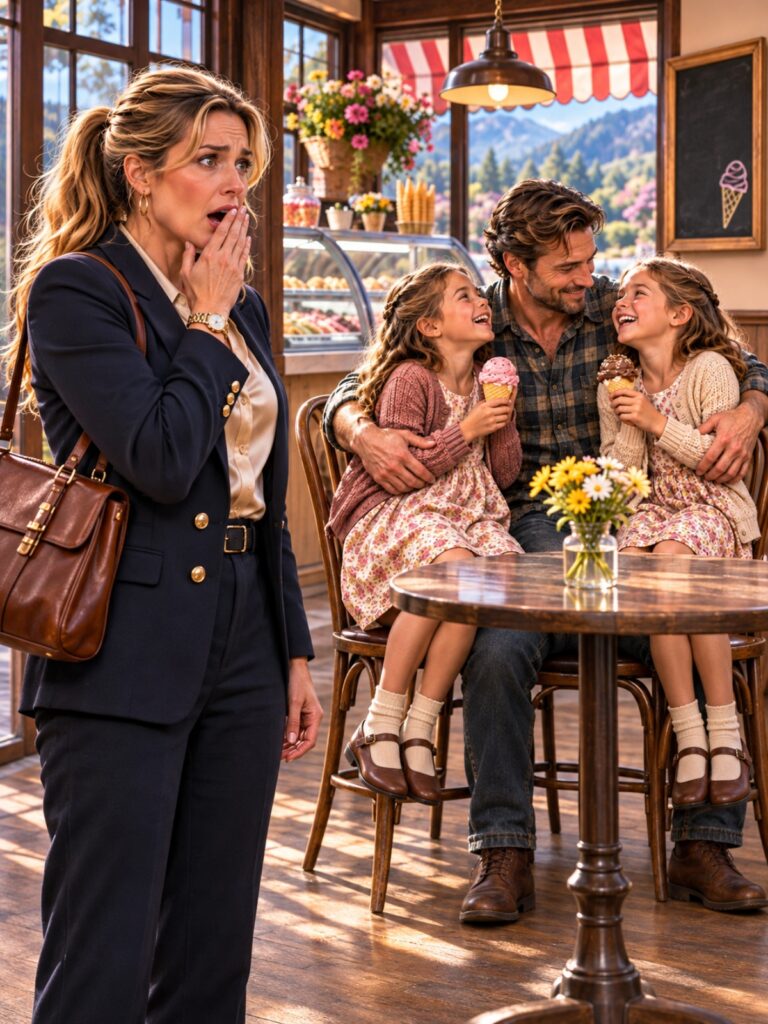
Now, in the booth, she opened the merger document to a section she’d marked in the morning and got as far as the words “in accordance with” before a girl’s laugh cut across the room. It had a sharp little hitch in the middle, as though the thing she was laughing at kept surprising her all over again. Vivian looked up, prepared to register exactly how far away the noise was and decide if another table would help. By the window, a dark-haired man in a faded green flannel was listening to an eight-year-old make a point with her spoon. A smaller girl in a yellow raincoat was trying to hold both a waffle cone and a second spoon in the same hand.
The man looked to be in his late thirties and had a faint smear of what might have been white paint along his jaw. His eyes had the bruised look Vivian recognized from walking past her own bathroom mirror after three hours of sleep. He’d shoved one sleeve halfway up his forearm and left the other hanging at his wrist, and a set of car keys sat beside his elbow within range of a creeping ring of condensation. He noticed the water, lifted the keys, and slid a napkin under the cup while keeping his attention on whatever the older girl was saying. Vivian had been on dates with men who checked the time during stories they’d asked her to tell.
“Dad, if a zombie bites a vampire, does the vampire become a zombie, or does the zombie just get really cold?” the older girl demanded. She was digging chocolate chips out of her mint ice cream and arranging them in a precise arc around the rim of her paper dish. Her father leaned back and said, “That’s a jurisdictional nightmare, Maya,” in the tone of a man who’d hoped to leave the office before exactly this sort of question came in. He considered her theory another moment before giving his opinion. “If it’s a virus, you’ve got an already-dead vampire, so probably nothing happens, but if it’s magic, I think you’ve got a cold zombie.”
Maya thought about it long enough that Vivian nearly went back to reading. Then the girl nodded and moved a chocolate chip to the far end of the arc, apparently satisfied that the essential problem had been settled. Her father picked up a stray bit of waffle cone from the table and ate it when neither child was looking. For a second he caught Vivian’s eye across the shop, and she made the small, stern adjustment to her face she used when caught reading a stranger’s name badge. He’d already turned back to the girls by the time she made it.
She lowered her eyes to section 4B. Somebody that morning had called the liquidation of physical assets a clean break. She knew what the other side was asking for, and she knew what a clean break could cost the people still loading trucks while everybody above them discussed eliminating duplication. What she hadn’t found was a way to protect the parts that worked without accepting responsibility for the parts that didn’t. She highlighted the sentence that would let them shut the facilities down.
A dog went past the shop window, its belly barely clear of the puddles. The little girl in the yellow raincoat lifted her spoon to point it out, forgot she had a cone in the other hand, and tilted the whole thing in the direction of the glass. Vivian caught the movement at precisely the wrong moment to do anything about it. The pink scoop eased away from the edge of the waffle cone, hung there for the fraction of a second in which a person can still believe disaster might reverse itself, and landed on the floor with a flat, heavy splat. The girl held the empty cone in front of her face.
Vivian set her finger against the volume button on her phone with the reflex of somebody who’d spent too much time trapped on planes. She’d watched men twice her age go red in the face because a truck hadn’t cleared a loading dock before midnight. She could pick out the tiny sequence at the start of a tantrum, the long stare, the mouth pulling out of shape, the alarming breath. The little girl got as far as the breath, and then her father slid out of the booth and got down beside her. One knee went directly into a splash of strawberry.
“I know, Bug,” he said before she could speak. “It’s a real, actual tragedy.” The little girl made a broken sound and got out the words “It fell,” with the particular bewilderment of somebody who’d been holding a thing exactly the way she’d been told to hold it until a dog came along. Her father took the empty cone from her when she let him and set it on a napkin. “It sure did,” he said. “Gravity’s undefeated, and it gets the best of us.”
The girl reached for the scoop, which was losing its shape in front of her. “I want it,” she said, and when her father gently put his hand in the path of hers, she held on to his thumb with just two sticky fingers. “I know you do, Chloe,” he said. “It belongs to the floor now, because the floor was hungry.” Chloe considered this through a tear that had reached the end of her nose. “Is the floor happy?”
“Overjoyed,” he told her, wiping her cheek with his thumb. He stayed where he was until her breathing slowed enough for her to hear him offer to negotiate a replacement. Then he waited a little longer while she looked him in the face and decided whether to believe him. From across the room Vivian saw the moment the girl trusted that he understood what she’d lost. It came before he promised her anything else.
Vivian’s tablet went black. In the screen she could see the reflection of the hand that had been holding her phone, braced and ready to turn something up loud enough to drown out a little girl. She laid the phone down and watched the father pull a mass of brown napkins from the dispenser. They were the thin kind that shredded when they got wet, and he had to go back to the dispenser twice before he had anything he could use to lift the mess instead of pushing it from square to square. Maya held a clean napkin out for him without looking up from her dish. He reached behind himself, found it on the first try, and gave her shoe a grateful tug.
Then the front door opened and a dozen wet baseball players came in all at once. A coach tried to count heads over the sound of cleats and equipment bags, and somebody asked whether they took a team discount, which prompted the teenager at the register to set his phone down for the first time since Vivian had arrived. He opened one side of the ice cream case and stood there waiting for a boy to decide between cookie dough and cookies and cream. Vivian looked at the end of the line. Then she looked back at Chloe, who was holding her empty cone again with both hands.
She had forty minutes to get to the office. The normal thing would have been to take her tablet, wait another minute for the rain to ease, and leave the family to settle the question of strawberry among themselves. She might have done exactly that if Chloe had been screaming, or if her father had looked up and tried to recruit her into the situation. He was still on the floor, using the clean corner of a filthy napkin to get at one last pink streak in a seam in the linoleum. She watched him reach for the dispenser again, and before she’d decided what to say, she was on her feet.
At the counter she tapped one nail against the laminate and asked the teenager for a single scoop of strawberry in a waffle cone. He pointed down the line with his scoop and said, “Uh, there’s a line,” which was both true and a fair description of where she ought to have been standing. Vivian took a crisp fifty out of her wallet, flattened it on the counter, and said, “Keep the change. The cone, please, now.” A boy with red piping on his wet uniform stopped swinging his helmet and stared at the bill. For once, Vivian suspected the person silently judging her had the better argument.
Thirty seconds later the teenager handed her a fresh scoop of strawberry in a waffle cone. He’d given her so much it leaned over one side, and she turned the cone around to balance it as she walked toward the booth. There was a cold, sweet smell coming off it that brought back a summer afternoon she’d spent as a child trying to finish an ice cream before it ran down to her wrist. She could remember the ring of damp paper around the cone and the terrible feeling of seeing a drop reach the back of her hand when she still had half the scoop to go. Until that second, she’d remembered almost nothing about the afternoon in her own life when that had happened.
The man looked up with pink-stained napkins cupped in one hand. It took Vivian an absurd amount of concentration to extend her arm toward a child. “I believe this is for you,” she said, glancing at the father first and waiting until he gave her a little nod. Chloe took the cone with both hands, let out a nearly inaudible “Whoa,” and raised her eyes to Vivian’s face. At her father’s quiet prompting, she said, “Thank you, lady,” with great care, as though the words might tip the scoop if she spoke them too fast.
“You didn’t have to do that,” the man said as he got to his feet. Up close, his eyes were warm hazel, and he was taller than she’d expected from the way he’d folded himself into the booth. He wiped his free hand on his jeans, a gesture that accomplished very little. “But thank you. I was about three seconds away from offering her my wallet to eat instead.”
Vivian said, “I’ve seen executives handle losses with a lot less grace,” and half expected him to ask which executives, in which industry, at which company. He looked down at his knee, where the strawberry had soaked through, and gave a short laugh. “I hear toddlers and CEOs have about the same level of emotional regulation.” He said his name was Abbisai, started to hold out a hand, and pulled it back when he remembered what was on it. “Actually, don’t shake that. I’m currently thirty percent corn syrup.”
“Vivian,” she said, and reached for his forearm just above the wrist. It was the sort of handshake she might once have given a driver who’d just climbed out of a cab with both palms black from checking a belt. Abbisai looked at her fingers where they curved briefly around his sleeve, then came back to her face with just enough amusement for her to know he’d felt the strangeness of it, too. Behind her, a catcher dropped his equipment bag onto her table so hard the napkin dispenser jumped. Her tablet was underneath one of the straps.
“Would you like to sit with us?” Abbisai asked as she retrieved it. He tipped his head toward the open seat beside Maya, who moved her ice cream an inch in the opposite direction. Through the front window Vivian could see the rain thinning to a drizzle and people beginning to risk the sidewalk again. She had her tablet in her hand and a clear path to the door. All she’d meant to give this family was one scoop of strawberry, and now she was standing beside an empty seat afraid of how much she wanted to take it.
PART 2 — The Number on the Brown Napkin
Vivian set her tablet down, took off her wet coat, and slid in beside Maya. The girl waited until Vivian had settled before pointing her plastic spoon at the lapel of Vivian’s jacket. “Why are you wearing a suit?” she asked. “Are you going to a funeral?” Abbisai rubbed the bridge of his nose and said, “Maya, we talked about interrogating strangers,” with the resignation of a man who knew how many more times he was going to have to say it.
“It’s a fair question,” Vivian said, mostly because she wanted to see what the next one would be. She explained that she’d just come from work, which led Maya to ask whether she worked at a bank. “I run a logistics company,” Vivian said, and Maya gave her the look a banker would have hidden if Vivian had started an answer with a term somebody in his line of work was expected to understand. The refrigerator motor cut off, and she could hear water running through the gutter.
“Think about the milk and the sugar that went into that ice cream,” she tried again. “Somebody has to get them from wherever they come from to wherever the ice cream is made. I make sure the trucks go to the right places at the right times, so everything’s there when somebody needs it.” Maya looked down at the softening remains of her dessert, calculating, Vivian imagined, the distance between a cow and the tip of her spoon. Then she looked up and said, with the deepest sympathy Vivian had received from anyone all day, “That sounds incredibly stressful.”
A laugh came out of Vivian before she could decide how much of one to allow. “You have no idea,” she said, and looked across the booth just in time to see Abbisai lower his eyes to his cup. She leaned back against the vinyl and let her shoulders come down. Beside her, Maya pushed a little row of chocolate chips into the melting ice cream and ate every one she’d spent the better part of ten minutes digging out.
Chloe, who had acquired a pink mustache and seemed unaware of it, wanted to know whether Vivian had an ice cream day, too. Vivian said she didn’t, and Chloe considered this such a basic failure of household organization that she looked to her father for confirmation. “It’s just the three of us,” Abbisai explained. “My wife passed away a few years ago, and since then a good part of the job has been getting everybody to bedtime. Tuesday afternoon sugar bribery buys me a little cooperation on that front.”
He said it plainly, keeping the tip of Chloe’s cone pointed up. Vivian could feel the familiar condolence getting ready to leave her mouth, and for a second she held it there. She’d paid for funeral flowers that went out with a card somebody else had signed for her, and she’d written sincere things in company emails with the benefit of a little distance between her and the person reading them. Here, across from a man in wet jeans who’d just used the words my wife, she had to look at his face while he heard her. “I’m sorry,” she said, and felt the difference in how long she let the silence after it go on.
“Thanks,” he said, softly enough that she almost missed it. He looked down at the knee of his jeans. “We do all right. We’ve got a pretty solid crisis management protocol, as you saw.” Vivian smiled at that and told him she’d been impressed, adding that she had no children, her life was very structured, and unpredictability was generally something she tried to fire.
“If I could fire unpredictability, I’d have a lot more hair left,” Abbisai said, dragging a hand over the top of his head before remembering there might still be sugar on it. Then he looked down at Chloe, who was so intent on lifting the waffle cone to her mouth with both hands that she forgot to breathe between bites. “You can’t control everything, Vivian. Sometimes you just have to kneel in the melted ice cream and wait for the crying to stop.”
The sentence stayed with her long enough for Maya to lean against his shoulder and Chloe’s yellow boots to set up a quiet little rhythm under the table. Vivian thought of the view from her penthouse at the hour when the lights came on in the buildings across the street. On the nights she got home in time to see it, she usually stayed in the kitchen, answering emails in the dark with her coat still on. There were people in those windows who got to come home and complain about something as silly as the grocery store being out of their favorite cereal, and someone beside them who knew why it mattered. She’d spent years acquiring the right to be left alone and was sitting in Sullivan’s with a man who had to wait until both his children were asleep for five minutes of it. Something about his life made her envy him so sharply that she wanted to look away.
The baseball team emptied out in batches, and cold air reached their booth with each swing of the door. Vivian’s assistant called, a name and a pattern of vibration she could identify through the bottom of her bag. She took out the phone, silenced it, and looked at the screen just long enough to see that people had already started gathering in the conference room. “I should go,” she said, though her hand stayed on the edge of the table after she’d said it.
Abbisai nodded and thanked her again for the ice cream, then added, “And for giving me time to get it off the floor before anybody called social services.” She liked that he could make her laugh at the moment she was trying to arrange her face into something she could take back to the office. She stood, drew the coat up over her shoulders, and said all three of their names in her goodbye because it occurred to her she might never have another reason to use them. Chloe waved a hand sticky enough to leave prints on the glass. “Bye, ice cream lady.”
At the door Vivian looked back and saw Abbisai wipe a smudge of strawberry off Chloe’s nose. Chloe scrunched up her whole face, and the look made him smile while his thumb was still against her cheek. Out on the sidewalk, where everyone had reemerged all at once, Vivian made it half a block before she stopped. A man’s wet umbrella brushed her leg, and she moved closer to the curb, holding the phone she’d taken out with no idea what she was going to do with it. The smell of vanilla clung to her coat, and she tried to remember when a room had last made her want to stay after she’d said goodbye.
He hadn’t asked for her number. Just inside the door she’d been relieved about that, because turning him down would have put an ordinary, irritating end to an afternoon she hadn’t expected to mind remembering. Now she had to look squarely at the fact that she’d walked away before he could ask anything, and that even after she’d done it, she was standing in the street waiting for him to make the next move. She knew the expression people used when they were about to give her an answer she’d made it impossible for them to give honestly. She wondered if she’d worn that expression herself when she said goodbye.
She turned around. When she opened Sullivan’s door again, the bell sounded vastly louder than it had the first time, though of course it was exactly the same bell. Abbisai was wrestling one of Chloe’s arms into a puffy pink coat, with the yellow raincoat gathered beside him, and Maya was in the middle of a battle with her zipper. He stopped with a hand on the cuff, holding Chloe’s sleeve so that the end of it stuck out empty. “Forget your tablet?”
Vivian shook her head and came as far as the end of their booth, leaving a little space between herself and the family preparing to go home. “I don’t like leaving things unfinished,” she said, hearing, with dismay, how much it sounded like the beginning of a meeting. Abbisai eased Chloe’s hand through the cuff and ran a palm over her shoulder to straighten the coat. “The floor’s clean,” he said, looking up at Vivian. “The ice cream’s secure. You’ll have to tell me which thing.”
So Vivian told him she evaluated risk for a living, that she spent her days looking at the variables in a situation and deciding whether a likely return justified the cost. She heard herself explain that ten years of minimizing her liabilities had left her with a very quiet, very clean life. It was an uncomfortable amount to say to a man whose last name she didn’t know, particularly with the folded umbrella of a customer bumping gently against the back of her leg. “And when I walked out of here,” she said, “I felt like I was walking away from a high-yield asset.”
Maya finally got her zipper to the top. “Are you guys doing a business deal?” she asked, twisting her head to see whether her father was looking at the woman or at her. “Something like that,” Abbisai said, his eyes still on Vivian. There was a small space after he said it in which Vivian could have rescued herself with a joke. Instead she said, “What I mean, Abbisai, is that I want your phone number, and I didn’t want to get three blocks down the street and realize I’d let the chance go by.”
Abbisai let his hand fall from Chloe’s shoulder. “I have two kids,” he said, low enough that his daughters could keep talking to each other over the top of it. “I work forty-five hours a week teaching high school history to kids who’d rather be on their phones. I get up at five to make lunches, and my car makes this terrible grinding sound when I turn left.” He glanced at the pink now set into the fabric at his knee, as if that were the day’s smallest piece of evidence. “Even on a good day, Vivian, my life is chaos.”
“I know how to manage chaos,” she said, so quickly she could have been responding to an objection from somebody paid to come up with one. He gave her the same attentive look he’d given Maya before answering her question about the vampire. “This isn’t a supply chain. You can’t optimize grief or put a five-year-old’s tantrum in a spreadsheet.” He let her hear it without doing anything to soften it, and she was grateful to him half a second before she was ready to be grateful.
“I’m asking for a cup of coffee,” she said, leaving a little pause while the heartbeat she could feel in her neck settled enough for her to speak normally. “A weekend when you have a babysitter would be great. I know you’ve got a whole life going on, and that’s yours. You get to tell me whether coffee fits anywhere in it.” The last time she’d felt this naked waiting for an answer, she’d been pitching the first people who could put money into her company, and even then she’d had figures she could lay on a table while she waited.
The corner of his mouth moved before the rest of his face did. He reached into his flannel pocket for a cheap plastic pen, drew one of the thin brown napkins from the dispenser, and smoothed it along the edge of the table. Vivian could hear the ballpoint skip where his hand traveled over a crease. When he gave it to her, he kept hold of one corner for a second and said, “I drink the stuff that tastes like battery acid and keeps you up for three days. Can you work with that?”
“I can lower my standards,” Vivian said, which made him laugh once, quietly. She folded the napkin and put it into her coat pocket, then told Maya and Chloe goodbye again. “Bye, business lady,” said Maya, already helping her sister steer a sticky collar away from her face. Vivian walked out to the curb, hailed a cab, and saw as she slid onto the back seat that she was going to be exactly four minutes late.
On the forty-second floor of the Ramos Logistics Building, fourteen men in tailored suits looked up as Vivian walked through the glass conference room door. Behind them Chicago looked washed and hard-edged, and the air had the oddly intimate smell of too many kinds of expensive cologne confined in one place. She set her tablet at the head of the oak table, slipped her coat over the back of the chair, and listened as her lead counsel picked up where they’d left off. “We were on section 4B,” he said. “They’re digging in. They want the existing infrastructure torn down.”
Her morning notes were still there, one neat highlight across a sentence that had been easier to mark than to answer. She thought about the facilities by name, about how long new capacity took to build and who the customers would call when their shipments sat somewhere the plan said they could no longer sit. She’d had an argument ready for keeping the schedule manageable and another for protecting the company if transition costs ran high. Sitting there with the room waiting, she thought instead of Abbisai’s knee going straight down into the strawberry and how much he’d managed to learn from Chloe by staying long enough to listen.
“We keep the existing infrastructure,” Vivian said. She pulled the tablet toward her and laid a finger beside the liquidation clause. “We absorb it and restructure the management. The facilities are still doing work we need done, and I want that work to continue while we change who’s responsible for it.” Her lead counsel took his glasses off, a small maneuver that gave him an extra second before anybody expected a response.
Her CFO broke the silence. “Vivian, that’s messy. We’d inherit their legacy issues, and we’re going to spend weeks figuring out what they really are.” He was looking at her with the frank alarm of a man reminding her of her own instructions, and she understood why. She’d rewarded him for anticipating everything that could go wrong during a changeover and penalized people who showed up with optimism where a cost estimate should have been.
“I can handle unpredictable,” she said, reaching back to touch the napkin in her coat pocket. “Put the management changes in the counteroffer and bring me the problems you can identify now. When we find more, we’ll deal with those too.” Her lead counsel put his glasses back on and opened a fresh document. For the first time that day, somebody in the room asked what it would take to keep the freight moving.
Later, alone in the elevator, Vivian entered Abbisai’s number in her phone and typed, “It’s Vivian. I’d still like that coffee.” She sent it before the doors opened, then got all the way out to the curb before going back to the screen. “Good,” he wrote. “I was starting to worry I’d oversold the coffee.” They went back and forth around his school schedule and the weekend the girls already had plans until, two weeks after she’d walked into Sullivan’s, there was a Saturday morning they could both protect.
The night before, Vivian was in her kitchen with the lights off, looking out past her own reflection, when his name appeared on her phone. She’d been expecting a time and place, and for a moment that’s what she thought she was reading. Then her eyes went back to the beginning of his message. “Vivian, I think I might have to call it off.”
PART 3 — The Stain She Couldn’t Get Out
The rest of the message came while Vivian was still looking at the first one. Mrs. Higgins had the flu, the backup sitter had a college midterm, and Abbisai was explaining the sequence in the careful order of somebody who’d tried all his options before involving her. He said he’d be taking the girls to a park in Evanston the next morning. He could bring a second coffee if she felt like coming, though he would completely understand if she’d rather pick another day. Vivian sat down at the kitchen counter, where nobody could see the relief on her face, and typed, “What time should I be there?”
She’d dressed for a Saturday morning in dark straight-leg jeans and a thick cream cashmere sweater, the most ordinary-looking expensive clothes she owned. The sweater had cost more than the rent on her first apartment, and when she’d pulled it over her head she’d tried to remember how she’d justified that to herself. Something about buying a piece that would last. She’d moved the brown napkin from her trench coat to her jeans before leaving home, even though Abbisai’s number had been in her phone for nearly two weeks. It felt more personal than the name on her screen.
The park’s oak trees were beginning to lose their leaves. The biggest one had a trunk that split low enough to make a seat, and Vivian stood beside it on a morning so bright she could see the threads of a spiderweb between two bare branches. A toddler in a striped hat kept trying to climb up a slide from the bottom while a bigger child descended in fits and starts, turning sideways to miss him each time. The toddler’s father was holding a travel mug in one hand and the child’s empty mitten in the other, making the same reasonable argument over and over without effect. Vivian was halfway to stepping in when the bigger child figured it out, scooted to one side, and let the toddler climb.
“You look like you’re about to fire the jungle gym,” Abbisai said behind her. She turned to find him carrying two enormous paper cups, holding them apart with his fingers splayed to survive the heat. In the green flannel at Sullivan’s he’d looked as though he’d been awake for a hundred years. In a faded gray zip-up hoodie over a thermal shirt, with the sun on his face, he looked like a man who’d been looking forward to a Saturday morning.
“I was just looking at the swing set,” she said, taking one of the cups. The seam in the cardboard was too hot to hold in one place for long, and she switched hands. “It has the structural integrity of a lawsuit.” Abbisai followed her gaze, considered the rust at the base of the post, and said, “It builds character and, potentially, tetanus immunity.”
Then he pointed out Maya, hanging upside down from the monkey bars with the ends of her hair brushing the wood chips. Chloe was in the sandbox trying to bury a plastic dinosaur so capacious that its tail kept sticking up no matter which end she started with. Watching Abbisai watch them, Vivian noticed that he knew how to tell when one of the girls had wandered out of his line of sight. His eyes would go back to the spot where he’d last seen her, then take in the space around it in a wide, unhurried arc. Somebody had taught him that by being five and fast.
“I thought you might get a sitter after all,” Vivian said, nodding toward the playground. He shook his head and leaned against the oak, his boots pointed in slightly different directions. “I called Mrs. Higgins back to see if she needed anything from the store and somehow she apologized to me again.” He brought his cup to his mouth and lowered it without drinking. “I was going to cancel, and I really didn’t want to.”
“I’m glad you didn’t,” Vivian said. To give both of them somewhere else to look, she took a sip of the coffee. It tasted like badly burned toast with the sweetness of a cheap pancake syrup she might once have found in a motel breakfast room. Abbisai waited for her to swallow and lifted both eyebrows, and she took a second sip with her eyes on him. He turned toward the playground before she could see how much that pleased him.
They settled on a splintering bench near the sandbox. The bench was damp, so they both edged toward the middle. For a while they drank their dreadful coffee and watched Maya lower herself from the bars one carefully timed hand at a time. Vivian usually kept a running account of how much silence she could use in a conversation before someone else rushed to fill it. Here she was curious how long she could leave it alone before the woman beside Abbisai felt entirely like herself.
“So,” he said eventually, looking over the playground rather than at her, “you run an empire. I figure you usually date men who own yachts and bring up cryptocurrency before dessert.” Vivian could tell from the way he said it that if she laughed at the wrong part, he’d laugh along and drop a question he genuinely wanted answered. “I usually don’t date,” she said. “When I did, there were men who wanted to know who else I’d invited before they said yes to dinner at my place.” She took another sip and added, “You can ask why I came if that’s what you want to know.”
He turned his cup in his hands. “Why’d you come, Vivian?” At her office, she would have been able to buy five or six seconds with a joke. She looked instead at the line of wet leaves that had accumulated beneath the bench and found she could answer with the word that had been in her mouth since the night before. “I’m tired.”
Abbisai waited. Vivian had meant the kind of tired a person felt after years of arranging her days so that nobody could surprise her, but she’d never spent enough time thinking about it to know what that sounded like outside her own head. “I built a company,” she said. “Then I got very good at coming home to rooms where everything was exactly how I’d left it. I turn out lights I never turned on, because the clock did it for me, and sometimes I get all the way to bed with my phone still in my hand because there’s nobody to say good night to.” She shifted her cup to the other hand and realized she was looking for a dry place to set it down while she told him things her former fiancé had practically begged her to tell him.
“And I’m bored, which sounds ungrateful as hell,” she said, surprised by how quickly the admission followed the first. “I know exactly what I want to happen when I walk into a room these days. Then I saw you get down on that floor, and I couldn’t guess what you’d do next, and every single thing you did made sense as soon as you did it.” She could see in his face that he remembered kneeling there and remembered the cost of standing up again on those particular knees. “You were so tired, Abbisai, and Chloe still knew exactly where to look when she needed somebody. I wanted to sit next to you because I wanted to know how you managed that.”
His face changed without much movement. He rested his elbows on his knees and took a moment to see where both girls were before he answered. “Some days I turn around and count to ten,” he said. He tried for a smile, then let it go. “My girls have lost enough, Vivian. When they start expecting to see somebody, I have to be able to tell them why that person keeps showing up.”
She could hear the park around them in the pause he left. The cheap chain on a swing squeaked at regular intervals, and someone dumped a handful of stones out of a small shoe. Abbisai straightened and looked at her full on. “If you came because our life looks interesting from the outside, that’s one thing,” he said. “But there’s going to be a day when it looks like laundry and a kid who won’t let you take a brush through her hair. If what you want is a morning away from your own life, I need you to walk away while this is still one morning.”
Vivian set the coffee on the bench between them. A little stain of its own was growing under the cup, dark enough to follow one grain in the wood. She remembered the ease with which she could have left Sullivan’s, and how relieved she’d been for those first few steps when nobody had stopped her. Abbisai was giving her the same freedom now, with the added difficulty that he knew what she stood to lose and was letting her make the choice anyway. She understood why he needed a real answer and let herself sit through the uncomfortable part of finding it.
“When I invest, I hold,” she said at last, and saw him open his mouth to object before she lifted a hand. “I know how that sounds coming from me. I’m trying to tell you I’ve stayed through some very bad days when leaving would’ve been easy, and I’ve never once wished I’d run because somebody needed me on a Tuesday.” She waited until he looked at her again. “If a date gets complicated because one of your girls needs you, we can figure it out. I came because I want the chance to keep coming.”
He searched her face for long enough that Vivian could have filled the pause three times over. She wanted to tell him that she already knew which daughter would tell her outright if she did something wrong, and which might just get quiet until she figured it out. She wanted to ask how long it took Chloe to get her two mittens on and whether Maya had any other questions about the division of powers among the undead. None of those things could establish how she’d behave when life became inconvenient. She sat where she was and let him see what he’d asked to see.
“Dad!” Chloe sprinted across the grass with a yellow boot swinging wide on each stride. She reached the bench faster than she’d reckoned on and crashed into her father’s knees, sending coffee up through the hole in his lid. Abbisai caught her with one forearm and held the cup far enough away that the spill hit the ground. “Whoa, Bug,” he said, and Vivian could hear in those two words the same immediate attention she’d heard over the sticky linoleum. “What’s the emergency?”
Chloe opened an extraordinarily muddy fist to reveal a gray rock. “I found a dinosaur egg,” she announced, still short of breath from the run. Abbisai lowered his head for a closer look and told her it was a spectacular specimen, and Chloe beamed until she noticed the person at the other end of the bench. “You’re the ice cream lady,” she said. Then, suspiciously, “Where’s your suit?”
“At home,” Vivian said, leaning forward until she could rest her elbows on her knees. Up close she could see a yellow curve of dried leaf stuck to the cuff of Chloe’s jacket. “I thought I’d wear normal clothes today.” Chloe reached out and tested the truth of this with the tip of one finger, leaving a distinct brown streak on the sleeve of Vivian’s cream sweater. Abbisai sucked in a quick breath and said, “Chloe,” in a voice that had already started apologizing.
“It’s fine,” Vivian said, and heard, too late to alter it, how quickly the answer had come. A few weeks earlier she’d moved an entire stack of papers because somebody had set an unopened water bottle too near the cuff of her jacket. Now she looked at the precise whorl Chloe’s fingertip had left on the cashmere and turned her arm so the girl could balance on it while standing on the tip of one boot. “May I see the egg?” she asked.
Chloe looked at her father, who appeared to be waiting to learn what kind of negotiation this was, then put the rock in Vivian’s palm. It was ordinary park gravel on a scale just large enough to be astonishing to a person who spent a lot of time being told to leave things where she found them. It was also as cold as if Chloe had fetched it out of a creek, with rough little pits that still held water. Vivian examined each side before looking up. “Very rare,” she said. “I’d guard it carefully if I were you.”
Chloe took it back, wrapped her hand around it, and whispered, “I’m gonna put it in Maya’s bed,” with the air of a person presenting the one place a thief would never think to look. Then she ran back toward the sandbox, the egg held down close to her stomach, and Vivian and Abbisai watched Maya on the monkey bars with the newfound sympathy of people who knew something about the day ahead of her. A granule of dirt slid off Vivian’s sleeve and landed on her knee.
She fished the brown napkin out of her pocket and unfolded it. The numbers were still there in ballpoint, one of the sevens shorter than the other where the pen had skipped, and she chose the blank corner to dab at the mud. The streak widened and sank deeper into the weave. She tried again, achieved a second streak that was twice the size of the first, and started to laugh before she could even get a good look at what she’d done.
It was the laugh she’d been trying to hold back since the business about the zombie, only louder, and it surprised her how long it wanted to go on. Abbisai laughed too, his shoulders going loose as he settled farther back on the bench. When Vivian finally lifted her head, he looked years younger than the man she’d met at Sullivan’s. “You owe your dry cleaner an apology,” he said.
“I’ll buy the dry cleaner,” Vivian said. She folded the napkin once more as she carried it to the trash can, then opened her hand over the rim. The napkin landed numbers up among a used paper cup and a child’s abandoned granola bar wrapper. She went back to the bench and sat close enough for her shoulder to touch Abbisai’s. As soon as she felt him ease his arm against hers, she knew he had spent a portion of the morning wondering whether he was allowed to do that.
“You sure about this, Vivian?” he asked, his eyes on the sandbox, where Chloe was trying to re-create a hole she’d filled in herself. “There are a lot more dropped ice cream cones and muddy rocks where that came from.” Vivian pictured her clean kitchen, the lights waiting to switch on at dusk, the phone she’d be carrying all the way to bed if she’d taken him at his first word and let him cancel. She felt the warmth of his arm through the damp spot on her sleeve and took another swallow of the worst coffee she’d ever tasted. “I’m counting on it,” she said, smiling into her cup.
From halfway across the playground came a small, insistent voice. It took Vivian a moment to recognize the word, because until then the little girl in the yellow boots had only called her the ice cream lady. “Vivian,” Chloe called again, and held out her hand.