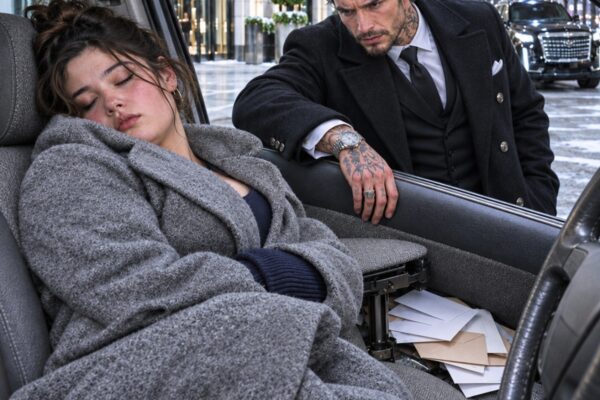
A Single Dad Agreed to Be Her Date for the Weekend — Not Knowing She Was a Millionaire CEO

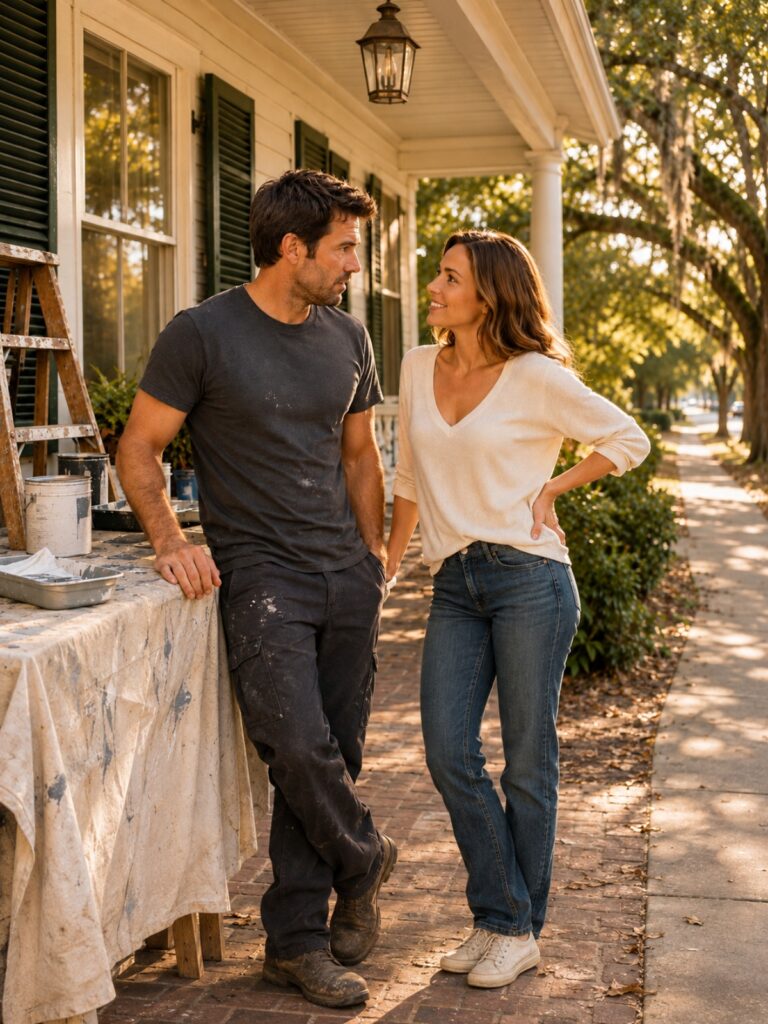
I Took $5,000 to Play Her Boyfriend for a Weekend. Then Her Grandfather Tried to Buy Me Out.
Four hundred people were about to lose their jobs over dinner, and I was only there because my daughter needed braces.
The woman paying me $5,000 to play her boyfriend ran the company that signed their paychecks.
By sunrise, her grandfather would know exactly how much money I had in the bank.
PART 1 — THE WOMAN IN THE BACK SEAT
At five in the morning, I stood in my driveway drinking coffee that tasted like the paper cup it came in. The streetlight across from our duplex was flickering again, and every time it came on, I could see where the rust had spread along the fender of my ten-year-old truck. Behind me, on the kitchen counter, lay an orthodontist’s estimate with $4,200 printed at the bottom in bold. I had seven hundred dollars in savings and a habit of checking the account even when I knew nothing had gone into it.
My daughter Emma was eight, and she’d recently started covering her mouth when she laughed. I first saw her do it at the kitchen table, when I picked up a burnt pancake and pretended to use it as a coaster. She laughed, brought her palm up fast, then checked whether I’d seen. A kid at school had made a joke about her teeth, she eventually told me, and she said it while picking little bits of burned batter off the pancake so I wouldn’t see her face.
The dentist was supposed to confirm the recommendation for braces at three that afternoon. Mrs. Gable from next door had agreed to take Emma if I couldn’t get free, and I’d left the permission form underneath the estimate. I stood in the driveway long enough to see the lamp come on in Emma’s room, then heard the blinds clatter against the window. I waved at the glass even though I couldn’t see her through it, and climbed into the truck before she could catch me figuring out whether I had enough gas to reach the job.
I’d spent fifteen years framing houses, hanging drywall, and building the occasional set of cabinets for somebody whose brother-in-law had given up halfway through the job. My finest work was usually hidden under paint or behind tile by the time anyone paid to look at it. That morning I hung board until noon, then changed shirts in a parking lot and picked up the leased black SUV I used to drive for a luxury rideshare app. Two rides would put groceries in the fridge, assuming nobody threw up and the app felt like paying me for the time I spent sitting still.
By three, Mrs. Gable had sent a photo of Emma with a paper bib clipped around her neck. Emma was holding up two thumbs, with the bib pulled as high as her chin. I was still looking at the picture when a pickup flashed on the screen, financial district to Midtown, and the app gave me a few seconds to make up my mind. I accepted, put my phone in the mount, and spent the next ten minutes inching toward a building that disappeared into the clouds.
The woman waiting on the curb wore a charcoal trench coat and had her dark hair pulled so tight I could see the strain at her temples. She got into the back seat with a gust of cold air and a trace of something like sandalwood and orange peel. Before I could confirm the address, she said, “JFK, Terminal Four. I’ll double the fare if you get me there in forty minutes.” Her voice was level, but I could see in the mirror that her hand had missed the seat belt buckle twice.
“The Van Wyck’s backed up for miles,” I told her. “I’ll take the side streets where I can, but you might want to tell whoever’s waiting that you’re running late.” She got the buckle on the third try and said, “Just drive.” I pulled out behind a delivery truck that had its hazards on and, judging by the driver’s feet up on the dashboard, no plans to move.
For about fifteen minutes the woman typed so fast I could hear her nails on the glass. Then her phone rang and she answered before the second buzz. “I told you, I’m handling it,” she said, in a voice so different from the one she’d used with me that I checked the mirror again. She listened for a while, looking straight past my headrest, then said, “Yes, I have someone. He’s a consultant from Chicago, we’ve been seeing each other for six months, and he’ll be at dinner on Friday.”
She dropped the phone on the seat when the call ended, leaned forward, and pressed the heels of both hands against her eyes. The sound she made was small enough to belong to somebody alone in a locked bathroom. I should’ve let her have it in private, but we’d been sitting at the same red light for two changes and my brain had apparently taken the afternoon off. “Boyfriend cancel on you?” I asked.
“Excuse me?” she said, and I apologized while making the left I’d been waiting for. She watched the side of my face in the mirror a little longer than I liked, then leaned back against the leather. “I have a board of directors and a grandfather who controls my trust. I told them I was bringing a boyfriend to a corporate retreat this weekend, so now I need to produce one by Friday.” She rubbed a place on her finger where there was no ring and added, “What I really need is a human shield in a suit.”
Apparently she’d offered her assistant a ten-thousand-dollar bonus to find an actor, an escort, anyone who could pass a long weekend with the family. The ones who looked convincing on paper had frightened her in person, and the ones she’d been willing to meet had turned up with mug shots or smiles she couldn’t picture seeing across a breakfast table. She said she’d budgeted a thousand dollars a day for whoever took the job, with expenses covered. The way she rattled off the terms made it sound like she’d been trying to hire somebody to fix a leak in her roof.
We passed a laundromat with half its sign burned out, and I thought about the counter at home. I could see the estimate under Mrs. Gable’s permission slip, and I could see Emma pulling her paper bib up with both hands. “What would this human shield actually have to do?” I asked. The woman looked up so sharply she knocked the back of her head against the seat, but she leaned forward anyway, as if better reception might make the question less ridiculous.
I told her I owned a suit, usually knew which fork to use, and could keep my mouth shut. She said I’d have to be available from Friday morning until Sunday night, learn a fake history, and spend three days in rooms where somebody might order a bottle of wine that cost more than the SUV. “The jokes will be bad,” she said. “You’ll have to laugh anyway.” I thought about some of the foremen I’d worked for and figured I was overqualified for that part.
“Five thousand,” I said, before I could talk myself down. “Flat rate, and you cover travel and food.” I felt the ridiculousness of the number as soon as it left my mouth. A year earlier I’d fought for three weeks to collect less than a fifth of it from a man whose new cabinets still had my pencil marks on the backs.
“What’s your name?” she asked finally, and I told her Tom. She asked what I actually did for a living, and I said I built things, mostly houses and cabinets and whatever else paid on time. “You don’t look like a consultant from Chicago,” she said. I caught her looking at the bit of drywall dust that always seemed to work its way out of the seams of my boots. “For five grand,” I told her, “I’ll look like one by Friday.”
It started to drizzle as we pulled up to departures. She had her hand on the door handle for a long moment, and I thought she was going to take her bag and get out without saying another word. Instead she turned all the way toward me. We looked at each other without a mirror between us for the first time, and I saw the red at the rims of her blue eyes and the little dent in the bridge of her nose where she’d been pressing her fingers. She pulled a black card from her bag and put it in my hand.
“I’m Audrey,” she said. “My assistant will send you an address. Friday morning, seven sharp.” There was a second, after she’d opened the door, when I nearly asked her what business she was in and why anybody cared who she brought to dinner. But traffic was backing up behind me, and I was so relieved to hear her say yes that I let her go.
At six-thirty Friday morning I faced the closet mirror in the navy suit I’d bought for a funeral five years earlier. I’d shaved, but the jacket was tight enough in the shoulders that I could see my outline change when I took a deep breath. Emma appeared in the doorway with toast in one hand and her pajamas dragging on the carpet. She studied me from my head down to my boots and said, with genuine admiration, “Dad, you look like a secret agent.”
I said I was going to a boring conference. She wanted to know if Mrs. Gable had bought the pizza rolls with the weird cheese, and I told her I’d checked personally. Then she wiped her toast hand on her pajama leg and came in for a hug, pushing her forehead against my clean shirt. I held still so the moment would last and went out to my truck with a duffel bag containing two button-downs, one pair of slacks, and a tie that still had a crease from the funeral.
Audrey’s assistant had confirmed the five thousand and told me to bring my own vehicle. I knew practically nothing else about the job, which was something I would’ve given another contractor hell for. On the drive out of the city and into New Jersey, I kept trying to give Audrey an ordinary title. A vice president at a bank, maybe, or a partner at a law firm who had put up with too many lectures about her personal life. Then the GPS told me to turn into a private airfield, and a guard in a tactical uniform stepped out to look at my truck.
I gave him my name and told him who I was meeting. He studied his tablet, looked at my truck again, and pointed toward a long-term lot. I parked between a Mercedes G-Wagon and a Porsche Cayenne and lifted my bag out through the driver’s door, which took a little shove at the bottom to open all the way. A shuttle took me around to the terminal, where a man in a spotless uniform offered to carry the canvas duffel and I found myself gripping the frayed handles like he’d asked for my wallet.
Audrey was waiting beside a wall of windows in a cream cashmere sweater and trousers that hung perfectly even when she moved. She looked me over, her eyes pausing a fraction of a second at each shoulder. “We’ll say you prefer vintage tailoring,” she said. I decided to take it as a compliment, and followed her outside with my bag cutting a familiar groove into my fingers.
She told me the retreat was at her family’s estate on an island off the Maine coast. We passed a row of small prop planes, and I kept expecting her to stop at whichever one looked as if it had room for us. She walked straight to a Gulfstream with its engines idling and a uniformed pilot at the foot of the stairs. “Good morning, Miss Hayes,” he said, and Audrey greeted him by title and went up without breaking stride.
I stood on the tarmac trying to figure out how I’d missed every sign that I was in this far over my head. The plane had its own stairs, and I’d been congratulating myself for getting my truck’s passenger window to go back up. Audrey looked down from the open doorway, her hair blowing across one cheek, and called, “You coming?” I pictured myself explaining to Emma that I’d driven all the way to New Jersey and then come home because somebody’s airplane was too big, and I climbed aboard.
The leather chair gave under me so deeply I had to sit up twice to find the buckle. A flight attendant handed me a hot towel with silver tongs, which I used to wipe my hands before folding it neatly for her, the way I did with my napkin at Mrs. Gable’s. Across a mahogany table, Audrey opened her laptop and began typing. I waited until she came to the end of a sentence and said, “You left out the part where you own a plane.”
“The company owns it,” she said. “I’m the CEO.” I asked which company, and for the first time since I’d seen her on the curb she seemed to realize we’d agreed to something without exchanging the most basic information. Her fingers stopped over the keyboard before she said, “Hayes Global.”
I’d hung drywall in a building owned by Hayes Global the week before. I’d eaten a gas station sandwich in its unfinished stairwell while reading a warning about overtime taped to the wall by a subcontractor. The company’s name was on ships, warehouses, and buildings I couldn’t afford to set foot in after they were finished. I looked down at the scratches on my hands and said, “I think you underpaid me.” The corner of her mouth lifted before she told me she’d throw in a bonus if I survived.
By the time we started down through rain over Maine, she’d deleted whatever she’d been writing so often I could recognize the sound of her holding down the backspace key. She finally shut the laptop and told me her grandfather Conrad was eighty-two, had built the company from a single cargo ship, and was actively looking to remove her as CEO. Her cousin Philip, the CFO, would spend the weekend trying to embarrass me. Her aunt Caroline would judge my shoes, which I thought was at least going to save her some time.
We’d met at a charity gala in Chicago six months earlier, according to Audrey. I was an independent architectural consultant who advised commercial developers on structural integration, which explained why I might know my way around an old building and why Philip wouldn’t find me on LinkedIn. “What if your grandfather asks me what structural integration is?” I said. She told me to steer the conversation toward whatever he was investing in. I said I might just tell him I advised on whether the roof was going to cave in, and she looked at me long enough for me to realize she was too worried to laugh.
The town car waiting on the runway took us through twenty minutes of wet pine forest. When the trees opened, I saw a wrought-iron gate and what looked like a stone fortress standing so close to the edge of the island that salt had streaked the seaward walls. A butler came out before the driver had put the car in park. He offered to take my canvas bag, and a look of quiet disapproval passed over his face when I told him I could carry it. Audrey threaded her arm through mine and squeezed so hard I felt her fingertips through two layers of fabric.
Conrad called her name from the top of a staircase wide enough for two moving crews to pass each other. He came down slowly, one hand on a silver-tipped cane, followed by a younger man in a gray suit with an immaculate beard. There was a fire in a room off the foyer, and I could hear the pop of a log as Audrey introduced me to her grandfather and Philip. Neither of them put out a hand, so I kept mine on the bag.
“Your assistant told us you were a consultant,” Conrad said to Audrey, his eyes still on me. He took in my jacket, my boots, and the hand I had wrapped around the bag. “You look like a man who works for a living.” I said I did, and that knowing how a building went together came in handy when somebody paid you to look at it. His eyes went back down to my hands, and I got the uneasy feeling he had heard something in my answer that I’d missed.
Philip asked what firm I was with, mentioning that Audrey generally brought home men who managed money. I said I worked independently, and he told me about a redevelopment in Chicago’s South Loop, old manufacturing warehouses they planned to turn into luxury lofts. “What’s your take on the load-bearing integrity of prewar masonry?” he asked. Audrey’s grip on my arm tightened, and I realized Philip had just asked the first question all day that I felt comfortable answering.
I’d spent six months drilling into prewar brick on a warehouse job three years earlier. I told him that if the buildings went up before 1930, the mortar was likely lime-based, and their mechanical plans had better account for where the new HVAC would leave moisture. On our job, I said, the engineer had specified a secondary reinforced concrete sleeve because driving anchors for steel straight into the old masonry would’ve meant cracks and a brutal retrofit. “You can lose millions by the time an inspector catches a bad plan,” I said, and watched Philip’s smile disappear before I’d finished the sentence.
Conrad tapped his cane once on the checkered marble. “Lime mortar,” he said, still looking at me. “Philip’s contractors missed it last quarter. Cost us three million in delays.” I’d worked around men who would carry a mistake like that for the next twenty years, so I kept my eyes on Conrad while he told me dinner was at eight and advised me to find a tie that went with my suit, since we wouldn’t be eating with farmers. Then he and Philip went into the library, leaving Audrey and me in the foyer with my bag still in my hand.
“How did you know that?” she whispered. I told her about drilling holes in an unheated warehouse until I could feel the vibration in my hands at night, hours after I’d put the drill down. She let go of my arm and leaned back against the wall, breathing like she’d just set down something heavy. I asked where my room was, and as she led me upstairs, I noticed she had to take the corner at the landing with one hand flat on the banister.
At eight I put on the funeral tie and sat at Audrey’s right, with Aunt Caroline and her diamonds directly across from me. Philip took the chair on Audrey’s other side, and Conrad sat at the head beneath an iron chandelier. I worked through the silverware from the outside in, the way my father had taught me at a wedding, and said very little through courses that came and went at the slightest signal from the man at the head of the table.
When they removed the main course, Conrad swirled his wine and said he wanted the Ohio logistics hub closed by December. Four hundred people worked there, Audrey said, and the new software had slowed the docks during installation. She’d need time to clear the backlog, and taking out their fastest Midwest route would jeopardize the two-day shipping guarantee. Philip called the union crew dead weight and said it was her obligation to look at what they were costing the company in overtime.
Audrey explained what it would cost to breach the shipping contracts. I watched Conrad wait until she was halfway through a sentence to wave his hand, and watched her stop on the exact beat he expected her to. “You lack the stomach for the hard choices,” he told her. “You always have.” She lowered her eyes to the place where her plate had been, and something in the speed of that small surrender made me realize how often they’d had this conversation.
I picked up my water glass under the impression that I could still do the job she’d hired me for. Then I thought about the men I’d seen come to work sick in December because they had children at home and nobody had told them whether there’d be a January. Across from me, Caroline was still chewing, which gave me the strange feeling that an entire town could disappear between the steak and the coffee in this house. I set down my glass and said the one thing Audrey had paid me to keep to myself.
PART 2 — WHAT IT WOULD COST ME TO STAY
“Close that hub and you’ll lose more than money,” I said. Caroline lowered her fork, and Philip leaned back far enough to see me on the other side of Audrey. Conrad turned his head very slowly, as if he wanted to give me time to pretend I’d said something else. “I beg your pardon, Thomas?”
I thought of a crew I’d worked with who could steer a loaded cart through a building with no lights because they knew where every dip in the floor was. I told him the men and women in Ohio knew which bay doors stuck in freezing weather and how to load a truck for an icy road. What would a new crew do when a shipment came in late and a supervisor told them to get it out by morning? They’d rush, and somebody would get hurt.
“And what does an architectural consultant know about freight?” Philip asked. His chair gave a little creak as he leaned toward me. I told him I knew what happened when the people who drew up a schedule had never worked a shift doing what they scheduled. “You’ll pay for spoiled freight, broken gear, and overtime wherever you send the work,” I said. “You could spend triple what you save.”
Conrad looked straight at me, and I could suddenly hear the fire again. I said Audrey was right to absorb the temporary loss, keep the people who knew the docks, and give the software time to work. For about ten seconds, nobody at that table moved. Then Conrad took a sip of wine and said they’d revisit Ohio on Monday, and under the table, Audrey closed her hand around my knee so hard I felt it through my trousers.
The dinner went on for another hour. I remember Caroline asking when I’d last been in Chicago, and I remember giving an answer that must have satisfied her, because she left me alone after that. Mostly I remember Audrey sipping coffee while the hand she’d used to squeeze my knee lay open on her lap. She kept running her thumb over the faint crescents her own nails had left.
Hours later, after the rain had stopped, I went out onto the stone terrace off my room and lit a cheap cigar. I’d shed the jacket and tie, and the cold went straight through my undershirt, but I stayed where I was and listened to the ocean below the cliff. The glass door slid open behind me. Audrey came out in gray sweatpants and a cable-knit sweater with the sleeves pulled down over her hands, holding a tumbler of whiskey.
“You saved my life in there,” she said. I told her I’d said what any of those four hundred people would’ve said if Conrad had invited one to dinner. She turned her glass in her hands for a while and asked why I needed five thousand dollars. Her eyes were on the water when she asked, and she kept them there long enough for me to decide how much I wanted to tell her.
“My daughter needs braces,” I said. I told her Emma was eight and had started hiding her teeth when she laughed, and that the estimate came to $4,200. I could’ve left it there, but she’d had the decency to let me finish every sentence since we’d walked out of that dining room. So I told her about the seven hundred dollars, too.
“You came here for braces?” she asked. She sounded genuinely confused, and I could see her trying to fit the man who’d quoted her five grand at a traffic light to a father counting what was in the bank. I told her I’d have walked into a burning building for them. “You get a number,” I said, “you figure out what you can do about it, and you try to finish before your kid figures out how scared you are.”
The whiskey went still in her glass. She said she made decisions that moved goods all over the world, and some days she went home unable to think of one person whose life she’d made easier. I said four hundred people in Ohio would probably have something to say about that. Audrey gave a little laugh that came halfway out, then wrapped both hands around her glass again.
“I’m scared every day,” she said finally. “I keep thinking there’s a point when I’ll have to be as ruthless as they are, and I won’t be able to do it.” The wind blew a piece of hair across her cheek and it caught at the corner of her mouth, and I brushed it away before I had time to decide whether I should. She leaned her face into my hand and shut her eyes for a second, and I felt how cold her cheek was.
“Get clear about what you’re building,” I told her. “Then make them explain why they want to tear it down.” I’d meant the people at the table, but I could tell by how long she stood there that she was thinking about more than Friday dinner. When she finally went in, she left the glass door open a fraction, and I listened to it rattle until I got too cold to stay outside.
I woke before dawn on Saturday and went downstairs looking for coffee. I found Conrad in the library with one lamp on and a thin manila folder open on the desk. “I take mine black, Mr. Sullivan,” he said, without looking up. “There’s a pot on the sideboard.” I’d given him the name Thomas in the foyer, and I took my time pouring the coffee so he’d have to be the one to explain where he’d found the rest of it.
He waited until I sat down before he closed the folder. “Thomas Sullivan, independent contractor. Two mortgage defaults, restructured last year. Four hundred dollars in checking, and a rideshare job to make up the difference.” He paused, his thumb resting on one corner of the file, then told me his security chief had run the truck’s plates from the airfield.
I took a sip and burned my tongue. He said Philip had wanted to call the police, drag me out of bed, and let the board watch Audrey explain why she’d brought a man she’d picked up on the way to the airport. “You wanted to speak to me first,” I said. Conrad’s gaze stayed on me as he told me how much he’d enjoyed watching Philip ask his little question about Chicago, and how little his grandson had learned from my answer.
He drew a leather checkbook out of his breast pocket. The cap came off his gold pen with barely a sound, but in that room I could hear every pass of the nib across the paper. He tore out the check and pushed it toward me until it reached the edge of the desk. I read the number twice, because my mind kept trying to take off a zero.
Fifty thousand dollars. He said a car was waiting at the service entrance and I could be gone before Audrey woke up. When she came down, he’d tell her precisely what I’d done, and he expected her to step down by noon so Philip could take the chair. He sounded as sure of her response as he had when he’d told me where to find the coffee.
I could see a transmission in that money, an account for Emma’s college, and enough to pay off what I still owed on the duplex. I could see her laughing with her mouth open and a stretch of months where Mrs. Gable might get to go to a dentist appointment of her own. Conrad waited in perfect silence while I put down my mug. Then I reached across his desk and picked up the check.
PART 3 — THE ENVELOPE SHE LEFT ME WITH
The paper was heavier than the checks people gave me for hanging doors. I held it by one corner, watching the end of it dip, and gave myself a couple of seconds to imagine taking it. Nobody at home would’ve known where the money came from, least of all Emma. I could’ve paid the orthodontist up front and let Mrs. Gable think I’d landed a commercial job. Half the people I owed money to would’ve been so relieved to hear from me they might have congratulated me.
I folded the check in half, then in half again, and put it back on the desk. It sat there between us with the printed side tucked away, a white square small enough for Conrad to cover with his thumb. “I made a deal for five grand,” I said. “I don’t break contracts.”
There was a change in his face so slight I could’ve imagined it. I’d watched him cut his granddaughter off at dinner and seen Philip relax the moment he realized he had permission to laugh. I had the feeling Conrad was used to a room changing temperature when he did something with his hands, and right then I wanted to give him the experience of watching somebody go on talking. “She’s tired of pretending to be a machine for you,” I said. “Keep your money, Conrad. You’re going to need it when she beats your projections.”
I left the library and pulled the door shut behind me. The latch clicked so quietly that, down the hall, I could still hear somebody laying out the breakfast dishes. I made it as far as the bottom step of the staircase before I had to sit down. My hands had started shaking, and I was afraid if somebody asked me anything more complicated than whether I took sugar, I might tell them exactly how close I’d come to walking out of that house.
I’d spent a lot of time being angry with people who called a gamble courageous because somebody else was losing the money. Sitting on the stairs, I tried to imagine one customer, just one, calling me back after a job and offering enough money that I could replace the truck without doing the math. I couldn’t get the picture out of my head, or the other one of Audrey coming down in that gray sweater and being told I’d been bought before she’d had her coffee. After a while I got up, went back to my room, and turned the shower on long enough for my feet to stop feeling cold.
At breakfast Audrey came in with wet hair and read a message on her phone while a slice of toast cooled on her plate. “Philip’s already spoken to two board members about Ohio,” she told me. She tore the toast into pieces while she talked, leaving them in a little pile without eating any. When she finally glanced up and asked if I’d slept, she looked so much like herself on the terrace that I could barely meet her eyes. I said I’d been up early and poured her some more coffee.
The family called what happened that Saturday a series of informal conversations. I saw Philip intercept a director coming in from the rain, take the man’s coat, and get halfway through a sentence about December before anyone offered him someplace to hang it. Caroline showed two other guests into the good sitting room and remarked that Audrey had always taken factory closings terribly hard. She sounded almost affectionate, and I watched both people nod the way you nod when somebody tells you a child still cries at the sad part of a movie.
Audrey spent most of the morning in a small room off the library where one wall was taken up by a desk and the other by a photograph of Conrad’s first cargo ship. I walked in once with coffee and found her on the phone with somebody in Ohio. “Tell me how it went at the dock,” she said, tapping a pencil against her legal pad. Whoever was on the line started giving her the numbers from a report, and she asked him to walk her through what he’d personally seen after the first truck pulled up.
The pencil stopped tapping. From where I stood I could hear the distant voice say there were people at the morning shift who could clear a backlog if somebody gave them two hours and let them use the way they already knew to check in trucks. The trouble came when the next shift inherited a half-cleared queue and the software showed three trucks assigned to the same place. Audrey asked how many nights that had happened, then waited, her fingertips flat on the desk, while the man went to find somebody who could tell her.
When she got off the phone she looked at the photograph of the cargo ship. “I used to sit under that desk on weekends and listen to him talk to captains,” she said. “He knew who to ask when something went wrong. He’d wait on the phone until the right person showed up.” I set the coffee where she could reach it and asked when she’d last heard him ask anybody what had gone wrong in Ohio. She picked up her pencil and wrote another name down, and then she called it.
Around noon, I went upstairs and called Emma. She and Mrs. Gable had already gone through most of the pizza rolls, and she claimed to have examined the box closely enough to rule out actual cheese. I told her I was inclined to believe her, and then she asked if the conference was as boring as I said it would be. Through the wall I could hear Philip on the stairs, explaining to somebody that an orderly transition would give the markets confidence. “There’s a guy here who talks too much,” I said, and Emma told me I should get out my phone and politely pretend to look something up.
Before she hung up, she asked what the dentist had told me. I said he’d confirmed she needed braces and that I’d set up a time to talk to him when I got back. “Do I have to get them right away?” she asked, and when I said we still had to work out the dates, she told me she wanted green bands. It was the first thing she’d said about the braces that sounded like a decision she got to make. I promised to remember, then sat on the bed long enough for the screen to go dark in my hand.
That afternoon I passed the service entrance on my way back from the terrace. A staff member was wiping rainwater off the slate, and when he saw me look toward the drive, he asked if I was waiting for a car. There was an easy answer I could give him, and I still had to stop and swallow before I gave it. He wished me a good afternoon and went back to his mop, and for a little while I stood in that doorway thinking how quickly I could have reached it from the library.
I saw Audrey again late that day, standing at the bottom of the main stairs while Philip told her he’d made sure the board could discuss Ohio at Sunday morning’s session. “I thought Grandfather wanted to wait until Monday,” she said. Philip straightened a cuff and told her that by Monday some of the directors would be back at their desks on the other side of the world, and that everyone would appreciate going home with a decision. I expected him to walk off as soon as he said it, but he stayed and watched her face. She said she’d put Ohio first on the agenda and asked him to bring the overtime figures he’d used at dinner.
Philip wanted to know why. Audrey waited until he’d looked directly at her, the way Conrad used to wait when he asked men to repeat a number. “I want them to have your figures in front of them when I give them mine,” she said. He smiled and told her he’d see what he could do, and she said, “Send them by six,” then picked up her bag and went past him.
That night I found her outside my door in the same sweater she’d worn on the terrace. She had a legal pad tucked under her arm and asked if I had a minute to listen to the first thing she planned to say in the morning. I said sure, and she opened the pad on my dresser, beside the loose change and keys I’d emptied out of my pockets. She got three sentences in before she stopped herself. “I’m still explaining why I’m allowed to be in the room,” she said, and drew a line through most of the page.
She started over with what the Ohio hub could do by December if the vendor met its obligations. I wondered whether the first line had come from the man on the phone or the woman who’d sat under a desk listening to old captains. Before she left, she asked me to be there the next morning, even though I could spend the time packing or get breakfast without an audience. I said I’d sit where she could see me, and she seemed to think about that for a second before she said good night.
By Sunday morning the long dining table was covered in folders. The staff had taken away the crystal and put out water glasses so plain I could’ve bought them in a four-pack, though the man beside me wiped his without looking up from his phone. I pulled a chair into a corner where Audrey could catch my eye if she wanted to. From there I could see the empty place where she’d set down her fork Friday and the fireplace where I’d looked when I needed to stop talking.
Philip arrived with overtime figures so neatly bound they already looked like the decision. Conrad took his place at the head of the table and rested his cane against the leg of his chair. When Audrey brought up Ohio, Philip opened his folder and began to say something about the quarterly projections. She looked at him until he finished straightening the first page, then said she’d start with the operations report and give him the floor when she was done.
She had a revised timeline for integrating the software, with dates for clearing the backlog and a written plan for what the docks would do when a shift changed. She’d checked the work with the people who would have to complete it and put the dates beside the promises Hayes Global had already made to customers. The man who’d wiped his water glass set down his phone and pulled the binder closer. I watched Audrey wait for him to find his page before she described what would happen to the fastest route into the Midwest if they removed Ohio from it.
“We’ll hold the vendor to its service-level agreement,” she said. “If they breach it, I’m prepared to fire them and move the work.” Someone asked whether that gave her enough time to protect the two-day shipping guarantee, and she showed them where they could keep freight moving while the crews got trained, and which secondary hubs were already close to their limit. When Philip got his turn, he went straight to overtime. Audrey asked whether his projected savings included the penalties on shipping contracts they’d be at risk of missing. He put a finger midway down a page and kept it there, even after it was clear he had nothing to read from it.
I kept thinking about the four hundred workers and how strange it was to hear the same number in the same room two days later. Friday night it had meant the size of a problem Philip wanted off his books. This time a director wanted to know how many people would need training on each shift and how the company would give them the time to do it. Audrey had the answer, down to who could cover the dock during the gap, and made a note when another director offered to put her in touch with someone who’d handled a similar transition.
“The Ohio hub will remain operational,” Audrey said, and she told them what she’d report back and when. She gathered the pages she’d actually spoken from, leaving the rest of the folder for anyone who wanted to stay. I looked at Conrad then and realized he’d been watching her for much longer than I had. Before the meeting adjourned, his chin dipped in a barely visible nod. It was the first time I’d seen him acknowledge that she’d told him something he needed to hear.
Audrey stayed upstairs to make calls until it was time to leave. I packed the tie and the spare shirt, shook the change off the dresser into my hand, and went down to the foyer with my duffel. When the butler held the door open, he remembered I liked carrying the bag and stepped aside. I thanked him, and he said, “Safe trip, sir,” while I tightened my grip on two handles that looked ready to give out.
By three we were back on the Gulfstream. Audrey’s laptop stayed shut as we climbed through the clouds. She sat with her face toward the window, and I thought she might be taking the first chance she’d had to be alone with her thoughts for three days. I was trying to get the loose end of my seat belt to lie flat when she said, “You didn’t have to stay.”
“We had a deal,” I told her. She said Conrad had spoken to her before we left, and I stopped fiddling with the belt. “He told me he offered you fifty thousand dollars to walk out on me,” she said. She’d turned to face me by then, and there was nothing in her expression I could use to tell how Conrad had chosen to say it.
I looked down at my hands. I’d used one of them to pick up his check, and I remembered having to be careful with my fingertips or I’d leave a crease where I grabbed it. I could’ve told her I thought about taking it or that afterwards I sat on the stairs to wait out the shaking. What came out was the only answer I’d given anybody all weekend that had worked twice. “Like I said, we had a deal.”
Audrey reached over the table. Her hand settled on top of mine with enough weight that I could feel the warmth of it coming through. There was no ring on the finger she’d rubbed in the back of my car, and a small rough place on her thumb caught against my knuckle when she moved it. I’d learned more about her from one hand across a table than I’d learned from the company name on the plane. She held on until we touched down in New Jersey.
The light was going by the time we reached the long-term lot. My truck was still between the Mercedes and the Porsche, and I could see an old coffee cup through the back window and one of Emma’s knitted gloves under the driver’s seat. I put the key in the door, pulled at the bottom where the hinge always caught, and heard the familiar groan that told me I’d have to grease it again. Audrey stopped a few feet away in the same charcoal coat she’d worn the day we met.
She took a thick white envelope out of her purse and held it out. I’d known exactly what I meant to say about payment when we’d stopped at JFK, and three days later the best I could come up with was “Thanks for the work.” The words came out tighter than I wanted, because I’d have gladly stood in that parking lot another hour if I could’ve figured out what to say after them. Audrey watched me take the envelope and said, “Thank you, Tom. For everything.”
I climbed in and turned the key. The engine sputtered before it caught, rocking the cab with a shudder I could feel through the soles of my boots. I pulled out, and by the time I got to the end of the row, I could see Audrey in the mirror with her coat pulled tight around her, still standing where I’d left her. I watched until the lane bent and the red light from my taillights slid off her shoes.
An hour later I pulled into my driveway. Across the street, the light flickered, and through the front window I could see the lamp Emma liked to leave on even when she was in another room. I cut the engine and sat there getting used to how close the walls of the duplex were, how quickly I could reach the front door from the truck. Then I saw the envelope where I’d put it on the passenger seat.
Inside was a cashier’s check for ten thousand dollars. The amount was spelled out, and I ran the tip of my finger under each word before I let myself think about the estimate on the counter. Emma could choose green bands, and if she changed her mind in the chair, she could choose something else. The money was already there, and for once I wouldn’t have to leave the room to call anybody about it.
Wrapped around the check was a piece of heavy, watermarked stationery. The handwriting was elegant and a little hurried, as if the car had been waiting when Audrey wrote it. There was one line, signed with an A. “Call me when the braces come off.”
I started to smile before I’d finished reading it. I folded the note and put it in my chest pocket, where I could feel the edge of the paper when I got out to go see my daughter. There’d be a stack of appointments between the day Emma picked her colors and the day she smiled without metal on her teeth, and I’d be there for every one of them. I made it halfway to the front door before I started wondering how long I could make myself wait.