Gangsters Bullied a Quiet Man and His German Shepherd on a Bus — Unaware He Was a Navy SEAL….
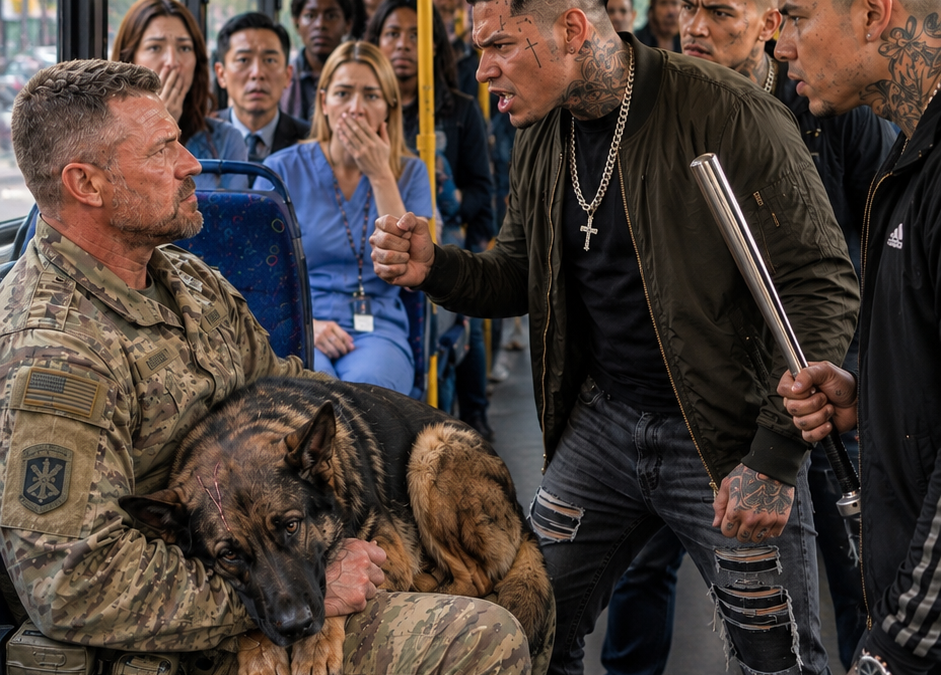
Gangsters Bullied a Quiet Man and His German Shepherd on a Bus — Unaware He Was a Navy SEAL
The gangster raised his knife toward the quiet man, certain that the old soldier would beg for mercy.
But the German Shepherd sitting beside him didn’t bark, and the man didn’t even blink.
Seconds later, three violent men would discover that the most dangerous passenger on that midnight bus was the one who had spent years trying to forget how to fight.
PART 1 — THE WRONG MAN TO THREATEN
The Last Bus Through the Rain
At 11:40 p.m., Seattle looked like a city trying to wash away its own sins.
Rain hammered the windows of the nearly empty Crosstown bus, turning streetlights into long streaks of gold and red. The heater rattled beneath the seats, fighting a losing battle against the November cold. Every few seconds, a loose panel above the driver’s compartment vibrated with a metallic buzz.
Tristan Hale sat in the rear corner, his elbows resting on his knees.
He was forty-eight years old, though the gray in his close-cropped hair made him look older. A faded canvas jacket hung loosely around his broad shoulders, concealing a body that had once endured things most people only saw in movies. His face was weathered, his jaw marked by an old fracture, and his pale blue eyes rarely settled on anything for more than a few seconds.
Beside his left leg sat Duke.
The German Shepherd was nine years old, with dark sable fur, intelligent amber eyes, and a long scar running from his right ear toward his neck.
Duke wore a fitted service-dog harness. He remained perfectly still despite the vibrating floor, the wet coats, and the occasional screech of the bus brakes.
Every few minutes, Tristan touched the dog’s collar twice.
Duke would briefly glance up.
Then both returned to watching the dark windows.
They had been doing this together for a long time.
Six years earlier, their nights had been filled with helicopters, distant gunfire, and whispered commands in mountains thousands of miles from Washington. These days, Tristan repaired old furniture at a neighborhood workshop, attended medical appointments, and lived in a small apartment overlooking an alley.
He wanted nothing more complicated than quiet.
Unfortunately, quiet had become something his mind no longer knew how to trust.
Across the aisle, a young man in a fast-food uniform stared at his shoes. Farther forward, a nurse in green scrubs slept against the window. Near the rear exit, a teenage boy wearing oversized headphones kept looking at his phone.
The boy appeared nervous.
Tristan noticed it without meaning to.
The teenager checked the front doors whenever the bus slowed. His fingers tightened around his phone when headlights appeared behind them. Once, he looked directly at Tristan before quickly lowering his eyes.
Tristan recognized fear.
He also recognized the difference between someone frightened of the world and someone waiting for something specific to happen.
He might have said something.
Instead, he touched Duke’s collar and looked away.
He had promised himself that he would stop making strangers’ problems his own.
At Fourth and Pike, the bus stopped.
The doors folded open.
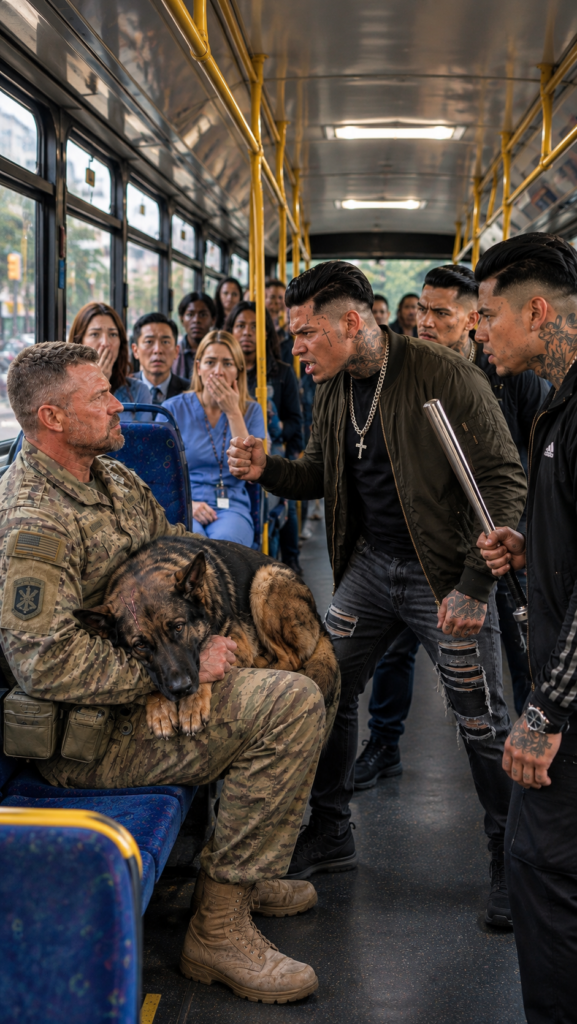
Three young men climbed aboard, bringing cold rain, cheap cologne, and trouble with them.
The first was broad through the shoulders, with a fresh buzz cut and a black puffer jacket. He slapped his transit card against the reader and gave the driver a contemptuous grin.
“Come on, old man. Some of us got places to be.”
The driver, Martin Bell, looked up from behind the protective partition.
“Keep moving. Plenty of seats.”
“Didn’t ask for directions.”
The second man was tall and narrow-faced, with restless hands and a metal flashlight clipped to his belt. The third was heavyset, his round face wearing the easy smile of someone who enjoyed watching other people become uncomfortable.
Tristan knew their type.
Not professional criminals, exactly.
Young men who had discovered that cruelty could make them feel important.
The broad one, Tommy Rusk, deliberately brushed against the sleeping nurse as he passed.
She woke with a startled gasp.
“Watch yourself,” she said.
Tommy’s friend laughed.
“Relax, sweetheart. Nobody’s interested.”
The nurse said nothing more. She stood at the next stop and disappeared into the rain.
The remaining passengers became very interested in their phones, their shoes, and the dark streets outside.
Tommy and his friends settled halfway down the bus.
For several minutes, they talked loudly about a fight outside a nightclub. They laughed about someone being dragged across a parking lot. The heavyset man, Gary Danner, described how much money a frightened man had handed over to avoid being hurt.
Tristan closed his eyes.
He had heard enough boasting in his lifetime to know that men who talked constantly about violence usually understood very little about its consequences.
Duke rested his chin against Tristan’s knee.
Two taps.
Everything was all right.
Until Tommy noticed them.
“Yo. Look at this.”
His voice carried down the aisle.
“Grandpa’s got himself a police dog.”
The tall man, Shane Voss, turned around.
“Maybe it’s his bodyguard.”
Gary laughed.
“That thing looks like it lost a fight with a lawn mower.”
Tristan opened his eyes.
“Leave the dog alone,” he said quietly.
Tommy grinned.
“Oh, he talks.”
Tristan didn’t answer.
Tommy rose from his seat and walked down the aisle, gripping the overhead rail as the bus turned.
“Hey, old man. I’m talking to you.”
“I heard you.”
“Then show some respect.”
Tristan looked at him.
There was no challenge in his expression.
Only exhaustion.
“I’m going home,” he said. “I suggest you do the same.”
Tommy laughed and glanced at his friends.
“You hear that? Grandpa’s giving orders.”
He stopped beside Duke.
“What’s with the ugly dog?”
“He’s a service animal.”
“Service animal?” Tommy repeated mockingly. “What does he do? Help you find your dentures?”
Shane laughed.
Gary moved closer.
The teenage boy near the back lowered his headphones slightly.
Tristan noticed Tommy’s right hand moving toward Duke.
“Don’t touch him.”
Tommy stopped.
For a moment, his smile disappeared.
Then it came back, uglier than before.
“Or what?”
He reached down.
Tristan caught his wrist before his hand touched Duke’s head.
The movement was so fast that Shane flinched.
Tommy stared at the fingers wrapped around his arm.
“Let go.”
“Walk away,” Tristan said.
His voice remained perfectly calm.
Tommy tried to pull free.
He couldn’t.
For one brief second, something changed in his eyes.
He realized the tired man wasn’t struggling to hold him.
He was barely using any effort at all.
Then his friends started laughing.
And embarrassment became more powerful than common sense.
“You think you’re tough?”
Tommy swung his free fist.
Tristan released his wrist and shifted aside. The punch passed harmlessly over his shoulder.
Then Tristan drove his boot against Tommy’s chest.
It was a hard shove intended to create distance.
Tommy stumbled backward into Shane, and both men crashed into the opposite seats.
The bus jerked as Martin slammed on the brakes.
“Enough!” the driver shouted. “I’ve already hit the emergency button. Police are coming!”
Tristan remained seated.
Duke rose beside him.
“Stay,” Tristan whispered.
The dog obeyed.
But his ears were forward now.
And his body had become very, very still.
Tommy scrambled up, his face burning with humiliation.
“You’re dead.”
He pointed at Tristan.
“You hear me? You’re dead.”
Gary reached into his jacket.
A folding knife appeared in his hand.
Shane pulled the heavy flashlight from his belt.
The young fast-food worker near the front pressed himself against the window.
Martin stopped the bus completely.
“Put those things away!” he shouted.
Nobody listened.
Tristan stared at the knife.
Something cold moved through his chest.
Not fear.
Recognition.
For a second, the aisle vanished.
He smelled desert dust instead of diesel. Heard a radio crackle through static. Saw a young man’s hand reaching toward him from beneath collapsed concrete.
Then Duke pressed against his leg.
Tristan returned to the bus.
He looked at the three men.
“You’re making a mistake.”
Tommy spat onto the floor.
“Not as big as yours.”
Tristan rose slowly.
The oversized jacket fell away from his shoulders.
He wasn’t enormous, but there was something unmistakably solid about him. His posture changed, his weight settling evenly over his feet.
Duke stepped beside him.
Tristan unclipped the leash.
The small metal clasp made a sharp sound in the silence.
“Last chance,” he said. “Put the weapons down.”
Gary glanced at Tommy.
Tommy’s eyes burned with fury.
“Cut him.”
Gary hesitated.
“Tommy—”
“I said cut him!”
Gary lunged.
Everything happened faster than the other passengers could understand.
Tristan moved away from the knife’s path and struck Gary’s attacking arm. The blade fell against the rubber floor with a metallic clatter.
Gary cried out.
A second movement sent him stumbling sideways into a seat frame. He collapsed, clutching his arm.
Shane swung the flashlight.
Tristan saw the arc coming.
“Duke!”
The German Shepherd moved before the blow landed.
He struck Shane high in the body and caught the arm holding the flashlight. Shane screamed as the weapon dropped beneath the seats.
Duke brought him to the floor and held him there.
The dog did not continue attacking.
He held the arm, waiting for Tristan’s next command.
Three seconds.
Perhaps four.
Then Tommy reached beneath his jacket.
Tristan saw the dark grip of a handgun.
His thoughts narrowed to one fact.
The boy with the headphones was directly behind him.
Tristan surged forward.
The gun never cleared Tommy’s waistband.
The two men collided against a seat. Tristan forced Tommy’s arm away from the passengers and drove him down into the narrow aisle.
Tommy’s knee twisted beneath him.
He screamed.
The handgun fell beside the seat support.
“Don’t move,” Tristan said.
His voice was low and hard.
Tommy looked up at him, pale and shaking.
“You—”
“Don’t.”
The word stopped him.
For several seconds, nobody spoke.
Then Tristan turned toward Duke.
“Out.”
The dog immediately released Shane and returned to his side.
Tristan clipped the leash back onto the harness.
“Good boy.”
Duke looked up at him.
His tail moved once.
As though the entire incident had been nothing more than an unpleasant interruption to their journey home.
The bus driver stared in disbelief.
Gary was moaning beside the seats. Shane held his injured arm against his chest. Tommy lay on the floor, one hand clutching his knee.
Martin spoke into his radio.
“Three injured. Possible firearm. Get officers here now.”
Tristan looked down at his hands.
They were trembling.
Not from fear of the men lying on the floor.
From what those few seconds had awakened inside him.
He hated that feeling.
He hated how familiar it was.
He hated that part of him had responded before the man he had tried so hard to become could stop it.
He picked up the knife, carefully folded it closed, and placed it on an empty seat away from the injured men.
Then he looked at Martin.
“There’s a gun under that seat. Make sure nobody touches it.”
The driver nodded.
Tristan turned toward the rear doors.
He knew he should remain for the police.
He also knew the moment he heard the sirens, memories he had spent six years burying would become much harder to control.
“Open the door,” he said.
“Sir, you need to stay—”
“Please.”
Something in his expression made Martin hesitate.
Then the door hissed open.
Tristan stepped toward it.
“Wait.”
The voice came from behind him.
The teenager with the headphones had stood up.
He looked younger without his hood pulled over his face. Seventeen, perhaps. Dark hair stuck to his forehead, and his hands trembled around a phone.
“Sir,” the boy whispered. “Don’t leave.”
Tristan stopped.
“The police are coming. Tell them what happened.”
The teenager shook his head.
“You don’t understand.”
Tommy, still lying on the floor, suddenly turned his head.
“Shut your mouth, Eli.”
The boy froze.
Tristan looked from Tommy to the teenager.
It was the first time he had heard genuine fear in Tommy’s voice.
Eli took a step closer.
“They weren’t supposed to come after you,” he whispered.
Tristan frowned.
“What?”
“They were looking for me.”
Tommy struggled against the seat.
“Eli, I swear to God—”
“Quiet,” Tristan said.
Tommy stopped.
Eli swallowed.
His eyes were bright with tears he was desperately trying not to shed.
“I recorded something three nights ago. Something their boss did at the bus depot.”
Tristan felt the weight of the words.
“What did you record?”
Eli looked toward the front windows.
A black SUV had stopped across the street.
Its engine remained running.
Behind the dark windshield, a phone screen briefly illuminated someone’s face.
Eli’s voice dropped to almost nothing.
“That man outside,” he said. “He’s the one who sent them.”
Tristan followed his gaze.
The SUV’s headlights flickered on.
And then Eli said something that made even Tristan feel cold.
“They told me if I showed anyone the video, my mother would be next.”
PART 2 — THE MAN WHO WALKED AWAY FROM WAR
A Warning in the Darkness
Tristan had spent years learning that the most dangerous decision was often the one made in the first few seconds after a crisis.
He stood between Eli and the open bus doors, watching the black SUV.
The vehicle did not approach.
It simply waited.
Then two police cruisers turned onto the street, blue lights flashing across the wet pavement.
The SUV pulled away.
Not quickly.
Not suspiciously.
It merged into traffic like any other vehicle.
Tristan memorized the last three characters of its license plate before it disappeared.
“Eli,” he said, “sit down and keep your phone.”
“But—”
“Don’t delete anything. Don’t give it to anyone except the police, and only after you explain what it contains.”
Eli glanced toward Tommy.
The older boy was watching him with an expression that made Tristan understand why he had been frightened.
“Are they going to believe me?”
“They’ll have a better chance if you tell them the truth.”
Two officers boarded the bus.
Tristan raised his hands slowly.
“There’s a knife on the seat and a handgun under the one beside it,” he said. “Three injured men. My dog is leashed.”
The first officer ordered him to remain still.
For a moment, Tristan saw the officer’s hand hovering near his holster.
He felt his own body become rigid.
Duke leaned against his leg.
The pressure brought him back.
Tristan lowered his eyes.
“I’m not resisting.”
Within minutes, the bus filled with questions, radios, and the smell of wet uniforms.
Paramedics attended to the injured men.
Gary had a serious arm injury. Shane’s forearm was bleeding through his torn jacket. Tommy was unable to stand without assistance.
The officers separated the passengers.
Eli sat trembling beside the window while another officer took his statement.
Tristan answered questions without embellishment.
Yes, he had restrained Tommy’s wrist.
Yes, he had pushed him.
Yes, Duke had bitten Shane.
Yes, he had used force when the men produced weapons.
“Why did you release the dog’s leash?” an officer asked.
“Because a man had a knife and another had a metal object. I needed my hands free and Duke needed room to move.”
“You trained him to attack people?”
“He was a military working dog.”
The officer looked at Duke.
Then at Tristan.
“Military?”
“Retired.”
“What branch?”
Tristan hesitated.
“Navy.”
The officer waited for more.
Tristan gave him nothing.
He had spent twenty-two years being defined by what he did in uniform.
He had no desire to spend the rest of his life explaining it to strangers.
An hour later, after the weapons had been recovered and initial statements collected, Tristan was allowed to leave.
He received an incident number and a warning that investigators would need to speak with him again.
Duke would also require a veterinary examination and an animal-control review because of the bite.
Tristan nodded.
He accepted everything without argument.
What troubled him was Eli.
The teenager sat with a police officer near the front of the bus, his phone sealed in an evidence bag after he had agreed to provide it.
Before Tristan left, their eyes met.
Eli mouthed two words.
I’m sorry.
Tristan gave a small shake of his head.
The boy had nothing to apologize for.
Outside, the rain had softened to a cold mist.
Tristan walked the six blocks home without speaking.
Duke stayed close, occasionally brushing his shoulder against Tristan’s knee.
Their apartment was on the second floor of a weather-beaten building above a closed hardware store.
Tristan unlocked the door, turned on a single lamp, and removed Duke’s harness.
The dog went straight to his water bowl.
Tristan remained by the door.
His hands had stopped trembling.
That worried him more than the trembling had.
He stared at the narrow hallway, where the old wooden floorboards had begun to warp.
For an instant, he saw another corridor.
Concrete walls.
Dust.
A door hanging from one hinge.
A voice screaming his name.
He closed his eyes.
“Not tonight.”
Duke came back and pressed his head against Tristan’s thigh.
Tristan lowered himself to the floor.
He wrapped one arm around the dog’s shoulders and sat there until his breathing slowed.
“Good job, buddy,” he whispered.
Duke settled beside him.
Neither moved for a long time.
The Video That Changed Everything
At 7:16 the following morning, someone knocked on Tristan’s door.
He had slept less than two hours.
Duke was lying near the entrance, alert but calm.
Tristan checked the peephole.
A woman in a dark coat held up a badge.
“Detective Lena Ortiz. Seattle Police Department.”
Tristan opened the door.
Ortiz was in her early forties, with tired brown eyes and the controlled manner of someone accustomed to hearing several versions of the same disaster.
“Mr. Hale?”
“Yes.”
“I’d like to ask a few more questions about last night.”
“Come in.”
She entered and glanced at Duke.
“He friendly?”
“When nobody tries to hurt him.”
Ortiz almost smiled.
Almost.
She sat at the small kitchen table while Tristan poured coffee into two mismatched mugs.
He noticed she didn’t touch hers immediately.
That was rarely a good sign.
“Three men were taken to the hospital,” she began. “One has a fractured arm. Another required treatment for a dog bite. The third has serious knee damage.”
Tristan stared at the steam rising from his coffee.
“Are they alive?”
“Yes.”
“Good.”
Ortiz studied him.
“That’s all you have to say?”
“What would you prefer?”
“Most people are curious whether they’re going to be charged.”
“I assumed that was why you’re here.”
Ortiz took a breath.
“There’s something else.”
She opened her tablet and turned it toward him.
A video filled the screen.
Tristan watched himself standing in the bus aisle with Duke at his side.
The footage showed him unclipping the leash.
Then it jumped forward.
Duke lunged.
Shane screamed.
Tristan forced Tommy toward the floor.
The video ended with the three men injured and Tristan standing over them.
A caption across the top read:
FORMER MILITARY MAN UNLEASHES ATTACK DOG ON YOUNG PASSENGERS.
Tristan watched it twice.
“Where did you get that?”
“It’s circulating online. Someone sent it to local reporters.”
“That’s not the whole incident.”
“I know.”
“Who posted it?”
“We’re working on that.”
Ortiz leaned forward.
“There’s already a complaint claiming you attacked those men without provocation. One of them says you threatened him with the dog before anyone produced a weapon.”
Tristan’s expression remained unchanged.
But beneath the table, his fingers tightened.
“Tommy had a gun.”
“We recovered it.”
“Gary had a knife.”
“We recovered that, too.”
“Then what’s the question?”
“The question is what happened before those weapons came out, and whether every action was necessary.”
Tristan looked toward Duke.
The dog lay beneath the window, where morning sunlight had finally broken through the clouds.
“He was defending me,” Tristan said.
“I understand that’s your position.”
Ortiz hesitated.
“Animal control is reviewing the bite. For now, Duke has to remain at home except for veterinary appointments and approved essential outings. They may seek temporary custody if their investigation raises concerns.”
For the first time, Tristan visibly reacted.
“No.”
“Mr. Hale—”
“He doesn’t hurt people for entertainment.”
“I’m not saying he does.”
“He’s saved lives.”
Ortiz held his gaze.
“Then help me establish exactly what happened.”
Tristan leaned back.
For several seconds, he said nothing.
Ortiz noticed a framed photograph on a shelf beside the kitchen window.
It showed three men wearing military uniforms standing beside a younger Duke.
One of the men was Tristan.
Another, a smiling young man with sandy hair, had his arm around the dog’s shoulders.
Ortiz looked back at Tristan.
“How long were you in the Navy?”
“Twenty-two years.”
“What was your job?”
His eyes shifted toward the photograph.
“Special operations.”
Ortiz paused.
Then she understood.
“Navy SEAL?”
Tristan nodded once.
The detective sat back.
She had investigated violent encounters involving trained men before. Experience did not automatically make someone right, but it explained the speed with which the confrontation had ended.
“That wasn’t in your initial statement.”
“It wasn’t relevant.”
“It may become relevant.”
“Only if somebody mistakes it for an excuse.”
Ortiz regarded him more carefully.
“Fair enough.”
She took out a notebook.
“The teenage passenger, Eli Navarro, is seventeen. He told us those men were looking for him.”
“I know.”
“He also told us you stopped them from hurting him.”
Tristan said nothing.
“But there’s a problem,” Ortiz continued.
“What problem?”
“The video he gave us was damaged.”
Tristan looked up.
“Damaged how?”
“The portion recorded before the fight is intact. But the earlier recording he says he made at the depot isn’t there.”
“Did he delete it?”
“He says he didn’t.”
“Then someone else did.”
Ortiz closed her notebook.
“Possibly.”
Tristan glanced at Duke.
The dog was asleep now, his scarred ear folded against the floor.
Six years earlier, Tristan would have treated a situation like this as an operation.
Identify the threat.
Protect the vulnerable.
Find the source.
Eliminate the danger.
But this was not a battlefield.
He was a civilian.
And the people involved were not enemy combatants.
He had to remember that.
“What happens to the boy?” he asked.
Ortiz’s expression darkened.
“His mother reported that someone followed her home from work last night.”
Tristan straightened.
“Is she safe?”
“For now. We’ve advised them to stay with relatives while we assess the threat.”
“And the men from the bus?”
“All three are under investigation. Their lawyer is already involved.”
Tristan stared at her.
“That was fast.”
“Very.”
Ortiz stood.
“Someone with money and influence is trying to control how this story is told. I don’t like that.”
She paused beside the door.
“Mr. Hale, I strongly recommend you get an attorney. And please don’t contact those men.”
“I have no intention of doing that.”
She looked at Duke.
“Take care of him.”
Tristan waited until she had gone.
Then he closed the door.
For several minutes, he stood in the kitchen, listening to the old refrigerator hum.
His phone vibrated.
An unknown number.
He considered ignoring it.
Then he answered.
“Hello?”
A young voice came through.
“Mr. Hale? It’s Eli.”
Tristan gripped the phone.
“Where are you?”
“At my aunt’s house.”
“Did the police tell you to call me?”
“No.”
“Then you probably shouldn’t.”
“I know. But there’s something I didn’t tell them.”
Tristan closed his eyes.
“Eli, whatever it is, tell Detective Ortiz.”
“I tried.”
The boy’s breathing became uneven.
“The first video wasn’t just about gangsters taking money.”
Tristan waited.
“It showed someone from the transit department accepting an envelope.”
The refrigerator clicked off.
The apartment fell silent.
“Who?”
Eli whispered a name.
“Ronan Pierce. The operations supervisor.”
Tristan recognized it.
Pierce’s name had been printed on the service notices posted inside the Crosstown buses for months.
“Eli, listen carefully. You need to tell the detective right now.”
“I will. But there’s something else.”
“What?”
“The man who paid him was standing next to a black SUV.”
Tristan felt a quiet chill.
“Victor Sloane,” Eli continued. “He runs Harborwatch Security.”
Tristan looked toward the window.
A black vehicle was parked across the street.
Its engine was running.
“Mr. Hale?” Eli whispered.
“Yes.”
“Last night, before those guys got on the bus, I heard Tommy talking on the phone.”
“What did he say?”
“He said they couldn’t let me reach the police.”
Tristan watched the SUV.
“And?”
Eli’s voice broke.
“He said their boss had already arranged for the cameras to stop recording.”
At that exact moment, the vehicle across the street slowly rolled forward.
Its driver lowered the window.
A man in a gray coat looked directly up at Tristan’s apartment.
Then he smiled.
And Tristan realized that someone had found his home before he had even decided whether to fight back.
PART 3 — THE PRICE OF SILENCE
The People Who Were Afraid to Speak
Tristan didn’t go outside.
Six years ago, he might have followed the SUV, memorized the driver’s movements, and spent the rest of the morning finding out who had sent him.
But six years ago, he had been a different man.
He closed the curtains, called Detective Ortiz, and repeated everything Eli had told him.
Ortiz listened without interrupting.
“Is the vehicle still there?”
“No.”
“Did the driver approach the building?”
“No.”
“Then stay inside. I’ll have an officer check the area. And Mr. Hale?”
“Yes?”
“Whatever happens, don’t try to handle this yourself.”
Tristan looked down at Duke.
“That’s exactly what I’m trying not to do.”
By noon, he had contacted a Seattle attorney named Claire Mercer.
She worked with a nonprofit that assisted veterans, and she had handled cases involving disability rights and service animals.
She arrived that afternoon carrying a battered leather briefcase and an expression that suggested she had little patience for unnecessary drama.
“Before we discuss anything else,” she said, placing a notebook on his kitchen table, “I need you to understand something.”
Tristan sat across from her.
“Go ahead.”
“Being a Navy SEAL doesn’t give you permission to hurt people.”
“I know.”
“Being threatened doesn’t automatically make every response reasonable.”
“I know that, too.”
“And a trained dog biting someone creates legal complications, even when its handler believes the action was necessary.”
Tristan stared at her.
“Are you here to help me or give me a lecture?”
Claire met his eyes.
“Both, if necessary.”
For the first time that morning, Tristan almost smiled.
She continued.
“Your military record may explain your actions. It won’t excuse them. What matters is what actually happened on that bus.”
“Then we need the complete recording.”
“Exactly.”
Claire opened her notebook.
“Detective Ortiz told me about the recovered weapons. That’s important. But it doesn’t answer why three men boarded that particular bus, why a teenager believed he was being hunted, or why a security company is interested in your case.”
Tristan leaned forward.
“What do you know about Harborwatch?”
“More than I knew yesterday.”
Harborwatch Security had operated in downtown Seattle for almost twelve years.
Its owner, Victor Sloane, had built a respectable business providing security for warehouses, parking garages, and small commercial properties.
His company’s website showed smiling guards standing beside expensive vehicles. There were photographs of charity events, neighborhood cleanups, and Sloane shaking hands with local business owners.
But Claire had discovered another side.
Over the previous eight months, several complaints had been filed about young men demanding money from night-shift workers around Fourth and Pike.
The reports described threats, stolen wallets, broken phones, and workers being followed after midnight.
Most incidents had never resulted in arrests.
Witnesses withdrew statements.
Victims stopped answering calls.
And several businesses reported being approached by Harborwatch representatives offering paid nighttime protection.
Tristan studied the papers.
“Create the danger. Sell the solution.”
Claire nodded.
“That’s one possibility. We need evidence, not just a theory.”
“Tommy works for Sloane?”
“Not officially. But there are photographs of him wearing a Harborwatch jacket.”
Tristan remembered Tommy’s arrogance.
The way he had behaved as though the entire bus belonged to him.
The way he had become frightened when Eli started talking.
“He’s more than a street bully,” Tristan said.
“Maybe. Or maybe he’s an impulsive young man being used by someone who knows exactly what he’s doing.”
Claire placed another document on the table.
It was a copy of a statement issued by Harborwatch that morning.
Sloane expressed concern about the violence on public transportation and offered assistance with future passenger-safety initiatives.
Tristan read it silently.
Then he placed it facedown.
“He wants people frightened enough to hire him.”
“That’s what I intend to find out,” Claire replied.
The Boy With the Headphones
That evening, Ortiz arranged for Tristan and Claire to speak with Eli at the detective’s office.
Eli’s mother, Rosa Navarro, accompanied him.
She was a hospital kitchen worker in her early forties, with tired eyes and the guarded posture of someone who had learned to stretch every dollar without complaining.
The moment she saw Tristan, she approached him.
“Are you the man from the bus?”
“Yes, ma’am.”
She took his hand.
It was rough from years of work.
“My son told me what you did.”
Tristan looked uncomfortable.
“I didn’t do anything special.”
Rosa tightened her grip.
“You don’t get to decide that for me.”
He didn’t know what to say.
She released his hand and turned away, wiping beneath one eye.
Eli sat beside the table, his headphones resting around his neck.
Without them, he seemed smaller.
Tristan sat across from him.
“How long has this been going on?”
Eli looked at his mother.
“Almost a year.”
Rosa closed her eyes.
“It started with twenty dollars,” she said. “A man waited near the employee entrance at the hospital and told us there had been trouble on the bus. He said his people could make sure nobody bothered us.”
“And when you refused?” Claire asked.
“They started bothering us.”
Rosa folded her hands.
“One woman had her purse taken. Another man’s car was damaged. My friend Denise was cornered at the bus stop and told she should have paid.”
“Did you report it?”
“Yes.”
“What happened?”
“Nothing anyone could prove.”
Rosa looked at Eli.
“He heard me crying about it one night. I didn’t know he was listening.”
Eli stared at the table.
“I started recording things.”
He explained that he had spent several evenings near the bus depot, photographing vehicles and watching men who approached workers after their shifts.
Three nights before the attack, he had filmed Victor Sloane meeting Ronan Pierce beside a maintenance building.
Sloane had handed Pierce a thick envelope.
Then Pierce had pointed toward a row of parked buses.
“I was behind a fence,” Eli said. “They didn’t see me at first.”
“What happened next?” Ortiz asked.
“Tommy came out of the building. I recognized him from the bus stop.”
Eli swallowed.
“He looked toward the fence, so I ran.”
“Did he follow?”
“Not then.”
“How did he know you recorded them?”
“I sent a short clip to a friend.”
Rosa turned toward him.
“Eli.”
“I know.”
His voice cracked.
“I thought if enough people saw it, somebody would finally do something.”
His friend had forwarded the clip to two other teenagers.
Within a day, Tommy had appeared outside Eli’s school.
He warned Eli to delete everything.
The next evening, Rosa received an anonymous message containing a photograph of her leaving work.
On the night of the bus attack, Eli had been traveling to his aunt’s house with his headphones pulled over his ears.
He thought he could disappear among the passengers.
But at Fourth and Pike, he saw Tommy board.
“I knew they were looking for me,” he whispered.
Tristan studied the teenager.
“Why didn’t you tell the driver?”
“Because I thought he might know them.”
Martin Bell’s face passed through Tristan’s memory.
The way he had watched the men board.
The way he had looked away.
Tristan said nothing.
Eli continued.
“Tommy saw me when he came toward the back. I thought he was going to grab my phone.”
“But he stopped at Duke.”
Eli nodded.
“He wanted to scare you first. I think he thought everyone would move away.”
Tristan looked down.
He remembered Tommy’s friends laughing.
Their casual cruelty.
Their surprise when he resisted.
“They weren’t expecting trouble from me,” he said.
“No,” Eli answered.
Then his expression hardened.
“They were expecting you to be afraid.”
For a moment, Tristan couldn’t speak.
He had spent so much of his life afraid of what he might become again that he had forgotten how other people experienced fear.
For them, it wasn’t a memory.
It was an ordinary bus ride home.
Ortiz leaned toward Eli.
“Let’s talk about the original video. You said it disappeared from your phone.”
Eli nodded.
“After Tommy threatened me, I moved it into an app that locks private files. I thought it would be safer. When I checked yesterday, it wouldn’t open.”
“Did you keep a backup?”
“I don’t know.”
“What about your friend?”
“He only has the short clip.”
Ortiz made a note.
“We’ll have the digital evidence team examine the phone’s storage. Sometimes a damaged file isn’t completely gone.”
Eli looked toward Tristan.
“Do you think they’ll find it?”
“I don’t know,” Tristan said.
It wasn’t the answer the boy wanted.
But Tristan had learned that false promises were particularly cruel when offered to frightened people.
“What I do know,” he continued, “is that you aren’t going to fix this by getting hurt trying to prove something.”
Eli’s eyes lowered.
“I already got you hurt.”
Tristan shook his head.
“No. The men who brought weapons onto that bus made their own decisions.”
Rosa covered her mouth.
For the first time since entering the room, she allowed herself to cry.
The Witness Who Changed His Story
The following afternoon, Claire called Tristan.
Her voice was unusually tight.
“Are you sitting down?”
“Should I be?”
“Martin Bell gave a supplemental statement.”
Tristan glanced toward Duke.
“What did he say?”
“He claims you threatened Tommy before the men produced their weapons. He says you deliberately released Duke because you wanted to frighten them.”
Tristan went still.
“That’s not what happened.”
“I know that’s your account.”
“He’s lying.”
“Possibly because someone persuaded him to.”
Tristan stood and walked toward the window.
Outside, traffic crawled through the rain.
“What about the bus cameras?”
“According to the transit department, the recording system suffered a maintenance failure that evening.”
He stared at the street.
“All the cameras?”
“That’s what they say.”
“Convenient.”
“Very.”
Claire paused.
“There’s something else. Harborwatch’s lawyers have filed a formal complaint about Duke.”
Tristan turned.
“What kind of complaint?”
“They want him classified as dangerous. They’re arguing that you intentionally used him as a weapon.”
Duke lifted his head at the sound of his name.
Tristan looked at the long scar beneath the dog’s ear.
He remembered holding Duke in the back of a military transport, blood soaking through a field dressing while a young medic tried to keep the dog breathing.
Duke had survived.
The man who had saved him hadn’t.
Tristan closed his eyes.
“Claire.”
“I’m here.”
“Whatever they want from me, they can have a conversation about it.”
His voice became quieter.
“But they don’t get to punish him for protecting someone.”
“Then we need the truth.”
Tristan stared at the photograph on his shelf.
For the first time in six years, he wondered whether staying silent had become another way of running away.
Then Claire spoke again.
“And Tristan?”
“Yes?”
“Martin Bell didn’t just change his statement.”
“What do you mean?”
“Detective Ortiz sent officers to ask him about the camera failure. His wife says he left home this morning and hasn’t returned.”
Tristan felt the old coldness settle behind his ribs.
“Did he go to work?”
“No.”
“Does anyone know where he is?”
Claire hesitated.
“His wife found an envelope on their kitchen table.”
“What was inside?”
“Six hundred dollars in cash and a handwritten note.”
Tristan waited.
Claire read the words slowly.
“I should have told the truth before somebody else got hurt.”
PART 4 — THE SECRET BEHIND THE UNIFORM
A Debt That Never Disappeared
The last time Tristan had felt this helpless, he had been kneeling beside a dying friend in Afghanistan.
The memory returned that night while he sat on the edge of his bed, staring at the faded military photograph Claire had noticed.
The young man smiling beside Duke was Chief Petty Officer Nathan Cole.
Nathan had been thirty-one.
He had a wife named Emily, a four-year-old daughter, and a habit of making terrible jokes when everyone else was frightened.
Tristan had served with him for almost a decade.
They had trusted each other with things that couldn’t be explained to people who had never been there.
On their last deployment together, an explosion struck during an operation near a village road.
Duke was injured.
Tristan was thrown against a wall and buried beneath debris.
Nathan had gone back for them.
He managed to pull Tristan clear, then returned for Duke.
A second collapse caught him before he could reach safety.
Tristan remembered the sound more clearly than anything else.
Not the explosion.
Nathan’s final attempt to call his name.
For years, Tristan had replayed those moments.
He had survived.
Duke had survived.
Nathan hadn’t.
And somewhere inside Tristan, a cruel thought had taken root: every good day he experienced was one Nathan had been denied.
He had carried that thought home.
It followed him through rehabilitation, sleepless nights, and the months when even a dropped saucepan could send his pulse racing.
Duke had become his anchor.
After retiring from military work, the dog underwent additional training to help Tristan manage the effects of his injuries and trauma.
He learned to interrupt nightmares, respond to specific signs of distress, and guide Tristan toward a familiar routine when panic threatened to overwhelm him.
Duke didn’t cure anything.
He simply stayed.
Sometimes that was enough to keep Tristan in the present.
A soft sound came from the doorway.
Tristan looked up.
Duke stood there, watching.
“Come here, buddy.”
The dog crossed the room and rested his chin on Tristan’s knee.
Tristan scratched the fur beneath his collar.
“Nathan would have liked Seattle,” he murmured. “He’d have complained about the rain every day.”
Duke sighed.
Tristan smiled sadly.
“Yeah. Me too.”
His phone rang.
The screen showed an unfamiliar number.
He answered.
“Tristan Hale?”
The voice was deep and polished.
“Who’s asking?”
“Victor Sloane.”
Tristan’s hand stopped moving.
“I believe we’ve been involved in a misunderstanding,” Sloane continued.
Tristan looked toward the window.
“Three men brought weapons onto a bus. One threatened a teenager. I don’t misunderstand that.”
A short silence followed.
“Tommy is a troubled young man,” Sloane said. “He makes poor decisions. He’s paying a painful price for them.”
“He made the decisions.”
“Of course.”
Sloane sounded almost sympathetic.
“But there are other people to consider. Your dog. Your reputation. That young boy who seems determined to make accusations he doesn’t understand.”
Tristan felt his jaw tighten.
“What do you want?”
“An opportunity to settle this before everyone suffers.”
“Speak plainly.”
“Withdraw your accusations against my company. Sign a statement acknowledging that the incident was an unfortunate misunderstanding. I’ll arrange for the complaint against your animal to be withdrawn.”
Tristan said nothing.
“And,” Sloane added, “I’ll compensate you for the inconvenience.”
“How much?”
“Twenty-five thousand dollars.”
Tristan looked at Duke.
The dog blinked slowly.
“You’re offering me money to lie.”
“I’m offering you a peaceful solution.”
“You’re confusing peace with silence.”
Sloane sighed.
“Mr. Hale, people are frightened. That boy’s mother has a job she needs. Martin Bell has a family. You have a dog you’re very attached to.”
Tristan’s grip tightened around the phone.
“Leave them alone.”
“Then consider my offer.”
The call ended.
For several seconds, Tristan sat motionless.
Then he called Claire.
He repeated the conversation as accurately as he could.
She asked him to write down the time and every phrase he remembered.
“Do not call him back,” she said.
“I wasn’t planning to.”
“Good. Forward me the call details, and tell Ortiz what happened.”
Tristan hesitated.
“Claire?”
“Yes?”
“I want to do something.”
“That’s understandable.”
“I don’t mean call Sloane.”
She waited.
“I want to help those people.”
The attorney’s voice softened.
“Then let’s make sure you help them in a way that doesn’t give Sloane another victim.”
The Man Who Couldn’t Look Away
The next afternoon, Tristan met Claire at a small diner near the transit center.
Detective Ortiz had agreed to speak with someone who had contacted the attorney that morning.
The man waiting in the rear booth wore a red fast-food jacket.
Tristan recognized him immediately.
He had been on the bus.
His name was Malcolm Reed.
He was thirty-four, with tired eyes and hands that shook slightly as he wrapped them around a paper cup of coffee.
“I almost didn’t come,” Malcolm admitted.
“Why did you?” Ortiz asked.
Malcolm glanced toward Tristan.
“Because I watched three guys try to hurt this man and his dog, and afterward I went home and pretended I hadn’t seen anything.”
Tristan shook his head.
“You didn’t owe me anything.”
Malcolm looked miserable.
“Maybe not. But I owe somebody the truth.”
He reached into his jacket and removed a small notebook.
The cover was bent, and several pages had been repaired with tape.
Ortiz leaned forward.
“What’s that?”
“Numbers.”
Malcolm opened the notebook.
Every page contained dates, amounts, and initials.
“Those guys have been collecting money from people on the night route,” he said. “Not just at bus stops. At loading docks, restaurant exits, wherever workers are alone.”
He pointed to the first page.
“Fifty dollars here. Thirty there. Sometimes a hundred if they think somebody can afford it.”
Claire examined the entries.
“How did you get these?”
“I kept track.”
“Why?”
Malcolm looked at his hands.
“Because they took money from me for seven months. I wanted to know how much.”
His voice cracked.
“I kept telling myself it would stop.”
He looked at Tristan.
“You know what the worst part was? After a while, I started putting the money aside before I paid my electric bill. Like it was rent.”
The table fell silent.
Tristan knew what it meant to surrender pieces of your life to fear.
But Malcolm’s fear had no battlefield.
It lived at a bus stop.
“I saw Tommy take cash from another worker two nights before the fight,” Malcolm continued. “Then I saw a Harborwatch van pick him up.”
Ortiz asked whether he could identify the driver.
Malcolm nodded.
“One of Sloane’s supervisors. Name’s Warren Pike.”
“Would you make a formal statement?”
Malcolm looked toward the diner entrance.
“I’ve got two daughters.”
Ortiz didn’t rush him.
“I understand. We can discuss available protection measures and how your information would be handled.”
Malcolm rubbed both hands over his face.
“I keep thinking about that kid. Eli. He looked terrified.”
He turned toward Tristan.
“On the bus, when those guys pulled the weapons, I hid. I didn’t even call for help.”
“You weren’t armed,” Tristan said.
“I could’ve done something.”
“You were alive when it ended.”
Malcolm looked up.
Tristan held his gaze.
“That isn’t something you need to apologize for.”
For a moment, Malcolm’s face crumpled.
Then he closed the notebook and pushed it toward Ortiz.
“All right,” he whispered. “I’ll tell you everything.”
The Offer Tristan Refused
That evening, Claire reviewed the new evidence with Tristan in her office.
Malcolm’s notebook could help establish a pattern, but it would need corroboration.
They had the weapons recovered from the bus, Eli’s statement, and photographs of the men associated with Harborwatch.
What they lacked was direct proof connecting Sloane to the intimidation campaign.
“Unless we recover Eli’s video,” Claire said.
Tristan leaned back.
“Or Martin tells the truth.”
Claire looked at him.
“He’s frightened.”
“He’s not the only one.”
“No. But frightened people sometimes make terrible choices.”
Tristan thought of Martin’s tired face behind the wheel.
The way he had shouted at Tommy.
The delay before he opened the rear doors.
“Why would he lie?” Tristan asked.
“Money. Threats. Something he doesn’t want exposed.”
Claire folded her hands.
“People rarely risk destroying their lives unless they believe they’re protecting something.”
That night, Tristan received another call.
This time it was from an older woman.
“Mr. Hale?”
“Speaking.”
“My name is Evelyn Bell. Martin is my husband.”
Tristan sat down.
“Has he come home?”
“No.”
Her voice trembled.
“I don’t know where else to turn.”
“Mrs. Bell, have you spoken to the police?”
“Yes. They told me to call if I heard from him.”
Tristan glanced toward Duke.
“Then you should call them.”
“I will. But first, there’s something you need to understand.”
She began crying quietly.
Tristan waited.
“My husband was diagnosed with heart trouble two years ago. He missed work. We fell behind on everything. Then my own medical bills started piling up.”
“I’m sorry.”
“Martin got desperate.”
She swallowed.
“A man from Harborwatch offered him money for helping with security scheduling. At first, it sounded harmless.”
Tristan closed his eyes.
“What kind of help?”
“He had to tell them which buses were running late and when certain routes had fewer passengers.”
Tristan felt sick.
“Did he know people were being threatened?”
“Not at first.”
“And later?”
Evelyn began sobbing.
“Later, he said it was too late to stop.”
Tristan looked toward the window.
The city lights blurred behind the rain.
He imagined Martin sitting behind that Plexiglas partition, watching passengers climb aboard night after night.
Knowing which ones had already paid.
Knowing which ones hadn’t.
Then Evelyn said something that changed everything.
“Martin told me he was going to make it right.”
“When?”
“Yesterday morning.”
“Did he say how?”
“He said he had proof.”
Tristan leaned forward.
“What proof?”
“A message from Ronan Pierce. Something about the cameras.”
Tristan’s pulse quickened.
“Mrs. Bell, you need to tell Detective Ortiz exactly what you just told me.”
“I will.”
“Right now.”
She hesitated.
“Mr. Hale?”
“Yes?”
“If Martin comes home, will you tell him you don’t hate him?”
The question caught Tristan completely off guard.
He looked down at his own scarred hands.
He remembered Nathan.
The choices he had made.
The people he couldn’t bring home.
“I don’t know your husband well enough to hate him,” Tristan said.
“But if he tells the truth, I’ll listen.”
Evelyn began crying again.
After the call, Tristan contacted Ortiz.
She told him officers were already looking for Martin, and that Evelyn’s information could be important.
“Do not go searching for him,” she warned.
Tristan sighed.
“You keep telling me that.”
“Because I have a feeling you keep considering it.”
For once, he didn’t deny it.
An hour later, his phone vibrated with a text message from an unknown number.
It contained a photograph.
Duke.
The image had been taken through Tristan’s apartment window earlier that evening.
Beneath it was a single sentence.
“You survived the war, Hale. Let’s see whether your dog survives this.”
Tristan stared at the screen.
His breathing slowed.
His hands became perfectly still.
Then he looked at Duke asleep beside the couch.
For the first time since returning home from Afghanistan, Tristan felt something more frightening than anger.
He felt the urge to become the man he had spent six years trying to leave behind.
And he knew that if he acted on it, Victor Sloane would get exactly what he wanted.
PART 5 — THE DOG THEY CAME TO TAKE
The Most Painful Kind of Goodbye
Tristan forwarded the threatening photograph to Claire and Detective Ortiz.
Within an hour, officers had visited his building, interviewed the landlord, and requested security footage from a nearby convenience store.
Claire persuaded him to stay with a friend for a few nights.
But the next morning brought another problem.
Animal control had obtained authorization to place Duke in temporary custody while the bite investigation continued.
An officer named Hannah Brooks arrived with two colleagues and a written explanation of the procedure.
She spoke gently.
“Mr. Hale, this isn’t a final decision about Duke’s behavior. We need to complete the required observation period and evaluation.”
Tristan stood beside the kitchen table.
Duke sat at his feet.
“He’s a trained service animal.”
“I understand.”
“He’s never attacked anyone without a threat.”
“That’s something the investigation needs to establish.”
Tristan looked at the papers.
He knew he could refuse to cooperate.
He also knew it would make things worse for Duke.
He knelt beside the dog.
Duke looked into his face.
Those amber eyes had followed Tristan through ruined buildings, hospital corridors, and countless nights when sleep had felt more dangerous than staying awake.
Tristan took off the dog’s worn collar.
His fingers paused over the small metal identification tag.
Nathan had given it to Duke years earlier.
On the back, he had scratched three words.
Bring him home.
Tristan swallowed.
“You’re going to be okay, buddy.”
Duke tilted his head.
The officer waited respectfully.
Tristan pressed his forehead against the dog’s.
For a moment, he couldn’t breathe.
He had held this same animal against his chest in a military transport, begging a medic to save him.
He had promised Nathan’s memory that he would protect Duke for the rest of his life.
Now he had to hand him over to strangers.
“Good boy,” Tristan whispered.
He stood and passed the leash to Hannah.
Duke took two steps toward the door.
Then stopped.
He turned back.
The look on his face broke something inside Tristan.
“It’s okay,” Tristan said, forcing a smile. “Go on.”
Duke obeyed.
The door closed.
Tristan remained standing in the middle of the apartment.
The silence that followed was unbearable.
That night, he woke from a nightmare reaching toward the empty space beside his bed.
His fingers touched cold flooring.
For several seconds, he didn’t remember where he was.
Then he remembered everything.
The bus.
The knife.
The frightened teenager.
Duke disappearing through his front door.
He sat on the floor until morning.
At eight, he called Claire.
“I need to see him.”
“I’ve already requested a supervised visit.”
“When?”
“As soon as they approve it.”
Tristan closed his eyes.
“Claire, he’s all I have left from that life.”
There was a silence.
Then she answered quietly.
“I know. And we’re going to do everything we legally can to bring him home.”
The Truth Martin Bell Was Hiding
Two days later, Detective Ortiz called.
Martin Bell had been located.
He had been staying at a relative’s vacant house outside Seattle, frightened that someone connected to Harborwatch would harm his family.
He had contacted his wife after learning that officers were investigating threats against Tristan and Duke.
Evelyn persuaded him to speak with Ortiz.
His first interview lasted nearly four hours.
When it ended, Ortiz called Claire.
Martin had admitted accepting money from a Harborwatch supervisor in exchange for transit information.
He had also admitted that Ronan Pierce directed him to keep quiet about camera outages and irregular bus operations.
But his most important admission concerned the night of the attack.
Martin had received a voicemail from Pierce shortly before his shift.
He had never deleted it.
In the recording, Pierce told him that the security cameras on his assigned bus were undergoing a scheduled diagnostic interruption.
Martin was instructed not to report the outage unless maintenance requested it.
“The timing wasn’t an accident,” Claire told Tristan.
“Did Pierce say why?”
“No. But there are messages between him and Sloane that investigators are examining.”
“What about Martin’s statement?”
“He’s correcting it.”
Tristan sat at his kitchen table.
For the first time in days, he felt the weight on his chest loosen.
“Did he explain why he lied?”
“Yes.”
Claire paused.
“He said Sloane’s people told him his wife would lose her home if he didn’t cooperate. They offered to help with the medical debt first. Then they made him understand the help came with conditions.”
Tristan looked toward Duke’s empty water bowl.
“He could have told someone.”
“Yes.”
“He let those men terrorize people.”
“Yes.”
Claire didn’t try to defend Martin.
That was one reason Tristan trusted her.
“But now he’s telling the truth,” she continued. “And that matters.”
Tristan rubbed his face.
“Does it help Duke?”
“It may help establish the circumstances of the attack. But the animal-control hearing is separate. We still have work to do.”
That afternoon, Tristan received permission to visit Duke at the veterinary facility.
The German Shepherd was being housed in a quiet enclosure with a blanket and familiar bedding.
When Tristan entered, Duke lifted his head.
Then his entire body changed.
His ears rose.
His tail began to sweep the floor.
Tristan knelt.
The dog pressed against him so firmly that he nearly lost his balance.
“Hey, buddy.”
His voice broke.
“Missed you, too.”
He buried his face in Duke’s fur.
The officer supervising the visit looked away.
For fifteen minutes, Tristan forgot Victor Sloane, the bus, and everything that had happened.
He was simply a man holding his best friend.
When the visit ended, Duke tried to follow him.
Tristan knelt one last time.
“Stay.”
Duke stopped.
His eyes remained fixed on Tristan.
“Good boy.”
Tristan walked out without looking back.
He couldn’t bear to see that expression again.
A Recording Nobody Expected to Survive
Three hours later, Detective Ortiz called Claire with news from the digital evidence team.
The technicians had recovered Eli’s original depot recording.
Part of the file had been corrupted, but a cached copy remained in the phone’s protected storage.
The video was grainy.
The audio was uneven.
But it showed Victor Sloane speaking with Ronan Pierce beside the maintenance building.
There was an envelope.
There was a clear exchange.
And then, as Sloane turned toward his vehicle, he said something that changed the direction of the investigation.
“Thursday night. The eleven-forty Crosstown. I don’t want cameras on that run.”
Pierce answered.
“You’ll get your maintenance window.”
Then Sloane said:
“Make sure the kid doesn’t leave the neighborhood with that phone.”
Ortiz played the recovered audio for Claire during an evidence review.
Claire sat very still.
The silence in the room felt heavier than any argument.
The attack on Tristan had begun as an attempt to frighten a teenager into surrendering evidence.
But what Sloane had not anticipated was a quiet man with a German Shepherd who refused to look away.
Ortiz replayed the final seconds.
A third voice could be heard near the edge of the recording.
It belonged to Tommy Rusk.
“Boss, what if someone gets involved?”
Sloane’s reply was almost casual.
“Then make sure everyone else remembers what happens to people who interfere.”
Claire closed her notebook.
At last, the investigation had something stronger than suspicion.
But when she called Tristan, her voice carried an unexpected urgency.
“There’s been another development.”
“What?”
“Ortiz believes Sloane knows the recording was recovered.”
Tristan looked toward the window.
“How?”
“One of his employees contacted Martin Bell and demanded to know what he’d told police.”
Tristan’s expression hardened.
“Where’s Martin now?”
“He’s supposed to meet investigators at a secure location tonight.”
“Supposed to?”
Claire hesitated.
“He hasn’t arrived yet.”
Then her phone chimed.
She looked at the message.
Her face changed.
“Tristan…”
“What happened?”
“Martin just sent his wife his location.”
Claire swallowed.
“He’s at the old transit maintenance yard. And he says two men have been waiting outside his car for almost an hour.”
PART 6 — THE LAST NIGHT OF FEAR
A Different Kind of Courage
Tristan was halfway to the door before he stopped himself.
His hand rested on the knob.
He imagined Martin Bell trapped in his car.
He imagined two men approaching through the rain.
Then he imagined Duke sitting alone in a veterinary enclosure because Tristan had already used force once.
He stepped away from the door.
Instead of grabbing his jacket, he called Ortiz.
Claire had already forwarded Martin’s location.
Ortiz answered immediately.
“Tristan, I know what you’re thinking.”
“Then you know where he is.”
“We have units responding.”
“Has he answered?”
“Not yet.”
Tristan stared at his empty hallway.
“Listen to me. That yard has two service exits. One is on the south side, behind the maintenance sheds. If someone’s watching the main gate, they might not see an approach from there.”
Ortiz paused.
“How do you know the layout?”
“I worked on a furniture restoration contract there last spring.”
“All right. I’ll pass that along.”
Tristan sat down.
Every part of his old training told him to move.
But this time, he stayed.
He called Evelyn Bell and kept her talking while the officers reached the yard.
Her voice trembled as she described their thirty-one years of marriage.
She told him Martin had always been a gentle man.
Then she admitted that gentleness hadn’t prevented him from making terrible choices.
“He thought if he paid one bill, then another, everything would be all right,” Evelyn whispered.
Tristan closed his eyes.
“People do foolish things when they’re afraid.”
“Will they hurt him?”
“I don’t know.”
He wouldn’t promise what he couldn’t control.
But he stayed on the phone.
Twenty-six minutes later, Ortiz called.
Martin was safe.
The men watching him had attempted to intimidate him into surrendering his phone and withdrawing his statement. Responding officers had interrupted the confrontation before anyone was seriously injured.
Both men were detained.
One was a Harborwatch supervisor.
The other was an associate of Tommy Rusk.
Their phones and vehicle were secured as part of the investigation.
Martin agreed to provide a detailed recorded statement.
Tristan let out a breath he hadn’t realized he was holding.
“Thank you,” he said.
Ortiz sounded tired.
“You helped us by not turning this into another fight.”
Tristan looked down.
“That may be the hardest thing I’ve done all week.”
“I believe you.”
The Man Behind the Gang
Over the following days, the investigation accelerated.
Martin’s testimony, Eli’s recovered recording, Malcolm’s notebook, and the recovered weapons provided investigators with several independent sources of evidence.
Search warrants uncovered financial records connecting Harborwatch employees to the men who had been collecting money from workers.
Investigators also recovered messages discussing specific bus routes, employee shifts, and which businesses had refused security contracts.
The pattern became increasingly clear.
Harborwatch was not merely exploiting an unsafe neighborhood.
People associated with the company had helped make it unsafe.
Sloane used fear as an advertisement.
When workers complained, his representatives offered paid protection.
When businesses refused, harassment increased.
And when victims tried to document what was happening, men like Tommy appeared to remind them of the consequences.
Sloane had kept his own hands clean by placing distance between himself and the violence.
He attended charity events while other men collected cash.
He gave speeches about community safety while workers were frightened to walk home.
But the records showed that money moved upward.
Eventually, Tommy agreed to speak with prosecutors through his attorney.
He was facing serious criminal charges.
His knee had required surgery, and he would need months of rehabilitation.
He had entered the bus believing that intimidating a middle-aged man would impress his friends.
Now, he faced the possibility of losing years of his freedom because he had followed orders from someone who hadn’t been on the bus when the weapons appeared.
During his interview, Tommy was shown Tristan’s military service record, which had become relevant to the investigation and the defense filings.
He stared at the document.
“Navy SEAL?” he asked.
The detective nodded.
Tommy looked at the photograph of Tristan standing beside Duke.
“That dog was in the military, too?”
“Yes.”
Tommy lowered his eyes.
For a long time, he said nothing.
Then he whispered:
“Why didn’t he tell us?”
Ortiz looked at him.
“Would you have listened?”
Tommy didn’t answer.
He remembered mocking the scar on Duke’s neck.
He remembered calling Tristan an old man.
He remembered how easily he had mistaken silence for weakness.
And for the first time, he began to understand that Tristan hadn’t been trying to intimidate them.
He had been trying to give them a chance to leave.
The Arrest
Victor Sloane was arrested after investigators established probable cause connecting him to the extortion scheme and the attempts to intimidate witnesses.
Ronan Pierce was also taken into custody in connection with the corruption investigation.
Neither man had the opportunity to make the case disappear with a charitable donation or a polished public statement.
Their attorneys disputed the allegations.
The legal proceedings would take months.
But the men who had frightened workers for nearly a year were no longer operating with the same freedom.
Eli and Rosa were informed that the immediate threats had been addressed, though the police advised them to remain cautious during the continuing case.
Malcolm returned to his night shift.
For the first time in seven months, he walked to the bus stop without putting fifty dollars in his pocket for someone who might demand it.
Tristan watched the news coverage from his apartment.
The report showed Sloane being escorted into a courthouse.
Reporters shouted questions.
Sloane kept his head down.
Tristan felt no triumph.
Only relief.
And an unfamiliar sadness.
So much suffering had come from something as ordinary as people trying to get home from work.
His phone rang.
Claire.
“They’ve scheduled Duke’s hearing.”
Tristan stood.
“When?”
“Friday morning.”
“Will the criminal investigation help?”
“Yes. We have the recovered footage, witness statements, and the weapons evidence.”
“Then he’s coming home?”
Claire hesitated.
“I believe we have a strong case. But the hearing officer still has to evaluate his conduct and the circumstances of the bite.”
Tristan looked at the empty space beside the couch.
He had learned that defeating the people responsible did not automatically repair what they had damaged.
The law moved carefully.
Sometimes painfully carefully.
That night, he opened a drawer and took out the old photograph of Nathan, Duke, and himself.
He placed it beside the worn collar waiting on his kitchen table.
Then he sat down and wrote a statement.
Not about being a Navy SEAL.
Not about how many dangerous situations he had survived.
He wrote about a dog that had saved his life long after their military service ended.
And he ended with one sentence.
“Duke does not exist to remind me of the violence I survived. He reminds me that I am still capable of living peacefully.”
PART 7 — THE QUIET MAN’S FINAL VICTORY
The Hearing
Friday morning arrived beneath a pale gray sky.
Tristan wore a dark blue shirt and a jacket that no longer concealed his military bearing.
Claire sat beside him at the hearing.
Across the room, a city animal-control representative reviewed the case file.
The question before the hearing officer was whether Duke’s behavior during the bus incident justified a dangerous-dog designation and continuing restrictions.
The injured man’s complaint remained part of the evidence.
So did the recovered weapons.
So did the witnesses.
Claire presented Duke’s veterinary history, service-animal training documentation, and records of his behavior since retirement.
There were no previous bite complaints.
His trainers described him as responsive and disciplined.
A veterinary behavioral specialist who had evaluated Duke during his observation period reported no signs of generalized aggression toward people.
Then Detective Ortiz testified.
She described the sequence of events on the bus.
Tommy’s threats.
Gary’s knife.
Shane’s raised flashlight.
The recovered handgun.
The frightened passengers.
And Tristan’s attempts to make the men walk away before anyone was hurt.
The footage from Eli’s phone was played.
Everyone watched the same moments that had been distorted in the video circulating online.
But this time, nothing was missing.
They saw Tommy approaching Duke.
They heard Tristan tell him not to touch the dog.
They saw the attempted punch.
They heard the threats.
They saw Gary produce the knife.
They saw Shane lift the flashlight.
Then they watched Duke act while Tristan faced multiple armed threats in a confined space.
When the video ended, the room remained silent.
Claire stood.
“Mr. Hale isn’t asking this hearing to disregard what happened. A man was injured, and that injury deserves serious consideration.”
She looked toward the hearing officer.
“But the full evidence shows that Duke’s actions occurred during an active attack involving weapons. His handler ended the confrontation and immediately commanded him to release.”
Claire paused.
“Duke was under control before and after the incident. This was not an unprovoked attack against an innocent passenger.”
The hearing officer asked several questions about Duke’s training and whether the bite could have been avoided.
Tristan answered carefully.
He did not pretend that everything he had done was perfect.
He acknowledged that releasing the leash and directing a dog during a violent confrontation carried serious risks.
He explained why he had believed that immediate protection was necessary.
Then the hearing officer asked him about Duke’s work as a service animal.
Tristan stood.
His throat tightened.
For the first time, he spoke publicly about Nathan.
About the explosion.
About returning home with injuries nobody could see.
About waking in the middle of the night unable to remember which country he was in.
And about the dog that pressed against him until he remembered.
When he finished, he looked down at his hands.
They were trembling.
“I spent most of my adult life learning how to face danger,” he said. “After I came home, I had to learn how to live without expecting it every day.”
He swallowed.
“Duke helped me learn that.”
The hearing officer thanked him.
After reviewing the evidence and the specialist’s findings, the hearing officer declined to impose the dangerous-dog designation.
Duke’s observation requirements had been completed.
He could return home.
For several seconds, Tristan didn’t move.
Claire touched his arm.
“Tristan.”
He looked at her.
“He’s coming home.”
Tristan lowered his head.
Then, very slowly, he covered his face with both hands.
He had endured injuries without crying.
He had attended funerals without crying.
But now, in a small hearing room, he couldn’t stop the tears.
Not because he had defeated anyone.
Because something he loved was finally safe.
The Apology He Didn’t Need
Duke came home that afternoon.
The moment the veterinary staff brought him into the waiting room, his ears rose.
He saw Tristan.
Then he pulled forward with an excitement so completely unlike his usual composure that the staff began smiling.
Tristan knelt.
Duke pressed his head into his chest and let out a long, trembling whine.
Tristan held him tightly.
“Yeah, buddy.”
He laughed through his tears.
“I’m here.”
The dog licked his cheek.
“All right, all right.”
Claire stood beside them, smiling.
For the first time since the bus attack, Tristan felt the world become quiet without feeling dangerous.
The criminal case continued.
Over the following months, Tommy and his associates faced charges for their roles in the violence and intimidation.
The broader investigation into Harborwatch uncovered additional victims and financial records.
Sloane and Pierce faced court proceedings related to the extortion and corruption allegations.
Martin Bell acknowledged his wrongdoing and cooperated with investigators. His decision to tell the truth did not erase the harm he had caused, but it helped other workers come forward.
Eventually, Tommy entered a guilty plea to charges arising from the bus attack and his participation in the intimidation scheme.
His attorney sent Claire a letter addressed to Tristan.
Tristan opened it at his kitchen table.
Duke slept beside his chair.
The letter was short.
Tommy admitted that he had tried to humiliate Tristan in front of his friends.
He acknowledged threatening Duke.
He wrote that he had spent the months since the attack thinking about how quickly everything had gone wrong.
Then came the final paragraph.
I didn’t know you were a Navy SEAL. I didn’t know your dog had served in the military. I thought you were just an old guy who wouldn’t fight back.
I realize now that none of that should have mattered.
You asked me to walk away, and I should have.
Tristan read the letter twice.
Then he folded it.
Claire called later that evening.
“Did you read it?”
“Yes.”
“What did you think?”
Tristan watched Duke dreaming beside the couch.
“I think he finally understands something.”
“What?”
“That a person’s worth shouldn’t depend on whether they can hurt you.”
Claire was quiet for a moment.
“Do you forgive him?”
Tristan looked toward the rain.
“I hope he becomes a better man.”
“That’s not quite the same thing.”
“No.”
He placed the letter in a drawer.
“But it’s what I can give him.”
The Boy Who Found His Voice
Spring arrived slowly in Seattle.
The rain became warmer.
The trees along the sidewalks began to turn green.
And Eli Navarro returned to riding the bus.
He no longer wore his headphones to pretend nobody could see him.
He still checked his surroundings. Some habits took time to fade.
But he had stopped believing that fear meant he was powerless.
His mother continued working at the hospital.
With help from other employees and community advocates, she joined an effort to improve late-night transit safety.
Several workers who had remained silent finally agreed to share their experiences with investigators.
Malcolm became one of the first to speak publicly about the extortion.
He didn’t give a dramatic speech.
He simply stood before a local community meeting and explained what it felt like to work a full shift, then surrender part of his wages to men waiting outside.
People listened.
That was more than he had once believed possible.
Eli finished high school that June.
He applied to a community college journalism program.
When asked why he wanted to study journalism, he wrote about a bus ride that had changed his understanding of courage.
He didn’t describe Tristan as an unstoppable warrior.
He wrote about an exhausted man who had repeatedly asked three armed strangers to leave him alone.
And about how the truth could be endangered when the loudest people controlled the story.
On graduation day, Eli invited Tristan.
Tristan almost declined.
Large crowds still made him uncomfortable.
But Rosa called.
“You helped my son get here,” she told him.
“He got himself here.”
“Then come and let him thank you.”
Tristan attended.
He sat near the back of the auditorium in a clean jacket, with Duke resting quietly beside his chair where permitted.
When Eli’s name was called, Rosa stood and cheered so loudly that several people turned around smiling.
Tristan clapped.
Duke lifted his head.
At the reception afterward, Eli approached them wearing his graduation gown.
“Mr. Hale.”
“Congratulations.”
Eli smiled.
“I wanted to show you something.”
He handed Tristan a photograph.
It had been taken outside the courthouse after Duke’s hearing.
Tristan was kneeling on the sidewalk, his arms around the German Shepherd.
The photograph wasn’t perfectly framed.
The lighting was ordinary.
But the expression on Tristan’s face was something Eli had never seen on the bus.
Peace.
“I thought you might want it,” Eli said.
Tristan stared at the image.
For a moment, his throat tightened.
“Thank you.”
Eli looked down at Duke.
“Can I pet him?”
Tristan smiled.
“He’s off duty right now. Ask him.”
Eli held out his hand.
Duke sniffed it, then leaned forward for a scratch behind his ear.
Eli laughed.
“He’s a lot friendlier than people think.”
Tristan looked at the scar beneath Duke’s ear.
“So are most of us, given the chance.”
The Last Bus Home
Several weeks later, Tristan found himself waiting at Fourth and Pike again.
It was almost midnight.
Rain brushed softly against the shelter roof.
Duke sat beside him, wearing his familiar harness.
Tristan held a paper bag containing leftover ribs from a neighborhood restaurant.
He had spent the evening helping a friend repair an old dining table.
For the first time in years, he hadn’t checked the time every twenty minutes.
He hadn’t spent the evening studying doorways.
He had laughed at a joke without immediately feeling guilty for being happy.
The Crosstown bus approached.
Its headlights swept across the pavement.
The doors opened.
A different driver sat behind the wheel.
“Evening,” she said.
“Evening.”
Tristan tapped his transit card.
Duke followed him into the aisle.
The bus was nearly empty.
A young woman in hospital scrubs sat near the front, reading a paperback.
A construction worker slept with his hard hat balanced on his knees.
Two college students whispered over a phone.
Ordinary people.
Ordinary lives.
Tristan chose a seat near the rear window.
Duke settled beside his left leg.
For a while, they rode in silence.
The bus turned onto a familiar street.
Tristan looked at the empty seats where Tommy and his friends had once stood.
He could still remember everything.
The threats.
The knife.
The sound of the flashlight striking the floor.
The fear in Eli’s eyes.
But those memories no longer owned the bus.
He looked down at Duke.
“Remember this place?”
The dog lifted his head.
Tristan smiled.
“Yeah. Me too.”
Outside, Seattle moved quietly through the rain.
At the next stop, an elderly man boarded, carrying two heavy grocery bags.
He struggled to lift one onto the seat.
Tristan stood.
“Need a hand?”
The man looked relieved.
“Would you mind?”
“Not at all.”
Tristan placed the bags beside him.
“Thank you,” the man said. “You don’t see people helping much anymore.”
Tristan glanced toward Duke.
Then back at the stranger.
“There’s more of it around than you think.”
He returned to his seat.
The elderly man didn’t know Tristan had spent twenty-two years in the Navy.
He didn’t know he had served as a SEAL.
He didn’t know that the scarred German Shepherd beside him had once worked in dangerous places far from home.
And he certainly didn’t know that three gangsters had once mistaken the quiet man on this bus for someone they could humiliate without consequence.
None of that mattered.
Tristan didn’t need strangers to know what he had survived.
He didn’t need them to respect his past.
He didn’t need to prove that he was dangerous.
All he wanted was to return home with the dog he loved, close the door, and live a life that belonged to him.
When their stop arrived, he stood.
“Come on, buddy.”
Duke rose immediately.
They stepped into the cool night.
The rain had almost stopped.
Tristan walked slowly toward his apartment, the paper bag warm in one hand and Duke’s leash resting loosely in the other.
At the entrance, he paused beneath the streetlight.
He looked down at the dog.
“You know something, Duke?”
Duke tilted his head.
“For a long time, I thought coming home meant the war was over.”
He looked toward the quiet windows above them.
“Turns out coming home is something you have to keep learning how to do.”
Duke pressed against his leg.
Two gentle taps on the collar.
The same signal Tristan had used in the mountains.
The same signal he had used in hospital rooms.
The same signal he had used on the night three armed men tried to frighten them on a nearly empty bus.
But its meaning had changed.
It no longer meant prepare for danger.
It meant we’re safe.
Tristan unlocked the door.
Duke walked inside.
And for the first time in a very long time, the silence that greeted them felt exactly like what Tristan had been searching for.
Home.
THE END