Mafia Boss Found the Single Mom Feeding His Old Parents — Then Something Unbelievable Happened
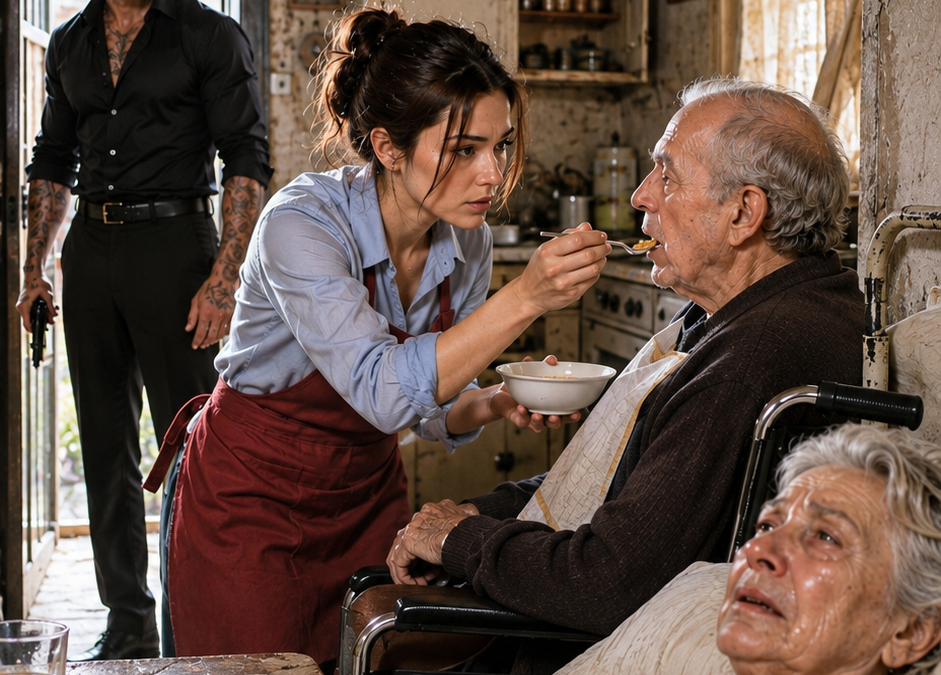
Mafia Boss Found the Single Mom Feeding His Old Parents — Then Something Unbelievable Happened
The most feared man in South Philadelphia walked into his parents’ kitchen expecting to find strangers taking advantage of two helpless old people. Instead, he found a young single mother feeding his trembling father with a plastic spoon.
She had no idea who he was, and when he offered her five hundred dollars to disappear, she did something nobody had dared to do in fifteen years.
But what Dominic Bruno discovered afterward would force him to choose between the empire he had built through fear and the family he had nearly destroyed by abandoning them.
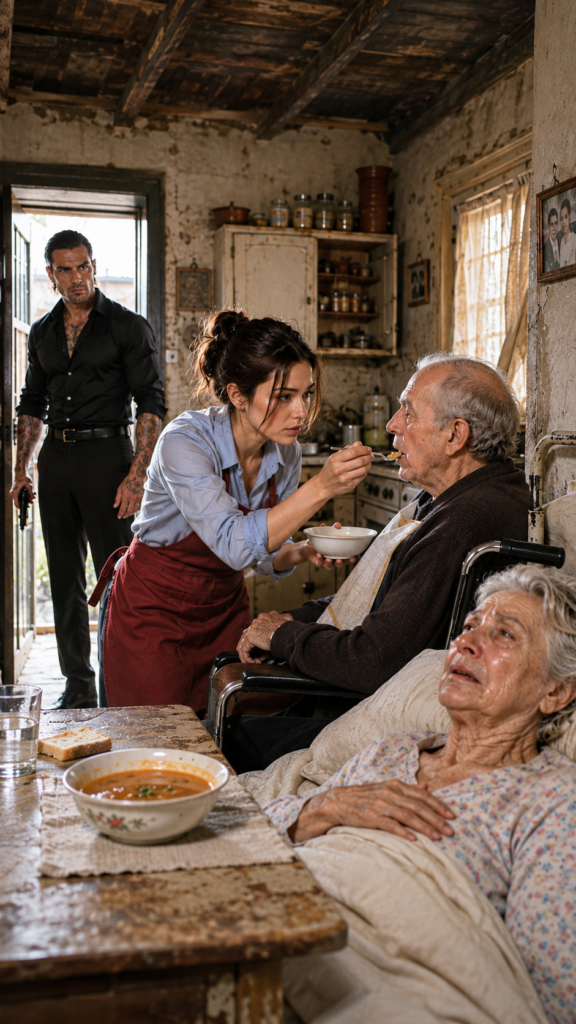
PART 1 — THE WOMAN WHO REFUSED THE MAFIA BOSS
The Stranger at His Father’s Table
Dominic Bruno had spent twenty years teaching South Philadelphia what happened to people who crossed him.
At forty-one, he controlled trucking contracts, warehouses, construction companies, and enough men with questionable loyalties to make even experienced detectives careful about saying his name. The legitimate businesses paid his taxes. The others paid for everything he couldn’t explain.
But on a freezing Tuesday afternoon in November, none of that power could prepare him for what he found inside a narrow brick rowhouse on Wharton Street.
His parents’ house.
He hadn’t stepped inside in eight months.
The last time, his father had thrown a coffee mug at his chest and told him to take his dirty money somewhere else.
Dominic had obeyed the second part.
He’d left fifteen hundred dollars on the hallway radiator before walking out.
Now his black Lincoln idled across the street while rain crawled down the windshield.
“Everything’s quiet,” Dean Mercer said from behind the wheel.
Dean had worked for Dominic for fourteen years. He knew when to speak, when to drive, and when silence was worth more than an explanation.
“Stay here,” Dominic ordered.
He stepped into the cold, adjusted his charcoal overcoat, and crossed the street.
The front door was unlocked.
That stopped him.
His father had always been obsessive about locks. Even when Dominic was a boy, Sam Bruno checked the deadbolt twice before bed and once more after turning out the kitchen light.
Dominic pushed the door open carefully.
He expected an argument.
Perhaps an empty refrigerator. Maybe another stack of unpaid medical bills his father would refuse to discuss.
Instead, he smelled garlic.
Fresh garlic sizzling in olive oil, tomatoes warming on the stove, and the unmistakable fragrance of his mother’s Sunday sauce.
It was Tuesday.
He moved down the hallway toward the kitchen.
Then he heard a woman’s voice.
“One more spoonful, Sam. Just one. Then you can complain about my cooking all you want.”
A dry, irritated voice answered.
“I’ve been eating Italian food since before you were born, sweetheart.”
“Then you should know better than to let good soup get cold.”
Dominic reached the doorway.
His father sat in his usual vinyl-backed chair, his thinning white hair combed carefully to one side. Parkinson’s disease had reduced the strength of the man who once carried two bags of cement up three flights of stairs without stopping.
His left hand shook against the kitchen table.
Standing beside him was a young woman Dominic had never seen.
She wore faded jeans, worn sneakers, and a gray sweatshirt with a cracked high-school track-team logo. Her dark hair was twisted into a messy knot, and the shadows beneath her eyes suggested she hadn’t slept properly in years.
She held a plastic spoon near Sam’s mouth.
“That’s it,” she said. “Slowly.”
She waited until he swallowed before gently wiping a trace of tomato sauce from his chin.
At the other end of the table, Dominic’s mother, Connie, sat with a pile of bills.
Beside her was a small boy coloring a dinosaur green.
“Teresa, honey,” Connie asked, “why is the electricity company charging me twelve dollars just to deliver electricity?”
The young woman smiled faintly.
“Because apparently the electricity takes a limousine.”
Connie laughed.
Even Sam’s mouth twitched.
Dominic couldn’t remember the last time he’d heard his mother laugh like that.
He shifted his weight.
A floorboard creaked.
The little boy looked up first.
Then Connie.
Her smile disappeared.
“Dominic?”
Sam’s spoon stopped halfway to his mouth.
The young woman turned.
For a moment, she studied Dominic without speaking.
His expensive coat.
His polished shoes.
The bruising across his right knuckles.
The cold expression that had ended arguments in rooms full of dangerous men.
Then she quietly moved herself between Dominic and the boy.
It was such a small movement that anyone else might have missed it.
Dominic didn’t.
“Who are you?” he asked.
“Teresa Kincaid. Everybody calls me Tess.”
“What are you doing in my parents’ house?”
“Helping your father eat.”
“I can see that.”
“Then I’m not sure why you’re asking.”
Connie made a small, nervous sound.
“Tess, sweetheart, this is our son.”
“I figured.”
Dominic stepped farther into the kitchen.
“Put the spoon down.”
Tess looked at him, then at Sam.
“He’s not finished.”
“I said put it down.”
“Donnie.”
His father’s voice was rough but unmistakably angry.
“Don’t come into my house barking orders at the one person who bothers to show up.”
Dominic went still.
His father hadn’t called him Donnie in years.
“Who hired her?” he asked.
“Nobody,” Connie answered.
That made no sense.
Dominic paid a private senior-care management company more than four thousand dollars every month to ensure his parents had groceries, medication assistance, and regular home visits.
“What happened to the nurses?”
Connie lowered her eyes.
“They stopped coming in September.”
Dominic stared at her.
“September?”
“The agency said they couldn’t find anyone willing to come down this street anymore. Something about parking and safety.”
“And nobody told me?”
Sam gave a bitter laugh.
“You think we were supposed to call your secretary and make an appointment to complain?”
Dominic turned toward Tess.
“How long have you been coming here?”
“About ten weeks.”
“Why?”
She seemed genuinely confused by the question.
“Your mother nearly fell carrying groceries up the porch steps. I helped her inside. Then I noticed the gas burner was on without a flame.”
Connie looked embarrassed.
“I thought I’d turned it off.”
“Tess opened the windows and called the gas company,” Sam said. “Could’ve been ugly.”
Tess shrugged.
“After that, I started checking in. Your father sometimes has trouble eating, and your mother shouldn’t be lifting him when his legs stiffen.”
“Are you a nurse?”
“No. I have home-health aide training, but I work at a laundry plant now.”
Dominic glanced toward the refrigerator.
He opened it.
Eggs. Milk. Fresh vegetables. Ground turkey. Containers of soup labeled with dates.
The shelves were fuller than he remembered.
“Who pays for this?”
Connie suddenly became interested in the electricity bill.
“Mom.”
“Tess gets what she can,” Connie whispered.
Dominic closed the refrigerator.
He turned toward the young woman.
“How much have you spent?”
“It’s fine.”
“That’s not what I asked.”
“Maybe thirty dollars this week.”
He reached into his pocket and removed five crisp hundred-dollar bills.
He placed them on the table.
“Take that. It covers the groceries and your time.”
Tess stared at the money.
Then she looked at him.
“I don’t want five hundred dollars.”
“Take it.”
“No.”
Dominic’s jaw tightened.
“Nobody works for free.”
“I didn’t say I worked for free. I said your parents needed help.”
“Tomorrow morning, I’ll have a professional nurse here. You won’t need to come back.”
For the first time, genuine anger flashed across her face.
“Wonderful. Just make sure the nurse actually arrives.”
Sam made a faint choking sound that might have been laughter.
Dominic ignored him.
“You’re being offered more money than most people earn in a week.”
“And you’re offering it like you expect me to thank you for remembering your parents exist.”
The room fell silent.
Connie’s hand moved to her mouth.
Dominic stared at Tess.
Men had lost jobs for speaking to him with less disrespect.
But Tess didn’t retreat.
She looked exhausted, not intimidated.
“You want to help them?” she continued. “Your mother has an appointment with her cardiologist Thursday morning. Your father needs his medication organized before the weekend. The bathroom grab bar is loose, and somebody needs to replace the light above the back stairs.”
She pointed toward the money.
“None of that gets fixed by throwing bills on a kitchen table.”
Dominic said nothing.
Tess took the boy’s hand.
“Come on, Sammy. We need to get you home before I leave for work.”
The child gathered his crayons.
“Bye, Grandpa Sam.”
Sam reached out with his trembling good hand.
“Bring that dinosaur back tomorrow, buddy. You forgot his tail.”
Sammy smiled.
“Okay.”
Tess collected her bag and turned toward Connie.
“I left the medication schedule beside the microwave. Call me if he has trouble swallowing again.”
“Thank you, sweetheart.”
Tess hesitated at the doorway.
She looked back at Dominic.
“Your parents are good people, Mr. Bruno. They deserve more than an expensive explanation for why you’re never here.”
Then she walked out.
Dominic stood motionless.
Five hundred dollars remained untouched on the table.
For the first time in many years, he had no idea what to say.
The Signature That Shouldn’t Exist
Connie was the one who finally broke the silence.
“She’s a good girl, Donnie.”
Dominic didn’t answer.
He was staring toward the hallway.
Sam pushed his soup away.
“You scared her.”
“She didn’t look scared.”
“Then you aren’t as smart as people say.”
His father slowly stood, gripping the edge of the table.
Dominic moved instinctively to help.
Sam pulled away.
“Don’t.”
That single word hurt more than Dominic expected.
“I’ve been paying for your care,” Dominic said.
Sam looked at him.
“Have you?”
“Four thousand two hundred dollars a month.”
Connie’s face changed.
“What?”
Dominic took out his phone.
He opened the payment records.
Every month, Sterling Senior Concierge had withdrawn exactly $4,200 from an account managed through his family office.
September.
October.
November.
All paid.
Connie’s lips parted.
“Donnie, nobody has been here since Labor Day.”
Dominic called Dean.
“Get me every record from Sterling Senior Concierge. Tonight. And find out who signed off on their visits.”
He hung up.
Sam gripped the back of his chair.
“You think putting someone else’s name on a check means you did your job as a son?”
Dominic looked at the floor.
“No.”
It was the first time he’d admitted it.
Sam studied him for a moment.
Then his expression softened, though only slightly.
“Your mother waited by that window every Sunday for the first two months.”
“Sam,” Connie whispered.
“She told herself you were busy.”
Dominic felt something tighten beneath his ribs.
He had faced federal investigations, betrayal, and men who wanted him dead.
Nothing had ever made him feel as small as his mother quietly folding an electricity bill so he wouldn’t see her shaking hands.
He stayed until the soup cooled.
He fixed the loose back-door latch.
He replaced the burned-out stair light with a bulb from the kitchen drawer.
Then he drove away.
At 10:37 that night, Dean sent him the agency records.
There were twenty-seven completed care visits listed since September.
Each included medication notes, meal reports, and an electronic acknowledgment supposedly authorized by Sam Bruno.
Dominic enlarged the signature on his phone.
Samuel A. Bruno.
Clean, steady handwriting.
Perfectly formed letters.
His father hadn’t been able to sign his full name without assistance for nearly a year.
Dominic called Dean again.
“Who witnessed these signatures?”
There was a pause.
“According to the records, a coordinator named Evelyn Price.”
“Find her.”
“Boss, there’s something else.”
Dominic stopped walking.
“What?”
“Sterling says your father’s care wasn’t canceled because they couldn’t staff the neighborhood. They claim he personally requested that all in-home visits be suspended.”
“That’s impossible.”
“They have a signed authorization.”
Dominic opened the document Dean forwarded.
The date was September 18.
The signature was the same unnaturally perfect handwriting.
But beneath the authorization was a second signature.
One Dominic recognized immediately.
It belonged to Dean Mercer.
And Dean was standing in the doorway of Dominic’s office, looking as though he’d just seen a ghost.
END OF PART 1
PART 2 — THE NIGHT THE HEAT WENT OUT
A Debt Nobody Had Asked Him to Pay
Dean didn’t sit down when Dominic told him to.
He stood beside the office door, looking at the scanned authorization on Dominic’s phone.
“That’s my signature,” he admitted. “But I didn’t sign that document.”
Dominic waited.
“In July, I signed the original service agreement. Sterling kept a digital copy. Whoever prepared this cancellation used the same signature.”
“You were supposed to check on them.”
“I checked the invoices.”
“That’s not what I said.”
Dean looked away.
In their world, checking a financial arrangement usually meant making certain nobody was stealing money.
Neither man had considered that the company might steal something harder to replace.
Time.
Safety.
The last healthy months of two aging people.
“Find out who handled the account,” Dominic said. “But nobody gets threatened. Not yet.”
Dean looked surprised.
“That’s new.”
“Don’t make me regret it.”
By eleven fifteen, they were parked outside Apex Industrial Laundry near the South Philadelphia industrial district.
Dean had discovered that Teresa Kincaid was twenty-six, legally separated, and raising her six-year-old son without financial support from his father.
She earned $12.50 an hour loading industrial washing machines with hospital linens.
Her husband, Corey Kincaid, had disappeared four years earlier, leaving behind unpaid bills, a damaged marriage, and medical debt from an injury Tess had never fully explained.
“She works nine-hour shifts,” Dean said.
“Who’s watching the kid?”
“A woman named Mrs. Gable. Three miles from here. She charges extra after midnight.”
Dominic looked toward the factory doors.
“Anything else?”
Dean hesitated.
“She’s behind on rent.”
“How far?”
“Two months. The landlord’s Gregori Vlasov.”
Dominic’s expression hardened.
He knew Gregori.
The man had spent years acquiring cheap properties, dividing them into illegal apartments, and charging desperate tenants whatever they could afford.
“How much?”
“Two thousand one hundred fifty dollars with fees.”
“What’s the monthly rent?”
“Nine hundred.”
Dominic looked back toward the factory.
“So she’s working nights to pay for a place she can barely keep warm.”
“There’s more. The building’s boiler shuts down at ten every night.”
Dominic turned.
“It’s below freezing.”
“I know.”
Before Dominic could answer, the factory doors opened.
A dozen exhausted workers hurried into the rain.
Tess emerged last.
Her shoulders were hunched beneath a cheap yellow rain poncho. She walked with a slight limp and carried a canvas bag so worn that the handle had been repaired with electrical tape.
She reached a faded Honda Civic.
The engine struggled.
Stopped.
She tried again.
Nothing.
Through the windshield, Dominic watched her lower her forehead onto the steering wheel.
She remained perfectly still.
There was something almost unbearable about that silence.
No anger.
No dramatic breakdown.
Just a young woman calculating how much another problem was going to cost her.
“Pull over,” Dominic said.
Dean brought the Lincoln beside her car.
Dominic lowered the window.
Tess looked up.
“You’ve got to be kidding me.”
“Car trouble?”
“No. I’m practicing sitting in the rain.”
Despite himself, Dominic almost smiled.
“Let us take you home.”
“I have to pick up my son.”
“Then we’ll take you there first.”
“Mr. Bruno, I don’t need—”
“Teresa.”
She stiffened.
He changed his tone.
“Your son is waiting. It’s freezing. You can argue with me after he’s inside somewhere warm.”
She looked toward her dashboard clock.
11:24 p.m.
Her face changed.
“Mrs. Gable charges another twenty dollars if I’m late.”
“Then we’re already wasting time.”
Tess hesitated.
Finally, she opened the Civic’s door.
“Fine. But this is a ride. Nothing else.”
“Understood.”
“And nobody touches my car.”
Dominic glanced at Dean.
Dean raised both hands.
“Wouldn’t dream of it.”
The ride took six minutes.
Tess sat rigidly on the leather seat, clutching her bag.
She didn’t ask about the car’s price.
She didn’t comment on the heated seats.
Instead, she watched the clock.
“How long have you been looking after my parents?” Dominic asked.
“Every day I can.”
“Even with your work schedule?”
“Your mother watches Sammy for an hour after school sometimes. We help each other.”
Dominic turned toward her.
“She watches your son?”
“Yes.”
He hadn’t known that.
He hadn’t known his mother had become somebody’s emergency babysitter, or that his father had learned to recognize the handwriting of a child who wasn’t related to him.
“They like having him around,” Tess added. “Your dad says the house is too quiet.”
Dominic looked out the window.
He couldn’t remember the last time he’d heard his father complain about silence.
When they reached Mrs. Gable’s house, Tess hurried through the rain.
She returned carrying Sammy, asleep against her shoulder.
His little sneakers dangled beneath a blanket.
She stumbled slightly on the icy steps.
Dominic was already outside the car.
“Let me help.”
She tightened her grip.
“I’ve got him.”
“Your hip hurts.”
“It’s fine.”
“You’ve been limping since the factory.”
Her eyes narrowed.
“Do you notice everything?”
“Only things people try to hide.”
For a moment, something passed across her face.
Then Sammy shifted in her arms.
Tess sighed.
“All right. Just until the car.”
Dominic gently lifted the sleeping boy.
Sammy weighed almost nothing.
His cheek rested against Dominic’s expensive overcoat, leaving a damp impression in the fabric.
Dominic carried him to the Lincoln without speaking.
He had held stacks of cash worth more than Tess would earn in a decade.
Nothing had ever made his hands feel as strangely careful as that sleeping child.
The Building at Number 48
The hallway inside Tess’s building was colder than the street.
The overhead light flickered, and damp plaster peeled from the walls.
Tess carried Sammy upstairs, refusing further assistance.
Dominic stopped at the landing.
A bright pink notice had been taped to her apartment door.
TEN-DAY NOTICE TO QUIT.
Below it, someone had written:
Payment required by Friday. No further extensions.
Tess saw him reading.
“Don’t.”
He turned.
“Don’t what?”
“Don’t look at that like it’s an invitation.”
From inside the apartment came a low electrical hum.
Dominic glanced past her.
A small space heater stood near a mattress covered in dinosaur-patterned sheets. The kitchen occupied one corner of the room, and a narrow curtain separated Sammy’s sleeping area from the rest.
“Where’s the heat?”
“The boiler shuts off at night.”
“That’s illegal.”
“Then somebody should tell my landlord. Preferably somebody who doesn’t have to live here afterward.”
She settled Sammy onto his mattress.
The boy curled onto his side, completely unaware of the conversation.
Tess returned to the doorway and crossed her arms.
“Mr. Bruno, thank you for the ride. I mean that.”
“Dominic.”
“Fine. Dominic. But I know who you are.”
He said nothing.
“I’ve lived in this neighborhood long enough to know what people whisper. Your parents don’t talk about your business, but other people do.”
“And?”
“And I don’t want my son growing up afraid that somebody owns us.”
The words struck closer than she could have known.
Dominic looked toward the sleeping child.
“What happens Friday?”
“I’ll figure it out.”
“How?”
“That’s my problem.”
He studied her for a long moment.
Then he stepped back.
“Get some sleep, Tess.”
She waited until he reached the stairs.
“Dominic?”
He turned.
“If you really want to help your parents, go see them when they’re awake.”
She closed the door gently.
Dominic remained on the landing.
Then his phone vibrated.
A new message from Dean.
He opened it.
Sterling Senior Concierge had provided another document: a complaint withdrawal form dated October 3.
It stated that Teresa Kincaid had acknowledged the agency’s services were satisfactory and had withdrawn concerns about missed home visits.
Her name appeared at the bottom.
Dominic stared at the signature.
Then he looked at the apartment door.
Tess had just told him that no one from the agency had returned.
He dialed Dean.
“Get me the original complaint.”
“Why?”
“Because somebody isn’t just stealing money from my parents.”
Dominic lowered his voice.
“They’re putting this woman’s name on documents she never signed.”
END OF PART 2
PART 3 — THE PRICE OF A FAVOR
The Man Who Thought Everything Was for Sale
The next morning, Dominic visited Gregori Vlasov’s salvage yard.
He brought Dean, a copy of the eviction notice, and an attorney’s letter listing fourteen housing-code violations documented by city inspection records.
He didn’t need to raise his voice.
Gregori’s smile vanished the moment he saw the letter.
“Dominic, my friend. We could have handled this over the phone.”
“You’ve been turning the heat off in a building full of tenants.”
“Heating oil is expensive.”
“So are lawsuits.”
Gregori shifted uncomfortably behind his desk.
“The girl owes me rent.”
“I know.”
Dominic placed a cashier’s check on the desk.
Seven thousand five hundred fifty dollars.
The exact amount required to clear Tess’s arrears and cover another six months.
Dean slid a written payment agreement beside it.
“The check covers the listed rent only,” Dean said. “Repairs are your responsibility under the lease and city code.”
Gregori read the paperwork.
“You came all this way for one tenant?”
Dominic looked at him.
“She’s the reason my mother didn’t fall down her front steps last month.”
Gregori swallowed.
“I didn’t know she was connected to you.”
“She isn’t.”
The landlord looked confused.
“Then why—”
“Because she shouldn’t have to be.”
Dominic leaned forward.
“You will restore the building’s heat. You will repair the broken entry lock. And you’ll stop sending a collector to sit outside her apartment.”
Gregori’s face changed.
“That’s a misunderstanding.”
“I know his name. Igor. I know he stood on her porch while her son was outside.”
“He’s only there to collect rent.”
“Then he can learn to send invoices.”
Dominic straightened.
“Your tenants have rights, Gregori. I suggest you start respecting them before inspectors begin visiting every property you own.”
Gregori glanced at Dean.
The threat was unmistakable, but the paperwork was legitimate.
For once, Dominic had brought documents instead of consequences nobody wanted recorded.
Gregori slowly signed the receipt.
“Fine.”
Dominic turned to leave.
“One more thing.”
Gregori froze.
“You deliver the payment acknowledgment to Tess yourself.”
“Of course.”
“And don’t make her thank me.”
The Woman Who Couldn’t Afford Gratitude
At 5:15 that afternoon, Tess appeared in the Bruno kitchen holding a white piece of paper.
Dominic was replacing the broken handle on his mother’s pantry door.
She stopped three feet from him.
“Did you do this?”
He looked up.
“What?”
She held out the rental receipt.
“Don’t.”
He put down the screwdriver.
“Yes.”
Her face flushed.
“I told you not to.”
“I paid what you owed.”
“That wasn’t your decision.”
“My parents need you.”
The words escaped before he could reconsider them.
Tess looked as though he’d slapped her.
“So that’s it.”
Dominic frowned.
“What?”
“You paid my landlord because you want me available.”
“No.”
“Then why bring your parents into it?”
He had no answer that didn’t sound like a transaction.
Tess placed the paper on the table.
“You know what happened when I was nineteen?”
He remained silent.
“I married a man who was charming when he was sober. He said he wanted to take care of me. He said I didn’t need to worry about money.”
She looked down at her hands.
“Then every grocery bill became proof of what I owed him. Every favor became something he could demand back.”
Dominic’s expression changed.
“When Sammy was little, Corey took my paycheck because he said he knew how to manage things better. I found out later he’d spent it gambling.”
Her voice stayed controlled, but one hand began trembling.
“When I finally got a separate bank account, he got angry. I ended up at Methodist Hospital with a broken collarbone and a story about falling down the stairs.”
Dominic felt a cold fury rise in his chest.
Tess saw it.
“No.”
He looked at her.
“Don’t even think about it,” she said. “I didn’t tell you so you could go hunting for him.”
“What happened after the hospital?”
“Corey disappeared. Arizona, supposedly. I haven’t seen him in four years.”
“Why aren’t you divorced?”
“I filed. He couldn’t be found for service, and then I couldn’t keep paying the lawyer. It never got finished.”
Dominic looked toward the hallway, where Connie was helping Sammy wash his hands.
For the first time, he understood that Tess’s refusal wasn’t pride for its own sake.
It was survival.
She had spent years making sure nobody could take away her choices again.
“I won’t ask you to do anything for me,” he said.
“That’s easy to say when you’ve already done it.”
He nodded slowly.
“You’re right.”
The admission surprised them both.
Tess stared at him.
“You can’t just walk into people’s lives and rearrange everything because you can afford it.”
“I know that now.”
“Do you?”
He considered the receipt.
“Would it help if we wrote this down? That there’s no obligation?”
“No. It would help if you asked before doing something this big.”
Dominic lowered his eyes.
“Then I’m sorry.”
Tess studied him.
He looked like a man who knew a hundred ways to force an outcome but had very little experience with an apology.
She pulled out a chair.
“I don’t want you calling my landlord again unless there’s an emergency. And if you want to help your parents, you show up and help them yourself.”
“All right.”
“And I want a copy of whatever you signed.”
“You’ll have it.”
She sat, exhausted.
After a moment, Dominic took a notepad from the counter.
“What are you doing?” she asked.
“Writing down the things I need to ask before I interfere again.”
Despite herself, Tess laughed.
It was brief.
Almost involuntary.
But he heard it.
A Missing Page
Two days later, Tess returned with an old spiral notebook.
Its cover was decorated with a cartoon sunflower.
She placed it on Connie’s kitchen table.
“I kept notes when the agency stopped coming,” she explained.
Dominic opened it.
Every page contained dates, times, medication reminders, grocery expenses, and short observations about Sam’s condition.
October 7: Tremor worse after lunch. Called doctor’s office.
October 12: Connie dizzy after climbing stairs. Rested. Blood pressure normal afterward.
October 19: Sam ate half a bowl of vegetable soup. Trouble swallowing carrots.
Dominic frowned.
The wording looked familiar.
He opened the Sterling records on his tablet.
On October 19, the agency claimed a caregiver had visited Sam at 2:30 p.m.
The note read:
Patient consumed half a bowl of vegetable soup. Difficulty swallowing carrots.
Tess leaned over his shoulder.
Her face drained.
“That’s my note.”
Dominic turned another page.
October 12.
The same observation appeared in the agency’s report.
Even the punctuation matched.
“Who else saw this notebook?” he asked.
Tess thought carefully.
“Your mother. Sometimes Sammy draws in the back.”
“Anyone from Sterling?”
“One woman came in early October. Said she was reviewing the account. She asked whether I was keeping records.”
“What happened?”
“I showed her the notebook. She took pictures with her phone.”
Dominic closed his eyes.
“Do you remember her name?”
Tess reached into her bag.
She pulled out a business card.
Evelyn Price — Client Services Coordinator, Sterling Senior Concierge.
Dominic took it.
On the back, Tess had written the date of the visit.
October 3.
The same day the agency claimed Tess had signed a complaint withdrawal.
Dominic’s phone buzzed.
A text from Dean.
I found Evelyn Price. We have a problem.
Dominic called immediately.
“What kind of problem?”
Dean’s voice was unusually tense.
“She resigned from Sterling three weeks ago. Left her apartment yesterday. Her phone is disconnected.”
Dominic looked at the notebook.
“Where did she go?”
“That’s what I’m trying to find out.”
A pause.
Then Dean added something that made Dominic’s blood run cold.
“Before she disappeared, she mailed a package to your parents’ address. Registered delivery. Tracking says somebody signed for it yesterday.”
Dominic slowly turned toward Connie.
“Ma?”
Connie looked up from the stove.
“What is it, Donnie?”
“Did a package arrive yesterday?”
Her face changed.
“Yes.”
“Where is it?”
She hesitated.
“Teresa told me to keep it somewhere safe until you came.”
Tess stared at Connie.
“I didn’t say that.”
The kitchen went silent.
Connie gripped the countertop.
“Then who was the woman who called me yesterday afternoon?”
END OF PART 3
PART 4 — THE TRUTH INSIDE THE ENVELOPE
Twenty-Seven Visits That Never Happened
Connie retrieved the package from the cupboard above the refrigerator.
It was a padded brown envelope, addressed to Samuel Bruno in careful handwriting.
“I thought it was something important,” she said. “The woman who called said Teresa wanted me to leave it unopened until somebody collected it.”
Tess shook her head.
“I didn’t tell anyone that.”
Dominic examined the envelope.
The sender’s name was Evelyn Price.
He opened it.
Inside were a handwritten letter, a small flash drive, and photocopies of several documents.
Dominic read the letter aloud.
Evelyn explained that Sterling Senior Concierge had continued billing for home visits after the contracted nursing provider withdrew from the neighborhood in September.
Rather than notifying the family or arranging replacement care, management instructed her to record the visits as completed.
She had used photographs of Tess’s notebook to fabricate believable reports.
The signatures on the authorization forms were copied from earlier records.
She also admitted that she’d falsely attributed a complaint withdrawal to Tess.
Connie slowly lowered herself into a chair.
“They knew nobody was coming?”
Dominic couldn’t answer.
Evelyn’s letter continued.
She had objected to the falsified reports, but her supervisor reminded her that she was supporting two children and couldn’t afford to lose her job.
At first, she had complied.
Then, in late October, another elderly client suffered a serious fall after scheduled assistance failed to arrive.
Evelyn began copying records.
She resigned when management instructed her to delete the original scheduling logs.
The final paragraph was short.
I know I should have spoken sooner. I cannot undo that. But if anything happens to your parents, please understand that your family was paying for care they were not receiving. I am willing to tell investigators what I know.
Beneath it was a telephone number.
Dominic placed the letter on the table.
No one spoke.
Finally, Sam reached for the paper.
His trembling fingers struggled to hold it.
“How much did they take?”
“More than twenty-five thousand dollars since September,” Dean answered.
Sam looked at his son.
“And how much of that money could have bought an hour of your time?”
Dominic closed his eyes.
There were no accountants who could answer that question.
The Difference Between Justice and Revenge
By the following morning, Dominic knew the names of Sterling’s owners, directors, investors, and senior managers.
He also knew the location of every company office.
Dean stood across from him in his warehouse headquarters.
“The director’s Martin Hale,” Dean explained. “He’s been running the operation for eleven years. Plenty of complaints, but nothing that stuck.”
Dominic examined a photograph of Hale leaving a restaurant.
“I could have him in this room by lunchtime.”
Dean understood what that meant.
“Yes, boss.”
Dominic’s phone rang.
Tess.
He answered.
“Have you spoken to Evelyn?” she asked.
“Not yet.”
“Then don’t do anything until you do.”
He glanced at Dean.
“What makes you think I’m doing something?”
“Because your mother called me and said you left her house looking like you wanted to break a wall.”
Dominic didn’t respond.
“Listen to me,” Tess continued. “That woman signed things she shouldn’t have signed. But she also sent us proof. If you scare her, she might never testify.”
“I wasn’t planning to scare Evelyn.”
“Then whoever you’re planning to scare, don’t.”
Dominic looked out over the loading yard.
“People took advantage of my parents.”
“I know.”
“They knew my father was sick.”
“I know.”
His voice dropped.
“And you’re telling me to do nothing?”
“I’m telling you to do something that still matters after the anger wears off.”
That silenced him.
Tess lowered her voice.
“My mother worked in a nursing home for nineteen years. She always said the people most likely to get neglected were the ones everybody assumed somebody else was watching.”
Dominic leaned against his desk.
“Is that why you started helping my parents?”
“Partly.”
“What’s the other part?”
There was a long pause.
“Because when my mother got sick, I was working overtime to pay her bills. I kept promising I’d visit the next morning.”
Tess swallowed.
“One morning, there wasn’t another morning.”
Dominic looked toward the window.
“I’m sorry.”
“So am I,” she whispered. “But you can’t fix that kind of regret by making somebody else afraid.”
He remained quiet.
Then he called Dean over.
“Find a lawyer who handles elder-care fraud.”
Dean blinked.
“We have lawyers.”
“Not one of ours. Someone independent.”
“Why independent?”
“Because I want them to believe Tess.”
That afternoon, they met Grace Alvarez, a Philadelphia attorney who had spent twelve years representing vulnerable adults and families affected by financial exploitation.
Tess chose her after speaking to three firms.
Grace reviewed the records for nearly an hour.
“This is substantial evidence,” she finally said. “But we need to preserve the original electronic files, confirm the billing trail, and obtain sworn statements from people who can testify to what actually happened.”
“I can testify,” Tess said.
“You may become one of the most important witnesses.”
Dominic leaned forward.
“What happens to Sterling?”
“Investigators decide that. We can file complaints with state regulators and refer the suspected fraud to the appropriate authorities.”
“That could take months.”
“It might.”
Dominic’s jaw tightened.
Grace looked directly at him.
“Mr. Bruno, this won’t work if anyone intimidates witnesses or interferes with the evidence.”
He stared at her.
She didn’t look away.
Finally, he nodded.
“Then let’s do it properly.”
For the first time in his adult life, Dominic Bruno had agreed to wait for a process he couldn’t control.
The Empty Parking Space
Three weeks passed.
December brought icy sidewalks, crowded grocery stores, and a string of nights when the temperature fell below twenty degrees.
Gregori repaired the heating system after receiving a municipal inspection notice.
Tess’s car received a new battery and terminal connection, paid for through a repayment arrangement she insisted on making with the mechanic.
Dominic began visiting his parents twice a week.
At first, Sam barely spoke to him.
Dominic didn’t push.
He repaired a loose cabinet hinge, cleared snow from the steps, and sat beside his father while an old baseball game played on television.
Sometimes they exchanged fewer than twenty words.
Still, Dominic returned.
He learned that his mother’s coffee tasted better when he made it a little weaker.
He learned Sam preferred his soup thicker than Connie did.
He learned that Sammy believed dinosaurs were still alive somewhere, but grown-ups were keeping it a secret.
And slowly, number 44 stopped feeling like a building he was paying to preserve.
It began feeling like home.
Then, on the second Tuesday in February, everything changed.
At 4:10 p.m., Dominic’s phone rang.
Connie was crying.
“Donnie, it’s Tess.”
He stood immediately.
“What happened?”
“Sammy came running over. He said there’s a strange man at their apartment.”
“Where’s Sammy now?”
“Here with us. He’s safe.”
Dominic was already moving.
“Where’s Tess?”
“She went back to get her purse. The man followed her upstairs.”
A sudden crash sounded in the background of the call.
Not from Connie’s house.
From somewhere close enough for her to hear through the kitchen window.
Dominic reached his car.
“Dean, drive.”
As they turned onto Wharton Street, Dominic saw a battered Dodge Dakota outside number 48.
A New Jersey license plate hung crookedly from its rear bumper.
Tess’s Honda wasn’t in its usual space.
The building’s front door stood open.
Then Dominic’s phone rang again.
Tess.
He answered immediately.
“Teresa?”
Her voice was barely above a whisper.
“Dominic, don’t bring Sammy here.”
A man’s voice sounded behind her.
“Who are you talking to?”
Tess drew a sharp breath.
Then the call ended.
END OF PART 4
PART 5 — THE MAN WHO CAME BACK
A Husband Who Had Forgotten His Son
Corey Kincaid had returned to Philadelphia with ninety dollars in his wallet, a truck held together by rust, and a story he told himself whenever he needed to justify another bad decision.
He was owed something.
Four years earlier, he’d left his wife and child behind.
Now he had heard that somebody wealthy was paying her rent.
To Corey, that meant Tess had money.
And money meant he had a reason to come home.
When Dominic reached apartment 2B, he found the door hanging crookedly from its frame.
A lamp lay broken near the couch.
Tess stood beside the kitchen counter, her left cheek swollen, one hand gripping her phone.
Corey was pacing in front of her.
He was thinner than the photographs Dean had found, with hollow cheeks and restless hands.
“Where is it?” he demanded.
“There is no cash, Corey.”
“Don’t lie to me. Gregori told Jimmy somebody paid seven grand for you.”
“It went straight to the landlord.”
“Then tell your rich boyfriend to give me some.”
Tess shook her head.
“You’re leaving.”
Corey laughed.
“This is my family.”
“You haven’t been part of this family in four years.”
He stepped toward her.
“You don’t get to decide that.”
A voice came from the doorway.
“Actually, she gets to decide who enters her home.”
Corey turned.
Dominic stood just inside the broken door.
For a moment, neither man moved.
Corey’s gaze traveled from Dominic’s face to his expensive coat.
Then recognition appeared.
“Bruno?”
Dominic didn’t answer.
Corey took a small step backward.
“I didn’t know she was connected to you.”
“She’s not something that belongs to me.”
Corey glanced toward Tess.
“Then why are you here?”
“Because Connie Bruno called me.”
Dominic looked at the broken lamp.
“She said there was trouble.”
Corey’s expression hardened.
“This is a private family matter.”
“Not when you break into a home and frighten people.”
“I’m her husband.”
“You’re a man she told to leave.”
Corey reached for the screwdriver on the counter.
Tess saw it first.
“Corey, put that down.”
He grabbed it.
Dominic stopped moving.
The room seemed to contract around the three of them.
“Don’t make another mistake,” Dominic said.
Corey’s hand shook.
“You think you scare me?”
“Yes.”
It was the simplest answer Dominic could have given.
Corey swallowed.
For one terrible second, Tess thought Dominic would reach beneath his coat.
She stepped forward.
“Dominic.”
His eyes moved toward her.
“Please,” she said. “Not here.”
He looked at her swollen cheek.
Then at the screwdriver.
Then at the child’s dinosaur blanket folded neatly on the mattress.
His hand fell away from his coat.
“Put it down, Corey.”
Corey hesitated.
Outside, sirens became audible.
Dean had called the police before entering the building.
Corey turned toward the window.
“She called the cops?”
“I did,” Dominic answered.
“You son of a—”
“Put it down.”
The screwdriver clattered onto the counter.
Corey backed toward the door.
“This isn’t over.”
Tess stepped forward.
“It is for today.”
He looked at her with naked resentment.
“You made me look like a monster.”
“No,” she said quietly. “You did that when our son was two.”
Corey’s face changed.
For a moment, he appeared almost wounded.
Then the anger returned.
“You think Bruno’s money makes you a better mother?”
Tess held his gaze.
“No. Getting up every morning does.”
The police arrived before Corey reached the bottom of the stairs.
After speaking to Tess and inspecting the damaged apartment, they took him into custody on suspicion of assault and related offenses.
Dominic stood back while Tess gave her statement.
He didn’t speak for her.
He didn’t correct her.
He didn’t tell the officers how to do their jobs.
He watched her describe the broken door, the stolen purse, and the man who had raised a screwdriver in her kitchen.
When an officer asked about Dominic, she answered simply.
“He’s my neighbor’s son. He came because his mother called him.”
The officer looked at Dominic.
Recognition flickered across his face.
But Dominic said nothing.
Afterward, he helped Tess gather the broken pieces of the lamp.
She sat on the edge of the couch.
For several minutes, neither spoke.
Finally, she whispered, “He’s going to come back.”
“There’s a report now.”
“Corey doesn’t care about reports.”
Dominic sat opposite her.
“Then we’ll make sure you have legal protection.”
She gave a tired laugh.
“We?”
He looked at her.
“You can choose the lawyer. You can decide what happens next. But you don’t have to figure out every form alone.”
Tess studied him.
“That’s different from what you would’ve said three months ago.”
“Three months ago, I would’ve paid him to leave town.”
“And threatened him if he didn’t?”
Dominic didn’t answer.
Tess looked down.
“Thank you for not doing that.”
He nodded.
It bothered him that she was thanking him for choosing not to hurt someone.
It bothered him even more that she’d had a reason to worry.
The Child Who Didn’t Ask About His Father
That evening, Sammy sat at Connie’s kitchen table coloring another dinosaur.
He was calm, but quieter than usual.
Tess knelt beside him.
“Hey, buddy.”
He looked up.
“Is the man gone?”
“Yes.”
“Was he mad at you?”
She brushed his hair back.
“He was angry, but that’s something grown-ups have to handle. You don’t have to fix it.”
Sammy thought about that.
“Grandpa Sam said I could stay here for dinner.”
Tess smiled.
“That sounds good.”
Sammy glanced toward Dominic.
“Are you staying too?”
Dominic hesitated.
“If your mom says it’s okay.”
Sammy turned toward Tess.
She looked at Dominic for a moment.
“Yes,” she said. “He can stay.”
Sammy picked up his green crayon.
“Then everybody gets a dinosaur.”
Connie turned toward the stove quickly.
Dominic saw her wipe her eyes with the corner of her apron.
Later, when Sammy was eating, Tess stepped into the hallway to speak privately with Grace Alvarez.
Grace had already begun preparing paperwork for a protection order and a request for temporary custody.
She advised Tess to document everything, preserve her photographs, and avoid discussing the incident with Corey directly.
“His arrest doesn’t end his parental rights,” Grace explained. “We need the court to establish arrangements that protect Sammy.”
Tess leaned against the wall.
“Corey hasn’t seen him since he was two.”
“That matters. His conduct today matters. But we still need to present the evidence.”
Tess closed her eyes.
“Okay.”
Grace hesitated.
“There’s something else. Has anyone warned you that Mr. Bruno’s involvement could become an issue?”
Tess looked toward the kitchen.
“What do you mean?”
“Corey’s attorney may argue that your child is being exposed to a dangerous environment.”
“Dominic protected us.”
“I understand. But courts examine the whole situation, and Dominic Bruno has a reputation.”
Tess was silent.
Through the kitchen doorway, she could hear Dominic telling Sammy that a Tyrannosaurus rex probably couldn’t outrun a modern racehorse.
Sammy loudly disagreed.
For a moment, Tess wanted to pretend that was all that mattered.
Then Grace spoke again.
“You need to decide how much involvement you’re comfortable with before the other side decides how to portray it.”
Tess looked at Dominic.
She finally understood the price of being close to a man everyone feared.
It wasn’t always collected by the man himself.
Sometimes it came from everyone watching.
The Court Papers
Four days later, Corey was released pending further proceedings.
A temporary no-contact order prevented him from approaching Tess, but the legal questions surrounding Sammy remained unresolved.
On Monday morning, Tess received an envelope.
Inside was an emergency custody petition.
Corey alleged that Tess had exposed their son to a known organized-crime figure who carried weapons and exercised financial control over her housing.
Attached were photographs.
Dominic’s black Lincoln outside the building.
Dean delivering groceries to Connie’s house.
And a blurry image from Corey’s phone showing Dominic inside the apartment, with the outline of a holstered handgun beneath his coat.
Tess read the petition twice.
Then a third time.
The final page contained Corey’s request.
Temporary sole physical custody of Samuel Kincaid pending a full hearing.
For the first time since her husband had left, Tess realized he might find a way to hurt her without ever entering her home again.
She called Dominic.
He answered on the first ring.
“Tess?”
Her voice was steady.
But her hands were shaking.
“Corey’s trying to take my son.”
END OF PART 5
PART 6 — THE DANGER OF A POWERFUL NAME
The Case She Could Lose Without Doing Anything Wrong
Grace Alvarez read Corey’s custody petition in silence.
Tess sat across from her, gripping a paper cup of coffee that had gone cold.
“Can he really do this?” she asked.
“He can file a petition,” Grace said. “That doesn’t mean he’ll win.”
“But Dominic was in my apartment.”
“Yes.”
“And he had a gun.”
“Apparently.”
Tess pressed her fingers against her forehead.
“He came because Corey attacked me.”
“Then that’s what we document.”
Grace introduced her to Maya Bennett, a family-law attorney who worked with a Philadelphia domestic-violence legal assistance program.
Maya was in her late thirties, with a practical manner and a habit of asking questions nobody wanted to answer.
“Did Mr. Bruno threaten Corey while he was inside your apartment?”
Tess hesitated.
“He told him to put down the screwdriver.”
“Did he take out the gun?”
“No.”
“Has Dominic ever threatened you?”
“No.”
“Has he ever asked you to commit a crime, hold anything for him, or hide anything?”
“No.”
Maya made a note.
“Has he made decisions about your housing without your permission?”
Tess looked down.
“Yes.”
Maya waited.
“He paid my rent. I told him not to.”
“Did he demand anything in exchange?”
“No.”
“Then we’ll be truthful about all of it.”
Tess exhaled slowly.
“What if the judge thinks I accepted money because I was afraid?”
“Then we’ll explain what happened. Your employment records, childcare arrangements, bank statements, and the records you kept for the Brunos all help establish that you have been supporting your son independently.”
Tess looked toward the window.
“What about his reputation?”
Maya folded her hands.
“We can’t make Dominic’s history disappear. We can show that your child has been living safely with you and that Corey’s allegations don’t justify taking him away.”
For the first time that morning, Tess felt the smallest bit of solid ground beneath her feet.
It was not a promise.
But it was something she could build on.
The Man Who Was Asked to Stay Away
Dominic arrived at Tess’s apartment the following afternoon carrying a small toolbox.
He’d arranged for the damaged door to be replaced and wanted to inspect the new lock.
Tess met him outside.
“We need to talk.”
He stopped.
“What’s wrong?”
“Maya thinks we should keep some distance until the hearing.”
His expression didn’t change.
But his hand tightened around the toolbox handle.
“Because of Corey?”
“Because the photographs are real. Because people know who you are.”
“I haven’t done anything to you.”
“I know.”
“Then why should I disappear?”
Tess looked at him.
“Because you aren’t the one who might lose a child.”
He flinched.
The words hung between them.
Behind the apartment window, Sammy was building a dinosaur out of plastic blocks.
Dominic looked at him.
Then back at Tess.
“What do you need?”
It was such a simple question.
And somehow, after everything that had happened, it meant more than the money he’d spent.
“I need you not to visit this building for a while,” she said. “And please stop having Dean watch the street.”
Dominic considered it.
His instincts argued against her.
Surveillance meant control.
Control meant safety.
At least, that was what he’d always believed.
But Tess was asking him to protect something he couldn’t buy back if it was lost.
“All right,” he said.
She stared at him.
“Just like that?”
“It’s your decision.”
He placed the toolbox on the ground.
“The repairman has already fixed the door. This is only in case something comes loose again.”
Tess nodded.
“Thank you.”
Dominic turned to leave.
“Will you still visit my parents?” he asked.
“Of course.”
He nodded once and walked away.
He didn’t look back.
Tess watched him reach his car.
She had spent four years learning to live without depending on anybody.
Now she was beginning to discover that allowing someone into her life could be just as frightening as losing them.
The Call From the Hospital
Nine days later, Tess was working an evening shift when Connie called.
Sam had begun coughing badly during dinner.
The coughing worsened, and his breathing became difficult.
Connie had called 911.
The ambulance was already on its way.
Tess asked her supervisor for permission to leave.
When she reached Pennsylvania Hospital, Dominic was standing outside the emergency department.
He looked different.
Not physically.
His coat was still expensive, his hair neatly combed, and his posture perfectly controlled.
But his hands were shaking.
For a moment, Tess didn’t recognize him.
“How is he?” she asked.
“They think he aspirated some food.”
“Has he been admitted?”
“Yes. They’re watching his breathing and checking for pneumonia.”
Dominic looked toward the doors.
“He was eating dinner, Tess. Just dinner.”
She stood beside him.
Parkinson’s could affect swallowing, and Sam’s difficulties had been increasing.
Tess had encouraged Connie to ask the doctor about a swallowing evaluation months earlier, but the appointment had been delayed while the family tried to reconstruct what care Sam had actually received.
Now that delay felt terrifying.
“He has a doctor looking after him,” she said.
Dominic nodded.
But his eyes remained fixed on the door.
After several minutes, he spoke.
“When I was sixteen, my father fell from a construction scaffold.”
Tess turned toward him.
“Broke three ribs and fractured his wrist. He went back to work before the doctor cleared him because the mortgage was due.”
Dominic smiled faintly at the memory.
“He used to carry me on his shoulders when we went to Phillies games. I thought he was indestructible.”
He looked down at his hands.
“Today, he couldn’t swallow a piece of chicken.”
Tess didn’t offer an easy reassurance.
She knew better.
Instead, she stayed beside him.
Eventually, Dominic sat down.
Tess took the chair next to his.
He stared at the floor.
“I can make half this city answer a phone call at three in the morning.”
His voice broke.
“But I can’t make my father breathe.”
Tess rested her hand over his.
For once, Dominic didn’t try to solve the problem.
He simply held on.
The Words Sam Had Waited Years to Say
Sam remained in the hospital for four days.
The doctors treated early aspiration pneumonia, adjusted his medications, and recommended changes to his meals, along with ongoing swallowing therapy.
He recovered slowly.
On the third evening, Dominic found himself alone beside his father’s bed.
The hospital room smelled of disinfectant and warmed blankets.
Sam lay against two pillows, his face pale but his eyes alert.
“You’re hovering,” he muttered.
Dominic looked up.
“Sorry.”
“Sit down before you wear a hole through the floor.”
Dominic obeyed.
For several minutes, they watched the muted television.
Then Sam spoke.
“Your mother says you’ve been fixing things around the house.”
“A few things.”
“You always were good with your hands.”
Dominic looked toward him.
“You taught me.”
Sam gave a small nod.
“I taught you how to work. I don’t know who taught you to scare people.”
Dominic lowered his eyes.
His father continued.
“When you were twenty-three, that trucking contractor lost his business after your friends threatened him. He had a wife and two daughters.”
Dominic knew exactly who he meant.
The man had refused to cooperate with a union arrangement Dominic was enforcing.
At the time, Dominic had considered the outcome a necessary warning.
Now he remembered the man’s daughter standing outside the warehouse, begging somebody to let her father inside.
“I remember,” he said.
“I know you do.”
Sam shifted against the pillows.
“That’s why I couldn’t take your money, Donnie. I kept thinking about the people who’d paid for it.”
Dominic’s throat tightened.
“I wanted you and Ma to be comfortable.”
“We wanted our son.”
The words settled heavily between them.
Sam looked at him.
“I’m not asking you to pretend you haven’t done terrible things. And I’m not asking you to become somebody else overnight.”
He paused to catch his breath.
“I’m asking you to stop believing that taking care of people gives you the right to control them.”
Dominic stared at his father’s trembling hand.
For years, he’d interpreted Sam’s rejection as stubbornness.
Now he understood that his father had been waiting for something more difficult than money.
He had been waiting for a reason to trust him.
Dominic reached out.
After a moment, Sam placed his hand in his son’s.
Neither spoke again for a long time.
The next morning, Dominic called Dean.
“I need every original document from the Sterling account.”
“We already gave Grace copies.”
“I want the complete family-office records. Including the authorization I signed and the payments processed through our companies.”
Dean hesitated.
“Those records may raise questions about the rest of the accounts.”
“I know.”
“Boss—”
“Do it.”
Dominic looked through the hospital window.
For the first time in twenty years, he was willing to open a door he couldn’t guarantee he’d be able to close.
END OF PART 6
PART 7 — THE THINGS HE COULD NOT BUY
The Truth Reaches Beyond One Family
The Sterling investigation grew larger in March.
Evelyn Price finally agreed to speak with investigators and provide sworn testimony.
She had moved temporarily to her sister’s home in Bethlehem after receiving letters from Sterling’s attorneys accusing her of stealing company information.
The company claimed she had acted alone.
Evelyn’s records told a different story.
They included internal messages instructing coordinators to mark scheduled care as complete when providers canceled at the last minute.
Several other families had been billed for services they couldn’t verify.
Grace brought the findings to Tess and Dominic at her office.
“This is potentially much bigger than your parents,” she explained.
Dominic reviewed the documents.
“How many families?”
“We don’t know yet. Investigators are examining the records.”
He looked at the signatures.
“I paid them every month.”
“And other people may have done the same.”
Tess sat quietly.
She remembered the nights she’d left the laundry plant wondering whether Connie had managed to get Sam into bed safely.
She remembered the cold refrigerator and the loose stair rail.
She thought about other elderly people who might not have had anyone living two doors away.
“Will the families get their money back?” she asked.
“Possibly. But the financial recovery may take time, and some of the harm can’t be measured in dollars.”
Dominic knew exactly what she meant.
There was no refund for the afternoon his mother had nearly fallen on icy steps.
No payment could restore the weeks his father had spent struggling alone.
Grace turned toward him.
“The records from your family office will be important.”
“They’re yours.”
She hesitated.
“I need to make sure you understand that these documents may receive scrutiny beyond the Sterling investigation.”
Dominic looked at Tess.
She was watching him carefully.
He thought about his father’s hospital room.
About the old contractor whose daughter he’d once ignored.
About a child sleeping in a cold apartment while his mother worked another shift.
“Then let them look,” he said.
Dean, sitting beside the door, lowered his head.
He had spent fourteen years protecting Dominic from scrutiny.
Now he was watching his boss invite it.
An Offer She Didn’t Accept
Two days later, Tess received bad news from the laundry plant.
Production had slowed after the facility lost a hospital contract.
Her supervisor offered her a reduced schedule.
Fewer shifts meant fewer wages.
The timing couldn’t have been worse.
She needed transportation, legal appointments, and a stable place for Sammy to live.
When Dominic heard about the reduction, he called her.
“I know somebody who can get you a better job.”
Tess closed her eyes.
“Dominic.”
“It’s legitimate work.”
“I believe you.”
“The pay’s better. Regular hours.”
“I know you’re trying to help.”
“Then why are you saying no?”
“Because I want to find out whether I can get hired without someone recognizing your name.”
He was silent.
“I don’t want every good thing in my life to have your fingerprints on it,” she continued.
That stung.
But this time, Dominic understood.
“All right.”
She sat down at her kitchen table.
“There’s a patient-care training program at Community College of Philadelphia. I applied last month.”
“That’s good.”
“They called today. I got a place, and there’s grant funding for the first semester.”
Dominic smiled.
“Congratulations.”
Tess laughed softly.
“Thank you. I haven’t figured out the schedule yet.”
“You will.”
“That’s very optimistic for you.”
“I’ve been practicing.”
After the call, Dominic sat alone for several minutes.
He’d wanted to solve her employment problem by making one phone call.
Instead, she’d found a path he couldn’t take credit for.
And he realized he was proud of her.
Not because she’d needed him.
Because she hadn’t.
The Letter From the Courthouse
The custody hearing was scheduled for March 19.
Corey’s attorney had submitted additional allegations.
He claimed Tess had allowed an organized-crime figure to exercise control over her household, creating an unsafe environment for Sammy.
The petition also alleged that Dominic’s payment of her rent demonstrated a financial relationship she was unwilling to disclose.
Maya reviewed the claims carefully.
“Some of these statements are misleading, but we can’t pretend they came from nowhere,” she told Tess.
Tess nodded.
“I know.”
“Corey’s assault case is pending. We have the police report, photographs, and your records. We also have statements from Connie and Mrs. Gable about Sammy’s care.”
“What about Dominic?”
“Having him in court might create more distractions than it solves.”
Tess looked down.
“He’ll understand.”
“Will he?”
She thought about the man she’d met in November.
The man who’d ordered her to put down a plastic spoon.
Then she thought about the man who’d sat outside his father’s hospital room, unable to stop his hands from shaking.
“Yes,” she said.
“I think he will.”
That evening, she visited the Brunos.
Sam had returned home, and a new care team was following the doctor’s swallowing plan.
Dominic was in the kitchen, carefully cutting his father’s food into small pieces.
Sam looked miserable.
“You’re cutting it like I’m six.”
“The doctor said smaller bites.”
“The doctor doesn’t have to eat this.”
Tess stood in the doorway.
“Sam, do you want to go back to the hospital?”
“No.”
“Then stop complaining about your chicken.”
Dominic looked up.
For a moment, their eyes met.
He smiled.
Tess felt something warm and painful move through her chest.
She hadn’t realized how much she’d missed seeing him.
Later, in the hallway, she told him about the hearing.
“Maya thinks it would be better if you stayed away.”
He nodded.
“I figured.”
“I’m sorry.”
“Don’t be.”
She looked at him.
“You’ve changed.”
Dominic gave a small, tired smile.
“Not enough.”
“More than you think.”
He glanced toward the kitchen.
“My father would disagree.”
“Your father gave you the good plate tonight.”
Dominic looked startled.
Tess smiled.
“The one with the blue flowers. Connie only uses it for people she’s happy to have at dinner.”
He stared toward the kitchen.
He hadn’t noticed.
Tess touched his arm.
“Sometimes the things you want most are happening quietly.”
She left before he could answer.
The next morning, Maya received notice that Corey intended to introduce another piece of evidence.
A recorded statement from Gregori Vlasov.
The landlord claimed Dominic Bruno had personally arranged Tess’s housing payments and threatened him with business consequences if he refused.
Maya read the statement.
Some parts were exaggerated.
Others were disturbingly close to the truth.
She called Tess immediately.
“We need to prepare for something difficult.”
Tess listened.
Then she asked the question she’d been afraid to ask for weeks.
“Could the judge decide Sammy would be safer with Corey?”
Maya was quiet for a moment.
“The evidence supports your position, Tess. But I can’t promise you what a judge will decide.”
That night, Tess sat beside her sleeping son.
His green dinosaur drawing hung over the bed.
She gently straightened the corner of the paper.
For four years, she’d protected him by making herself the only person he needed.
Now she might have to defend that choice in a courtroom where love wasn’t enough unless she could prove what she’d done.
END OF PART 7
PART 8 — THE FAMILY HE COULD NEVER BUY
The Day She Stood Alone
March 19 arrived cold and gray.
Tess stood outside the Philadelphia family courthouse wearing a navy-blue dress she’d bought secondhand the previous weekend.
Her hair was pinned back.
Her hands were cold.
Inside her bag were bank statements, employment records, school attendance reports, photographs, and the notebook she’d used to keep track of the Brunos’ care.
Maya stood beside her.
“Ready?”
Tess took a breath.
“No.”
Maya offered a small smile.
“Good enough.”
Inside the courtroom, Corey sat beside his attorney.
He wore a borrowed suit and looked healthier than he had in February.
For a moment, Tess remembered the nineteen-year-old man she’d once loved.
The man who bought her flowers after his first paycheck and promised they’d never become like the unhappy couples they knew.
Then she remembered her broken collarbone.
And the morning she’d found Sammy’s diaper bag sitting beside an empty drawer where Corey kept his clothes.
She sat down.
Corey’s attorney argued that Dominic’s presence created a dangerous environment for Sammy.
He introduced the photographs of the Lincoln, the rental payments, and Gregori’s statement.
Tess listened without interrupting.
Then Maya presented the police report from the apartment.
The photographs of the damaged door.
The documented injury to Tess’s face.
Records showing Corey’s years of absence and failure to provide financial support.
Mrs. Gable’s statement describing the child she’d cared for while Tess worked nights.
And Connie Bruno’s account of the day Corey returned.
When Tess was called to speak, her voice shook.
But she told the truth.
“I met Dominic Bruno because I was helping his parents. His father has Parkinson’s disease, and his mother needed assistance.”
She looked toward the judge.
“I didn’t know who their son was when I started. I didn’t ask him for money. And when he paid my rent, I was angry because he hadn’t asked permission.”
Corey’s attorney questioned her.
“Yet you continued accepting assistance from him.”
“I continued caring for his parents.”
“Isn’t that the same thing?”
“No.”
“Why not?”
Tess paused.
“Because his parents were my neighbors before I knew their son had money.”
The courtroom fell quiet.
She continued.
“Sammy has a home. He goes to school. He has people who love him. I’ve worked every job I could find to keep him safe.”
Her eyes moved briefly toward Corey.
“His father had years to be part of that life. I didn’t stop him from writing or calling. He chose not to.”
Corey looked down.
The judge considered the documents and testimony.
She did not dismiss concerns about Dominic’s involvement.
But she also found no basis for removing Sammy from the parent who had been caring for him consistently.
The temporary order granted Tess primary physical custody.
Corey’s future contact would be supervised under court-approved arrangements, with further conditions and review required.
It wasn’t the end of every legal question.
But Sammy was going home with his mother.
Outside the courthouse, Tess stood on the steps and cried.
Not loudly.
She simply covered her mouth and let the tears come.
Maya waited beside her.
When Tess could finally speak, she called Dominic.
He answered immediately.
“How did it go?”
She looked toward the gray Philadelphia sky.
“He’s staying with me.”
There was silence.
Then Dominic exhaled.
“Good.”
Tess closed her eyes.
“You didn’t come.”
“You asked me not to.”
“Thank you.”
He was quiet for a moment.
“Go get your boy, Teresa.”
And that was all.
For once, the most powerful man she knew had helped her by staying away.
The Gift She Was Finally Free to Refuse
Three weeks later, Tess was having Sunday dinner with the Brunos when she mentioned a strange telephone call.
“Gregori says he sold number 48.”
Dominic continued cutting his chicken.
“Did he?”
“He says the whole building has a new owner.”
“That’s usually how selling works.”
Tess narrowed her eyes.
“Dominic.”
Sam lowered his fork.
Connie suddenly became very interested in the bread basket.
Tess pulled a folded document from her purse.
“Grace had this reviewed for me. The building was purchased by a property trust, and the paperwork proposes Sammy as its beneficiary.”
Dominic set down his knife.
Tess looked straight at him.
“And it names me as trustee, if I agree.”
A long silence followed.
Finally, Dominic said, “I wanted you to have somewhere permanent.”
She stared at him.
“You bought an entire building?”
“Yes.”
“Without asking me?”
He sighed.
“That was the mistake.”
Sam made a low sound.
“At least the boy’s learning.”
Tess didn’t laugh.
“Dominic, a house isn’t a pair of shoes. It’s taxes, repairs, tenants, legal responsibilities. You can’t just hand somebody all that.”
“I know.”
“Do you?”
He reached into his jacket and removed a second envelope.
“The trust has money set aside for repairs and maintenance. Existing tenants keep their leases. Grace arranged for an independent attorney to review the source of the purchase funds and the ownership documents.”
Tess looked at him.
“And if I say no?”
“Then you say no.”
“That’s it?”
“That’s it.”
She searched his face.
“No conditions? No promises that I’ll keep visiting your parents?”
“None.”
“No expectation that Sammy owes you anything?”
“Never.”
“Then why?”
Dominic glanced toward his father.
Sam was carefully lifting his fork, his trembling hand moving with stubborn determination.
Dominic watched him for a moment.
“Because when you found my parents struggling, you didn’t ask what they could give you.”
He turned back toward Tess.
“And because I finally understand that helping someone doesn’t mean you get to own the rest of their life.”
Tess looked down at the documents.
Her eyes filled.
For once, she didn’t have to fight to be heard.
Dominic had already listened.
She didn’t accept the offer that afternoon.
She took the papers home, reviewed them with her own attorney, and asked every difficult question she could think of.
Only after the trust was confirmed to be legally sound, independently administered where necessary, and free of obligations to Dominic did she agree to serve as trustee for Sammy.
The arrangement gave her son something she’d feared she might never provide.
A secure home.
And it gave Tess something that mattered even more.
The freedom to decide whether she wanted it.
The Last Sunday of April
By late April, the streets of South Philadelphia had finally turned green.
Connie planted flowers in chipped clay pots along the back steps.
Sam continued his therapy and learned to eat more slowly, though he complained about every change to his meals.
The Sterling investigation remained active.
The family’s records had helped investigators identify additional questionable billing practices, and several affected families were pursuing reimbursement.
Dominic’s involvement hadn’t made the process easier.
His financial records drew questions of their own.
There were meetings with attorneys, uncomfortable interviews, and business arrangements he could no longer pretend were invisible.
He hadn’t magically become a different man.
But something had changed.
When Sam needed an appointment, Dominic went with him.
When Connie called, he answered.
When somebody offered to solve a disagreement by frightening the other person, Dominic increasingly asked what could be resolved without making another family afraid.
And every Sunday, he arrived at number 44 before dinner.
Sometimes he even brought groceries.
That afternoon, the kitchen smelled of garlic, tomato sauce, and fresh bread.
Sam sat at the head of the table.
Connie carried in a platter of chicken cutlets.
Sammy sat beside Dominic, proudly displaying a completed drawing of an enormous green dinosaur.
“This is you,” the boy announced.
Dominic examined the drawing.
The dinosaur had sharp teeth, enormous feet, and a tiny black tie.
“That’s me?”
“Yep.”
“Why am I a dinosaur?”
“Because you’re big and everybody thinks you’re scary.”
Connie nearly dropped the bread basket laughing.
Dominic looked at the drawing.
“And who’s that?”
Sammy pointed to a smaller dinosaur standing beside the first.
“That’s Mommy.”
“She looks scarier than I do.”
“She’s not scary,” Sammy said seriously. “She just tells everybody what to do.”
Even Sam laughed.
Tess shook her head.
“Sammy.”
“What? It’s true.”
Dominic smiled.
Then he noticed another figure in the corner of the drawing.
An elderly dinosaur seated in a chair.
A younger dinosaur was holding a spoon beside him.
Dominic looked at Sammy.
“What’s happening here?”
“You’re helping Grandpa Sam eat.”
The table went quiet.
Dominic stared at the drawing.
He remembered the first day he’d walked into the kitchen.
The plastic spoon.
The young woman in the faded sweatshirt.
The five hundred dollars nobody wanted.
He remembered how furious he’d been to discover a stranger sitting at his father’s table.
Now he couldn’t imagine what might have happened if she’d never knocked on their door.
Sam reached across the table.
His shaking hand rested briefly against Dominic’s wrist.
“Donnie.”
Dominic looked up.
“Yeah, Pop?”
Sam pushed the serving dish toward him.
“Get yourself some more meatballs.”
Dominic smiled faintly.
“I’m good.”
“You haven’t eaten enough.”
Connie chuckled.
“Listen to your father.”
Dominic took another meatball.
Sam nodded with satisfaction.
It was such a small thing.
But Dominic felt the years between them begin to loosen.
Later, after dinner, Tess stepped onto the back patio.
The evening was warm.
The sky above the brick rooftops glowed orange.
Dominic joined her, carrying two glasses of lemonade.
He handed her one.
“Sammy seems happy,” he said.
“He is.”
“And you?”
Tess considered the question.
For years, happiness had meant getting through another week without an emergency.
Now she’d begun classes.
Sammy had his own bedroom.
She could turn up the heat without calculating the cost.
She could imagine a future that wasn’t simply the next bill.
“I’m getting there,” she said.
Dominic nodded.
They stood quietly for a while.
Finally, Tess turned toward him.
“Do you know what surprised me most about you?”
“That I know how to repair a pantry door?”
She smiled.
“No.”
“That I can cook?”
“You can’t.”
“That’s unnecessarily cruel.”
She laughed.
Then her expression softened.
“You listened.”
Dominic looked at her.
“Eventually.”
“Most people who have as much power as you do never learn how.”
He lowered his eyes.
“Most people never speak to me the way you did.”
“Maybe they should.”
He smiled.
“Maybe.”
Through the open kitchen window, they heard Connie calling for someone to put away the leftovers.
Sammy was laughing.
Sam was complaining that somebody had taken the last cannoli.
Dominic turned toward the sound.
For years, he had thought power meant being able to make people obey.
He had thought loyalty could be purchased, fear could guarantee respect, and money could settle every debt.
Then a twenty-six-year-old single mother had walked into a neglected house with groceries she could barely afford.
She’d fed an old man who couldn’t hold his spoon.
She’d protected a frightened woman on an icy staircase.
And she’d demanded nothing in return.
Dominic had offered her cash, protection, and eventually a home.
But the unbelievable thing wasn’t what he had given her.
It was what she had made possible without ever trying.
A son came home.
A father learned to forgive.
An old house filled with voices again.
And the man who had once terrified an entire city discovered something he could never command.
He was welcome.
Tess set her lemonade on the railing.
“Come on,” she said. “Your mother needs help cleaning up.”
Dominic looked at the kitchen.
Then he rolled up his sleeves.
For the first time in years, nobody had to ask him twice.
THE END