Single Dad Defends a Woman in Wheelchair — Moments Later, She Reveals She Owns the Hotel….

Single Dad Defends a Woman in Wheelchair — Moments Later, She Reveals She Owns the Hotel 😳
The hotel manager threatened to throw a single father and a woman in a wheelchair out of the lobby. He had no idea the woman owned the entire building.
The father had already lost his career once for telling the truth. This time, he refused to remain silent—even with his six-year-old daughter watching.
But when the woman finally revealed her identity, she discovered something far more disturbing than discrimination. Someone had been hiding a dangerous secret inside her hotel, and the man who had just defended her was the same man they had tried to destroy.
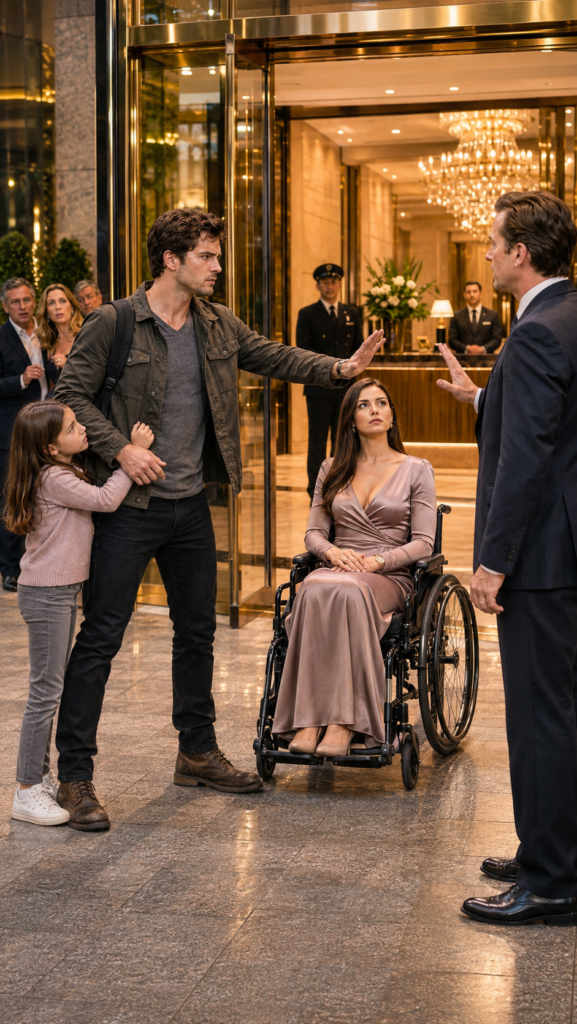
PART 1 — THE MAN WHO REFUSED TO WALK AWAY
A Reservation Nobody Wanted to Honor
The Grand View Hotel was designed to make ordinary people feel small.
Its marble floors reflected enormous crystal chandeliers. Gold-trimmed columns rose toward a ceiling painted with soft clouds, and the reception desk stretched across the lobby like the entrance to a private kingdom.
Every detail suggested money, influence, and exclusivity.
On a cold Tuesday evening in October, Caleb Ward walked through those magnificent doors carrying a battered black tool bag and holding his six-year-old daughter’s hand.
He was twenty-seven years old, a single father, and the kind of man expensive hotels rarely noticed unless something needed repairing.
His daughter, Sophie, wore a yellow sweater beneath her blue jacket. She carried a small notebook decorated with purple stars, and her dark hair had been gathered into a ponytail that was already coming loose.
“Daddy, are we staying here?” she whispered.
Caleb smiled.
“Not unless someone accidentally makes us millionaires.”
Sophie examined the enormous chandelier.
“Maybe we could just stay in the lobby.”
“We’d probably have to pay rent for that, too.”
She giggled, and Caleb squeezed her hand.
He had come to retrieve tools left behind during a maintenance consultation five days earlier. It was supposed to be a quick errand before dinner.
Their apartment was fifteen minutes away. A casserole waited in the refrigerator, and Sophie still needed help finishing an art project for school.
Caleb had promised her they would be home before eight.
He was already calculating whether they had enough time to stop for ice cream when a sharp voice interrupted his thoughts.
“Ma’am, I’ve explained the situation.”
Caleb looked toward the reception desk.
A young woman sat in a wheelchair directly opposite the receptionist.
She wore dark trousers, a cream blouse, and a simple navy cardigan. Her brown hair fell neatly around her shoulders, and she held a phone in one hand.
There was nothing theatrical about her appearance.
She looked like a tired traveler who wanted the room she had paid for.
“I’m not asking for special treatment,” she said calmly. “I’m asking for the accessible room I reserved.”
The receptionist glanced at his computer.
“Unfortunately, that room is no longer available.”
“Then why did your system confirm it?”
“There was an administrative error.”
The woman studied him.
“Was the room given to someone else?”
The receptionist hesitated.
Before he could answer, a taller man wearing an expensive charcoal suit approached.
His name badge identified him as Dylan Carter, Shift Manager.
“Is there a problem here?”
The receptionist looked relieved.
“Miss Bennett has a concern about her accommodation.”
Dylan turned toward the woman with a polished smile.
“Good evening, ma’am. I’m sure we can resolve this misunderstanding.”
“There isn’t a misunderstanding,” she replied. “I booked an accessible room forty-eight hours ago. Your receptionist is telling me it doesn’t exist anymore.”
Dylan folded his hands.
“Our property has certain physical limitations. Unfortunately, we cannot always accommodate every individual’s requirements.”
The woman’s expression remained steady.
“Your website advertised the room.”
“Yes, but availability can change.”
“After you’ve confirmed the booking?”
Dylan’s smile tightened.
“Perhaps another hotel would be better equipped to meet your needs.”
The woman looked at him for several seconds.
“Are you refusing to honor my reservation because I use a wheelchair?”
Dylan glanced toward the other guests.
“Please don’t make this more confrontational than necessary.”
Something changed in Caleb’s face.
He recognized that sentence.
It was the kind of sentence people used when they wanted someone else’s legitimate concern to become the problem.
He had heard variations of it fourteen months earlier, shortly before losing his job.
He turned slightly toward the exit.
He had Sophie with him. He needed the freelance contracts he was still receiving from companies connected to the Grand View.
Making an enemy of a hotel manager would be financially foolish.
Then Sophie tugged his sleeve.
“Daddy?”
“Yeah, sweetheart?”
“Why won’t they let her have her room?”
Caleb looked at his daughter.
She wasn’t angry. She was genuinely confused.
And somehow that made the answer harder.
“Sometimes,” he said quietly, “people forget that rules are supposed to protect everyone.”
Sophie considered this.
“Then somebody should remind them.”
Caleb closed his eyes for half a second.
He knew exactly what walking away would teach her.
He also knew what speaking up might cost.
Then he turned toward the reception desk.
“Excuse me.”
Dylan looked over.
“Can I help you?”
“I think you can help her.”
Caleb gestured toward the woman.
“She has a confirmed reservation. Why isn’t the hotel honoring it?”
Dylan examined Caleb’s work clothes, boots, and tool bag.
“Sir, this is a private matter.”
“She’s standing in a public lobby asking for a room she booked. There’s nothing private about the way you’re treating her.”
The receptionist stopped typing.
The woman in the wheelchair turned toward Caleb.
Dylan’s eyes narrowed.
“Do you work here?”
“No.”
“Then I suggest you mind your own business.”
Caleb took a slow breath.
“I’ve worked on this building’s systems. I know you have an accessible room on the fourth floor. Room 412.”
For the first time, Dylan appeared uncertain.
“How would you know that?”
“Because I inspected the east wing five days ago. And because her reservation confirmation is still visible on your screen.”
Dylan glanced sharply at the receptionist.
Caleb continued.
“Your main entrance ramp is too steep to meet the applicable accessibility requirements. The ground-floor accessible restroom lacks sufficient clearance, and the east elevators have been missing required tactile markings.”
Dylan’s expression darkened.
“Those are maintenance matters.”
“They’re accessibility matters. And you know it.”
The woman watched Caleb carefully.
He wasn’t shouting. He wasn’t trying to impress the gathering crowd.
He spoke like someone accustomed to identifying problems people preferred not to discuss.
Dylan stepped closer.
“Sir, I’m going to ask you to leave.”
Caleb didn’t move.
“You’re welcome to ask. But first, I’d like you to explain why this guest’s reservation was canceled.”
Dylan looked toward security.
“That will be enough.”
Two uniformed officers approached.
Sophie immediately moved closer to her father.
Caleb felt her fingers tighten around his hand.
He looked down.
“You okay?”
She nodded, but her face had become serious.
“Are they going to make us leave?”
“Not for asking a question.”
He turned toward the woman.
“I’m sorry. I should have asked before getting involved. Would you prefer I step away?”
She studied him.
“No.”
Her voice was quiet but unmistakably firm.
“I’d prefer you stayed.”
Caleb nodded.
“Okay.”
Dylan gestured to the security officers.
“This gentleman is interfering with hotel operations.”
One officer, a woman named Nina Brooks, looked between them.
“What’s the issue?”
Caleb answered before Dylan could.
“The hotel confirmed an accessible reservation and is refusing to provide it. I’ve asked why.”
Nina looked at the woman.
“Is that accurate, ma’am?”
“Yes.”
Dylan exhaled impatiently.
“We’ve already explained that the room isn’t suitable.”
The woman tilted her head.
“Interesting. Your receptionist said it wasn’t available. Now you’re saying it isn’t suitable. Which is it?”
Dylan opened his mouth.
Nothing came out.
Behind Caleb, someone raised a phone to record.
Dylan noticed.
His posture changed immediately.
“Everyone needs to calm down.”
“We are calm,” Caleb replied. “You’re the only person threatening to remove anyone.”
A faint murmur moved through the lobby.
Then the lights flickered.
Once.
Twice.
Caleb looked toward the east corridor.
His face became still.
He knew that flicker.
Five days earlier, he had documented a failing relay contact in the electrical distribution system.
He had submitted a written warning to the facilities department.
Apparently, nobody had acted on it.
The lights dimmed again.
This time, the entire lobby fell into an uneasy half-darkness.
A startled cry rose from the reception area.
The computer screens froze.
Somewhere above them, an elevator alarm sounded.
Then the hotel’s emergency lighting activated.
Dylan turned sharply.
“What happened?”
Caleb set down his tool bag.
“The same thing I warned your facilities manager about last Thursday.”
Phones began ringing behind the desk.
A receptionist hurried over.
“Mr. Carter, the east ballroom just lost power. The kitchens are reporting electrical faults, and three elevators are showing errors.”
Dylan stared at the screens.
“Call maintenance.”
“They’re not answering.”
Caleb looked toward the service corridor.
“The main relay contact is failing. The distribution system is transferring to backup. If the fault continues, more circuits may drop.”
Dylan stared at him.
“Can you fix it?”
Caleb almost laughed.
Five minutes earlier, the man had threatened to throw him out.
Now he needed his help.
“Where’s your on-duty electrician?”
“Downstairs,” Nina said. “He’s responding to the elevator alarms.”
“Get him on the radio. We need to isolate the affected branch and inspect the panel before touching anything.”
Nina responded immediately.
Caleb crouched beside Sophie.
“Sweetheart, I need you to stay here with Officer Brooks.”
Sophie looked worried.
“Will the lights come back?”
“That’s what we’re working on.”
“Will you come back?”
He brushed a loose strand of hair from her cheek.
“Always.”
Sophie nodded.
Then she reached into her jacket and held out her purple pencil.
“For luck.”
Caleb smiled and tucked it behind his ear.
“Best tool I’ve got.”
Eleven minutes later, after working with the hotel’s electrician to isolate the affected circuit, replace the failing component with an approved spare, and restore the operating sequence, Caleb returned to a fully illuminated lobby.
The check-in terminals were functioning.
The elevator systems were being checked before returning to service.
The ballroom staff had resumed operations.
And Dylan Carter was standing behind the reception desk looking considerably less confident than before.
Sophie ran toward Caleb.
“You fixed it!”
Caleb lifted her briefly.
“With some help.”
He set her down and turned toward Nina.
“Please make sure facilities gets the follow-up list. Two more components need urgent inspection, and the third should be replaced before the end of the week.”
Nina accepted his handwritten notes.
“I’ll make sure they receive it.”
Dylan cleared his throat.
“Well, Mr. Ward, I suppose we should thank you.”
Caleb looked at him.
“You should thank your electrician. And you should stop ignoring written safety reports.”
Dylan’s face tightened.
The woman in the wheelchair moved forward.
“Mr. Ward?”
Caleb turned.
“Yes?”
“My name is Charlotte Bennett.”
“Nice to meet you, Miss Bennett.”
She glanced at Sophie.
“And this is?”
“My daughter, Sophie.”
Charlotte smiled.
“Hello, Sophie.”
“Hi,” Sophie replied. “I’m glad they turned the lights back on.”
“Me too.”
Charlotte looked back at Caleb.
“I have one question.”
“Go ahead.”
“If you were responsible for this hotel’s operations, what would you fix first?”
Caleb considered the question.
“The culture.”
Dylan gave a short, disbelieving laugh.
Caleb ignored him.
“Equipment breaks. Systems fail. Those things are predictable. But when employees are taught to ignore problems, hide mistakes, and treat certain guests like inconveniences, the entire building eventually reflects those choices.”
Charlotte’s expression changed.
“That’s a very specific answer.”
“I’ve had time to think about it.”
She nodded slowly.
Then she turned toward Dylan.
“Mr. Carter, I’d like to know who authorized the reassignment of room 412.”
Dylan straightened.
“Ma’am, as I’ve explained, our reservations system—”
“Who authorized it?”
“Those decisions are made internally.”
Charlotte reached into her handbag.
She removed a slim leather cardholder and placed a business card on the reception desk.
Then she spoke six words that seemed to stop every clock in the building.
“I am the owner of this hotel.”
The receptionist stared.
Nina looked at the card.
Dylan went pale.
Charlotte continued.
“I purchased the Grand View eighteen months ago through Bennett Hospitality Holdings. I booked room 412 myself, under my own name, using the same reservation system available to every guest.”
She looked around the lobby.
“I wanted to understand why our guest complaints kept increasing while management reports insisted everything was excellent.”
Her gaze returned to Dylan.
“Now I do.”
Dylan took a step forward.
“Miss Bennett, if I’d known who you were—”
“That’s exactly the problem.”
Her voice remained quiet.
“You shouldn’t need to know who someone is before deciding they deserve respect.”
Nobody spoke.
Charlotte looked toward Caleb.
“And you, Mr. Ward, have shown me more about this property in one evening than my management company has shown me in eighteen months.”
She paused.
“I’d like to offer you a consulting contract.”
Caleb blinked.
Before he could answer, Dylan spoke.
“Miss Bennett, there’s something you should know before you hire him.”
Charlotte turned.
Dylan’s confidence returned in a different form.
“I recognize that name. Caleb Ward used to work for our management company.”
Caleb’s jaw tightened.
Dylan continued.
“He was dismissed fourteen months ago.”
Charlotte looked between them.
“On what grounds?”
Dylan hesitated, then delivered the words with deliberate precision.
“For falsifying safety inspection reports.”
Sophie looked up at her father.
“Daddy?”
Caleb went completely still.
Charlotte studied his face.
And for the first time that evening, the man who had answered every accusation with calm certainty seemed unable to find his voice.
Because Caleb knew something neither woman knew yet.
The report Dylan was talking about had not been falsified by him.
Someone had changed it after he was fired.
And whoever had done it was still working inside the Grand View.
PART 2 — THE REPORT THAT DESTROYED HIS CAREER
Fourteen Months Earlier
Caleb had promised himself that Sophie would never see him humiliated again.
He had made that promise on the night he lost his job, sitting on the kitchen floor of their old apartment while his daughter slept in the next room.
There had been three unpaid bills on the table.
His employer had just withdrawn his health insurance.
And the man who had signed his termination letter had told him that raising safety concerns was one thing, but challenging management’s judgment was quite another.
Now, fourteen months later, that accusation had returned.
In front of his daughter.
In front of strangers.
And in front of a woman who had just offered him the first significant professional opportunity he’d received in more than a year.
Caleb looked at Dylan.
“Careful.”
Dylan lifted his chin.
“I’m only stating what’s in the personnel record.”
“Then you know the record doesn’t tell the whole story.”
Charlotte raised one hand.
“Enough.”
Both men fell silent.
She looked at Nina.
“Please arrange for Mr. Carter to surrender his access credentials. He is relieved of his duties effective immediately.”
Dylan stared.
“You can’t be serious.”
“I am.”
“Without hearing my explanation?”
“I’ve heard your explanations for the past forty minutes. Human Resources will review the documentation and contact you concerning the next steps.”
Dylan looked around.
The guests who had watched him command the lobby were now watching him lose control of it.
He turned back toward Charlotte.
“You’re making a mistake.”
“Possibly,” she said. “But the mistake would be mine. I won’t ask someone else to carry the consequences.”
Dylan looked at Caleb one last time.
There was no satisfaction in Caleb’s expression.
Only exhaustion.
After Dylan left with security, Charlotte turned to Marcus, the receptionist.
“Please preserve the reservation records, including every manual change made to room 412 during the past seventy-two hours.”
Marcus swallowed.
“Yes, ma’am.”
“And don’t delete anything.”
His eyes dropped.
Charlotte noticed.
But she didn’t press him yet.
Instead, she looked toward Sophie.
“There’s a lounge just beyond the elevators. Would you like something to drink?”
Sophie nodded.
“Apple juice?”
Charlotte smiled.
“I think we can manage that.”
Ten minutes later, the three of them sat in a quiet corner of the east lounge.
Sophie occupied a comfortable armchair with a glass of apple juice and a plate of cookies.
Caleb sat opposite Charlotte, holding a cup of coffee he had not touched.
The lobby’s chaos felt distant now.
But Dylan’s accusation remained between them.
Charlotte spoke first.
“Was he telling the truth?”
Caleb stared into his coffee.
“About me being fired? Yes.”
“About the reason?”
“No.”
“Then tell me what happened.”
He looked at her.
“Why?”
“Because I want to understand the person I’m considering hiring.”
Caleb leaned back.
“Fourteen months ago, I was a systems engineer for Northstar Hospitality Management. They operated this hotel and three other properties in Chicago.”
He paused.
“I’d worked there almost five years. Started as a maintenance assistant, studied at night, earned my engineering certifications, and moved into systems oversight.”
Charlotte listened.
“I wasn’t making executive money, but I had a salary. Benefits. Predictable hours. For a single father, those things matter.”
“What happened?”
“I found repeated maintenance deferrals that weren’t being disclosed accurately.”
He placed his untouched coffee on the table.
“Electrical components approaching failure. Accessibility deficiencies being listed as completed. Elevator inspections that had been signed off even though corrective work hadn’t been done.”
Charlotte’s expression hardened.
“At this property?”
“And another one.”
“Did you report it?”
“Three times internally.”
“What happened?”
“Nothing. Then I sent the evidence to the regional operations director and copied our compliance department.”
“Who was the director?”
“Warren Hale.”
Charlotte recognized the name immediately.
Warren Hale was Northstar’s senior regional vice president.
He also attended her quarterly property reviews.
He was charming, confident, and exceptionally good at presenting favorable numbers.
“What did Warren say?”
Caleb gave a humorless smile.
“He told me I lacked perspective.”
Charlotte waited.
“He said hotels were complicated businesses, that revenue pressures required practical compromises, and that I needed to understand the difference between a critical safety issue and a technical imperfection.”
Caleb looked toward Sophie.
She was drawing something in her notebook.
“I asked him to put that distinction in writing.”
“And?”
“Two weeks later, I was terminated.”
Charlotte sat very still.
“What was the official reason?”
“Professional misconduct. Inaccurate reporting. Failure to follow management procedures.”
“Did you challenge it?”
“I tried.”
Caleb rubbed his thumb along the edge of his coffee cup.
“I contacted an employment attorney. She reviewed the documents and said I might have a case, but litigation would be expensive and uncertain.”
He glanced toward Sophie again.
“By then, I’d already been raising her alone for almost two years.”
Charlotte looked at the little girl.
“What happened to her mother?”
Caleb’s face changed.
Not dramatically.
It was the almost invisible movement of someone touching an old injury.
“Emma died three years ago. A sudden medical complication. Sophie was three.”
Charlotte lowered her eyes.
“I’m sorry.”
“Thank you.”
Caleb’s voice softened.
“After Emma died, everything became a calculation. Rent. Childcare. Food. Whether I could work late. Whether Sophie could get to school. How many hours I could spend fighting people with lawyers before I stopped being able to afford our life.”
He gave Charlotte a small, tired smile.
“I chose our life.”
Charlotte didn’t respond immediately.
She understood something about making choices from an unfavorable position.
People often admired courage when they weren’t the ones paying for it.
“What happened to the original reports?” she asked.
“I kept copies.”
“Do you still have them?”
“Every page.”
Charlotte leaned forward.
“Then I’d like to review them.”
Caleb studied her.
“Why?”
“Because if your allegations are accurate, someone may have used my property to conceal compliance failures.”
“And if they’re not?”
“Then I’ll say so.”
He almost smiled.
“That’s fair.”
Charlotte folded her hands.
“I meant what I said about the contract.”
“You don’t know enough about me.”
“I know you defended someone you believed was being treated unfairly, even though you had something to lose.”
Caleb looked toward Sophie.
“I had more to lose than you realize.”
“Then why did you do it?”
He took a moment before answering.
“Because Sophie was watching.”
Charlotte followed his gaze.
The little girl had drawn a building with enormous windows.
Beside it, she was adding a ramp.
Charlotte looked back at Caleb.
“That makes sense.”
The following morning, Caleb arrived at the Grand View at nine.
Sophie was at school.
He had spent most of the night reviewing documents he’d hoped never to open again.
Charlotte met him in a private conference room with a laptop, several folders, and a woman named Elise Harding.
Elise was Bennett Hospitality’s chief financial officer.
She was in her forties, wore practical clothes beneath an expensive jacket, and had the careful expression of someone accustomed to finding problems hidden behind attractive spreadsheets.
Charlotte made the introduction.
“Elise is the only person from my executive team who knows the full reason for this review.”
Elise shook Caleb’s hand.
“I’ve read your preliminary report.”
“And?”
“You were unusually polite.”
Caleb looked surprised.
Elise opened a folder.
“Your warning about the electrical relay was submitted five days before last night’s failure. Facilities acknowledged receipt. There is no documented corrective action.”
Charlotte looked toward the window.
“What did the manager say?”
“He claims the issue was scheduled for the next maintenance cycle.”
Caleb shook his head.
“That contact was already failing intermittently. Waiting was a choice, not a scheduling necessity.”
Elise turned another page.
“That’s not our only concern.”
She placed a printed reservation history on the table.
Room 412 had been reserved by Charlotte forty-eight hours earlier.
The confirmation was valid.
But at 3:17 p.m. on the day of her arrival, someone had manually changed its status.
The system now listed it as unavailable for accessibility-related maintenance.
Charlotte frowned.
“Who made the change?”
Elise pointed to the record.
“Dylan Carter.”
Caleb leaned forward.
“Was the room actually under repair?”
“No.”
“Was another guest assigned?”
“No.”
Charlotte looked up sharply.
“Then why was I told it had been reassigned?”
Elise hesitated.
“Because the internal system has a secondary classification.”
She turned the page.
The room had been marked with a code Caleb recognized.
ACCESS HOLD — GUEST REDIRECTION.
He stared.
“That shouldn’t exist.”
Charlotte looked at him.
“What does it mean?”
“In practical terms? Someone is deliberately preventing accessible rooms from being assigned through the normal process.”
Elise nodded.
“I found twelve reservations over the past six months where accessible-room bookings were accepted and then canceled or redirected.”
Charlotte’s face lost color.
“Twelve?”
“At least.”
Caleb pushed back his chair.
“That’s not a booking error.”
“No,” Elise agreed. “It isn’t.”
Charlotte’s phone vibrated.
A message from Warren Hale appeared on the screen.
Charlotte, I heard about last night. Before you take further action, we need to discuss the contractor who caused this situation.
She turned the phone toward Caleb.
He read the message.
Then he placed his hands flat on the table.
“What did he say when I was fired?”
Charlotte looked at him.
“What?”
“Did Warren tell you anything about me?”
“Not personally. I wasn’t involved in Northstar’s staffing decisions.”
Caleb nodded slowly.
“Then he’s going to tell you that I’m bitter. That I have a history of making unfounded accusations. That I engineered the electrical failure to embarrass management.”
Elise looked up.
“How can you be so certain?”
“Because that’s what he said last time.”
A heavy silence settled over the room.
Elise opened another folder.
“There’s something else.”
She slid a document toward Caleb.
It was an electrical maintenance completion certificate for the Grand View’s east wing.
The certificate claimed that critical repairs had been completed eight months earlier.
The work had supposedly been inspected and approved by an independent engineer.
Caleb looked at the signature at the bottom.
His breathing changed.
Charlotte noticed immediately.
“Caleb?”
He didn’t answer.
He read the date again.
Then the signature.
Then the engineer’s identification number.
His number.
His name.
His handwriting, reproduced so carefully that a stranger might never have questioned it.
Elise spoke quietly.
“According to Northstar’s records, you certified these repairs.”
Caleb looked up.
“I was fired fourteen months ago.”
Charlotte said nothing.
He tapped the document.
“Someone signed my name to a safety certificate six months after I stopped working for them.”
Elise turned another page.
“And Northstar paid the contractor one hundred eighty-four thousand six hundred dollars for the work.”
Caleb stared at the figure.
He had inspected the same equipment five days earlier.
The repairs listed on that certificate had never been completed.
Someone had stolen the money.
Someone had used his professional identity to cover it.
And the man responsible had just learned Caleb was back inside the building.
PART 3 — THE SECRET BENEATH THE MARBLE FLOORS
A Building Full of People Who Had Learned to Stay Quiet
By Thursday morning, the video from the Grand View lobby had been viewed hundreds of thousands of times.
Someone had posted the confrontation online with a simple caption:
Hotel Manager Tries to Remove Disabled Guest—Then Discovers She’s the Owner.
The footage showed Charlotte announcing her identity.
It showed Dylan’s expression collapsing.
It showed Caleb standing beside Sophie, his hand resting protectively on her shoulder.
What it did not show was the forged safety certificate, the missing maintenance money, or the years of decisions that had made the confrontation possible.
Charlotte disliked the attention.
Caleb disliked it more.
At seven that morning, his phone rang.
It was Sophie’s teacher, Mrs. Palmer.
“Mr. Ward, I wanted to check in. Some parents have seen a video of you and Sophie at the hotel.”
Caleb closed his eyes.
“Is Sophie okay?”
“She’s fine. But a few children have been asking questions.”
“What kind of questions?”
“Whether you were arrested. Whether the hotel was dangerous.”
Caleb felt his stomach tighten.
“Neither happened.”
“I understand. I thought you’d want to know.”
He thanked her and ended the call.
Sophie was sitting at the kitchen table eating cereal.
She watched him with the perceptiveness she had inherited from her mother.
“Was that my teacher?”
“Yeah.”
“Am I in trouble?”
“No, sweetheart.”
She pushed a piece of cereal around her bowl.
“Some kids said you almost got arrested.”
Caleb crouched beside her chair.
“Look at me.”
She did.
“I didn’t hurt anyone. I didn’t do anything wrong.”
“Then why was everybody mad?”
“Because sometimes people don’t like being told they’ve made a mistake.”
Sophie considered that.
“Even grown-ups?”
“Especially grown-ups.”
She looked toward the refrigerator, where a photograph of Emma holding her as a baby hung beneath a magnet.
“Mommy used to say being brave doesn’t mean you aren’t scared.”
Caleb felt something tighten behind his ribs.
“She did.”
“Were you scared?”
He could have said no.
Instead, he answered honestly.
“Yes.”
Sophie reached for his hand.
“But you did it anyway.”
Caleb kissed her forehead.
“Yeah, kiddo. I did.”
At the hotel, Charlotte was discovering how much she had failed to see.
The Grand View’s quarterly reports were immaculate.
Occupancy rates were healthy.
Guest satisfaction scores were presented in flattering graphs.
Maintenance spending appeared reasonable.
The hotel’s financial performance had improved steadily since her acquisition.
But the reports concealed a different reality.
Staff had been instructed to redirect complaints rather than resolve them.
Maintenance requests were routinely downgraded.
Accessible accommodations were advertised but frequently restricted by internal inventory controls.
And employees who questioned these practices had learned to keep quiet.
Charlotte sat across from a housekeeper named Renée Alvarez.
Renée was fifty-one and had worked at the Grand View for eleven years.
She kept her hands folded in her lap.
Charlotte noticed how tightly she held them.
“You’re not in trouble, Renée.”
Renée gave a polite smile.
“People always say that before someone gets in trouble.”
Charlotte absorbed the remark.
“Then I won’t ask you to trust my words. I’ll ask you to judge what happens afterward.”
Renée looked up.
For the first time, she seemed interested.
Charlotte leaned forward.
“Have you ever been instructed to hide a maintenance problem from a guest?”
Renée laughed once.
Not because it was funny.
Because the question was almost painfully obvious.
“Miss Bennett, we have a whole vocabulary for hiding problems.”
Charlotte waited.
“An elevator that stops working is called temporarily unavailable. A leaking bathroom is called an inspection delay. A broken accessible shower is called a guest preference issue.”
Renée’s voice grew harder.
“And if someone complains, we apologize and offer points toward their next stay.”
“Who gives those instructions?”
“Supervisors. Managers.”
“Warren Hale?”
Renée hesitated.
“I don’t deal with corporate people.”
Charlotte nodded.
“What happens when employees refuse?”
Renée looked toward the door.
“Sometimes their hours disappear.”
Charlotte felt a cold anger settle inside her.
She had spent eighteen months examining operating margins.
Renée had just explained what some of those margins cost.
Caleb’s investigation began in the service corridors.
He preferred them to conference rooms.
Machinery was honest in ways people sometimes weren’t.
A failing component didn’t care whether the maintenance budget looked attractive to investors.
He worked alongside the hotel’s chief electrician, Thomas Reed, examining electrical panels, emergency lighting systems, and elevator maintenance records.
Thomas was fifty-eight and close to retirement.
For two hours, he answered Caleb’s questions with careful, guarded sentences.
Finally, Caleb shut a maintenance binder.
“Thomas, how many of these completed work orders are actually completed?”
Thomas looked at him.
“What do you mean?”
“You know what I mean.”
The older man looked toward the open panel.
“I’ve got twenty-seven years in building maintenance.”
“I know.”
“I’ve got a wife with medical bills and a grandson starting college.”
Caleb waited.
Thomas lowered his voice.
“I reported those failing components.”
“I know you did.”
“I reported them three times.”
Caleb placed a printed report on the workbench.
“Then why does this say the repairs were completed?”
Thomas stared at the document.
“Because someone upstairs decided a completed report looked better than an open problem.”
“Who?”
Thomas said nothing.
Caleb softened his voice.
“I’m not asking you to lose your job to protect mine.”
The older man looked at him.
“That’s what everyone says until the layoffs start.”
Caleb felt the words land.
He knew exactly what Thomas meant.
“I’m not going to promise you something I can’t control,” he said. “But I can promise I won’t erase your name from your own warnings.”
Thomas looked at him for a long moment.
Then he opened a locked drawer.
Inside was a thick folder.
“Copies,” he said.
“Of what?”
“Every request I made that they told me to close.”
Caleb stared.
Thomas pushed the folder toward him.
“Take them before I change my mind.”
That afternoon, Warren Hale arrived at the Grand View.
He was forty-six, broad-shouldered, immaculately dressed, and skilled at making people feel they had been invited into an important conversation.
Charlotte met him in her private conference room.
Elise sat beside her.
Caleb stood near the window.
Warren’s smile faltered when he saw him.
“Caleb.”
“Warren.”
Fourteen months vanished from the space between them.
Warren turned toward Charlotte.
“I see you’ve already brought in outside help.”
Charlotte gestured toward a chair.
“Sit down.”
Warren sat.
“I understand last night was unfortunate.”
“Which part?” Charlotte asked.
He blinked.
“The guest interaction.”
“And the electrical failure?”
“We’re investigating.”
“The unauthorized reservation changes?”
Warren’s expression became cautious.
“Those decisions are normally handled locally.”
“The forged engineering certification?”
Silence.
Charlotte slid the document toward him.
Warren examined it.
Then he looked at Caleb.
“Well.”
Caleb waited.
“This is precisely the kind of issue we had with Mr. Ward before.”
Charlotte leaned back.
“Explain.”
“He has a history of challenging technical records after the fact.”
Caleb’s face remained still.
Warren continued.
“We terminated his employment because we couldn’t rely on his documentation.”
Charlotte placed another sheet on the table.
“His employment ended fourteen months ago. This certificate was supposedly signed six months afterward.”
Warren looked down.
“That could be a clerical error.”
“Someone also used his engineering number.”
“We’ll have to investigate the vendor.”
“And the payment?”
Warren’s eyes moved to Elise.
“Payment?”
Elise opened a spreadsheet.
“One hundred eighty-four thousand six hundred dollars to Crestline Mechanical Services.”
Warren straightened.
“Crestline is an approved contractor.”
“Who approved them?” Charlotte asked.
“Our procurement department.”
“Under whose authority?”
Warren looked at her.
“Mine.”
The room went quiet.
Charlotte folded her hands.
“Did they perform the work?”
“According to our records.”
“According to the physical equipment,” Caleb said, “they didn’t.”
Warren turned sharply.
“You’ve been back in this building for less than forty-eight hours. You don’t have enough information to make that accusation.”
Caleb opened Thomas Reed’s folder.
“I have maintenance requests. Equipment serial numbers. Inspection photographs. And a certificate bearing my forged signature.”
Warren stared at the folder.
For the first time, his confidence looked effortful.
Charlotte spoke.
“Northstar’s contract requires full cooperation with an owner-authorized audit. You will provide the original procurement records and all communications concerning Crestline.”
Warren’s jaw tightened.
“And if I refuse?”
“Then my attorneys will handle it.”
He looked toward Caleb.
“You really want to do this again?”
Caleb met his eyes.
“No.”
Warren smiled faintly.
“Then perhaps you should remember how the last time ended.”
Caleb didn’t look away.
“I remember every day.”
That evening, Charlotte found Caleb sitting alone in the east lounge.
He had finished his inspection but hadn’t left.
A photograph lay on the table beside him.
It showed Sophie at three years old, sitting on Emma’s lap in a park.
Charlotte approached quietly.
“May I?”
Caleb nodded toward the chair.
She positioned her wheelchair beside the table.
For a while, neither spoke.
Then she looked at the photograph.
“She looks like Sophie.”
“Emma?”
Charlotte nodded.
Caleb smiled.
“Same eyes. Same stubbornness.”
“What was she like?”
He considered the question.
“She was a school librarian. She could make anyone feel welcome in a room full of strangers.”
He looked down at the picture.
“She used to say you could learn everything important about a person by watching how they treated someone who couldn’t do anything for them.”
Charlotte was quiet.
“She would have been proud of what you did.”
Caleb shook his head.
“She would have told me to be careful.”
Charlotte smiled.
“Probably both.”
He looked toward the windows.
“I wasn’t careful fourteen months ago.”
“You were telling the truth.”
“I was also young enough to believe telling the truth would be enough.”
Charlotte let the words settle.
Caleb continued.
“I thought if I documented everything properly, somebody would look at it and do the right thing.”
“Somebody should have.”
“Yeah.”
He picked up the photograph.
“Instead, I spent six months trying to explain to employers why my last company said I couldn’t be trusted.”
Charlotte watched his fingers tighten around the edge of the picture.
“I can’t give those months back,” she said.
“I know.”
“But I can make sure the truth is documented now.”
Caleb looked at her.
“That would mean more than a job.”
Charlotte nodded.
“I understand.”
For the first time, he believed she might.
At eight the next morning, Elise called an emergency meeting.
Charlotte and Caleb arrived to find three folders spread across the conference table.
Elise looked exhausted.
“I’ve traced Crestline’s invoices.”
Charlotte sat beside her.
“What did you find?”
“Crestline billed Northstar for more than eight hundred thousand dollars in repairs across three properties.”
Caleb stared.
“How much of that work was completed?”
“We don’t know yet.”
Charlotte felt her pulse quicken.
“And the signatures?”
“Several approvals were issued using employee credentials that were no longer active.”
Caleb looked down.
His forged certificate wasn’t an isolated incident.
It was part of a pattern.
Elise turned toward Charlotte.
“There’s something worse.”
She placed a budget memorandum on the table.
The document was dated seventeen months earlier, shortly after Charlotte acquired the hotel.
It authorized a temporary restriction on noncritical capital expenditures while the company restructured its properties.
Charlotte recognized it.
She had approved it herself.
Elise pointed to a paragraph buried inside the attached operating guidelines.
Under the revised classification system, certain accessibility improvements and preventive maintenance projects could be postponed until future review periods.
Charlotte read the paragraph twice.
Then a third time.
“I never approved ignoring accessibility requirements.”
“No,” Elise said. “But you approved the budget policy that Northstar used to justify delaying them.”
Charlotte looked at Caleb.
He didn’t accuse her.
Somehow that made the truth more painful.
She had believed she was protecting the hotel’s financial stability.
Instead, she had helped create the conditions that allowed dangerous decisions to continue.
Then Elise turned one final page.
“There is one more document.”
It was an internal email from Warren Hale.
The subject line read:
WARD — EMPLOYMENT RISK.
Beneath it was a short instruction dated fourteen months earlier.
“Remove Ward before the pending capital audit. His reports create unacceptable exposure. Close the findings, retain the original data internally, and ensure he is not rehired at any Northstar-managed property.”
Charlotte stared at the screen.
Caleb didn’t move.
The room seemed to lose its air.
He had not merely been fired.
Someone had deliberately tried to make sure he could never work in the industry again.
And Charlotte’s company had continued paying the people responsible.
PART 4 — THE PRICE OF TELLING THE TRUTH
The Decision Charlotte Could No Longer Avoid
Charlotte had spent much of her adult life proving that people underestimated her.
When she first began using a wheelchair after a spinal injury in college, strangers frequently spoke to whoever accompanied her rather than directly to her.
When she entered commercial real estate, investors assumed she was too young to understand large transactions.
When she purchased the Grand View, several executives had praised her ambition while quietly questioning whether she could manage a property of that size.
She had responded by becoming exceptionally prepared.
She reviewed numbers, negotiated relentlessly, and rarely entered a room without knowing more than the person sitting opposite her.
But preparation had become a kind of protection.
And protection had become distance.
She knew the Grand View’s operating income to the dollar.
She had not known that Renée Alvarez was afraid to report a broken shower.
She knew its average occupancy rate.
She had not known that disabled guests were being turned away from rooms that had already been confirmed.
She knew its maintenance budget.
She had not known that Thomas Reed had been keeping copies of ignored safety warnings in a locked drawer.
Now she sat alone in the conference room, staring at the budget memorandum she had approved.
Her own signature was at the bottom.
It was legitimate.
Nobody had forged it.
That distinction hurt more than she expected.
When Caleb entered, she didn’t look up.
“I signed this.”
He closed the door.
“I know.”
“I didn’t understand how they would use it.”
“I believe you.”
“That doesn’t make it better.”
“No.”
Charlotte finally raised her eyes.
“You’re not going to tell me it wasn’t my fault?”
Caleb pulled out a chair.
“Would you believe me?”
She looked away.
“No.”
“Then I won’t.”
He sat opposite her.
“You’re responsible for what happens next. That’s more useful than pretending you could have known everything.”
Charlotte studied him.
“You make accountability sound simple.”
“It isn’t.”
He looked at the memorandum.
“But I’ve noticed something. People who really want to fix a mistake spend less time explaining why they made it.”
She smiled faintly.
“Was that directed at me?”
“Mostly.”
For the first time in two days, Charlotte laughed.
It surprised them both.
Then her expression became serious again.
“What would you do?”
Caleb thought for a moment.
“I’d stop asking whether this hotel can afford to fix these problems.”
Charlotte waited.
“I’d start asking whether it can afford to keep pretending they don’t exist.”
Three hours later, Charlotte called her attorneys.
She ordered an independent engineering review of the Grand View and the other properties operated under the same Northstar contract.
She instructed the hotel’s leadership to preserve employee records, reservation histories, procurement files, and maintenance documentation.
She also authorized an anonymous channel for staff to report problems without having to go through their supervisors.
Then she made a decision Warren Hale had warned her against.
She notified the appropriate municipal inspectors about the outstanding building concerns and requested an accelerated inspection.
Elise arrived at her office with a troubled expression.
“Northstar’s legal team is threatening breach-of-contract proceedings.”
Charlotte looked up.
“On what grounds?”
“They’re claiming we’ve interfered with their management authority and damaged their commercial reputation.”
“What about the forged signatures?”
“They’re calling those allegations unproven.”
Charlotte closed her laptop.
“Then we’ll prove them.”
Elise hesitated.
“There’s another consideration.”
Charlotte waited.
“The Grand View’s financing agreement includes operating-performance requirements. If we close enough rooms for repairs, the bank could demand a financial review.”
“How serious?”
“Potentially very serious.”
Charlotte stared out the window.
Below, Chicago traffic moved through the afternoon rain.
She had built her career through calculated risks.
Now the right decision threatened to become the most expensive one.
“Prepare a liquidity plan,” she said.
Elise blinked.
“Charlotte—”
“Prepare it.”
Caleb received his first anonymous message that evening.
It arrived while he was helping Sophie cut colored paper for her school project.
The phone vibrated beside the scissors.
He glanced at the screen.
You got lucky once. Don’t make your daughter pay for your stubbornness.
He stared at the message.
Sophie looked up.
“Daddy?”
He turned the phone facedown.
“Yeah?”
“Do you think a building can be mean?”
Caleb tried to return his attention to the paper.
“What do you mean?”
She pointed toward her drawing.
“If a building has a door, but some people can’t get through it, is the building mean?”
Caleb considered the question.
“No, sweetheart. Buildings don’t make choices.”
“People do?”
“Yeah.”
She studied her drawing.
“Then why don’t they just make better ones?”
Caleb felt his throat tighten.
He took the pencil she offered him.
“Sometimes people need help seeing the choice.”
Sophie nodded as though that settled everything.
Then she placed a little stick figure in a wheelchair beside the ramp.
“That’s Miss Charlotte.”
Caleb smiled.
“I thought so.”
“And this is you.”
She drew another figure carrying a square black bag.
“Why am I so tiny?”
“Because you’re far away.”
“Fair enough.”
She added a third figure between them.
“This is me.”
Caleb looked at the drawing for a long moment.
Three figures.
One open door.
No one left outside.
His phone vibrated again.
He didn’t look at it until Sophie went to bed.
The second message contained a photograph of his apartment building.
Caleb felt the blood drain from his face.
He immediately saved both messages and called the police.
The responding officer explained that the messages might constitute harassment or threats, depending on further evidence.
Caleb gave a statement.
He also called Charlotte.
She answered on the second ring.
“Caleb?”
“Someone knows where I live.”
Her tone changed immediately.
“What happened?”
He explained.
Charlotte listened without interrupting.
When he finished, she said, “Don’t come to the hotel tomorrow.”
Caleb frowned.
“I’m not quitting.”
“I didn’t ask you to quit.”
“You just told me not to come.”
“Because you have a daughter. And someone is trying to frighten you.”
He looked toward Sophie’s bedroom.
“I know.”
Charlotte softened her voice.
“Let the police investigate. Let the attorneys handle the threats. You don’t have to carry every part of this yourself.”
Caleb sat down.
For several seconds, he said nothing.
Then he spoke quietly.
“That’s what people said after Emma died.”
Charlotte waited.
“They told me to ask for help. To let people in. But everyone had their own lives, and eventually it was just me and Sophie again.”
His voice faltered.
“So I learned not to expect much.”
Charlotte’s expression changed.
“Caleb, I can’t promise I’ll never disappoint you.”
He closed his eyes.
“But I can promise that when I say I’m going to do something, I intend to do it.”
A long silence followed.
Then Caleb said, “Okay.”
It was a small word.
For him, it required more trust than he wanted to admit.
The following day, Charlotte arranged for the independent auditors to meet Caleb at a separate office.
Their work progressed quickly.
Crestline’s invoices referenced equipment that had never been installed.
Several serial numbers corresponded to components still sitting unopened in storage.
Labor logs included employees who denied having worked at the property.
The forgery was no longer merely Caleb’s allegation.
It was becoming a documented pattern.
Meanwhile, Elise traced the payments.
Crestline was a legitimate company, but several disputed invoices had been submitted through a small administrative division controlled by a Northstar procurement manager.
That manager reported directly to Warren Hale.
The evidence suggested a coordinated effort to inflate completed maintenance spending while delaying actual repairs.
A percentage of the payments appeared to have been routed through consulting agreements with a company connected to the procurement manager.
Charlotte’s attorneys contacted outside forensic accountants.
The investigation expanded.
But the most important witness was someone nobody expected.
Marcus, the receptionist.
He requested a private meeting with Charlotte late Friday afternoon.
When he entered her office, his hands were trembling.
“I know I should have said something that night.”
Charlotte gestured toward a chair.
“Tell me now.”
Marcus sat.
“I didn’t cancel your room because of a system error.”
“I know.”
He swallowed.
“Mr. Carter told us to keep room 412 off the normal inventory whenever a guest had accessibility requirements that might lead to a complaint.”
Charlotte stared.
“Why?”
“Because the room wasn’t fully compliant.”
“Then why was it advertised as accessible?”
Marcus looked miserable.
“We were told the upgrades were scheduled. They kept getting delayed. Corporate didn’t want the room removed from the booking website because it would affect how the property appeared in accessibility searches.”
Charlotte felt sick.
“And when someone actually booked it?”
“We were supposed to redirect them.”
“Even when there was no suitable alternative?”
Marcus nodded.
“Sometimes we offered another hotel. Sometimes we said the system made a mistake.”
He looked down.
“I knew it was wrong.”
Charlotte didn’t interrupt.
“My mother uses a walker,” Marcus continued. “She has trouble getting into buildings all the time. I know what it feels like when someone treats you as an inconvenience.”
His voice cracked.
“But this was my first steady job after college. I kept thinking I couldn’t afford to lose it.”
Charlotte leaned forward.
“Who gave Dylan those instructions?”
Marcus pulled out his phone.
“I saved an email.”
He opened a message forwarded months earlier from Dylan.
The original sender was Warren Hale.
The instruction concerned accessibility-related complaints.
It directed managers to reduce the hotel’s exposure by using inventory controls, alternative accommodations, and guest redirection procedures until the planned renovations were completed.
Charlotte read every word.
There was no explicit instruction to discriminate.
That was the point.
The language was carefully constructed to sound like operational guidance.
But its consequences were unmistakable.
“Will you provide this to our attorneys?” she asked.
Marcus nodded.
“Yes.”
“Why are you coming forward now?”
He looked at her.
“Because that man with the little girl stood up for you.”
Charlotte was quiet.
Marcus continued.
“He didn’t know who you were. He wasn’t trying to get anything.”
He looked at the floor.
“I kept thinking about what his daughter must have seen. And I realized I didn’t want to become the kind of person who needed somebody else to tell him when something was wrong.”
Charlotte nodded slowly.
“Thank you for telling me.”
Marcus stood.
“Am I going to lose my job?”
Charlotte looked at him honestly.
“Your conduct still has to be reviewed. But cooperating and accepting responsibility matter. I’ll make sure your account is considered fairly.”
He nodded.
It wasn’t the reassurance he had hoped for.
But it was the truth.
The municipal inspection began Monday morning.
By noon, two elevators had been removed from passenger service pending corrective work.
Several guest rooms were temporarily closed.
The east wing’s electrical distribution required urgent remediation.
And the building’s accessibility deficiencies were more extensive than Charlotte had expected.
At 2:40 p.m., the lead inspector entered the conference room.
Charlotte, Caleb, Elise, and Thomas Reed stood as he approached.
His expression was serious.
“Miss Bennett, we have significant concerns about the east wing.”
Charlotte nodded.
“What are our options?”
“We can discuss a phased remediation plan, but certain areas cannot remain in normal operation until the immediate hazards are addressed.”
“How many rooms?”
“Potentially forty-eight, depending on the final engineering assessment.”
Elise went still.
Forty-eight rooms represented a substantial portion of the hotel’s conference-season revenue.
The inspector continued.
“We also need to review whether the remaining accessible accommodations can be provided reliably during construction.”
Charlotte looked toward Caleb.
He had already begun calculating alternate routes, contractor schedules, staffing needs, and the practical consequences for guests.
But before he could speak, Elise’s phone rang.
She stepped outside.
When she returned, her face was pale.
“What happened?” Charlotte asked.
Elise looked between them.
“The bank received a notification from Northstar’s legal department.”
Charlotte’s jaw tightened.
“About what?”
“They’re claiming our operational intervention has caused a material disruption to the property’s revenue.”
“And?”
“The lender is requesting an immediate financial review.”
Charlotte closed her eyes briefly.
The inspector waited.
The hotel was losing rooms.
The management company was threatening litigation.
The bank was asking questions.
And hundreds of employees depended on the building staying open.
Caleb spoke quietly.
“Charlotte, you don’t have to decide everything this minute.”
She looked at him.
“No.”
Then she turned to the inspector.
“But I can decide one thing.”
Her voice became steady.
“Close whatever needs to be closed. We’re not going to risk anyone’s safety to protect a quarterly report.”
Elise stared at her.
Charlotte continued.
“Then we’ll figure out how to keep this hotel alive.”
Outside the conference room, the enormous building continued operating.
Guests checked in.
Housekeepers pushed carts.
Servers carried trays.
People moved through the Grand View believing the marble floors beneath them were solid.
None of them knew how close the hotel had come to collapsing under the weight of its own hidden decisions.
And Charlotte had just made a choice that could cost her everything.
PART 5 — THE MAN THEY COULDN’T SILENCE
The Hearing That Changed Everything
The next three weeks nearly broke the Grand View.
Construction crews worked around the clock in restricted areas.
Guests were moved to nearby properties when their reservations could not be accommodated.
Conference organizers demanded compensation.
The hotel’s operating income fell sharply.
Northstar claimed Charlotte’s intervention had caused unnecessary commercial damage.
Warren Hale stopped answering her calls.
Then his attorneys sent a formal notice denying responsibility for the disputed maintenance records.
They also claimed Caleb Ward had a documented history of unreliable reporting.
When Caleb read the letter, he didn’t become angry.
He became quiet.
Charlotte found him in a temporary maintenance office, staring at the same accusations he had spent fourteen months trying to escape.
“Caleb?”
He looked up.
“They’re doing it again.”
She approached.
“I know.”
He pushed the letter toward her.
“Professional misconduct. Inaccurate reporting. Lack of credibility.”
He laughed bitterly.
“They’re using the exact same phrases.”
Charlotte pulled a chair beside him.
“We have evidence this time.”
“I had evidence last time.”
She didn’t argue.
Caleb rubbed his face.
“Do you know what the worst part was?”
Charlotte waited.
“Not losing the job.”
His voice dropped.
“It was walking into interviews and watching people become polite the moment they learned where I’d worked.”
He stared toward the wall.
“They’d say they were impressed with my qualifications. Then they’d ask why I’d left Northstar. I’d tell them the truth, and something would change in their faces.”
Charlotte listened.
“After a while, I stopped applying for jobs I wanted. I applied for jobs I thought might believe me.”
He swallowed.
“And every time I opened another rejection email, Sophie would ask if we were going to be okay.”
Charlotte looked at his hands.
They were shaking.
Only slightly.
But enough.
“What did you tell her?”
Caleb looked up.
“The same thing every time.”
He tried to smile.
“Of course we are, sweetheart.”
Charlotte felt tears sting her eyes.
She resisted the urge to offer him another contract, more money, or some extravagant promise.
He didn’t need her to purchase a solution.
He needed the truth to finally matter.
She placed her hand on the table.
“Then we’ll make sure this investigation is independent, documented, and impossible to dismiss as a personal argument.”
Caleb looked at her.
For a long moment, he didn’t speak.
Then he nodded.
The independent audit presented its findings on a rainy Thursday afternoon.
Charlotte had requested that Northstar’s leadership, the property’s legal representatives, senior department managers, and relevant members of her ownership team attend.
The meeting took place in the Grand View’s west conference room.
Warren Hale arrived with two attorneys.
He wore a navy suit and the confident expression of a man who believed that every difficult conversation could be controlled through procedure.
Caleb sat beside Elise.
Charlotte positioned herself at the head of the table.
The independent auditor, Marianne Cole, began without ceremony.
“Our findings concern procurement irregularities, inaccurate maintenance certifications, failures in complaint escalation, and deficiencies in guest accessibility procedures.”
Warren folded his arms.
“We dispute several assumptions underlying that description.”
Marianne nodded.
“Your objections will be recorded.”
She displayed the first document.
It was Caleb’s original electrical safety report from fourteen months earlier.
Dated.
Signed.
Accompanied by photographs.
Then she displayed the revised version stored in Northstar’s records.
Several critical findings had been changed from unresolved to completed.
The original recommendation for immediate corrective work had been replaced with a statement describing the conditions as acceptable.
Marianne looked around the table.
“Digital records indicate the changes were made after Mr. Ward’s employment ended.”
Warren leaned forward.
“That doesn’t establish who made them.”
“Correct.”
She changed the slide.
The altered file had been saved using a Northstar administrative account assigned to the regional operations office.
Its activity logs showed access from a company-managed computer.
The same account had processed three disputed contractor certifications.
Warren’s attorney interrupted.
“Administrative access does not establish individual responsibility.”
“Also correct,” Marianne said.
She clicked again.
Next came the invoice history.
Crestline Mechanical had received substantial payments for work that independent inspections could not verify.
Several items listed as newly installed still bore the serial numbers of the original equipment.
Other items were documented as completed while their associated work orders remained open.
Marianne displayed photographs taken by Caleb and Thomas.
Then she placed the invoice approvals beside them.
“The discrepancies are material,” she said.
Warren stared at the screen.
His smile had disappeared.
Charlotte spoke.
“Mr. Hale, did you know these invoices were being approved?”
“My department handled thousands of transactions.”
“That wasn’t my question.”
He adjusted his cuffs.
“I relied on the procurement team.”
Elise opened another file.
“Then perhaps you can explain the consulting agreements between the procurement manager’s outside company and the division of Crestline submitting these invoices.”
Warren looked sharply at her.
His attorney leaned close and whispered something.
Warren said nothing.
Marianne continued.
The audit had not established that Warren personally received the missing funds.
It had established that his department approved the disputed transactions, failed to investigate repeated warnings, and continued reporting the maintenance work as completed.
It had also established that Caleb’s professional identification had been used without authorization.
Then Charlotte asked the question she had been saving.
“Why was Caleb Ward terminated?”
Warren leaned back.
“That was a personnel matter handled under established procedures.”
Charlotte looked at him.
“His file says he falsified reports.”
“Correct.”
“The audit shows someone else altered those reports after he left.”
Warren’s expression tightened.
“Those findings remain subject to review.”
Charlotte nodded.
“Then explain this email.”
Elise displayed the internal message instructing Northstar personnel to remove Caleb before the pending audit and prevent him from being rehired.
Warren stared at it.
Nobody spoke.
Finally, he said, “That communication has been taken out of context.”
Caleb looked at him.
Fourteen months earlier, Warren had said almost the same thing about his safety reports.
Now the words sounded different.
Smaller.
Charlotte remained composed.
“What context would make it appropriate to prevent a qualified engineer from being rehired after he reported unresolved safety concerns?”
Warren’s attorney placed a hand on his arm.
“We won’t answer further questions about pending employment matters.”
Charlotte nodded.
“Understood.”
Then she turned toward Marianne.
“Please continue.”
The final evidence came from employees.
Thomas Reed testified about repeated repair requests that had been closed without action.
Renée Alvarez described the pressure placed on housekeeping staff to minimize guest complaints.
Marcus explained the internal reservation restrictions and produced the email he had saved.
Nina Brooks confirmed the events in the lobby and the condition of the hotel systems during the electrical failure.
Each account supported a different part of the larger pattern.
None of the witnesses knew everything.
Together, they showed how the hotel had been managed.
Warren’s attorney questioned the reliability of individual recollections.
Marianne referred back to documents, timestamps, and system records.
Caleb watched the process unfold.
He had imagined this moment hundreds of times.
In those imagined versions, he would confront Warren, demand an apology, and finally make him understand what he had done.
But sitting there now, Caleb realized he didn’t need Warren to understand.
He needed the record corrected.
Charlotte turned toward him.
“Mr. Ward, would you like to say anything?”
Caleb looked at Sophie’s drawing, folded inside his notebook.
He had brought it with him that morning.
He hadn’t planned to show anyone.
He took a breath.
“Fourteen months ago, I told this company that several systems needed attention.”
He looked toward Warren.
“I was told I was overreacting.”
His voice remained calm.
“When I documented the problems, I was told I didn’t understand business priorities.”
He glanced toward Charlotte.
“When I refused to change my reports, I lost my job.”
He paused.
“I could tell you how much money that cost me. I could tell you about the interviews I didn’t get, the savings I spent, or the nights I worked after my daughter went to bed.”
He looked down.
“But what I remember most is Sophie asking why I didn’t go to the office anymore.”
The room became completely still.
“She was four. She thought maybe I’d done something wrong.”
His jaw tightened.
“I told her I hadn’t.”
He looked toward Warren again.
“For fourteen months, I kept telling her the truth while a professional record said otherwise.”
Caleb placed the notebook on the table.
“Last week, my daughter watched me defend someone who was being treated unfairly.”
His voice softened.
“I want her to grow up knowing that doing the right thing doesn’t always protect you from consequences.”
He swallowed.
“But I also want her to know that consequences aren’t the same thing as being wrong.”
Nobody interrupted.
He looked toward Marianne.
“That’s all I have to say.”
Charlotte lowered her eyes.
The room remained silent for several seconds.
Then Marianne closed her folder.
“The audit recommends immediate referral of the suspected document forgery and procurement misconduct to the appropriate authorities, correction of Mr. Ward’s employment record, and a comprehensive review of Northstar’s management practices.”
She looked toward Charlotte.
“It also recommends that the owner formally acknowledge its failure to provide sufficient oversight.”
Charlotte nodded.
“I agree.”
Warren looked up sharply.
Charlotte continued.
“My company approved cost restrictions that were later used to justify postponing necessary work. We relied too heavily on incomplete performance reports. We failed to investigate warning signs.”
She looked around the table.
“That responsibility belongs to us.”
Then her gaze settled on Warren.
“But no budget policy authorizes forged documents, inaccurate certifications, or discrimination against guests.”
Warren’s attorney began to speak.
Charlotte raised her hand.
“Our counsel will address the contractual remedies. We’re initiating the formal process to terminate Northstar’s management agreement for cause, subject to the findings and legal requirements.”
Warren stared at her.
For the first time since Caleb had known him, he seemed to have no prepared response.
The meeting ended without a dramatic confession.
There was no shouted apology.
No sudden admission of guilt.
Only documents, witnesses, and an independent record that Warren could no longer control.
For Caleb, that was enough.
Over the next month, the consequences became real.
Northstar agreed to an early management transition under a negotiated settlement that preserved the owner’s claims concerning the disputed transactions.
The procurement manager responsible for several questionable approvals was suspended pending further investigation.
The accounting evidence was referred to the appropriate authorities.
Warren Hale was removed from oversight of the Grand View while Northstar’s internal investigation proceeded.
Caleb’s personnel record was formally corrected.
The company withdrew its accusations of falsification and provided a written statement confirming that his prior safety concerns had been supported by independent findings.
The correction did not undo fourteen months of damage.
But it gave Caleb something he had almost stopped believing was possible.
Proof that his career had not ended because he was incompetent.
Proof that he had not invented the problems.
Proof that the truth had survived.
When the letter arrived, he read it alone at his kitchen table.
Sophie was coloring beside him.
“Daddy?”
He looked up.
“Yeah?”
“Why are you crying?”
Caleb touched his cheek.
He hadn’t realized there were tears there.
He smiled.
“Somebody finally fixed something that was broken.”
Sophie looked at the letter.
“Like the hotel?”
“Something like that.”
She climbed into his lap.
“Did you fix it?”
Caleb wrapped his arms around her.
“Not by myself.”
She nodded wisely.
“That’s better.”
He kissed the top of her head.
“Yeah, sweetheart. It is.”
Two days later, Charlotte invited Caleb to dinner at a quiet restaurant near the lake.
It was the first time they’d met outside the hotel for something that wasn’t strictly related to work.
Sophie was spending the evening with Mrs. Palmer and her family.
Charlotte wore a dark green dress and a soft black jacket.
Caleb arrived in a clean white shirt, dark jeans, and the same old boots.
He looked uncomfortable when the waiter pulled out his chair.
Charlotte smiled.
“You look like you’re expecting a performance review.”
“Is that not what this is?”
“Not exactly.”
They ordered dinner.
For the first twenty minutes, they talked about ordinary things.
Chicago weather.
Sophie’s school project.
Charlotte’s disastrous attempts at cooking.
Caleb’s belief that every apartment should have at least one drawer containing nothing but spare screws and batteries.
Charlotte laughed more than he had ever heard her laugh.
Then, after the plates were cleared, she reached into her bag.
“I have something for you.”
Caleb looked suspicious.
“That sounds expensive.”
“It is.”
She placed a folder on the table.
Inside was a formal employment proposal.
A senior operational leadership position overseeing the Grand View and two other properties.
A salary considerably higher than Caleb had earned before his termination.
Full benefits.
Long-term financial security.
And a clear path into executive management.
Caleb read the offer twice.
Charlotte watched his expression.
“You’re qualified,” she said.
“That’s not what I’m thinking.”
“What are you thinking?”
He closed the folder.
“I’m thinking about Sophie.”
Charlotte nodded.
“I expected that.”
“This position would mean travel.”
“Some.”
“Late meetings?”
“Occasionally.”
“Emergencies?”
“Possibly.”
Caleb looked down.
“For years, I’ve been trying to get back everything I lost when Northstar fired me.”
He touched the edge of the folder.
“And now that it’s right here, I’m realizing some of what I have is worth more.”
Charlotte didn’t speak.
Caleb continued.
“Sophie remembers when I used to come home after she was asleep. She remembers when Emma was alive and our life felt normal.”
His voice softened.
“She doesn’t have that anymore.”
Charlotte looked at him.
“So what do you want?”
Caleb met her eyes.
“I want to do meaningful work.”
He paused.
“And I want to be there when my daughter comes home from school.”
Charlotte smiled faintly.
“Those things shouldn’t be mutually exclusive.”
“Usually they are.”
“Then perhaps we should change the job.”
Caleb stared at her.
“You can’t rewrite an executive role around one employee.”
Charlotte tilted her head.
“Why not?”
“Because that’s not how businesses operate.”
She smiled.
“I’ve recently discovered that some of the ways businesses operate are precisely what need changing.”
Caleb laughed.
Then his expression became serious.
“Charlotte, I don’t want you to offer me something because you feel sorry for me.”
Her smile faded.
“Is that what you think this is?”
“I don’t know.”
She looked at him for a long moment.
Then she spoke quietly.
“I don’t pity you, Caleb.”
He lowered his eyes.
“I respect you. Professionally, because you do work that matters. Personally, because I’ve watched how you raise Sophie.”
She paused.
“And I enjoy being around you.”
Caleb looked up.
The restaurant seemed suddenly quieter.
Charlotte continued.
“But I’m not asking you to make a decision tonight.”
He stared at the folder.
For years, he had wanted one thing.
Security.
Now he had been offered more security than he had ever imagined.
And for the first time, he wasn’t sure accepting it would mean he had won.
Charlotte reached for her glass.
“Take the contract home. Think about it.”
Caleb nodded.
But when he opened the folder again, he noticed something.
A handwritten note tucked beneath the employment proposal.
It was from Charlotte.
Whatever you decide, I hope you never again feel that being a good father requires giving up the work you love.
He read it twice.
Then he looked at her.
She was watching the city lights reflected on the restaurant window.
And he realized that somewhere between the hotel lobby and this quiet table, Charlotte Bennett had stopped being merely the woman he had defended.
She had become someone whose opinion mattered to him.
Someone he trusted.
Someone he was beginning to care about in a way he hadn’t expected.
That frightened him more than the contract.
Because Caleb had spent three years learning how to build a life around an absence.
He wasn’t certain he knew how to make room for someone new.
PART 6 — THE BUILDING THAT FINALLY LET EVERYONE IN
Six Weeks After the Night Everything Changed
The Grand View’s main entrance reopened on a bright November morning.
There were no television crews.
No ribbon-cutting ceremony.
No carefully staged photographs of executives congratulating one another.
Charlotte had insisted that the improvements speak for themselves.
The entrance ramp had been rebuilt to meet applicable accessibility requirements.
The doors had been modified.
Elevator indicators and accessible pathways had been corrected.
Four guest rooms had been renovated and independently inspected for accessibility.
Other rooms and systems remained under a phased improvement plan, with affected services unavailable until the necessary work was complete.
The hotel was not perfect.
But for the first time in years, its management was required to document problems instead of disguising them.
On the morning the entrance reopened, Caleb stood beside the new ramp with a clipboard.
Thomas Reed was checking the maintenance logs.
Renée Alvarez approached carrying a small bouquet of flowers.
“These are for you,” she told Caleb.
He blinked.
“Why?”
“Because you listened.”
She placed the flowers in his hands.
Caleb looked embarrassed.
“I mostly asked questions.”
Renée smiled.
“That’s more than most people did.”
He looked toward the front doors.
Guests moved in and out without interruption.
A woman using a walker entered through the main doors while a staff member held one open.
Nobody pointed her toward a loading entrance.
Nobody apologized for an inconvenience.
Nobody acted as though she were asking for something extraordinary.
Caleb watched her pass.
Then he looked down at his clipboard.
One completed project.
Dozens more to go.
But it mattered.
Charlotte found him in the service corridor that afternoon.
He was reviewing the installation of a new electrical panel.
“You’re supposed to be taking a break,” she said.
Caleb didn’t look up.
“I am.”
“You’re holding a multimeter.”
“Some people meditate.”
She smiled.
“Some people have hobbies.”
“This is a hobby.”
“A deeply concerning one.”
Caleb grinned.
Charlotte positioned her wheelchair beside him.
“How’s the west corridor?”
“Better. Still needs another inspection.”
“And the east elevator bank?”
“Operational. Thomas is monitoring the new components.”
She nodded.
“Good.”
Caleb closed his notebook.
“How did the lender meeting go?”
“Better than expected.”
“Really?”
“Elise negotiated revised operating targets during the remediation period. We had to increase our cash reserve, but the bank accepted the recovery plan.”
Caleb exhaled.
“That’s good news.”
“It is.”
Charlotte looked toward the newly installed panel.
“Northstar’s final management transition is complete.”
He became quiet.
“And Warren?”
“Their investigation is ongoing. Our attorneys are cooperating with the authorities concerning the disputed invoices and forged records.”
Caleb nodded.
He had stopped expecting a single dramatic moment when every consequence would become visible.
Real accountability moved more slowly.
It required people to preserve evidence, answer difficult questions, and remain patient when the results weren’t immediate.
He had learned that the hard way.
Charlotte looked at him.
“Have you thought about the contract?”
Caleb smiled.
“Every day.”
“And?”
“I can’t accept the executive position.”
Charlotte nodded once.
“All right.”
He looked surprised.
“That’s it?”
“What did you expect?”
“An argument.”
“Would it change your mind?”
“No.”
“Then it would be a waste of both our time.”
He laughed.
Charlotte smiled.
“But I do have a counterproposal.”
Caleb raised an eyebrow.
“You’re persistent.”
“I’ve been told.”
He took a folded document from his notebook.
It outlined a consulting arrangement built around specific projects, defined responsibilities, reasonable travel requirements, and a schedule that allowed him to remain home most evenings.
Charlotte read it.
Then she looked up.
“You wrote your own contract.”
“Seemed efficient.”
She studied the terms.
“Two days per week at the Grand View, additional remote review work, emergency support only under clearly defined conditions.”
“Correct.”
“And the right to decline assignments that interfere with your parenting responsibilities.”
“Within reason.”
Charlotte turned the page.
“You also included a requirement for an independent safety reporting process.”
Caleb nodded.
“I won’t take responsibility for systems if someone can bury my findings.”
Charlotte looked at him.
For several seconds, she said nothing.
Then she held out her hand.
“Agreed.”
Caleb shook it.
Their hands remained together a fraction longer than either had intended.
Charlotte noticed.
So did he.
Neither commented.
Over the following months, the Grand View changed in ways no renovation contractor could have accomplished.
Department managers began holding regular meetings where employees could raise concerns without first obtaining permission from their supervisors.
Maintenance requests were tracked transparently.
Guest complaints were reviewed for patterns rather than treated as isolated annoyances.
Marcus completed retraining and remained at the front desk after a formal review of his conduct.
He no longer believed that following an instruction automatically made it the right thing to do.
Thomas received the resources to establish preventive maintenance schedules.
Renée joined an employee advisory group.
And Charlotte began visiting the hotel regularly.
Not with a corporate entourage.
Not for staged photographs.
She appeared in service corridors, staff break rooms, housekeeping offices, and kitchens.
She listened.
Sometimes what she heard made her uncomfortable.
She learned that several employees had been working unpredictable shifts without adequate notice.
She learned that housekeeping staff had been pressured to complete unrealistic room assignments.
She learned that temporary workers often felt unable to report safety concerns because they feared their contracts would not be renewed.
Not every problem could be fixed immediately.
Some required money.
Others required difficult decisions.
But the practice of pretending those problems didn’t exist began to disappear.
And that changed the hotel more profoundly than the new marble at the entrance.
Sophie became a familiar visitor at the Grand View.
On afternoons when Caleb needed to finish a short meeting, she sometimes sat in Charlotte’s office drawing while her father worked nearby.
At first, she treated Charlotte with the careful politeness children reserve for important adults.
Then she discovered Charlotte liked peanut butter cookies.
After that, formality became impossible.
One afternoon, Sophie entered Charlotte’s office carrying a construction-paper crown.
Charlotte looked up from her laptop.
“What’s that?”
Sophie held it out.
“For you.”
Charlotte accepted it.
“Why?”
“Because you own a castle.”
Charlotte looked around the office.
“A castle?”
“The hotel.”
“Ah.”
Sophie nodded seriously.
“So you’re the queen.”
Charlotte placed the paper crown on her head.
“Does that mean I get to make laws?”
Sophie thought about it.
“Only good ones.”
Charlotte smiled.
“I’ll do my best.”
Sophie climbed into the chair beside her.
“Can I ask you something?”
“Of course.”
“Does your wheelchair make you sad?”
Charlotte considered the question.
“Not usually. Sometimes places are difficult to get around, and that can be frustrating. But my wheelchair helps me go where I want to go.”
Sophie nodded.
“Like Daddy’s truck?”
Charlotte laughed.
“Something like that.”
“His truck is very old.”
“I’ve noticed.”
“It makes a funny noise when he turns left.”
“That sounds concerning.”
“Daddy says it’s character.”
Charlotte covered her mouth to hide a smile.
Sophie leaned closer.
“Do you like Daddy?”
Charlotte became still.
“What makes you ask?”
Sophie shrugged.
“You smile when he comes in.”
Charlotte looked toward the office door.
“And he smiles when you say his name.”
Sophie continued drawing as though she had merely commented on the weather.
Charlotte sat quietly for a moment.
Then she said, “Your dad is a very good person.”
Sophie looked up.
“I know.”
Charlotte smiled.
“And I like him very much.”
Sophie nodded.
“Good.”
Then she returned to her drawing.
She had received exactly the answer she wanted.
One evening in January, Caleb found Sophie asleep on the couch.
Her notebook lay open beside her.
He reached to close it and noticed a drawing.
It showed three people standing outside a large building.
A man.
A little girl.
And a woman in a wheelchair.
Above them, in Sophie’s uneven handwriting, were the words:
MY PEOPLE.
Caleb sat down.
He stared at the drawing for a long time.
Emma’s photograph stood on the shelf beside the television.
He looked toward it.
Three years earlier, he had believed that loving Emma meant protecting the life they’d built from anything that might replace her.
He had been afraid that allowing someone new into their world would somehow diminish the person Sophie had lost.
But looking at the drawing, he understood something he’d been unable to explain to himself.
Love did not have to erase what came before.
Emma would always be Sophie’s mother.
She would always be part of their story.
That didn’t mean every remaining chapter had to be written in loneliness.
Caleb carefully closed the notebook.
Then he picked up his phone.
Charlotte answered after two rings.
“Everything okay?”
“Yeah.”
He paused.
“Would you like to have dinner with us Saturday?”
A brief silence.
“At the hotel?”
“No.”
“Business dinner?”
“No.”
Charlotte’s voice softened.
“Then what kind of dinner?”
Caleb looked at Sophie’s sleeping face.
“The kind where I attempt to cook something decent and you pretend not to notice if I fail.”
Charlotte laughed.
“That sounds dangerous.”
“Very.”
Another silence.
Then she said, “I’d like that.”
Caleb smiled.
“Good.”
He ended the call and remained on the couch for several minutes.
Outside, snow began falling across Chicago.
For once, he wasn’t calculating bills or tomorrow’s work schedule.
He was thinking about Saturday.
And that felt unfamiliar.
But good.
Dinner became a regular occurrence.
Sometimes Charlotte joined them at Caleb’s apartment.
Sometimes they visited her home, where Sophie was fascinated by the enormous windows overlooking the city.
They went to a science museum, attended a school art exhibition, and spent an afternoon at the lake watching boats move through the winter fog.
Charlotte never tried to replace Emma.
She asked Sophie about her mother.
She listened to stories Caleb told about their marriage.
And when Sophie wanted to show her a photograph, Charlotte studied it with the same attention she gave everything important.
Slowly, Caleb stopped bracing himself for the possibility that Charlotte would disappear.
He learned that she could be impatient when work went badly.
That she disliked being fussed over.
That she sometimes stayed awake too late answering messages she should have delegated.
Charlotte learned that Caleb became quiet when he was worried.
That he always checked Sophie’s bedroom before going to sleep.
That he kept Emma’s favorite coffee mug in the kitchen cupboard even though he never used it.
Neither of them was simple.
Neither was trying to rescue the other.
But they were learning how to make room.
And for two people accustomed to protecting themselves, that was its own kind of courage.
One Year Later — The Answer Nobody Expected
On a clear Thursday afternoon, almost a year after the confrontation in the lobby, Caleb stood outside the Grand View watching guests enter through the renovated main doors.
The city moved around him.
Cabs stopped at the entrance.
Business travelers pulled suitcases across the sidewalk.
A family paused to take a photograph beneath the hotel’s familiar gold lettering.
The Grand View was still beautiful.
But it no longer looked quite the same to Caleb.
He knew what lay behind its polished walls.
He knew the names of the people who maintained its systems, cleaned its rooms, cooked its meals, and kept its elevators running.
He knew how much work it took to make a building worthy of the people who entered it.
Behind him, the automatic doors opened.
He recognized the quiet sound of Charlotte’s wheelchair before she spoke.
“The west service corridor panel,” she said.
Caleb smiled without turning.
“I already added it to next month’s schedule.”
“Of course you did.”
She stopped beside him.
For a moment, they watched the entrance together.
Then Charlotte said, “I received an unusual email this morning.”
Caleb looked over.
“Business unusual or personally unusual?”
“Personally.”
“Should I be worried?”
“Probably not.”
She hesitated.
“It was from Sophie’s school.”
Caleb frowned.
“Is she okay?”
“She’s fine.”
Charlotte looked down at her hands.
“Apparently, Sophie updated a classroom emergency contact form.”
Caleb stared.
“She did what?”
“She listed me.”
He blinked.
“She didn’t ask me.”
“I gathered that.”
Charlotte smiled faintly.
“The teacher contacted me to confirm whether I was comfortable being listed.”
Caleb rubbed his forehead.
“I’m sorry. I’ll talk to her.”
“There’s no need to apologize.”
He looked at Charlotte.
She seemed unusually nervous.
“What did you tell the teacher?”
Charlotte glanced toward the entrance.
“She asked whether I was a family member.”
Caleb waited.
“I told her I wasn’t sure how to answer that yet.”
The words hung between them.
Traffic moved beyond the hotel.
A doorman helped a guest with luggage.
Somewhere inside, an elevator chimed.
Caleb looked toward the new ramp.
It had taken months of planning to repair something that should have been right from the beginning.
And now it stood there, quietly doing its job.
He thought about the night he’d first met Charlotte.
The receptionist’s refusal.
Dylan’s threats.
The flickering lights.
Sophie standing on the marble floor.
The moment Charlotte had revealed she owned the hotel.
He remembered believing the evening had changed his professional life.
He hadn’t understood how much more it would change.
Finally, he turned toward Charlotte.
“That’s a careful answer.”
She smiled.
“I give careful answers.”
Caleb nodded.
Then he spoke softly.
“You could have told her yes.”
Charlotte looked up.
Her expression changed.
“Caleb—”
“I mean it.”
He crouched slightly so their eyes were level.
“You’re already family to Sophie.”
Charlotte didn’t move.
He continued.
“And somewhere along the way, you’ve become family to me, too.”
For a moment, her composure disappeared.
She looked at him as though trying to decide whether she’d heard correctly.
“Are you sure?”
Caleb smiled.
“About a lot of things? No.”
He glanced toward the hotel.
“But about this?”
He reached for her hand.
“Yeah. I’m sure.”
Charlotte closed her fingers around his.
She looked away briefly, blinking against sudden tears.
Then she laughed softly.
“I was supposed to be the difficult one to impress.”
“You were.”
“Apparently not difficult enough.”
Caleb grinned.
“I’d disagree.”
Behind them, the hotel doors opened again.
“DADDY!”
Sophie ran toward them wearing a purple jacket and carrying her school backpack.
She stopped between them, slightly breathless.
“Miss Charlotte!”
Charlotte smiled.
“Hello, Sophie.”
The little girl looked at their joined hands.
Her eyes widened.
Then she grinned.
“Finally.”
Caleb stared.
“Excuse me?”
Sophie shrugged.
“You take forever.”
Charlotte burst out laughing.
Caleb shook his head.
“I live with a tiny critic.”
“A very accurate one,” Charlotte said.
Sophie stepped closer.
She took Caleb’s free hand.
Then she reached toward Charlotte.
“Can we go get ice cream?”
Caleb looked at the sky.
“It’s November.”
“So?”
“It’s cold.”
Sophie examined him with exaggerated patience.
“That’s why we wear jackets, Daddy.”
Charlotte laughed again.
“She has a point.”
Caleb sighed.
“Apparently I’m outnumbered.”
Sophie smiled proudly.
“Three against one.”
Caleb looked down.
“Sweetheart, there are only three of us.”
She considered that.
“Then two against one.”
“Much better math.”
They began moving toward the sidewalk.
Sophie walked between them.
Halfway down the ramp, she stopped.
She looked back at the entrance.
Then at her father.
Then at Charlotte.
“Do you remember when we first came here?”
Caleb nodded.
“Of course.”
“That man was mean to Miss Charlotte.”
Charlotte’s expression softened.
“Yes, he was.”
Sophie looked at the ramp.
“But you helped her.”
Caleb glanced at Charlotte.
“I tried.”
Sophie shook her head.
“No. You did.”
Then she looked at Charlotte.
“And she helped you.”
Neither adult spoke.
Sophie continued.
“And then everybody fixed the hotel.”
She smiled.
“So now it’s a good building.”
Charlotte felt her throat tighten.
Caleb looked at the open entrance.
Guests moved through without anyone questioning whether they belonged.
The building had once been a symbol of everything that had gone wrong in his life.
A place where his warnings had been ignored.
Where his reputation had been destroyed.
Where a stranger had been denied something as ordinary as a hotel room.
Now it was a place where employees were heard.
Where mistakes could be acknowledged.
Where his daughter felt welcome.
And where he had found someone he never expected to meet.
Charlotte looked at Sophie.
“Do you know something?”
“What?”
“I think your dad changed this hotel more than anyone.”
Sophie considered that.
Then she shook her head.
“No.”
Charlotte raised an eyebrow.
“No?”
Sophie smiled.
“He just made everybody see what was already broken.”
Caleb stared at his daughter.
Charlotte was silent for a moment.
Then she looked up at him.
“She’s right.”
Caleb squeezed Sophie’s hand.
“She’s right about a lot of things.”
Sophie nodded enthusiastically.
“Like ice cream.”
Charlotte laughed.
“Especially ice cream.”
And so they continued down the sidewalk.
Not as a wealthy hotel owner, a struggling single father, and a little girl who had once been frightened by angry strangers.
But as three people who had found something extraordinary in an ordinary act of courage.
Almost a year earlier, Caleb had entered the Grand View intending to retrieve a forgotten tool bag.
He had expected nothing more than a ten-minute errand.
Instead, he had witnessed an injustice and made a choice.
He could have walked away.
He could have protected his fragile professional reputation.
He could have told himself that somebody else would eventually intervene.
But his daughter had asked a simple question.
Why won’t they let her in?
And Caleb had decided that the answer mattered.
That decision did not make him rich overnight.
It did not erase the years he had struggled.
It did not magically repair every broken part of his life.
What it did was bring the truth into the open.
The truth about a hotel.
The truth about a company.
The truth about a father who had lost everything except his integrity.
And the truth about a young woman who owned an entire building but had needed a stranger to show her what was happening inside it.
Later that evening, after Sophie had fallen asleep, Caleb stood in his kitchen holding the little notebook she had carried into the hotel one year earlier.
The pages were filled with drawings of buildings, elevators, ramps, flowers, and people.
On the final page, Sophie had drawn their apartment.
There were three figures in the window.
And beneath them, in large purple letters, she had written:
HOME IS WHERE EVERYBODY GETS TO COME IN.
Caleb stared at the words.
Then he looked toward the living room.
Charlotte sat by the window, reading a book.
Emma’s photograph remained on the shelf.
Sophie slept peacefully down the hall.
Nothing precious from the past had been erased.
Something beautiful had simply been added.
Charlotte looked up.
“What are you smiling at?”
Caleb closed the notebook.
“Something Sophie wrote.”
“Anything important?”
He walked over and sat beside her.
“Yeah.”
He took her hand.
“Something very important.”
Outside, Chicago’s lights shimmered against the night.
The Grand View stood several miles away, its doors open, its systems working, its staff preparing for another ordinary day.
A building repaired.
A reputation restored.
A family quietly becoming something new.
And Caleb Ward finally understood that the greatest thing he had gained from defending a stranger was not the career he recovered or the justice he received.
It was the discovery that after losing so much, his life could still become larger.
He had entered that hotel with one little girl holding his hand.
He had walked out with a future neither of them could have imagined.
And it had all begun because, when someone needed help, he refused to look away.
THE END