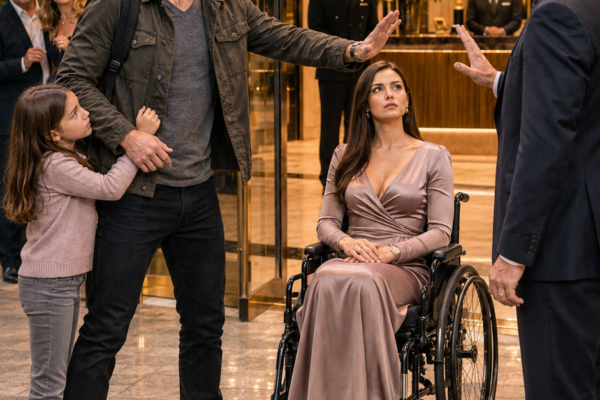
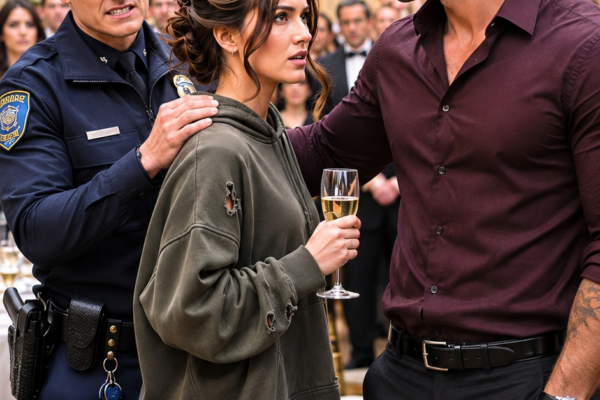
The CEO Mocked a Single Dad in Front of Her Bodyguard — Then Watched Him Drop the Guard in Seconds….

The CEO Mocked a Single Dad in Front of Her Bodyguard — Then Watched Him Drop the Guard in Seconds
The billionaire CEO laughed at the maintenance worker and asked what a single father could possibly know about protecting important people.
Three seconds later, her six-foot-two bodyguard was on the marble floor, a knife was spinning beneath the ballroom lights, and the man she had humiliated was the only person still standing.
But when police discovered how the attacker had entered the hotel, the CEO realized something far more terrifying: someone inside her own company had opened the door.
PART 1 — THE MAN EVERYONE UNDERESTIMATED
The Man in the Gray Uniform
At 5:17 on a rainy Tuesday morning in Chicago, Logan Grant stood in his small apartment kitchen, carefully turning a pancake shaped like a dinosaur.
The dinosaur had already lost its tail.
His nine-year-old daughter, Sophie, sat at the kitchen table wearing mismatched socks and a purple sweatshirt with a faded yellow star. She watched her father lift the damaged pancake onto a plate.
“That’s not a dinosaur,” she announced.
Logan examined his creation.
“Sure it is.”
“It looks like a chicken that got run over.”
“That’s a very specific kind of dinosaur.”
Sophie laughed, and for a moment, the apartment felt warmer than the old radiator could ever make it.
Logan smiled as he placed the plate in front of her.
At forty-one, he had become surprisingly good at making a little happiness out of ordinary things. Burned pancakes. Library books. Five-dollar movie nights. The excitement of finding a perfectly smooth stone on the sidewalk.
He had learned that children rarely cared how much money you made.
They cared whether you remembered what frightened them, what delighted them, and whether you showed up when you promised.
He had made Sophie one promise three years earlier.
He would always come home.
And he had built his entire life around keeping it.
“Don’t forget Friday,” Sophie reminded him.
“Science fair. Three-thirty. Lincoln Elementary. Your bridge project.”
“And?”
“And I’m supposed to wear something nice.”
“No, Dad.” She rolled her eyes. “You’re supposed to smile when they take pictures.”
Logan pretended to consider the request.
“That sounds unreasonable.”
She threw a napkin at him.
He caught it without looking.
For half a second, Sophie stared.
“How do you always do that?”
“Years of catching things you throw at me.”
“You’re weird.”
“So I’ve been told.”
She continued eating while Logan checked the clock.
They had eighteen minutes before he needed to leave.
His work shift at the Meridian Grand Hotel started at six. Mrs. Alvarez, their elderly neighbor, would take Sophie to school, just as she had on most weekdays for nearly three years.
Logan hated asking for help.
He had once earned more money in a month than he now earned in half a year. Back then, he had traveled first class, worn tailored suits, and stayed in hotels where people remembered his name before he reached the front desk.
Now he repaired air-conditioning systems, unclogged drains, and occasionally cleaned up after guests who treated a five-star hotel like their private playground.
He had never been happier to receive an ordinary paycheck.
Or more frightened of losing the life that came with it.
Sophie reached across the table and caught his hand.
“Dad?”
“Yeah, sweetheart?”
“Are you coming home early today?”
“I should be.”
“You always say should.”
Logan looked at her.
There was no accusation in her voice, only the careful disappointment of a child who had already learned that adults sometimes made promises they couldn’t keep.
He squeezed her fingers.
“I’ll be there for dinner.”
“Promise?”
“Promise.”
He meant it.
By the end of the day, that promise would become considerably harder to keep.
The Woman Who Owned the Room
The Meridian Grand was one of Chicago’s oldest luxury hotels, an imposing limestone building filled with polished marble, antique chandeliers, and employees trained to make wealthy guests feel that the world naturally belonged to them.
Logan arrived at 5:54.
He changed into his gray maintenance uniform, clipped his identification badge to his chest, and checked the day’s assignments.
The Grand Ballroom had been reserved for a major corporate event.
Vertex Capital.
Its CEO, Alexandra Vale, was launching a new risk-analysis platform called Lattice, designed to help large corporations identify operational vulnerabilities before they turned into expensive disasters.
The irony of what happened that afternoon would not be lost on anyone.
By 7:15, Logan was kneeling beside an electrical access panel near the ballroom’s eastern wall.
A backup lighting circuit had shown an irregular voltage reading during his morning inspection.
The problem was minor, but he disliked minor problems that occurred near crowded rooms.
Small failures had a way of becoming large ones when people assumed somebody else was responsible.
“You’re checking that thing again?”
Logan glanced over his shoulder.
Marcus Bell, a broad-shouldered maintenance technician with a cheerful face, stood in the doorway carrying two coffees.
“Third time,” Logan replied.
Marcus handed him a cup.
“Man, you’re going to inspect the electricity until it gets embarrassed and behaves.”
“That’s the plan.”
Marcus laughed.
“Listen, Danny said he’d swap shifts with you. Go home early. Take Sophie somewhere.”
Logan checked his meter.
“I’ll finish this first.”
“You know, someday you’re going to tell me what you did before you came here.”
“Maintenance.”
“Before maintenance.”
“Different kind of maintenance.”
Marcus shook his head.
“You’re impossible.”
When his colleague left, Logan returned to the circuit.
But his attention had shifted.
Across the enormous ballroom, a catering employee stood beside the third pillar near the stage.
He was tall, perhaps thirty-five, wearing a black service jacket and carrying a tray.
Nothing about his clothes was unusual.
His behavior was.
He had been standing in almost the same position for fourteen minutes, ignoring nearby servers who were arranging glassware.
Every so often, his eyes moved toward the VIP entrance and the main stage.
Then toward the security camera above the western doors.
Then back to the stage.
Logan watched him briefly.
The man touched the small of his back, adjusted his jacket, and stepped closer to a cable-access corridor.
Logan looked away before the stranger noticed his attention.
Three years ago, he would have immediately notified an advance security team.
Today, he was a maintenance worker.
He knew exactly where his authority ended.
Unfortunately, he also knew that danger rarely respected organizational charts.
At 11:02, three black SUVs arrived outside the hotel’s main entrance.
Alexandra Vale stepped from the middle vehicle.
She was fifty-one, striking, and elegant in a tailored charcoal suit, with dark hair swept neatly behind her ears and a single strand of pearls around her neck.
Financial magazines called her the Ice Queen of Wall Street.
Her employees rarely used the nickname aloud.
Alexandra had built Vertex Capital from a small investment partnership into a multibillion-dollar financial empire. She had survived hostile acquisitions, boardroom revolts, and a scandal that destroyed three of her competitors.
She believed in discipline.
She believed in preparation.
Most of all, she believed she could judge a person within the first thirty seconds of meeting them.
That belief had made her wealthy.
It had also made her careless.
“Press entrance?” she asked without looking up from her phone.
“North corridor,” answered Diana Brooks, her executive assistant.
“Investors?”
“Private reception at one-thirty.”
“Board representatives?”
“All confirmed.”
Alexandra nodded.
Walking beside her was Carter Bennett, a former military security specialist who had spent twelve years protecting executives, politicians, and international business leaders.
Carter stood six feet two inches tall.
His dark suit concealed a muscular frame, and he moved with the deliberate confidence of a man accustomed to making other people move out of his way.
He took his responsibilities seriously.
He had also grown accustomed to his employer’s belief that her judgments were almost always correct.
When Alexandra entered the ballroom, her eyes traveled over the room.
The stage.
The lighting.
The flowers.
The seating arrangements.
Then they stopped on Logan.
He stood beside the electrical panel, holding a voltage meter, his uniform marked with faint traces of oil.
Alexandra’s expression tightened.
“Why is maintenance still here?”
Diana glanced at her tablet.
“A technical inspection. The hotel reported a minor lighting issue.”
“During our final preparations?”
“It’s being addressed.”
Alexandra continued walking.
“Make sure it is.”
Logan heard every word.
He didn’t respond.
He had learned long ago that some people considered silence an admission of inferiority.
He considered it a way to save time.
The Joke That Changed Everything
At 12:34, the ballroom was almost ready.
Alexandra stood near the stage reviewing the security arrangements with Carter.
The presentation would begin at two. Nearly two hundred investors, executives, and financial reporters were expected.
A successful launch could increase Vertex Capital’s valuation by hundreds of millions of dollars.
A public failure would be expensive.
Carter pointed toward the VIP corridor.
“I’ll maintain this position during your opening remarks. My second team will cover the outer entrances.”
Alexandra followed his gesture.
Logan was standing beside the emergency electrical panel.
Again.
She stopped speaking.
“Excuse me.”
Logan turned.
“Yes, ma’am?”
“What exactly are you doing?”
“Monitoring the backup lighting circuit. We had an unstable reading earlier.”
“Hasn’t that already been repaired?”
“The circuit is stable now. I’m completing the final checks before the event begins.”
Alexandra glanced at Carter.
A small smile appeared on her face.
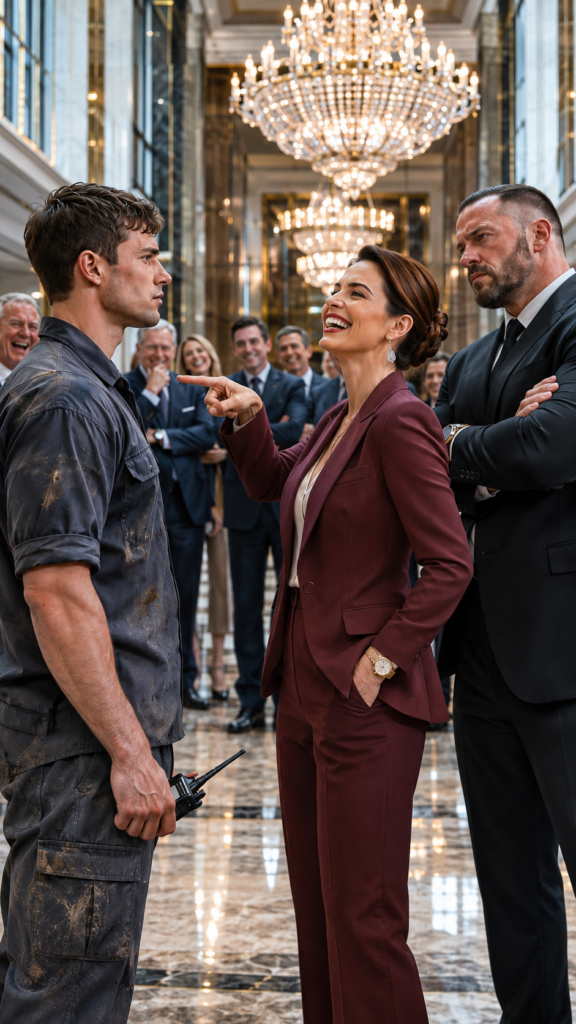
“Apparently, our security plan includes a maintenance man guarding my private entrance.”
Carter’s mouth twitched.
A few employees nearby lowered their eyes.
Logan remained still.
Alexandra took another step toward him.
“Tell me something. Do you know anything about executive security?”
“I know the hotel’s emergency exits, ma’am.”
“That’s not what I asked.”
“No, ma’am.”
She gave a quiet laugh.
“Because from where I’m standing, it looks like you’re very comfortable occupying a position you don’t understand.”
Carter folded his arms.
“Ma’am, I can have hotel management move him.”
Alexandra shook her head.
“No, let him stay a moment.”
She looked Logan up and down.
“What’s your name?”
“Logan Grant.”
“Mr. Grant, people in my position employ professionals who spend years learning how to recognize threats. They don’t simply stand beside a wall holding a toolbox.”
“I understand.”
“Do you?”
Her voice carried farther than she intended.
Several members of the technical crew stopped working.
“Because I have employees earning six-figure salaries to make sure I walk out of this building safely. And yet here you are, standing in the middle of a security corridor as though you might have something useful to contribute.”
Carter gave a restrained chuckle.
Alexandra noticed.
It encouraged her.
“Perhaps we should hire you instead, Mr. Grant. I’m sure you could teach Mr. Bennett a few things.”
A few people laughed.
Not because the joke was particularly funny.
Because Alexandra Vale was laughing.
Logan glanced toward Carter.
“He’s doing his job.”
Carter raised an eyebrow.
“And you should do yours.”
For a moment, neither man looked away.
There was something in Logan’s expression that Carter couldn’t quite identify.
Not fear.
Not anger.
Recognition, perhaps.
As though the maintenance worker knew exactly what Carter was capable of and found no reason to be impressed.
Alexandra tilted her head.
“Do you have children, Mr. Grant?”
The question surprised him.
“One daughter.”
“And you’re raising her?”
“Yes.”
“On your own?”
“Mostly.”
Alexandra nodded, as if that explained something.
“Then perhaps your priority should be getting home safely to your daughter, rather than standing around pretending to understand risks you aren’t qualified to manage.”
The room grew uncomfortable.
Logan’s hand tightened slightly around the handle of his toolbox.
He could tolerate being called incompetent.
He could tolerate someone laughing at his uniform.
But the casual use of his daughter in a conversation designed to humiliate him struck somewhere deeper.
Still, his voice remained calm.
“You’re right about one thing.”
Alexandra waited.
“My daughter is my priority.”
He picked up his toolbox.
“Have a successful event, Ms. Vale.”
Then he turned away.
Alexandra watched him leave.
“Well,” she murmured to Carter, “at least he understands instructions.”
Carter smiled.
Neither of them noticed that Logan had stopped near the western service corridor.
He was watching the catering employee.
The man’s tray was gone.
His right hand had disappeared beneath his jacket.
The Warning Nobody Wanted
Logan pressed the button on his radio.
“Isaac, this is Logan.”
Isaac Turner, the hotel’s security director, answered immediately.
“Go ahead.”
“I need a secondary identity check on one of the catering employees.”
“What’s wrong?”
“Male, mid-thirties, black jacket. He’s been observing the podium and security positions for several hours. He hasn’t performed normal catering duties.”
Isaac hesitated.
“Event security cleared the contractors this morning.”
“I know.”
“Do you have evidence he’s done anything wrong?”
“Not yet.”
“Then let the protection team handle it.”
Logan looked toward the stage.
Alexandra was speaking with Diana while Carter examined his phone.
The stranger had moved closer to the electrical junction.
“Isaac, please check his badge.”
“Logan, the client has already complained about maintenance personnel being visible near the VIP entrance. I can’t create another problem based on a feeling.”
“It’s not a feeling.”
Silence.
Then Isaac spoke more quietly.
“You’re not in that business anymore.”
The words landed harder than he intended.
Logan looked at the radio.
For three years, he had been trying to become someone else.
Someone who repaired broken things instead of anticipating the ways human beings might hurt each other.
Someone who didn’t spend dinner examining restaurant exits.
Someone whose daughter could fall asleep without finding him checking the front door twice.
But some habits were not merely habits.
Some were the residue of things that could never be undone.
“Understood,” Logan said.
He lowered the radio.
Across the room, the stranger shifted his weight.
His hand moved toward his lower back.
Logan set down his toolbox.
Then he walked toward him.
Three Seconds
Alexandra was standing at the podium when the stranger noticed Logan approaching.
Carter stood at the foot of the stage, several yards away.
The man in the catering jacket turned slightly.
“Can I help you?” he asked.
Logan stopped at a respectful distance.
“Hotel maintenance. I need to check your event identification.”
The stranger’s eyes narrowed.
“My supervisor already cleared me.”
“That’s fine. May I see your badge?”
Something changed in the man’s face.
It was small.
A tightening around the mouth.
A brief glance at the corridor.
The expression of someone realizing that a plan was beginning to collapse.
“Get out of my way.”
Logan kept his hands visible.
“I just need to verify your badge.”
The stranger reached behind his back.
Logan moved.
A narrow knife flashed beneath the ballroom lights.
“KNIFE!” Logan shouted.
Carter reacted instantly.
He saw the weapon.
He saw Logan directly in front of the attacker.
And in the chaos of that single moment, he made a terrible mistake.
He interpreted both men as possible threats.
“CLEAR!”
Carter charged from the stage, driving his shoulder toward Logan.
What followed happened so quickly that several witnesses later disagreed about the order.
In the first second, Logan turned with the impact instead of resisting it.
Carter felt his momentum redirected.
His arm was caught.
His balance vanished.
In the second, Logan guided Carter downward with a controlled movement that left the bodyguard on the marble floor, stunned but uninjured.
Then Logan turned toward the attacker.
The stranger lunged.
Logan shifted out of the knife’s path and seized the man’s wrist.
There was a brief struggle.
A metallic clatter.
The knife struck the floor and slid beneath a nearby table.
In the third second, the attacker lost his footing.
Logan brought him down and controlled his arm, keeping him restrained without striking him again.
Then everything stopped.
The enormous ballroom went silent.
Carter sat on the floor, breathing hard, staring at Logan as though he were looking at a ghost.
The attacker was pinned against the marble.
His empty hand trembled.
Diana’s tablet lay beside the stage.
Somewhere near the sound desk, a woman whispered, “Oh my God.”
Alexandra stood frozen at the podium.
Her lips were parted.
The same man she had mocked less than twenty minutes earlier had just stopped her own bodyguard and disarmed an armed stranger in approximately three seconds.
Logan looked toward Carter.
“You hurt?”
Carter swallowed.
“No.”
“Good.”
Logan glanced at the stage.
“Ms. Vale, stay where you are.”
For the first time all day, Alexandra obeyed without argument.
Logan reached for his radio.
“Isaac. Grand Ballroom. Armed intruder restrained. Call the police and secure the exits.”
His voice was steady.
Almost unnaturally steady.
But beneath his calm expression, a memory had begun to surface.
Another crowded room.
Another unexpected movement.
A woman screaming his name.
And the terrible knowledge that being fast wasn’t always the same as being fast enough.
The Apology
Police arrived nine minutes later.
The attacker was handcuffed and escorted away.
The knife was photographed and collected.
The ballroom was closed while officers interviewed witnesses and examined security recordings.
Alexandra sat in the front row, holding a cup of coffee she had not touched.
Carter stood against the wall, his right wrist wrapped in a temporary support.
Logan remained beside the service entrance, giving a precise account of what he had seen.
He described the stranger’s unusual movements.
The repeated attention toward the stage.
The missing work activity.
The warning he had given hotel security.
The detective taking his statement, Maria Castillo, looked up.
“You reported this before the confrontation?”
“Yes.”
“How long before?”
“Approximately forty minutes.”
“Did someone respond?”
“I was told the catering staff had already been cleared.”
Detective Castillo wrote something in her notebook.
Isaac, standing a few feet away, stared at the floor.
When the detective finished, Logan reached for his toolbox.
“Am I free to go?”
“For now. We may need another statement.”
“Understood.”
He was almost at the door when Alexandra spoke.
“Mr. Grant.”
He stopped.
She rose from her chair.
Carter watched from across the room.
“May I speak with you?”
Logan checked the time.
It was 3:26.
Sophie would already be out of school.
Mrs. Alvarez would be waiting with her.
He had promised to come home.
“Briefly,” he said.
Alexandra approached him.
For once, her expensive suit and immaculate appearance seemed completely irrelevant.
“I misjudged you,” she said.
Logan said nothing.
“I insulted you in front of my employees.”
“Yes, you did.”
She blinked.
People rarely answered her that directly.
“I apologize.”
“Thank you.”
“I also owe you an explanation.”
“You don’t.”
Alexandra paused.
He continued.
“You don’t know me, Ms. Vale. You saw my uniform and decided it told you everything worth knowing. That’s your decision. I can live with it.”
She looked down.
“What I can’t live with,” he added, “is someone getting hurt because the people responsible for noticing danger are more interested in looking important.”
Carter shifted slightly near the wall.
Logan didn’t look at him.
Alexandra took a breath.
“You’re right.”
“I don’t need to be right.”
“Then what do you need?”
He looked at his watch again.
“To pick up my daughter.”
Something changed in Alexandra’s face.
The single father she had used as the punch line of a joke was standing in front of her, having saved her life, and all he wanted was to go home.
“I understand,” she said.
Logan nodded and walked toward the door.
But before he reached it, Detective Castillo returned from the security office.
“Ms. Vale?”
Alexandra turned.
“We’ve found something concerning.”
The detective held a printed access report.
“The suspect entered the building using a contractor credential. The name on his physical badge was false, but the electronic access code was genuine.”
Diana stepped closer.
“That isn’t possible. Every contractor was verified.”
“The code was active,” Castillo replied. “It opened the service entrance and an internal event corridor.”
Alexandra’s expression hardened.
“Who issued it?”
Castillo looked at the report.
“According to the authorization record, it came from Vertex Capital’s executive office.”
Diana went pale.
Alexandra’s eyes narrowed.
“Who specifically?”
The detective hesitated.
Then she turned the paper toward the CEO.
“Your private executive authorization code was used, Ms. Vale.”
The air seemed to disappear from the room.
Alexandra stared at the screen capture, recognizing the identifier attached to the approval.
That code was restricted to her office.
It was not supposed to be available to the event staff.
And she had not approved the credential.
For several seconds, nobody spoke.
Then Logan noticed something else.
A second entry appeared beneath the authorization record.
He leaned forward.
“Detective, what’s that?”
Castillo followed his gaze.
“Another contractor access credential.”
“Activated when?”
She checked the timestamp.
“Eleven-forty-eight this morning.”
Logan looked toward the closed ballroom doors.
“Has it been used?”
The detective’s face changed.
“Yes.”
Alexandra gripped the back of a chair.
“Where?”
Castillo turned the report around.
“The hotel’s third-floor private executive corridor.”
Carter straightened.
Diana whispered, “That’s where our confidential launch documents are being stored.”
Logan looked at the access record one final time.
The first credential had delivered an armed man into a crowded ballroom.
The second belonged to someone nobody had identified.
And it had been used while everyone was distracted by the attack.
Someone hadn’t merely tried to hurt Alexandra Vale.
Someone had used the attack to get past her security.
And whoever it was might still be inside the hotel.
End of Part 1.
PART 2 — THE PAST HE TRIED TO BURY
The Second Visitor
For the first time in twelve years, Carter Bennett felt afraid of making a decision.
Not afraid of danger.
He understood danger.
He was afraid of being wrong again.
Detective Castillo had already called for additional officers when Carter approached Logan near the ballroom entrance.
“I need your help.”
Logan looked at him.
“With what?”
“The second credential. Someone accessed the private corridor during the confrontation. We need to understand how they moved without being noticed.”
“Then check the cameras.”
“That’s what I’m doing.”
“Good.”
Logan started toward the service elevator.
Carter stepped aside rather than block him.
“Look, Grant. I know what happened back there.”
Logan stopped.
“You saw a possible threat. You moved to protect your client.”
“I attacked the wrong man.”
“Yes.”
Carter’s jaw tightened.
There was no anger in Logan’s answer, only accuracy.
“You could have broken my arm,” Carter said.
“I didn’t need to.”
“Why not?”
“Because you weren’t trying to hurt me. You were trying to protect her.”
Carter stared at him.
The answer somehow made his embarrassment worse.
For years, Carter had believed that the difference between an ordinary bodyguard and an exceptional one was physical ability. Strength. Speed. Confidence under pressure.
Now he understood that he had attacked the wrong man because he had already decided the man wasn’t worth considering.
“Who trained you?” he asked.
Logan’s expression closed.
“Someone who taught me not to answer that question.”
Carter almost smiled.
But Logan wasn’t joking.
Detective Castillo approached them.
“We’ve confirmed that the second credential was used to enter the executive corridor at 1:41 p.m. Whoever carried it left through a service stairwell at 1:57.”
“Is anyone missing?” Carter asked.
“Not from the registered staff. We’re comparing camera footage with the contractor manifest.”
Logan looked at the floor plan in her hand.
“The west service stairwell doesn’t lead directly to the street.”
Castillo looked up.
“Where does it go?”
“Third floor to the laundry landing. From there, the service elevators connect to the loading dock. But you need a separate card to open the dock exit.”
“Unless someone opens it from outside,” Carter said.
Logan nodded.
“Or unless the door doesn’t latch properly.”
Castillo turned to Isaac.
“Does it?”
Isaac hesitated.
Logan answered before he could.
“It sticks in damp weather. I reported it last Thursday. Replacement hardware is scheduled for Friday.”
The detective slowly lowered the plan.
“So the building had an unsecured service exit.”
“An unreliable one,” Logan corrected. “It still locks most of the time.”
“That’s not much comfort.”
“No,” he said. “It isn’t.”
Alexandra had followed the conversation without interrupting.
Her company’s expensive security team had failed to recognize an attacker.
Her executive credentials had been compromised.
And a hotel maintenance worker knew more about the building’s actual weaknesses than the professionals assigned to protect her.
She looked at Diana.
“Get me every approval record for the event. Not just the summary. Every original message and every change.”
Diana nodded.
“And call our legal counsel,” Alexandra added.
“Already done.”
Alexandra turned toward Logan.
“Mr. Grant, would you consider staying to assist the investigation?”
He checked his phone.
Two missed calls from Mrs. Alvarez.
One message from Sophie.
Dad, are you bringing the strawberries?
Logan felt something tighten inside his chest.
“I can’t.”
Alexandra looked genuinely surprised.
“We can compensate you.”
“It’s not about compensation.”
“Then what is it about?”
He held up his phone.
“My daughter is waiting.”
Alexandra opened her mouth, then closed it.
Carter looked toward the detective.
“I’ll review the service routes with hotel security.”
Logan nodded.
“Start with the loading dock. Check the south camera before the stairwell footage. Anyone leaving with a bag would have to cross that sightline.”
Castillo made a note.
“Thank you, Mr. Grant.”
He left without waiting for another question.
The billionaire CEO watched him disappear into the elevator.
She had spent the entire day trying to understand what kind of man Logan Grant was.
She had not yet considered that the most important thing about him might be what he was willing to walk away from.
The Girl Waiting at the Window
By the time Logan reached his apartment building, the rain had stopped.
He hurried upstairs carrying a grocery bag containing strawberries, milk, and the cheap vanilla ice cream Sophie liked.
Mrs. Alvarez opened her door before he knocked.
“You’re late, mijo.”
“I know. I’m sorry.”
She took one look at his face.
“What happened?”
“Long day.”
“Was anyone hurt?”
Logan paused.
“No. Not seriously.”
Mrs. Alvarez studied him.
She had raised four children and buried one husband. She knew when a man was leaving important things unsaid.
But she also knew that not every silence needed to be challenged immediately.
“Sophie’s at your place,” she said. “I stayed with her until you called from the parking lot.”
“Thank you.”
“She was worried.”
Logan nodded.
“I know.”
He found Sophie sitting on the living room floor beside her unfinished science project.
It was a small bridge made from wooden craft sticks and glue.
A cardboard river ran beneath it.
She had spent the previous week trying to make the structure strong enough to support a stack of books.
So far, it had collapsed three times.
When she saw him, she stood.
“You’re late.”
“I am.”
“You promised.”
“I know.”
She looked at the grocery bag.
“Did you remember?”
He held up the strawberries.
Her expression softened, but only slightly.
“That’s not the point.”
Logan placed the bag on the kitchen counter.
“No,” he agreed. “It isn’t.”
He crouched in front of her.
“Something happened at work. I had to speak to the police.”
Her eyes widened.
“Did you do something bad?”
“No.”
“Did someone else?”
“Yes.”
She became very still.
“Are you okay?”
He nodded.
“I’m okay.”
She studied his face, unconvinced.
Then she stepped forward and wrapped her arms around his neck.
Logan held her.
For several seconds, neither spoke.
He could feel how much she had grown in the last year. Her arms reached farther around his shoulders now. Her head rested higher against his chest.
Time was moving, whether he paid attention or not.
“I’m sorry I worried you,” he whispered.
“Just don’t disappear.”
The words struck him harder than anything that had happened in the ballroom.
He closed his eyes.
“I won’t.”
That evening, he made spaghetti while Sophie worked on her bridge.
She asked him whether glue was stronger than tape.
He told her it depended on what she was trying to hold together.
She asked whether triangles were stronger than squares.
He explained how a triangular support distributed pressure.
Then she asked something unexpected.
“Dad, were you ever a policeman?”
Logan’s hand stopped over the saucepan.
“Why?”
“Because you always notice stuff.”
“Like what?”
“Like when that man followed us at the grocery store.”
“He wasn’t following us. He was looking for the same aisle.”
“And when the smoke alarm at school was broken.”
“That was easy to notice.”
“And when I lie.”
He laughed softly.
“That’s the easiest one.”
She didn’t laugh back.
“Mom says you used to have a dangerous job.”
Logan turned off the stove.
“Your mom’s right.”
“Was that why she got hurt?”
He stood motionless.
Three years had passed.
But that question could still put him back in a room full of shattered glass.
He carried the saucepan to the sink.
“We’ve talked about this, sweetheart.”
“Not really.”
He looked at her.
Sophie was right.
He had explained that her mother had been injured in an accident. He had explained that hospitals helped people get better.
He had never explained why his wife had been at that particular event, or what he had been doing when everything went wrong.
“Somebody tried to hurt a person I was protecting,” he said finally. “There was a lot of confusion. Your mom got caught in it.”
“Did you save her?”
His throat tightened.
“No.”
Sophie looked down at the bridge.
“Oh.”
A small word.
Barely audible.
Yet he heard the disappointment inside it.
“Other people helped her,” he added.
She nodded without looking up.
Logan wanted to explain that his responsibility had been somewhere else.
That the situation had developed faster than anyone could have predicted.
That he had done precisely what he was supposed to do.
But none of those explanations changed the answer.
No.
He hadn’t saved her.
And the man who could stop a trained bodyguard in three seconds had never learned how to make peace with that.
The Life Behind the Uniform
Three years earlier, Logan Grant had been one of the most respected executive protection specialists in the country.
He had worked for Blackridge Protective Services, a private security organization contracted to major financial institutions and wealthy individuals facing extraordinary risks.
His team handled advance planning, threat assessments, travel security, and crisis response.
He had spent ten years protecting people whose names appeared on magazine covers.
He had negotiated with frightened strangers, evacuated clients during civil unrest, and made decisions in seconds that other people spent months reviewing.
His colleagues trusted him because he rarely raised his voice.
His clients trusted him because he never seemed surprised.
His wife, Hannah, had once loved those qualities.
Then came the charity gala.
A private fundraiser at a downtown conservatory, where Logan’s team was protecting a prominent banking executive.
Hannah had arrived near the end of the evening to meet him afterward.
Sophie, then six, was spending the night with her grandparents.
The threat came from a man who had slipped through an employee entrance and confronted one of the guests.
There was shouting.
A sudden rush of frightened people.
A decorative glass structure toppled as guests fled.
Hannah had been helping an older woman move toward an exit when the structure collapsed.
Glass and metal struck her legs.
Logan heard her scream.
He turned.
He saw her on the floor.
Then he heard his client’s voice behind him.
“Logan, the exit!”
His team was moving the principal toward a secured corridor.
The attacker had not yet been fully contained.
For one impossible moment, Logan stood between two responsibilities.
The person he had been paid to protect.
And the woman he loved.
He directed another team member toward Hannah and completed the evacuation.
By the time he reached her, paramedics were already treating her injuries.
She survived.
But the fractures required surgery, and recovery took months.
Logan stayed beside her hospital bed.
He arranged physical therapy.
He learned how to assist her up stairs and how to help Sophie understand why her mother cried during the night.
He also became obsessed with preventing another emergency.
He installed cameras around their home.
He checked the locks repeatedly.
He discouraged Hannah from going places alone.
He began treating ordinary family decisions like security operations.
Hannah understood why.
For a while, she even felt grateful.
Then the gratitude began to suffocate her.
One evening, nearly a year after the accident, she found Logan studying a neighborhood map instead of helping Sophie decorate cupcakes.
She stood in the doorway, leaning on the cane she still occasionally used.
“Logan.”
He didn’t look up.
“One second.”
“We need to talk.”
“Is something wrong?”
“That’s the problem. You think something always is.”
He slowly turned.
Hannah’s eyes were wet.
“I know you love us.”
“Of course I do.”
“But I can’t spend the rest of my life being someone you’re afraid to lose.”
He had no answer.
“I don’t need a guard every time I leave the house. I need my husband.”
“I’m trying to keep you safe.”
“I know.”
Her voice broke.
“But you’re so busy watching for the next terrible thing that you’ve stopped being here for the good things.”
They tried counseling.
They tried taking short trips.
They tried rebuilding the ordinary trust that had once made their marriage feel effortless.
Eventually, Hannah accepted a job in Milwaukee, closer to her sister and a rehabilitation specialist she had come to trust.
Sophie remained in Chicago with Logan, near her school, friends, and grandparents.
Their parenting arrangement was carefully negotiated and affectionate.
Hannah visited regularly, and Sophie spent school breaks and many weekends with her mother.
Neither parent spoke badly of the other.
Their marriage had ended.
Their commitment to their daughter had not.
When Logan resigned from Blackridge, people assumed he was having a temporary crisis.
Some offered promotions.
Others suggested that a few months of leave would solve everything.
He declined.
A former professional acquaintance named Isaac Turner helped him find a job at the Meridian Grand.
The salary was modest.
The hours were predictable.
And most days, the most dangerous thing he encountered was an improperly secured ladder.
It was exactly what he wanted.
Until Alexandra Vale walked into his ballroom.
The Footage
At 8:42 that evening, Carter stood inside the hotel’s security office, watching the same recording for the ninth time.
Onscreen, he lunged toward Logan.
Then he was on the floor.
The entire movement lasted less than two seconds.
“Pause,” he said.
Isaac stopped the footage.
Carter leaned forward.
“Back three frames.”
Isaac complied.
Carter stared at the image.
“He’s not looking at me.”
“No.”
“He’s looking at the man’s weapon hand.”
“Yes.”
Carter sat back.
Logan had known exactly where Carter was coming from, yet he had never taken his eyes off the more dangerous threat.
His reaction hadn’t been about defeating Carter.
It had been about removing an obstacle.
That distinction troubled him.
Carter had spent twelve years becoming stronger, faster, and more capable.
Logan had spent the same moment conserving movement.
“He was Blackridge,” Carter said quietly.
Isaac didn’t answer.
“Don’t tell me. I already know.”
Carter ran a hand over his face.
“I went to one of their instructor seminars four years ago. They taught a principle I’ve never forgotten. Don’t confuse controlling a person with controlling a situation.”
Isaac nodded.
Carter looked at the frozen image.
“I forgot it today.”
Before Isaac could reply, Diana appeared in the doorway.
“We found the contractor approval.”
Carter stood.
“Who submitted it?”
Diana held out her tablet.
“The event-production company, Hartwell Events. They forwarded an electronic contractor request to my office yesterday afternoon.”
“Did you authorize it?”
“I approved the batch based on their verified vendor list.”
“Was the suspect on that list?”
“His alias was.”
Carter frowned.
“Who added it?”
“Someone using Hartwell’s contractor portal. The request came through a legitimate account.”
Isaac folded his arms.
“So someone compromised the contractor list.”
Diana nodded.
“There’s more. The second credential was connected to the same request. Whoever submitted the batch added two temporary workers.”
Carter looked toward the security monitors.
“One to create a diversion.”
“And one to steal whatever was upstairs,” Isaac finished.
Diana’s face tightened.
“The missing items include an encrypted development drive and a sealed folder containing internal acquisition records.”
“Could they open the drive?”
“We don’t know.”
“What was in the folder?”
Diana looked away.
“That’s what concerns me.”
At that moment, her phone rang.
She answered, listened, and went completely still.
“What video?”
A pause.
“How many views?”
Carter stepped closer.
Diana lowered the phone.
“Someone uploaded the ballroom confrontation.”
Isaac turned toward the monitors.
“Security footage?”
“No. A recording from the technical crew.”
She swallowed.
“It’s already spreading.”
The Wrong Kind of Attention
By ten o’clock, Logan Grant’s face was appearing on social media.
The video had been edited.
It began with Carter rushing toward him.
Then showed Carter falling.
The knife was barely visible, and the attacker had been cropped out of most of the frame.
A caption suggested that a hotel employee had assaulted a corporate bodyguard.
Thousands of strangers began debating what had happened.
Some called Logan a hero.
Others accused him of deliberately provoking the confrontation.
A few claimed the entire scene had been staged.
One person found an old photograph of Logan attending a Blackridge charity fundraiser.
Another found his name in an archived security industry newsletter.
Soon, the ordinary maintenance worker was being described as a former elite operative hiding under an assumed identity.
The last part was false.
But it sounded dramatic enough that people repeated it anyway.
Logan discovered the video when Hannah called.
He was washing dishes.
Sophie had already gone to bed.
“Logan, what happened today?”
Her voice was tight.
He closed his eyes.
“Where did you hear about it?”
“It’s everywhere.”
“It was an incident at work.”
“An incident?”
“Hannah—”
“I watched someone pull a knife while you were standing three feet away.”
Logan leaned against the kitchen counter.
“It’s over.”
“You’re telling me it’s over because you walked away from it. That’s what you used to say after every assignment.”
He said nothing.
Hannah lowered her voice.
“Does Sophie know?”
“Not about the video.”
“She’ll find out.”
“I know.”
“Promise me you won’t get pulled back into that world.”
Logan looked toward his daughter’s bedroom.
The door was open a few inches.
A small nightlight cast stars across the ceiling.
“I’m not going back.”
“Then why does it look like everyone is trying to drag you there?”
He had no answer.
After the call, Logan checked his messages.
Marcus had sent him a link.
Isaac had left two missed calls.
A local reporter wanted an interview.
The hotel’s general manager had requested a meeting before his next shift.
Then another notification appeared.
A message from an unfamiliar number.
There was no greeting.
No introduction.
Only a photograph.
It showed Logan outside Lincoln Elementary School, holding Sophie’s hand as they crossed the sidewalk.
The picture had been taken the previous Friday.
Logan felt the blood drain from his face.
A second message followed.
You should have stayed out of the ballroom, Mr. Grant.
He stared at the screen.
Then a third message appeared.
We know what matters more to you than being a hero.
For three years, Logan had lived with the fear that his old life might someday reach into his daughter’s world.
Now, looking at the photograph, he understood that it already had.
He crossed the apartment in four long strides and checked the front door.
Locked.
He went to Sophie’s bedroom.
She was asleep beneath a faded blue blanket, one hand resting on the stuffed rabbit she had owned since kindergarten.
He stood there, listening to her breathe.
For the first time since leaving Blackridge, he took out the emergency contact card he had kept hidden in the back of his wallet.
He stared at the number.
Then he made a call.
When someone answered, Logan spoke four words.
“They found my daughter.”
End of Part 2.
PART 3 — THE SECRET BEHIND THE ATTACK
The Call He Never Wanted to Make
The woman on the other end of the phone was Naomi Pierce, a former Blackridge colleague who now managed threat investigations for a private security consultancy.
She had worked beside Logan for eight years.
She knew what happened at the charity gala.
And she knew how much it had cost him to leave.
“Where are you?” Naomi asked.
“Home.”
“Is Sophie with you?”
“Sleeping.”
“Have you called the police?”
“Not yet. I called you first.”
“Then call Detective Castillo immediately. Save the messages, don’t respond, and don’t go looking for whoever sent them.”
Logan looked toward Sophie’s bedroom.
“They took the photograph last Friday. Before the incident.”
Naomi went quiet.
“Then this isn’t someone who found you through the video.”
“No.”
“Someone was watching you beforehand.”
Logan’s fingers tightened around the phone.
“I spent three years making sure this life was quiet.”
“I know.”
“I thought if I stayed away from everything—”
“Logan.”
He stopped.
“Quiet isn’t the same as safe,” Naomi said. “And you can’t protect Sophie by refusing to let anyone help you.”
He closed his eyes.
Those were almost the same words Hannah had once said to him.
Only this time, he listened.
Within twenty minutes, Detective Castillo had received the messages and opened a related threat investigation. Patrol officers were notified, and arrangements were made with Sophie’s school to verify anyone requesting access to her.
Logan called Hannah next.
He told her everything.
She didn’t shout.
That frightened him more than anger would have.
“I’m coming to Chicago in the morning,” she said.
“You don’t have to—”
“Logan, I’m her mother.”
He looked down.
“You’re right.”
“And one more thing.”
“Yeah?”
“Don’t make this into a mission you have to complete alone.”
After they hung up, Logan sat in the dark kitchen.
He had spent years believing that asking for help meant admitting he was no longer capable.
Now he understood what that belief had cost him.
A Different Kind of Fear
The next morning, Logan told Sophie that someone had taken a photograph of them without permission.
He explained that the police were helping and that, for a while, she needed to stay with a trusted adult whenever she was outside school.
He didn’t tell her every frightening detail.
But he didn’t lie.
“Is it because of your old job?” she asked.
“Maybe.”
“Are you going to leave again?”
He shook his head.
“No.”
She thought about that.
“Sometimes when you say you’re protecting me, you look really scared.”
Logan felt his throat tighten.
“I’m scared because I love you.”
She nodded.
“I know. But I like it when you laugh, too.”
He sat beside her.
Sophie rested her head against his shoulder.
“You don’t have to be brave all the time, Dad.”
He wrapped an arm around her.
For years, he had taught her that strong people stayed calm during emergencies.
He had forgotten to teach her that strong people could admit they were afraid.
At eight-thirty, he received a call from the Meridian Grand’s general manager.
Because of the viral footage and ongoing investigation, Logan was being placed on temporary paid administrative leave.
The manager apologized repeatedly.
Logan thanked him.
Then he hung up and stared at the kitchen wall.
He knew the decision wasn’t necessarily punishment.
Still, the hotel had been the center of his new life.
Its ordinary routines gave structure to everything else.
His paycheck paid the rent.
His predictable schedule allowed him to raise Sophie.
Without warning, the small stability he had spent three years building felt fragile.
Hannah arrived shortly before eleven.
She stepped out of her car carrying an overnight bag, her auburn hair tied back loosely.
She no longer needed a cane.
But Logan noticed the familiar stiffness in her left leg after the long drive.
He almost asked whether she needed help carrying the bag.
Instead, he stepped aside.
“Come in.”
She studied him.
“That’s new.”
“What is?”
“Not treating me like I’m made of glass.”
He gave a tired smile.
“I’m working on it.”
They stood in the doorway for a moment.
Not married.
Not enemies.
Two people who had once loved each other deeply and were still learning how to care without holding on too tightly.
Then Hannah walked inside.
What Alexandra Didn’t Know
Across the city, Alexandra Vale sat at the head of a conference table while her legal counsel, Diana, Carter, and the company’s chief financial officer reviewed the incident.
Martin Rusk, Vertex Capital’s CFO, was a polished man in his late forties who rarely spoke without considering how his words might affect the company’s share price.
He had worked with Alexandra for eleven years.
She trusted him.
Or, until that morning, she had.
“The stolen material is commercially sensitive,” Martin said. “We should focus on recovering it and moving forward with the launch.”
Alexandra looked at him.
“Someone attempted to attack me.”
“And that person is in custody.”
“Someone else entered our executive suite.”
“An isolated security breach.”
“And that person escaped with confidential company documents.”
Martin hesitated.
“We don’t yet know what the documents contain.”
Diana looked up from her tablet.
“Actually, we do.”
She placed a file in front of Alexandra.
“The physical folder contained correspondence relating to our acquisition of Riverton Analytics two years ago.”
Martin’s expression changed.
Only slightly.
But Alexandra saw it.
“Why would anyone want those records?” she asked.
Martin folded his hands.
“Old commercial disputes. Riverton’s former cofounder has been making allegations for years.”
“Name?”
“Jason Keller.”
Carter looked up sharply.
“That’s the name connected to the arrested catering contractor.”
Silence followed.
Alexandra slowly turned toward Martin.
“You knew he’d been making threats?”
“Not threats. Complaints. Lawyers’ letters. Allegations that the acquisition undervalued certain assets.”
“Did he contact my office?”
Martin hesitated.
“He contacted several departments.”
“That’s not what I asked.”
Diana quietly opened another document.
“Mr. Keller requested a meeting with you eight months ago, Alexandra.”
Alexandra stared at her.
“I don’t remember that.”
“The request was routed to finance.”
Martin leaned forward.
“It was a legal dispute. We followed the usual process.”
“Did anyone investigate his claims?”
“Our legal team concluded the acquisition contract was enforceable.”
Alexandra’s voice hardened.
“That is not the same thing.”
Martin said nothing.
She turned toward Diana.
“Bring me everything Jason Keller sent this company. Every complaint. Every financial report. Every unanswered warning.”
Then she looked at Martin.
“And until I understand what happened, we are not launching anything.”
Martin’s face tightened.
“The investors have already arrived.”
“They can wait.”
“Postponing could cost us millions.”
Alexandra stood.
“Someone almost died yesterday, Martin. If you can’t understand why that matters, you shouldn’t be in this meeting.”
For the first time in years, Martin Rusk had no immediate reply.
The Photograph Wasn’t Random
Detective Castillo called Logan at 12:18.
They had traced the photograph to surveillance conducted before the hotel incident.
The person who had taken it appeared to have been watching several Meridian Grand employees who would be near the ballroom during the event.
Logan had been one of them.
“Do you know Jason Keller?” Castillo asked.
“No.”
“Have you ever worked for him?”
“Not that I know of.”
“He used a private investigator to gather background information on hotel personnel. We believe your previous security experience was flagged.”
Logan looked toward the living room, where Hannah was helping Sophie strengthen her bridge.
“So whoever planned this knew I wasn’t just a maintenance worker.”
“Possibly. We’re still establishing who ordered the surveillance and when.”
“Why wasn’t I approached before the event?”
“Perhaps they intended to avoid drawing attention. We can’t confirm their intentions yet.”
Logan rubbed his forehead.
The stranger in the ballroom had not looked surprised to see a maintenance worker approaching.
He had looked surprised that Logan was asking questions.
A difference that mattered now.
Castillo continued.
“There’s another development. We’ve identified the second person who entered the executive corridor. Her name is Natalie Shaw. She previously worked for Riverton Analytics.”
“Has she been arrested?”
“Not yet. We have reason to believe she has information about the stolen documents, and we’re trying to locate her safely.”
“Do you think she’ll hurt anyone?”
“We don’t have evidence of that. Our immediate concern is locating the material and identifying everyone involved.”
Logan exhaled slowly.
“Thank you for telling me.”
“Mr. Grant, stay focused on your family. We have officers handling the investigation.”
He almost argued.
Then he looked at Sophie.
She had balanced three thick books on her bridge.
It was holding.
“I will,” he said.
The Offer
At four that afternoon, Alexandra arrived outside Logan’s apartment building with Carter.
She had asked permission before coming.
Logan met them in the courtyard rather than bringing them upstairs.
He was wearing jeans, a faded navy sweater, and sneakers.
For the first time, Alexandra saw him without his maintenance uniform.
He looked like an ordinary father who hadn’t slept enough.
Not an elite security specialist.
Not an employee.
Just a tired man trying to preserve his family.
“I heard about the messages,” she said.
Logan’s expression tightened.
“Then you understand why I don’t want publicity.”
“Yes.”
“I won’t participate in interviews. I won’t take a job protecting you. And I won’t let my daughter become a bargaining chip in your company’s problems.”
Alexandra absorbed his words.
“That’s not why I’m here.”
“Then why?”
“Because you warned my security team. You were ignored. I humiliated you, and afterward someone threatened your child because you intervened.”
She looked at him directly.
“I can provide a protective detail for your family, but only with your approval and in coordination with the police.”
Logan considered the offer.
“We already have arrangements in place.”
“Then I’ll respect that.”
Carter stepped forward.
“Mr. Grant, I also owe you an apology.”
Logan turned toward him.
Carter’s expression was serious.
“I made a dangerous assumption. You protected my client despite the way we treated you.”
“You responded to a weapon,” Logan said.
“I responded without understanding the whole situation.”
Logan studied him.
“Then learn from it.”
Carter nodded.
“I intend to.”
Alexandra opened her handbag and removed a small envelope.
“I also wanted to offer compensation for your involvement.”
Logan didn’t touch it.
“Put that away.”
“Mr. Grant—”
“You can’t purchase the part of this that matters.”
Alexandra slowly lowered the envelope.
“What would matter?”
Logan glanced toward the building.
“Fix whatever allowed those people inside. Make sure the next employee who reports a concern gets heard. And don’t punish the hotel staff because they work for someone with less money than you.”
She looked down at the envelope.
Then she put it away.
“All right.”
It wasn’t an easy promise.
But it was one she finally understood.
The Report That Never Reached Her
That evening, Diana discovered a document buried inside an old compliance archive.
It was an internal review of Riverton Analytics’ acquisition.
The report raised serious concerns about the data rights used to develop Lattice, the very platform Vertex Capital was preparing to launch.
Certain commercial data had been represented as fully transferable when the underlying customer agreements appeared to impose restrictions.
The report also questioned whether projected earnings had been overstated during the acquisition.
An independent investigation would be needed to determine the full consequences.
But the warning itself was unmistakable.
Diana brought it directly to Alexandra.
“Who prepared this?” Alexandra asked.
“Our former compliance director.”
“Why didn’t I see it?”
Diana hesitated.
“Martin’s department summarized it as a routine contractual matter.”
Alexandra began reading.
The report had been completed six months earlier.
It had recommended postponing the product launch until the data rights could be independently verified.
Then Alexandra reached the final page.
There was an executive approval attached.
Her office had received a shortened summary of the concerns.
She remembered it now.
A crowded afternoon.
A board presentation running late.
Martin assuring her that everything had been addressed.
And her own response, typed beneath his message.
Proceed on schedule. Resolve the remaining issues before launch.
Alexandra stared at the sentence.
She had not approved fraud.
She had not knowingly authorized unlawful data use.
But she had accepted a reassuring explanation without verifying it.
And when a warning threatened an important deadline, she had chosen the deadline.
Diana’s voice was quiet.
“There’s something else.”
She turned to an attached email.
“Martin was told the concerns were unresolved four weeks after your instruction.”
Alexandra read the reply.
It came from Martin’s account.
Keep this within Finance and Legal. No further escalation unless the risk is confirmed material.
Then, below it, an attachment reference.
The same file name as the folder stolen from the hotel.
Alexandra slowly looked up.
The intruders had not simply stolen valuable corporate information.
They had targeted the documents proving that Vertex Capital had been warned.
And the person most responsible for burying those warnings was sitting one floor below her, preparing to tell investors that everything was fine.
The danger outside the company had exposed something rotten inside it.
This time, Alexandra could not solve the problem by ordering someone else to make it disappear.
End of Part 3.
PART 4 — THE PRICE OF LOOKING AWAY
The Man Who Wanted Revenge
By Thursday morning, police had located Natalie Shaw.
She had contacted an attorney after discovering that the attack in the ballroom was far more serious than the disruption she had agreed to help arrange.
Her account, supported by messages recovered during the investigation, revealed how the plan had developed.
Jason Keller had once been a respected technology entrepreneur.
His company, Riverton Analytics, had built software capable of identifying weaknesses in corporate supply chains.
For years, he believed he was creating something valuable.
Then the company ran into financial difficulties.
Vertex Capital acquired its assets through a complicated transaction that Keller later argued was unfair.
The courts had upheld the contract.
But winning in court had not made the underlying dispute disappear.
Keller had lost his company, most of his investment, and his reputation.
Several former employees believed the sale had deprived them of compensation they had expected.
Others believed Keller had made reckless financial decisions long before Vertex became involved.
Both things could be true.
He had spent two years sending complaints, gathering documents, and searching for evidence that the acquisition had been mishandled.
Eventually, resentment became obsession.
When Vertex announced the Lattice launch, Keller saw an opportunity.
He recruited Natalie, a former Riverton analyst who believed the company’s original data had been misused.
She would enter the executive corridor and retrieve records that might support their allegations.
Another man, Evan Pike, would create a disruption downstairs.
Pike had previously worked as a contract event technician. He knew how to move through service areas without drawing attention.
Keller obtained access credentials through a compromised contractor account and arranged for both names to appear on the approved event list.
The original plan was a public interruption and a theft.
Pike’s decision to produce a knife transformed it into something far more dangerous.
And Keller had continued the operation even after learning that Logan Grant was a former security professional assigned to work near the ballroom.
He had commissioned surveillance of Logan and other employees before the event.
After the confrontation, he used the information gathered about Logan’s family to frighten him into silence.
Detective Castillo summarized the findings during a call with Logan.
“Keller’s attorney says he never authorized physical violence.”
Logan sat at the kitchen table, staring at the photograph of Sophie that had been sent to his phone.
“Did he authorize someone to watch my daughter?”
“We have evidence connecting him to the surveillance and threatening messages.”
“Then he knew exactly what he was doing.”
“That’s what we’re investigating.”
“Has he been arrested?”
“He’s being interviewed, and we’re pursuing the appropriate charges. We also have the contractor records and Natalie’s statement.”
Logan leaned back.
He wanted to feel relief.
Instead, he felt exhausted.
“Will Sophie be safe?”
“We’re maintaining the school precautions while we assess any remaining risk. We’ll update you as we confirm more.”
Logan looked across the kitchen.
Sophie and Hannah were comparing two versions of her science project.
One bridge had collapsed under four books.
The other held six.
Sophie was laughing at something her mother had said.
For the first time in two days, Logan allowed himself to listen to the sound.
The Truth a Daughter Deserved
That afternoon, Hannah found Logan standing by the living room window.
“You’ve checked that street six times,” she said.
“Four.”
“Logan.”
He exhaled.
“Okay. Six.”
She stood beside him.
“She’s safe right now.”
“I know.”
“Do you?”
He looked at her.
Hannah’s voice softened.
“I remember this.”
He turned away.
“I don’t want to do it again.”
“Then don’t.”
For a long moment, neither spoke.
Finally, Logan said, “Sophie asked whether I saved you that night.”
Hannah looked at him.
“What did you tell her?”
“The truth.”
“Which truth?”
“That I didn’t.”
Hannah closed her eyes.
“Oh, Logan.”
He stared at the floor.
“I saw you there. I heard you. And I kept moving.”
“You were protecting someone.”
“I was protecting a man I barely knew while my wife was lying under broken glass.”
“You sent help.”
“It wasn’t enough.”
“You’re confusing what happened with what you wish you could have done.”
His jaw tightened.
“I should have gone to you.”
“Maybe.”
The word surprised him.
Hannah continued.
“Maybe if you had turned around, it would have changed everything. Or maybe someone else would have been hurt. We don’t know.”
He looked at her.
“But that’s not why our marriage ended.”
Logan swallowed.
She touched the back of the chair between them.
“Our marriage ended because you never came home from that night. Not really.”
He looked away.
“You were physically there,” she said. “You made breakfast. You drove Sophie to school. You took me to every appointment.”
Her voice trembled.
“But you were always standing guard against something that had already happened. I couldn’t reach you anymore.”
Logan pressed his lips together.
“I thought if I stopped watching, I’d lose you again.”
“I know.”
Her eyes filled.
“And I spent a year trying to tell you that watching me wasn’t the same thing as loving me.”
He bowed his head.
“I was scared.”
“I know you were.”
It was the first time he had said those words aloud to her without disguising them as responsibility.
Hannah stepped closer.
“You’re a good father, Logan. But being a good father doesn’t mean making sure Sophie never experiences anything difficult. It means helping her face difficult things without believing she’s alone.”
He nodded slowly.
From the hallway came a small voice.
“Mom?”
They turned.
Sophie stood outside her bedroom.
“Can I ask something?”
Hannah held out her hand.
“Of course.”
Sophie walked between them.
“Were you mad at Dad because he didn’t save you?”
Hannah knelt carefully.
“No, sweetheart.”
“But he said—”
“I know what he said.”
She took Sophie’s hands.
“Your dad was doing a very hard job that night. Other people helped me, and I got better. I was never angry because he couldn’t be everywhere.”
Sophie looked at Logan.
“Then why don’t you live together?”
Hannah glanced at him.
This was the question they had always answered gently, but incompletely.
“Because sometimes two people love each other and still find that they can’t be happy living the same life,” Hannah said.
“Was it because of what happened?”
“It changed us,” Logan answered. “And sometimes I let my fear make decisions for everyone.”
Sophie thought about that.
Then she reached for both their hands.
“Can people change again?”
Logan looked at Hannah.
She smiled sadly.
“Yes,” she said. “They can.”
Sophie nodded.
“Good. Because Dad’s getting better at not worrying all the time.”
Logan almost laughed.
“Am I?”
“Mostly.”
She leaned against his side.
“Except when I use the stove.”
“That’s a reasonable concern.”
“And when I ride my bike.”
“Also reasonable.”
“And when I climb trees.”
“Sophie.”
She grinned.
For the first time in three days, Logan laughed without forcing himself.
The Boardroom Door
At Vertex Capital, the atmosphere had become poisonous.
Martin Rusk had retained his own attorney.
The company’s independent legal counsel had recommended preserving all records relating to Riverton, the Lattice development process, and the event-security arrangements.
Alexandra ordered full cooperation.
No private settlements.
No destruction of correspondence.
No reassuring press statements that contradicted what the investigation had actually established.
Martin came to her office shortly after noon.
“You’re risking the company,” he said.
Alexandra didn’t look up.
“I’m trying to find out what risks we’ve already taken.”
“We acquired Riverton legally.”
“The contract may have been enforceable. That doesn’t answer whether the information we sold investors was accurate.”
“You signed the launch authorization.”
“I did.”
Martin stopped.
He had expected her to deny it.
Alexandra closed the report.
“I approved moving forward because you told me the concerns were being resolved. And when I should have asked for proof, I accepted your assurance.”
“Then this is partly your responsibility.”
“Yes.”
For the first time, Martin seemed genuinely unsettled.
Alexandra continued.
“And you knew the compliance concerns remained unresolved. You kept those reports from further review.”
“We were protecting the business.”
“No. We were protecting the launch schedule.”
He stared at her.
“Don’t pretend you weren’t demanding results.”
“I demanded results,” she replied. “I didn’t authorize you to conceal evidence.”
Martin’s expression hardened.
“Investors don’t care about every internal warning, Alexandra. They care whether the company delivers.”
She stood.
“Then perhaps that’s the problem we’ve been teaching them to expect.”
Martin left without another word.
At three o’clock, the board held an emergency meeting.
Several directors supported an independent audit.
Others were furious that Alexandra had postponed the launch and allowed news of the dispute to reach investors.
The board chair, Eleanor Price, spoke privately with her afterward.
“We have a serious problem.”
“I know.”
“Tomorrow’s public presentation has already been announced. The financial press expects an explanation.”
“They’ll get one.”
“What are you planning to say?”
“The truth.”
Eleanor looked tired.
“You understand that admitting material failures before we know the full extent could damage the company.”
“Concealing them could do worse.”
“Some directors believe you should resign.”
Alexandra remained silent.
Eleanor placed a sealed folder on the desk.
“The board will vote tomorrow morning on whether you should remain CEO while this investigation proceeds.”
Alexandra looked at the folder.
For twenty years, she had fought to sit at the head of that boardroom table.
She had sacrificed weekends, friendships, and much of her personal life to become a woman no one could easily remove.
Now she faced the possibility of losing everything because she had trusted the wrong people—and because she had failed to listen when the right people spoke.
Her phone vibrated.
A message from Diana.
The police have confirmed Keller is in custody. The threat assessment for Logan’s family has been updated. There is no indication of an immediate continuing threat.
Alexandra read it twice.
Then she set the phone down.
One family might finally be able to sleep peacefully.
Her company might not survive the truth that had made it possible.
Eleanor stood.
“You can still change your statement.”
Alexandra looked toward the city skyline.
“No.”
“Then understand what’s at stake.”
“I do.”
Eleanor opened the door.
“Nine o’clock tomorrow morning. The board votes before the public presentation.”
Alexandra stayed at her desk long after everyone left.
She looked at the speech Diana had prepared for the original product launch.
It promised intelligence.
Responsibility.
The ability to recognize danger before it became disaster.
Then she turned the pages over.
And began writing something entirely different.
By nine the next morning, Alexandra Vale could lose the company she had spent twenty years building.
By ten, she intended to tell the world why.
End of Part 4.
PART 5 — WHAT A REAL HERO CHOOSES
The Woman Who Finally Listened
At 8:57 on Friday morning, Alexandra Vale entered the Vertex Capital boardroom.
She wore the same charcoal suit she had worn when she first arrived at the Meridian Grand.
But something about her had changed.
She no longer moved as though every room existed to accommodate her.
Eleanor Price sat at the head of the table.
The other directors watched in silence.
Alexandra placed her prepared statement in front of them.
“I know what this meeting is about,” she began.
“Then you understand the seriousness of our position,” Eleanor said.
“Yes.”
Alexandra looked around the table.
“Our company is facing an investigation into its acquisition practices, the accuracy of representations made during product development, and serious failures in event security.”
One director shifted impatiently.
“We’re aware of the allegations.”
“They aren’t all allegations,” Alexandra replied. “Some failures are already documented.”
Silence settled over the room.
She continued.
“I approved a launch despite receiving a warning that unresolved issues remained. I accepted assurances without demanding sufficient evidence. Those decisions were mine.”
Eleanor studied her.
“What are you proposing?”
“An independent investigation with full access to relevant records. Suspension of the Lattice launch until its data rights and representations have been verified. And a review of how employee safety concerns are reported and handled.”
A director near the window leaned forward.
“That could cost us a fortune.”
Alexandra looked at him.
“It may.”
“Shareholders won’t thank you.”
“No,” she said. “But they deserve the truth.”
The discussion continued for nearly forty minutes.
Some directors argued that removing Alexandra would create unnecessary instability.
Others believed her decisions had already damaged the company’s credibility.
Eventually, the board voted.
Alexandra would take a leave of absence while an independent investigation proceeded. An interim CEO would oversee operations, and Martin Rusk would remain suspended pending further review.
The company she had controlled for two decades was no longer hers to direct.
Alexandra accepted the decision.
She did not argue.
She signed the necessary documents, closed her folder, and stood.
Eleanor stopped her near the door.
“Do you regret postponing the launch?”
Alexandra considered the question.
“I regret that it took a man being attacked in front of me to understand how many warnings I’d ignored.”
Then she left.
The Speech Nobody Expected
At ten o’clock, Alexandra stood behind a podium in the Meridian Grand Ballroom.
The stage looked almost exactly as it had three days earlier.
The flowers had been rearranged.
The damaged equipment had been removed.
The marble floor had been polished.
But Carter Bennett stood in a different position.
He had personally reviewed the service entrances with Isaac, checked the contractor credentials with the event team, and confirmed that employees could report concerns directly to security without seeking permission from a supervisor.
It was a small beginning.
He understood now that security wasn’t measured only by how quickly a man could react.
It was also measured by how carefully he listened before something went wrong.
Alexandra faced the waiting reporters.
“Three days ago, this room was supposed to host the launch of a platform designed to help businesses recognize risks.”
She paused.
“Instead, we experienced a serious security failure.”
Camera shutters clicked.
“An unauthorized individual entered this building using credentials that should not have been available to him. Another person gained access to confidential company materials. A hotel employee noticed suspicious behavior and reported it, but his warning was not acted upon.”
She glanced toward the service corridor.
“He later intervened when an armed individual threatened the safety of people in this room.”
The reporters leaned forward.
“Some circulating footage has misrepresented that confrontation. I want to make one thing clear: the hotel employee did not initiate an assault against our security personnel. He helped stop an armed intruder.”
Carter stood motionless.
Alexandra continued.
“The employee has requested privacy, and I intend to respect it.”
She took a breath.
“That same employee was treated disrespectfully by me before the incident. I judged his competence by his appearance and job title. I spoke to him in a way no one should speak to another person.”
The room fell silent.
“I was wrong.”
For once, Alexandra did not hide behind the careful language of corporate responsibility.
She spoke about the security failures.
The independent investigation.
The decision to suspend the launch.
The unresolved questions surrounding Riverton Analytics and the need to verify the company’s representations.
She confirmed that she had stepped away from her duties as CEO.
She did not promise that every question would be answered immediately.
She promised that the relevant records would be preserved and independently examined.
And she acknowledged that correcting mistakes could not undo their consequences.
When she finished, the applause was hesitant.
Some reporters remained silent.
Several directors watching from the back of the room looked visibly uncomfortable.
Alexandra didn’t seem to mind.
For the first time in many years, she had spoken without measuring whether the truth would make her more powerful.
The Handshake
While Alexandra addressed the press, Logan Grant stood in the third-floor maintenance corridor repairing a damaged door hinge.
His administrative leave had ended after the hotel completed its initial review.
Management had apologized for the confusion surrounding the viral video.
Isaac had also apologized.
More importantly, the hotel was implementing a new procedure requiring documented follow-up on staff security reports, regardless of an employee’s position.
Logan had asked to return to his ordinary duties.
At 11:16, Carter found him beside the open door.
“Mr. Grant.”
Logan looked up.
“Carter.”
“I heard you’re back.”
“Door hinges don’t repair themselves.”
Carter smiled.
For a moment, he watched Logan tighten the final screw.
“I wanted to thank you properly.”
“You already did.”
“Not really.”
Logan stood.
Carter extended his hand.
This time, there was no embarrassment in the gesture.
Only respect.
Logan shook it.
“I’ve been thinking about what happened,” Carter said.
“So have I.”
“I was stronger than you.”
Logan raised an eyebrow.
“Probably.”
“I was bigger.”
“Definitely.”
“And you put me on the floor before I understood what was happening.”
Logan said nothing.
Carter looked at him carefully.
“I thought being good at my job meant never being caught off guard.”
“And now?”
“Now I think it means knowing when to admit I missed something.”
Logan nodded.
“That’s a better place to start.”
Carter hesitated.
“Isaac wants to arrange additional scenario training for hotel security. He asked whether you’d consider helping.”
Logan looked toward the clock.
“I can’t take on a second full-time job.”
“Nobody’s asking you to.”
“Then maybe. A few sessions, within my regular hours. If it helps the staff.”
Carter smiled.
“I think it would.”
He turned to leave.
Then stopped.
“Your daughter must be proud of you.”
Logan looked down at the screwdriver in his hand.
“She’s mostly interested in whether I remember her science fair.”
Carter laughed.
“Are you going?”
Logan checked his watch.
“Wouldn’t miss it.”
The Bridge That Held
At 3:21 that afternoon, Logan entered the gymnasium at Lincoln Elementary School.
Rows of colorful science projects filled the room.
Children stood beside volcanoes, solar-system models, miniature gardens, and homemade robots.
Parents moved from table to table with paper cups of coffee.
Logan searched the room.
Then he heard a familiar voice.
“DAD!”
Sophie came running toward him.
He caught her in his arms.
“You made it!”
“I said I would.”
“You said that Tuesday, too.”
He winced playfully.
“Fair point.”
She laughed and grabbed his hand.
“Come see!”
Hannah stood beside the science table, smiling.
She had stayed in Chicago an extra day so they could attend together.
On the table sat Sophie’s bridge.
It was made from wooden craft sticks arranged into carefully connected triangles.
Beneath it ran a painted cardboard river.
At one end, Sophie had written:
Strength Through Shared Support.
“That’s new,” Logan said.
Sophie nodded eagerly.
“I figured out why the first one kept breaking.”
“Why?”
“Because I made one section hold too much weight.”
She pointed to the supports.
“So I added more triangles. Now the weight spreads across the whole bridge instead of pushing down on one place.”
Logan studied the structure.
It was simple.
A little crooked.
And stronger than anything she had built before.
“That’s impressive, sweetheart.”
Sophie grinned.
“The teacher says engineers do that. They don’t make one part do everything.”
Hannah glanced at Logan.
He smiled faintly.
“Smart teacher.”
The judge arrived several minutes later.
Sophie explained her project with serious concentration.
She demonstrated how the earlier version had failed, then carefully stacked books onto the new bridge.
One.
Two.
Three.
Four.
Five.
The bridge held.
She placed a sixth book on top.
One of the wooden joints creaked.
Logan held his breath.
But he didn’t reach forward.
He didn’t try to fix anything.
He simply watched.
Sophie added a seventh book.
The bridge trembled slightly.
Then settled.
Still standing.
She turned toward her parents, beaming.
“I did it!”
Logan applauded.
Hannah laughed.
And for one perfect moment, there were no security cameras, no dangerous strangers, no billion-dollar companies, and no memories of the night everything had changed.
There was only a little girl standing proudly beside something she had built herself.
And two parents who had come to see it.
The Life He Chose
That evening, Hannah prepared to return to Milwaukee.
Logan helped place her overnight bag in the car.
Sophie had already hugged her mother goodbye and gone upstairs with Mrs. Alvarez to show her the science fair ribbon.
Hannah leaned against the open car door.
“She did well today.”
“She did.”
“So did you.”
Logan smiled.
“I didn’t build anything.”
“Exactly.”
He understood.
For years, he had believed his value depended on what he could prevent.
What he could control.
How quickly he could respond.
Now he was beginning to understand that love sometimes meant allowing the people closest to him to discover their own strength.
Hannah looked at him.
“I’m proud of you, Logan.”
He lowered his eyes.
“Thank you.”
She touched his arm briefly.
Their marriage was over, and neither pretended otherwise.
But the bitterness and fear that had followed them for years were finally beginning to loosen.
“Call me when Sophie wants to talk,” Hannah said.
“I will.”
“And let me help when things get difficult.”
He nodded.
“I will.”
She smiled.
Then she got into her car and drove away.
Logan watched until her taillights disappeared.
He didn’t feel the old urge to follow.
He trusted that she could find her own way home.
Upstairs, Sophie was waiting at the kitchen table.
Her science fair ribbon lay beside a plate of leftover pizza.
“Dad?”
“Yeah?”
“Mom told me what happened at your hotel.”
Logan sat across from her.
“Did she?”
Sophie nodded.
“She said you helped stop someone who wanted to hurt people.”
“I did.”
“Does that mean you’re a hero?”
He considered the question.
Three days earlier, a powerful woman had laughed at him because she saw nothing important in his uniform.
Then she had watched him do something she couldn’t understand.
Now thousands of strangers knew his face.
Some admired him.
Others had already moved on to the next dramatic video.
None of them knew what it had taken him to build the quiet life he almost lost.
Logan reached across the table and straightened Sophie’s ribbon.
“I think being a hero is complicated.”
She frowned.
“How?”
“Sometimes it means doing something difficult when someone needs help.”
“Like at the hotel?”
“Yes.”
He smiled.
“And sometimes it means admitting you were wrong. Or asking for help. Or showing up when somebody’s counting on you.”
Sophie thought about that.
“Like coming to my science fair?”
“Exactly.”
She leaned forward.
“Then you’re my hero.”
Logan felt his eyes sting.
He looked away for a moment.
Then Sophie added, “Even though you still make terrible dinosaur pancakes.”
He laughed.
“That’s harsh.”
“It’s true.”
She stood and wrapped her arms around him.
He held her tightly.
Outside, the Chicago streets glimmered beneath the evening lights.
Somewhere downtown, Alexandra Vale was facing the consequences of decisions she could no longer ignore.
Carter Bennett was learning to lead without allowing confidence to become arrogance.
Investigators were sorting through evidence that would determine accountability for the attack and the corporate wrongdoing it had exposed.
Their stories were not finished.
There would be difficult questions.
Legal proceedings.
Uncomfortable truths.
And consequences that no apology could erase.
But Logan’s life was no longer waiting for one extraordinary moment to give it meaning.
He had already found that meaning in ordinary mornings, difficult conversations, and the small hands that reached for his when the world felt uncertain.
The man everyone had underestimated was capable of extraordinary things.
Yet the most important thing he had done that week was not defeating a bodyguard or disarming an attacker.
It was coming home without letting fear take over his life again.
As Sophie rested against him, Logan understood something he had spent years trying to learn.
Strength wasn’t always the ability to hold everything together by yourself.
Sometimes it was trusting other people to help carry the weight.
And when Sophie whispered, “I’m glad you’re home, Dad,” he finally answered without looking toward the door.
“So am I, sweetheart.”
THE END