My Ex-Wife’s Best Friend Knocked on My Door at 10 PM… And Said, “I Had Nowhere Else to Go”….
My Ex-Wife’s Best Friend Knocked on My Door at 10 PM… And Said, “I Had Nowhere Else to Go”
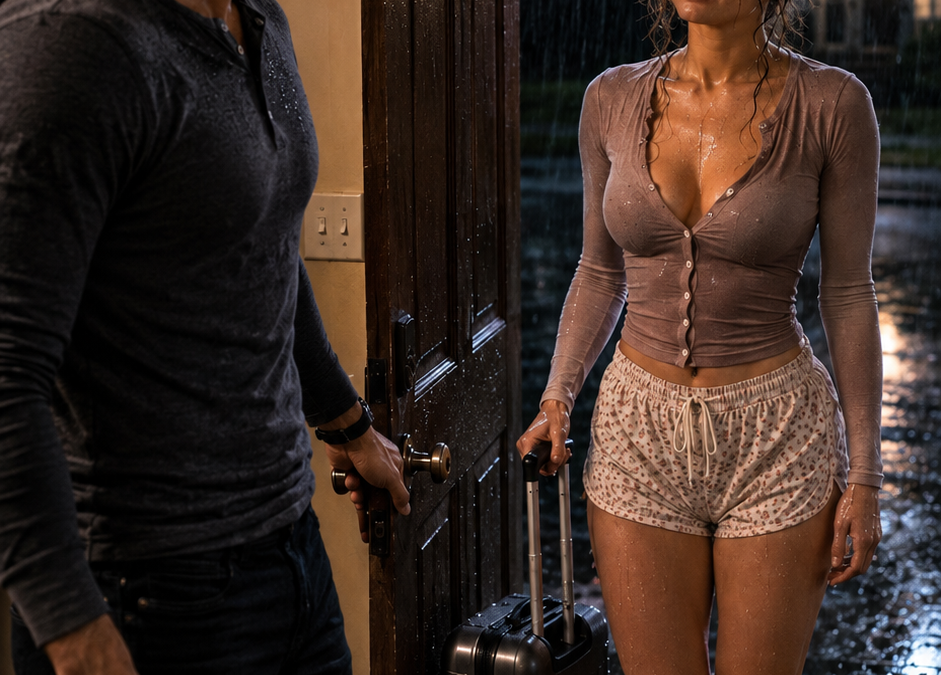
At 10:10 on a rainy Tuesday night, my ex-wife’s best friend appeared on my porch in her pajamas, carrying a suitcase and a secret.
She looked me in the eyes and whispered, “I had nowhere else to go.”
I believed her. But months later, I would discover that the real reason she chose my door had begun seven years before that night—and that my marriage had never been the story I thought it was.
PART 1 — THE WOMAN WHO CAME OUT OF THE RAIN
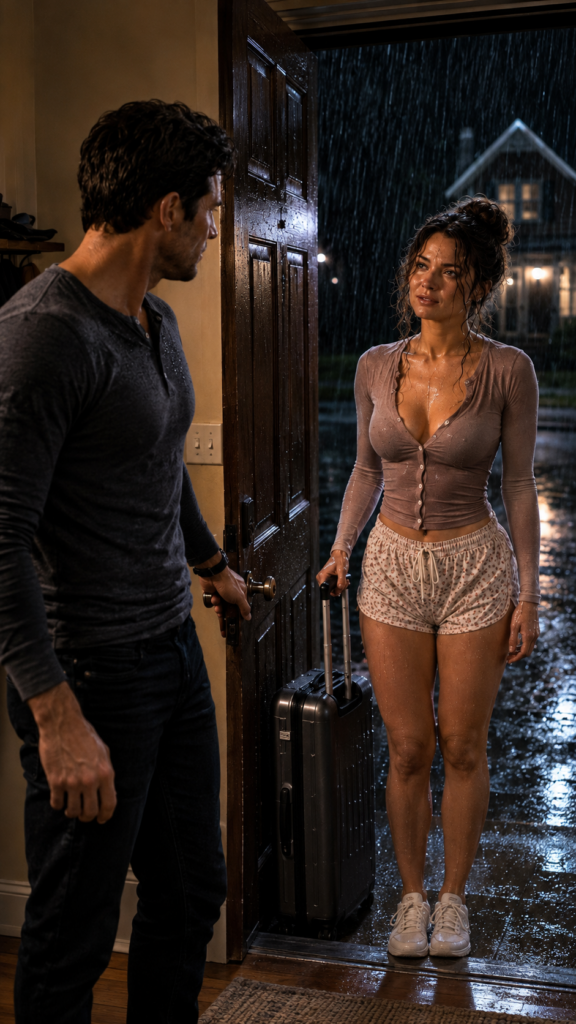
The first thing I noticed was that Mara wasn’t wearing shoes.
She stood beneath the porch light with rain dripping from her hair, a small black suitcase beside her bare feet, and a white cardigan soaked so thoroughly that I could see the outline of the thin cotton shirt underneath. Her pink floral sleep shorts looked absurdly out of place against the cold October night.
But it was her face that made me forget to ask why she was there.
Mara Whitmore had always been a quiet woman. I had known her for almost seven years, and I could count on one hand the occasions when she had raised her voice. Now her lips were trembling, her eyes were red, and she was standing at my front door as though she had spent the last hour trying to convince herself to knock.
“Daniel,” she said.
I waited.
“I had nowhere else to go.”
For a moment, all I could hear was the rain striking the cedar shingles above us.
Then I stepped aside.
“Come inside.”
She looked past me into the hallway, almost suspicious of the invitation.
“Are you sure?”
“You’re freezing, Mara.”
That was all it took.
She picked up her suitcase and crossed the threshold.
I closed the door behind her, shutting out the rain, and watched my ex-wife’s best friend stand in the middle of a house that had not heard a woman’s footsteps in fourteen months.
My name is Daniel Hayes. I was thirty-six years old that October, a restoration architect living in Asheville, North Carolina.
I had spent most of my adult life learning how to save old buildings.
I understood cracked foundations, rotting beams, and walls that looked perfectly sound until someone removed the plaster.
What I had never understood was how to save a marriage.
Vanessa and I had been together for six years before our lives finally came apart. She was beautiful, ambitious, and capable of making a room feel brighter simply by entering it. When we first met, she worked at an art gallery downtown and talked endlessly about the life we would build.
I believed every word.
I bought an old cedar-sided house on Linden Road, restored the staircase with my own hands, and spent entire weekends bringing its original oak floors back to life. I thought I was building a home for the family we would eventually have.
Vanessa thought I was wasting time on a house that would never make us wealthy.
The differences between us began as ordinary arguments. Then they became long silences. By the end, we had stopped discussing the future because our versions of it no longer had anything in common.
I wanted children.
Vanessa didn’t.
There was nothing wrong with her knowing she didn’t want to become a mother. What broke something inside me was that she had spent years telling me we would talk about it later, even after she knew her answer would never change.
Four times I asked whether we should begin trying for a baby.
Four times she found a different reason to postpone the conversation.
Eventually, she stopped pretending.
And when we separated, she told our friends that I had been trying to trap her in a life she never wanted.
I never corrected her publicly.
I was too tired to keep fighting for a version of our marriage that neither of us could recognize anymore.
Fourteen months after the divorce, I was still living alone in the house we had bought together. My work kept me busy, the rooms stayed clean, and I told everyone I was doing fine.
Most evenings, I ate dinner standing at the kitchen counter.
Sometimes I didn’t turn on the lights until it was almost dark.
I hadn’t realized how completely I had disappeared into that routine until Mara arrived.
“Bathroom’s down the hall,” I told her. “I’ll find you something dry.”
She nodded without looking up.
I brought her a clean towel, an old gray flannel shirt, and a pair of sweatpants. I left everything outside the bathroom and went into the kitchen to make ginger tea.
When she emerged, her hair hung damp around her shoulders. The flannel swallowed her small frame, and she had rolled the sleeves almost to her elbows.
She stopped when she saw the two mugs on the table.
“You didn’t have to make anything.”
“I know.”
She sat down carefully, as if she expected me to tell her that she’d made a mistake by coming.
For several minutes, neither of us spoke.
Then I asked what had happened.
Mara stared at her tea.
“Vanessa came home with Brent tonight.”
I knew the name.
Brent Lawson was a real estate investor Vanessa had begun seeing after our separation—or at least that was when she’d told me about him.
“They’d been drinking,” Mara continued. “She was angry about something at the gallery. I don’t even know what started it.”
She pressed both hands around the mug.
“She started talking about you.”
I felt my stomach tighten.
“What did she say?”
Mara hesitated.
“Does it matter?”
“Apparently it mattered enough for you to come here in the rain.”
She swallowed.
“She called you a second-rate architect living in a rotting house. Then she said you couldn’t even give her one decent child.”
The kitchen seemed to become very still.
I looked at the pale ring left by my coffee cup on the table.
For years, Vanessa had been the one refusing to have children. She knew how much I wanted to become a father. She knew exactly how deeply those words would cut.
And she had said them anyway, in front of people who had no business hearing about the most painful part of our marriage.
“What did you do?” I asked.
“I told her to stop.”
“And?”
“She laughed.”
Mara’s voice grew thinner.
“She said I was defending you because I never understood what it was like being married to a man who wanted a family more than he wanted his wife.”
I closed my eyes briefly.
Then Mara said something that made me look up.
“I told her she’d refused you four times. That she had no right to turn your disappointment into something shameful.”
“How did you know about the four times?”
“She told me. After every conversation, she called me to complain about how much pressure she thought you were putting on her.”
I had never known that.
Mara lowered her gaze.
“She told me to stop acting like your little advocate. I told her I was finished listening to her humiliate people who weren’t in the room.”
“And then?”
“She told me to get out.”
The words were almost inaudible.
Mara had been living in Vanessa’s apartment for four months. Her freelance illustration work had slowed, and giving up her studio lease had seemed sensible at the time.
Vanessa had offered her the spare bedroom.
Apparently, the offer had come with conditions Mara hadn’t fully understood until that evening.
“Why didn’t you change clothes?” I asked.
She gave a tired, embarrassed smile.
“Because I knew if I went back into my bedroom and started thinking, I’d convince myself to apologize.”
She glanced toward the window.
“And I was tired of apologizing for things I didn’t do.”
I let that settle between us.
Then I asked the question that had been waiting since I opened the door.
“Why here?”
She looked directly at me.
“At your housewarming party, four years ago, the caterer dropped an entire tray of glasses.”
I remembered.
“His name was Thomas,” I said.
Mara nodded.
“Everyone was staring at him. Vanessa was furious because she thought he’d ruined the evening. You got a broom, helped him clean up, and told him you’d broken more expensive things restoring the house.”
“He was embarrassed.”
“You remembered his name when he left.”
I shrugged.
“That doesn’t seem particularly extraordinary.”
“It wasn’t extraordinary to you.”
Something changed in her expression.
“That’s why I came, Daniel. I thought if I was standing outside someone’s door at ten o’clock at night, you might be the one person who wouldn’t make me feel ashamed of needing help.”
I had no answer to that.
Finally, I stood.
“The couch pulls out. There are extra blankets in the hall closet.”
“Just until morning,” she said quickly. “I can leave when the buses start running.”
“We’ll figure it out tomorrow.”
“Daniel?”
I turned.
“I’m sorry.”
“For what?”
She stared at the table.
“For sitting in rooms where people said terrible things about you, and telling myself it wasn’t my place to speak.”
I remembered Mara at dinner parties, at Vanessa’s birthday celebrations, at our wedding.
Always quiet.
Always somewhere near the edge of the group.
“You spoke tonight,” I said.
She shook her head.
“Maybe seven years too late.”
I didn’t understand what she meant.
Not then.
The next morning, I woke to the smell of coffee.
It was five thirty. The rain had stopped, leaving the windows fogged and the trees dripping over the driveway.
The living room was empty.
Mara had folded the blanket into a neat square and placed it on the sofa. On the kitchen table, beside the coffee pot, she had left a handwritten note.
Thank you for last night. I’ll be gone before noon. You don’t owe me anything.
I stood looking at those words longer than necessary.
Then I turned the paper over and wrote beneath them.
Stay through the weekend. I’m leaving for Charleston on Monday and could use someone to bring in the mail.
It wasn’t entirely a lie.
I did have a chapel restoration consultation in Charleston.
But I also knew that the mail could survive three days without me.
When Mara came downstairs and read the note, she glanced at me.
“You don’t have to invent reasons.”
“Then don’t invent reasons you have to leave.”
She laughed.
It was the first time I had heard her laugh in years without someone else talking over her.
“All right,” she said. “But I’m buying groceries.”
“Agreed.”
That afternoon, I drove her downtown to collect her belongings.
Vanessa was working at the gallery, so Mara went upstairs alone while I waited in the truck.
Twenty-three minutes later, she emerged carrying two suitcases, a cardboard box, and a long portfolio tube.
I got out to help.
“Is that everything?”
She looked up at the apartment building.
“Everything I want.”
There was a difference in the way she said it.
For the first time since she arrived, she sounded like someone making a decision rather than surviving one.
The days that followed were strangely ordinary.
I worked on the restoration plans for St. Bartholomew’s Chapel. Mara spread her watercolor supplies across the far end of the kitchen table.
She wasn’t a dramatic houseguest.
She didn’t turn every conversation into a confession, and she didn’t ask questions about my marriage just to fill the silence.
She simply existed in the house without demanding that it revolve around her.
Sometimes I returned from a meeting to find a pot of sweet potato soup warming on the stove. Sometimes she left a pencil sketch beside my blueprints, pointing out architectural details I had stopped noticing after years of studying buildings professionally.
Once, I found a drawing of St. Bartholomew’s south window.
Underneath, she had written:
I don’t know what beautiful means to a restoration architect, but I think this is beautiful.
I put the drawing in my desk.
I didn’t tell her that I had kept it.
One evening, she noticed a closed door upstairs.
“What’s in that room?”
I looked toward the staircase.
“Nothing anymore.”
She waited.
“It was supposed to be a nursery.”
Her expression softened, but she didn’t offer the usual sympathy.
“Does it still have furniture?”
“There’s a crib. I built it.”
“You built a crib before you had a baby?”
“Apparently, I’m very good at preparing for things that never happen.”
I tried to smile.
Mara didn’t.
“Maybe one day you’ll find something else that room can become.”
I turned away.
For fourteen months, I had refused to open that door.
And now a woman who had been in my house barely two weeks was asking me to imagine that the room might belong to my future instead of my past.
I wasn’t sure whether to thank her or ask her to stop.
Instead, I said, “Dinner’s getting cold.”
She understood.
She always seemed to know when silence was the only thing I could offer.
On the third Saturday after Mara arrived, I heard a car pull into my driveway.
Fast.
The crunch of gravel was followed by a door slamming hard enough to make me look up from my drawings.
A black Mercedes stood outside.
Vanessa stepped out wearing a cream-colored coat and oversized sunglasses, although the sky was gray.
Brent remained beside the car, smoking and staring at his phone.
I had barely reached the hallway when the front door opened.
“Where is she?”
Vanessa stood inside my house.
She looked around with an expression somewhere between disgust and disbelief.
“Where’s Mara?”
“You’re not supposed to come in without asking.”
“Oh, don’t start.”
She removed her sunglasses.
“Mrs. Patterson called me. Apparently, my best friend has been living in my ex-husband’s house.”
“She came here because she needed somewhere safe to stay.”
Vanessa laughed.
“Of course she did.”
Behind me, the back door opened.
Mara entered carrying a shallow basket of maple leaves she’d gathered from the yard. There was green watercolor on the side of her hand.
She stopped when she saw Vanessa.
For a moment, nobody moved.
Then Vanessa smiled.
Not kindly.
“Well, that didn’t take long.”
Mara set the basket on the table.
“Vanessa.”
“Don’t Vanessa me. Three weeks? That’s how long it took you to move into my old house?”
“Your name isn’t on this house anymore,” I said.
She ignored me.
“How long have you wanted him, Mara?”
The question landed harder than I expected.
Mara didn’t answer.
Vanessa stepped closer.
“Was it at our wedding? The housewarming? All those dinners where you sat there being quiet and helpful?”
“That’s enough,” I said.
“No, Daniel. You deserve to know who you’re letting sleep under your roof.”
Mara’s face had gone pale.
I saw it.
And Vanessa saw that I saw it.
For the first time, there was genuine satisfaction in her expression.
“Look at her,” she said. “She can’t even deny it.”
Mara placed both palms flat against the dining table.
Then she lifted her eyes.
“You’re right about one thing, Vanessa.”
The room went still.
“I should have stopped pretending a long time ago.”
Vanessa blinked.
Mara continued.
“For eleven years, I listened when you criticized people. I made excuses when you hurt them. I helped you repair friendships you never thought you needed to apologize for destroying.”
Her voice didn’t rise.
That made the words more difficult to interrupt.
“I watched you treat Daniel like an inconvenience because the things he wanted weren’t the things you wanted. And when he finally left, I watched you tell everyone he’d failed you.”
Vanessa’s face tightened.
“You have no idea what our marriage was like.”
“You’re right. I wasn’t inside your marriage.”
Mara’s fingers curled against the table.
“But I was there every time you came home and told me how easily you could make him feel small.”
Something moved across Vanessa’s face.
Not guilt, exactly.
Recognition.
Mara took a breath.
“The worst part is that I let you do it. I told myself being loyal meant keeping your secrets. I was wrong.”
Brent appeared in the doorway.
“Vanessa. Come on.”
“Stay out of this.”
“I’m serious. Let’s go.”
She turned on him.
Then, perhaps realizing that she was losing the only audience she’d come to impress, she looked back at me.
“You think you’ve won something, Daniel? You couldn’t make me happy, so now you’ve found someone grateful enough to settle for your leftovers.”
That was when I stepped between them.
“Get out.”
Vanessa stared.
I had never spoken to her that way during our marriage.
Not once.
“Excuse me?”
“I said get out of my house.”
She looked past my shoulder at Mara.
“You two deserve each other.”
Then she turned and walked toward the door.
At the threshold, she stopped.
“Just remember something, Daniel. People don’t always come into your life for the reasons they give you.”
The front door slammed.
Brent followed her without another word.
A few seconds later, the Mercedes disappeared down Linden Road.
I stood listening until the sound of the engine faded.
Behind me, Mara hadn’t moved.
Her basket of leaves was still on the table.
A single red maple leaf lay on the floor near Vanessa’s heel marks.
I bent to pick it up.
“Well,” I said, forcing a breath, “that could have gone better.”
Mara didn’t smile.
“Daniel.”
I turned.
She was looking at me with an expression I couldn’t read.
“There’s something I need to tell you.”
My chest tightened.
“What?”
She swallowed.
“Vanessa said a lot of cruel things.”
“I know.”
“Most of them weren’t true.”
I waited.
Mara looked down at the flannel shirt she was wearing, the same one I’d given her that first night.
Then she raised her eyes.
“But when she asked how long I’ve wanted you…”
Her voice broke.
I didn’t move.
And the next words changed everything I thought I understood about the woman standing in my kitchen.
“I couldn’t call her a liar, Daniel.”
PART 2 — THE TRUTH SHE WAS AFRAID TO SAY
There are sentences that change your life because they reveal something unexpected.
And there are sentences that change your life because they make you question everything that came before them.
Mara’s confession did both.
For several seconds, I could only stare at her.
I thought about our wedding, the birthday parties, the dinners at which she had sat quietly across from me. I remembered her carrying plates into the kitchen while Vanessa entertained guests, her laughter coming softly from the other end of the table.
I had never considered that Mara might have feelings for me.
I had barely considered that Mara had a life outside the small portion of it I had witnessed.
“How long?” I finally asked.
She closed her eyes.
“Please don’t ask me that yet.”
“That’s not a very reassuring answer.”
“I know.”
She looked at me again.
“But I need you to understand something. I never tried to come between you and Vanessa.”
“She was your best friend.”
“She was.”
“And I was her husband.”
“I know that, too.”
Her voice sharpened for the first time.
“Do you think I don’t know how that sounds?”
I ran a hand through my hair.
I was angry, although I couldn’t have explained exactly why. Mara hadn’t betrayed any promise she’d made to me. She hadn’t pursued me during my marriage, and until that morning she had given me no reason to believe she expected anything romantic.
But I had spent years discovering that the people closest to me hadn’t always said what they meant.
I didn’t know whether I could survive another relationship built around things left unsaid.
“Did you come here because you needed somewhere to stay,” I asked, “or because you thought something might happen between us?”
She looked wounded.
Then she nodded slowly.
“That’s a fair question.”
I waited.
“I came because I knew you’d be kind to me. I trusted you when I didn’t trust anyone else that night.”
“That isn’t quite an answer.”
“No,” she admitted. “It isn’t.”
A long silence followed.
Finally, Mara said, “I don’t want you to do anything with what I’ve told you. I don’t want you to feel responsible for me. I don’t want you to think you owe me something because I’ve carried feelings I never asked you to return.”
“Then why tell me?”
“Because Vanessa used my silence against you. And I couldn’t stand here and let you believe she invented everything.”
I looked toward the front door.
For six years, I had mistaken avoiding conflict for keeping peace.
Now I was standing opposite someone who had told me an uncomfortable truth without trying to control what I would do with it.
That mattered.
It didn’t make the situation simple.
“I can’t promise you anything,” I said.
“I haven’t asked you to.”
“And I don’t want you staying here because you believe there’s some future I’m going to give you.”
“I don’t want you to give me a future.”
Her eyes were wet.
“I want to be able to build one myself.”
That evening, we ate dinner in the kitchen as usual.
The difference was that we were both aware of every silence.
I noticed when she reached across the table for the salt. I noticed when she tucked her hair behind her ear, and when she looked away because she’d realized I was watching.
For three weeks, living together had felt uncomplicated.
One confession had made even the simplest movements seem deliberate.
I hated that.
Mara deserved a place where she could exist without being examined.
So did I.
After dinner, I stood beside the sink and said, “You can stay until you find a studio. There’s no deadline.”
She looked at me carefully.
“Are you saying that because you want me here, or because you feel sorry for me?”
The question caught me off guard.
“I’m saying it because I don’t think you should have to start over from a motel room.”
“Daniel.”
I turned.
“Those aren’t the only two possibilities.”
“What do you mean?”
“You can want someone to stay without knowing what they’ll become to you.”
I couldn’t answer.
She gave me a small smile.
“That’s all I’m asking you to consider.”
Two days later, I finally opened the upstairs room.
I did it while Mara was out interviewing a potential studio partner.
The door had swollen slightly in its frame from months without use. I had to push harder than expected, and when it opened, the smell of cedar and old dust rose around me.
The crib stood against the far wall.
I had built it during the third year Vanessa and I were together, when she still spoke about children as something that might happen someday.
The rails were smooth, the corners rounded, the joints fitted carefully without visible screws.
I’d spent five weekends making it.
Vanessa had looked at it once.
Then she’d asked whether I could sell it to a client instead of leaving it upstairs.
I had never told anyone how much that hurt.
Now, standing in the afternoon light, I realized that I had kept the crib for a reason that had very little to do with future children.
It was evidence.
As long as it remained there, I could tell myself that I hadn’t imagined the life I’d wanted.
I ran my hand along one wooden rail.
Then I went downstairs and called Father Henry at the chapel.
His parish worked with a local nonprofit supporting foster families, and I knew they sometimes helped furnish homes for newly placed children.
“Do you know anyone who needs a crib?” I asked.
He was quiet for a moment.
“Daniel, are you sure?”
I looked toward the staircase.
“Yes.”
“Then I know a family who would appreciate it.”
That weekend, I carried the crib downstairs in pieces, wrapped the rails in blankets, and loaded everything into my truck.
Mara came outside when she heard me closing the tailgate.
She stopped beside the driveway.
“You’re giving it away?”
I nodded.
“There’s a family waiting for a placement. They could use it.”
She looked at the truck, then back at me.
“How do you feel?”
I almost gave her the automatic answer.
Fine.
Instead, I admitted, “Like I’m dismantling a promise.”
She stepped closer.
“Was it a promise Vanessa made?”
“Partly.”
“Then maybe it was never yours to keep alone.”
I looked away.
For years, I’d carried the disappointment of two people as though it belonged entirely to me.
Hearing Mara separate those burdens made my throat tighten.
She didn’t touch me.
She simply stood beside me while I found the strength to close the garage door.
The following week, Mrs. Patterson came over with a loaf of banana bread.
She was seventy-one, sharp-eyed, and possessed an extraordinary ability to discover neighborhood news before it reached the people involved.
She stood on my porch looking genuinely uncomfortable.
“Daniel, I owe you an apology.”
I took the bread.
“For what?”
“For calling Vanessa.”
I said nothing.
She shifted her weight.
“I saw a young woman coming and going. I knew she was Vanessa’s friend. I thought someone should know.”
“Someone?”
She sighed.
“I suppose I thought I was helping.”
“Well, you weren’t.”
Her face reddened.
“Yes. I realize that now.”
I waited.
She looked past me into the hallway.
“Vanessa’s been telling people you and Mara were involved before the divorce.”
The words struck me with surprising force.
“That’s not true.”
“I believe you.”
“Then why are you telling me?”
“Because I thought you should know before the story reaches people you work with.”
I looked down at the loaf in my hands.
The banana bread was still warm.
Something about that made the moment feel especially cruel.
Vanessa had spent years accusing me of loving an imaginary future more than I loved her. Now she was inventing a past that had never happened.
And Mara, who had already sacrificed enough silence to that friendship, was about to pay for it again.
Mrs. Patterson touched my arm.
“I’m sorry, Daniel.”
I nodded.
Then I closed the door.
Mara stood at the foot of the stairs.
She had heard everything.
For a moment, I expected her to look frightened.
Instead, she looked furious.
“She’s not going to stop, is she?”
“I don’t know.”
Mara slowly folded her arms.
“Then maybe it’s time I stopped being the person she expects me to be.”
I watched her walk toward the kitchen.
For the first time, I understood that the quiet woman I had invited into my house was not simply trying to escape Vanessa.
She was preparing to become someone Vanessa could no longer control.
PART 3 — THE WOMAN WHO REFUSED TO BE RESCUED
The first consequence arrived the following Thursday.
Mara received an email from the Riverside Arts Collective informing her that the small exhibition she’d been scheduled to join in December was being postponed.
She read the message twice before showing it to me.
There were no accusations.
No direct reference to Vanessa.
Just a carefully worded explanation about changing priorities, limited wall space, and the need to avoid distractions during the holiday season.
I had worked with enough nonprofit boards to recognize the language.
“They’re trying to avoid a disagreement,” I said.
Mara nodded.
“Vanessa still knows two of their sponsors.”
“Then we should call them.”
“No.”
I looked up.
“Mara, this is your work.”
“I know.”
“She’s interfering with your career.”
“I know that, too.”
“Then why won’t you let me help?”
She folded the email and put it back inside her notebook.
“Because if you call them, they’ll decide I’m exactly what Vanessa says I am.”
“Which is?”
“A woman who found a man to solve her problems.”
I opened my mouth, then stopped.
Mara’s expression changed.
“I’m not accusing you of wanting that,” she said quietly. “But I’ve spent years letting Vanessa introduce me to people, recommend my work, and decide which rooms I belonged in.”
She looked around the kitchen.
“I don’t want to replace her influence with yours.”
It stung.
Then I realized it was supposed to.
Not because she wanted to hurt me, but because she wanted me to understand.
I’d spent years thinking love meant giving people everything I could provide.
Vanessa had interpreted every gift as an obligation or a weakness.
Mara was telling me that sometimes helping meant standing still while someone learned what they could do without you.
“All right,” I said.
She smiled faintly.
“All right?”
“I won’t call them.”
“Thank you.”
“But I reserve the right to be privately furious.”
That made her laugh.
“You’re very good at that.”
The next morning, Mara went to the exhibition coordinator herself.
Her name was Naomi Reed, a former school art teacher who had helped establish the Riverside Arts Collective.
Mara returned three hours later with a paper bag containing two pastries.
She put one in front of me.
“Well?” I asked.
“Naomi said the sponsors had concerns.”
“About your illustrations?”
“About the situation.”
I set down my pen.
“What situation?”
“Apparently, there are people who think I broke up a marriage.”
I felt heat rise behind my eyes.
Mara held up a hand.
“I told her the truth. Your divorce was finalized fourteen months before I moved into this house. I had never been romantically involved with you, and nobody had evidence suggesting otherwise.”
“And?”
“She believed me.”
“Good.”
“But she said the December exhibition was already being rearranged.”
I pushed back my chair.
“That’s ridiculous.”
“Yes.”
“Then what did you do?”
Mara took a bite of pastry.
“I asked whether she’d consider my work for the spring exhibition instead.”
I stared at her.
She shrugged.
“I wasn’t going to walk all the way downtown just to lose my temper.”
For a moment, I couldn’t help smiling.
“What did she say?”
“She said she’d review the portfolio herself.”
“And?”
“She asked why I’d been hiding my best work.”
I leaned forward.
Mara’s smile widened.
“I told her I’d spent too much time believing the person who kept telling me it wasn’t good enough.”
She looked almost surprised by her own words.
Then she added, “Naomi wants to see twenty finished pieces by January.”
I raised my coffee mug.
“To January.”
She touched hers against it.
“To January.”
That small sound of ceramic against ceramic felt more satisfying than any angry telephone call I could have made.
Over the following weeks, I watched Mara work harder than I had ever seen her work before.
She spent mornings drawing in the study and afternoons researching children’s book publishers, contacting agents, and submitting proposals.
She was neither effortlessly talented nor magically successful.
Some days she worked for six hours and hated everything she’d produced.
Once, I found three sheets of watercolor paper torn in half beside the trash can.
“Bad day?” I asked.
She looked up.
“Apparently, I can draw a convincing fox, but I can’t make one look lonely without making it look sick.”
I studied the illustration.
“Maybe it doesn’t need to look lonely.”
She stared at me.
“What?”
“Maybe the forest needs to look empty.”
She took the drawing from my hand.
For a long moment, she said nothing.
Then she went back to her desk.
An hour later, she brought me a new version.
The fox was sitting beneath a huge tree, surrounded by an enormous stretch of untouched white paper.
I looked at it.
My throat tightened unexpectedly.
“That’s it,” I said.
Mara’s eyes shone.
“You really think so?”
“Yes.”
She sat on the edge of the table, smiling at the illustration as though it were a person who had finally said what she’d been trying to hear.
I understood then why she kept working despite the rejection letters.
She wasn’t making pictures.
She was trying to put experiences into shapes that other people could recognize.
One Sunday afternoon, I returned home and found a list of studio rentals on the kitchen counter.
Mara was sitting beside them with a calculator.
“What’s this?”
“I’m looking for a place.”
I felt an immediate, unreasonable heaviness.
“Did something happen?”
“No.”
“Then why the sudden decision?”
She set down the calculator.
“Because I can finally afford to look.”
I glanced at the figures.
“Some of these are expensive.”
“The one in Riverside isn’t. It’s a shared studio with a printmaker. She has extra floor space and good northern light.”
“Is it safe?”
Mara raised an eyebrow.
“Daniel.”
“That was a reasonable question.”
“Yes, Dad.”
I laughed despite myself.
She smiled.
Then her expression became serious.
“I need this.”
“I know.”
“No, I mean I need to know I can leave this house without losing the good thing that’s happened here.”
I pulled out the chair opposite her.
“You’re not losing anything.”
“That’s easy to say when I’m still living under your roof.”
I wanted to argue.
Instead, I looked down at the calculator.
“When’s the appointment?”
“Tomorrow.”
“I can drive you.”
“You can drive me.”
She paused.
“But you can’t come inside and negotiate.”
“Agreed.”
“And you can’t offer to pay the difference if I can’t afford it.”
“Agreed.”
“And don’t ask the landlord for a discount.”
I pretended to think about it.
“That’s a very restrictive arrangement.”
“Daniel.”
“Agreed.”
The next afternoon, I sat in a coffee shop across from an old brick building in the Riverside Arts District.
For forty minutes, I watched Mara speak with the studio owner through the second-floor windows.
I couldn’t hear a word.
I saw her unfold a floor plan, measure a wall, and point toward the windows.
The printmaker nodded.
Then they shook hands.
Mara emerged carrying a folder.
She crossed the street, walked into the coffee shop, and sat across from me.
“Well?” I asked.
“I’m taking it.”
I felt genuine happiness.
And something else.
Something that frightened me more.
“Congratulations.”
“Thank you.”
“When do you move?”
“Next month.”
The words settled in my chest.
Next month.
For weeks, I’d become accustomed to the sound of someone moving around the kitchen while I worked. I’d begun looking forward to dinners I no longer had to eat alone.
Now I was realizing how easily a person could become part of your life without ever promising to remain there.
Mara watched me.
“You’re quiet.”
“Just thinking.”
“About what?”
I looked through the window at the small brick building where she would soon spend her days.
“How different this is from the night you knocked on my door.”
She nodded.
“That night, I didn’t know where I was going.”
“And now?”
She smiled.
“Now I do.”
Then she leaned forward.
“Daniel, there’s something I want you to understand.”
I met her eyes.
“I’m not moving out because I don’t want to be here.”
I said nothing.
“I’m moving out because I need to know that when I come back, it’s because I chose to.”
My hand tightened around the coffee cup.
“That’s the only reason I’d ever want you to come back.”
She held my gaze.
For a moment, something warm and dangerous passed between us.
Then she looked away.
We talked about rent, moving boxes, and the best place to buy a secondhand drafting table.
Ordinary things.
Safe things.
But by the time I drove her home, I understood what I had been too afraid to admit.
Mara was finally learning how to leave. And I was beginning to hope she’d choose to return.
PART 4 — THE ROOM THAT HAD BEEN WAITING
The house felt enormous after Mara moved out.
I had lived there alone for fourteen months before she arrived, yet somehow those first three weeks with her had changed the proportions of every room.
The kitchen seemed longer.
The staircase seemed quieter.
Even the sound of the refrigerator turning on at night reminded me that there was nobody else downstairs.
Mara rented a small studio apartment within walking distance of her workspace. It had uneven floors, a narrow bathroom, and a kitchen window overlooking Beaver Creek.
She loved it.
The first time she invited me over, there were still boxes stacked against the walls.
She opened the door wearing paint-stained overalls and socks that didn’t match.
“Welcome to my very expensive independence.”
I stepped inside.
The apartment smelled of fresh coffee, paper, and turpentine.
“Looks good.”
“It looks terrible.”
“It looks like somewhere an artist lives.”
She leaned against the doorframe.
“That’s exactly what I was hoping you’d say.”
I helped assemble a bookshelf.
Then I carried the empty boxes to the recycling room.
When I offered to repair a loose cabinet hinge, she handed me a screwdriver but insisted on watching so she could learn how to fix it herself.
That made me smile.
Vanessa used to call me whenever something broke, then complain that I spent too much time fixing things.
Mara wanted to know how the repair worked.
It was a small difference.
But small differences had begun to matter to me.
We developed a routine without discussing it.
Saturdays were ours.
Sometimes Mara came to my house around nine with fresh pastries from the bakery near her studio. Sometimes I walked across the wooden footbridge and found her painting beside the window.
We cooked.
We talked.
We argued about music and whether old houses should be restored exactly as they were or allowed to reflect the lives of the people who inhabited them.
Mara believed every building deserved evidence of the years it had survived.
I believed certain mistakes should be corrected.
One afternoon, while we were discussing a damaged stained-glass panel, she looked at me and said, “You know, you’re allowed to leave some things different from how they were.”
I glanced at her.
“Are we still talking about windows?”
She smiled.
“Mostly.”
I looked back at the drawing.
For the first time, I wondered whether trying to become the man I’d been before my divorce was another way of refusing to move forward.
In January, Mara submitted twenty illustrations to Naomi Reed.
Naomi accepted eleven for the spring exhibition.
Mara called me from the gallery.
I could hear traffic behind her and the tremor in her breathing.
“Daniel?”
“Everything okay?”
“They want my work.”
I sat upright.
“How much of it?”
“Eleven pieces.”
“Eleven?”
She laughed.
“I know.”
I stood from my desk without realizing it.
“That’s incredible.”
“I haven’t sold anything yet.”
“That’s not what you said.”
“What?”
“You said they want your work.”
She went quiet.
Then she whispered, “They do.”
I heard someone calling her name in the background.
She promised to call later.
After I hung up, I stood beside the desk with my phone still in my hand.
I realized I was smiling.
Not because Mara had done something for me.
Because something good had happened to her, and I was the person she’d wanted to tell.
That feeling was new.
Or perhaps it wasn’t new.
Perhaps I’d simply forgotten what it felt like to be happy about another person’s happiness without immediately wondering what it would cost.
February brought news about Vanessa.
Brent had left her.
A mutual acquaintance mentioned it during a meeting about a downtown property renovation. Apparently, Vanessa had moved to Atlanta to stay with her mother while she looked for another gallery position.
I listened without asking questions.
The man across from me seemed disappointed.
“Aren’t you curious what happened?”
“Not particularly.”
“She had a rough couple of months.”
“I’m sorry to hear that.”
He waited for more.
I had nothing to offer.
Walking back to my truck afterward, I realized that I no longer measured my life by whether Vanessa was happy, angry, successful, or suffering.
For years, her moods had determined the atmosphere of my entire house.
Now her name sounded like something that belonged to a different address.
I didn’t mention the news to Mara.
She already knew.
I learned that on the following Saturday.
“Vanessa called me,” she said while we were preparing lunch.
I stopped cutting vegetables.
“When?”
“Thursday.”
“What did she want?”
“She asked if we could start over.”
I looked at her.
“And?”
Mara laid down the knife.
“She said she’d had a terrible year. That she’d lost Brent, her apartment, and most of the friends she trusted.”
“That’s a lot.”
“It is.”
Mara was quiet.
“She said she missed me.”
I studied her face.
“Do you miss her?”
She took a long breath.
“Sometimes.”
The answer surprised me.
“After everything?”
“Eleven years is a long time to know somebody.”
She leaned against the counter.
“When I was twenty-two, my mother had surgery. I was living in a terrible apartment and barely making rent. Vanessa brought groceries every week for a month. She helped me get my first paid illustration assignment.”
I had never heard that part of their history.
“She wasn’t always cruel,” Mara continued. “That’s what makes it difficult. If she’d always been terrible, leaving would have been easy.”
I put down my knife.
“What did you tell her?”
“That I hoped she found her feet again.”
“And?”
“That I couldn’t be her best friend anymore.”
“How did she take it?”
“She cried.”
Mara looked toward the window.
“So did I.”
For a moment, I saw the cost of what she’d done.
Mara hadn’t simply walked away from an unpleasant roommate.
She had ended a friendship that had helped shape her adult life, one that contained genuine kindness alongside years of resentment and unequal loyalty.
And now she had to grieve both versions of Vanessa.
I stepped closer.
“Are you okay?”
She nodded.
“Not entirely.”
I reached for her hand, then stopped.
Mara noticed.
She gently touched my wrist.
“It’s all right,” she said.
Her fingers stayed there for only a moment.
Then she returned to chopping vegetables.
But the rest of that afternoon, I could still feel the warmth of her hand.
In March, I invited Mara to visit St. Bartholomew’s Chapel.
The restoration had reached an important stage. We’d finished stabilizing the south wall, and the main hall was finally safe enough for community gatherings.
Father Henry stood near the entrance when we arrived.
“So this is the artist I’ve been hearing about.”
Mara looked embarrassed.
“Daniel talks too much.”
“Only when he’s proud of someone.”
I shot him a look.
He smiled and walked away.
Mara explored the chapel slowly, pausing beneath the tall windows and tracing the restored wooden pews with her fingertips.
When we reached the south wall, she stopped.
“It’s more beautiful in person.”
“Better than the blueprints?”
“Much better.”
She turned toward me.
“You must be proud.”
I looked around at the exposed beams and carefully repaired plaster.
“I am.”
Then a small boy ran past us.
His father followed, apologizing.
The boy stopped beside a low wooden bench and pointed to the carved flowers along its edge.
“Did you make those?”
I knelt beside him.
“Some of them.”
He touched a petal.
“How?”
“Very slowly.”
The boy laughed.
His father called him over, and they disappeared into the next room.
When I stood, Mara was watching me.
“What?” I asked.
“Nothing.”
“You’re smiling.”
“I know.”
We walked outside into the cold afternoon.
For a long time, neither of us spoke.
Finally, Mara said, “You would have been a good father.”
The words caught me unprepared.
I stared toward the parking lot.
“I thought so once.”
“You still might be.”
I turned.
She looked frightened by what she’d said.
“I didn’t mean—”
“I know.”
“No, I wasn’t suggesting—”
“Mara.”
She stopped.
I looked at her carefully.
“You don’t have to protect me from every mention of something I wanted.”
Her eyes filled.
“And you don’t have to promise me something you don’t know if you want.”
She nodded.
Then she whispered, “Thank you.”
I had spent years believing that the only woman I could love was one who shared every dream I’d already made.
Standing beside Mara, I realized I was capable of wanting a future I hadn’t drawn yet.
And that frightened me more than the old one I’d lost.
At the end of April, Mara showed me the manuscript for a children’s book about a carpenter who built doors for abandoned houses.
The carpenter had dark hair, tired eyes, and a habit of repairing things nobody else considered worth saving.
I read the manuscript twice.
Then I looked up.
“Is this supposed to be subtle?”
She grinned.
“He’s much better looking than you.”
“He also wears a gray flannel shirt.”
“Lots of people wear flannel.”
“And he restores old buildings.”
“Very common profession.”
“And he lives alone until someone knocks on his door.”
Mara’s smile faded.
I closed the manuscript.
“Does the carpenter fall in love with the person who knocks?”
She looked at her hands.
“I haven’t written the ending.”
“Why not?”
“Because I don’t know how it ends yet.”
Something shifted between us.
I wanted to cross the room.
I wanted to tell her that I had begun looking forward to Saturdays more than any other day of the week.
That sometimes, when I heard footsteps on the porch, my heart rose before I could remind myself it was probably the mail carrier.
Instead, I looked down at the unfinished manuscript.
“Maybe you don’t have to decide right away.”
She smiled, but it was a sad smile.
“Maybe.”
Then she took the pages from me and slipped them back into her bag.
As she stood to leave, I noticed that she was still wearing the gray flannel shirt from the night she’d arrived.
I pointed to it.
“Are you ever going to give that back?”
She glanced down.
“No.”
I laughed.
She opened the front door.
Then she stopped and turned.
“Daniel?”
“Yeah?”
“There’s something I’ve been trying to tell you for a long time.”
The humor left her face.
I waited.
She looked at me with an expression I had begun to recognize—the look of someone standing at the edge of a confession.
But this time, she shook her head.
“Not yet.”
“Mara—”
“I need to be certain of one thing first.”
“What’s that?”
She looked toward the quiet road.
“That when you finally choose someone again, you’re choosing the woman standing in front of you—not the life you lost with Vanessa.”
PART 5 — THE FIRST TIME I CHOSE HER
By the end of May, Mara had signed contracts to illustrate two children’s books.
The first was about a little girl who lived beside a lighthouse and believed the sea was sending her messages.
The second was about a carpenter who built doors for houses everyone else had abandoned.
When she received the second offer, she called me from her studio.
I heard her crying before she said hello.
“Mara?”
“I’m okay.”
“You don’t sound okay.”
“I’m trying to read an email, and I can’t stop crying.”
I put down my pencil.
“What does it say?”
She laughed through her tears.
“They want the carpenter book.”
I closed my eyes.
For months, I’d watched her work through rejection, uncertainty, and the fear that her best years as an artist might already be behind her.
Now, somewhere across town, she was standing in a small room she’d rented with her own money, holding proof that her future belonged to her.
“I’m proud of you,” I said.
She went quiet.
Then she whispered, “I wanted you to be the first person I told.”
That sentence stayed with me all afternoon.
We celebrated the following Saturday.
Mara insisted on cooking, which meant that I spent half the evening trying to convince her that adding more garlic wouldn’t repair a sauce she’d accidentally burned.
She refused to listen.
Eventually, we ordered pizza.
We ate at the kitchen table with two glasses of sparkling cider because she’d promised herself she wouldn’t drink alcohol until the final illustrations were delivered.
“To the worst pasta I’ve ever made,” she said, raising her glass.
“To the most expensive pizza I’ve ever eaten.”
“You’re ruining my celebration.”
“I’m improving it.”
She laughed.
And I realized that somewhere during the previous seven months, the sound of her laughter had become one of my favorite things in the world.
After dinner, she helped me wash the dishes.
I watched her standing at the sink, wearing faded jeans and the same oversized gray flannel I’d given her in October.
The sleeves were rolled up, revealing a streak of blue paint on her wrist.
She was humming something under her breath.
I had never felt less alone.
And yet, I had never been more afraid of losing someone.
“Mara?”
She turned.
“Yeah?”
“Can I ask you something?”
“Of course.”
I dried my hands.
“Why haven’t we talked about what this is?”
She stopped humming.
For a moment, she looked almost frightened.
Then she smiled carefully.
“Because neither of us wanted to be the first one to get it wrong.”
I laughed softly.
“That sounds about right.”
She put the dish towel on the counter.
“Are you ready to talk about it?”
I considered the question.
Seven months earlier, I would have told her I was ready.
I would have mistaken relief for certainty.
Now I knew better.
“I think about you when you’re not here,” I admitted.
Her expression changed.
“I think about you, too.”
“When something good happens, I want to tell you. When something goes wrong, I want to hear what you think.”
She looked down.
“I’ve started making extra coffee on Saturdays before you arrive, even when you’re not coming until lunch.”
A small smile appeared.
“That’s terrible planning.”
“I know.”
We stood facing each other.
Then I said the words I’d been carrying for weeks.
“I don’t want to keep introducing you as my friend.”
Mara went very still.
“What do you want to call me?”
“I don’t know yet.”
Her smile faded slightly.
“But I know what I want it to mean.”
“Tell me.”
I took a breath.
“I want to know what it feels like to choose someone without trying to make her fit a life I planned years ago.”
Her eyes shone.
“And I want you to know you can choose me without having to give up everything you’ve built.”
She stepped toward me.
“Daniel, I’ve wanted that for longer than you know.”
Something in her voice made me pause.
But before I could ask what she meant, she reached for my hand.
I let her take it.
For the first time, we didn’t pull away after a few seconds.
Later, we sat together on the back porch.
The air was cool, and fireflies flickered above the long grass behind the house.
Mara leaned back in her chair, our hands resting together between us.
“I used to hate this time of year,” she said.
“Why?”
“Everything felt like it was moving forward without me. People getting married, having children, buying houses, changing careers.”
She watched a firefly disappear beyond the railing.
“I thought I was becoming the person who stayed in everyone else’s story.”
I turned toward her.
“You’re not.”
“I know that now.”
She squeezed my hand.
“But sometimes I still need reminding.”
I looked at her for a long time.
“I don’t want you standing at the edge of my life.”
She faced me.
“Then where do you want me?”
“Beside me.”
The word came out simply.
No speech.
No promises I couldn’t guarantee.
Just one place I knew I wanted her to occupy.
Mara leaned closer.
For a moment, I thought she was going to kiss me.
Instead, she pressed her lips gently against the corner of my mouth.
The touch was so light that I barely had time to react.
Then she pulled away.
“That’s all you get tonight,” she whispered.
I smiled.
“Why?”
“Because I want our first real kiss to happen when I come back.”
“You’re leaving in ten minutes.”
She laughed.
“Not what I meant.”
I looked at her.
She became serious.
“I want to be certain I’m coming toward something, Daniel. Not running away from something else.”
I nodded.
“I can wait.”
Her eyes filled with an emotion I didn’t understand.
Then she whispered something I would remember for the rest of my life.
“You’re better at waiting than you know.”
I walked her to the door.
She left with her bag over one shoulder and the smell of her perfume lingering in the hallway.
I stood on the porch until she disappeared down the road.
That night, I went upstairs and opened the room that had once been a nursery.
The floor was empty now.
The crib was gone.
The walls were bare.
For the first time, I didn’t see a room filled with everything I had lost.
I saw a room that might become something beautiful.
And I knew exactly whose opinion I wanted about what to do with it.
But when Mara returned that summer, she brought a drawing—and a confession that would make me question whether our love story had really begun on that rainy October night.
PART 6 — THE SECRET SHE HAD CARRIED FOR SEVEN YEARS
The first week of July was unusually hot.
Even after sunset, the upstairs rooms held the warmth of the day.
I was standing inside the former nursery, looking at the blank walls, when I heard the front door open.
“Daniel?”
“Upstairs.”
Mara appeared a moment later.
She was wearing a pale blue blouse, jeans, and a pair of canvas shoes stained with watercolor.
Under one arm, she carried a large sheet of drawing paper.
“I have something to show you.”
She unfolded it across the old wooden table.
It was a watercolor rendering of the room.
She had imagined the walls painted a warm cream, with bookshelves beneath the windows, a long worktable, and sunlight falling across an easel.
There were plants along the windowsill.
An old rocking chair stood in one corner.
No crib.
No nursery decorations.
Nothing that tried to erase what the room had been.
Instead, she’d turned it into a place where something new could grow.
“I know you haven’t decided what to do with it,” she said quickly. “I’m not asking you to build me a studio. I just thought—”
“It’s beautiful.”
She stopped.
I looked at her.
“It’s beautiful, Mara.”
Her face softened.
“I wanted you to see it differently.”
“I do.”
She stood beside me, looking at the drawing.
Then I turned toward her.
“Are you afraid?”
“Of what?”
“Of us.”
She looked surprised.
Then she nodded.
“A little.”
“Why?”
“Because what we have matters to me. And I’m afraid of doing something that changes it in a way we can’t undo.”
I reached for her hand.
“Everything changes something.”
She smiled faintly.
“That’s a very architectural answer.”
I stepped closer.
“Maybe I’m finally learning from your drawings.”
She laughed softly.
Then her expression changed.
I touched her cheek.
She closed her eyes.
And I kissed her.
It wasn’t dramatic.
There was no music, no sudden movement, no feeling that the entire world had stopped.
There was only the warmth of her face beneath my hand and the quiet certainty that I wanted to be standing exactly where I was.
When we separated, she kept her eyes closed.
Then she rested her forehead against mine.
For a few seconds, neither of us spoke.
I thought she was smiling.
Then I felt her trembling.
“Mara?”
She opened her eyes.
There were tears in them.
“Daniel, I have to tell you something.”
I pulled back slightly.
“Okay.”
“No. I mean something I should have told you a long time ago.”
She stepped away.
The sudden distance frightened me.
“Whatever it is, you can tell me.”
She shook her head.
“You might not feel that way afterward.”
I looked at her carefully.
“What happened?”
Mara stared at the drawing on the table.
Then she said, “Do you remember the children’s book fair at the Asheville Civic Center in October 2018?”
I frowned.
“Maybe. I’ve been to a few.”
“You bought a watercolor painting there.”
I tried to remember.
“An old house,” she continued. “A white one with a red maple tree in front of it.”
Something stirred in my memory.
A crowded exhibition hall.
Tables covered with books.
The smell of coffee.
A young woman standing behind a small display of paintings.
“I bought it for my cousin’s daughter,” I said slowly.
Mara nodded.
“Her sixth birthday.”
I turned toward her.
“How do you know that?”
Her eyes filled again.
“Because I was the woman who sold it to you.”
I didn’t speak.
For several seconds, I searched her face for the young woman I remembered.
Then the pieces began coming together.
The small booth near the back wall.
A display of watercolor houses.
A woman with dark hair tied loosely behind her head.
A shy smile.
“You were there?”
“I was.”
“I bought that painting from you?”
She nodded.
I sat down.
I remembered more now.
It had been a Saturday afternoon. I’d stopped at the fair because my cousin’s daughter, Lily, loved picture books, and I wanted to find something different for her birthday.
Most booths were crowded.
One small table at the back of the room had almost nobody around it.
The paintings were simple but beautiful—old houses, crooked fences, trees bending over narrow roads.
I remembered asking about the little watercolor with the red maple.
The woman behind the table had looked almost startled.
“That one?”
“Yes.”
“It’s twenty-five dollars.”
I remembered smiling.
“Only twenty-five?”
She had blushed.
“It’s one of my first.”
I’d asked whether she took commissions.
She’d laughed nervously and said she was trying to.
We’d talked about old buildings.
I remembered telling her that the roof on one of her painted houses wasn’t structurally possible.
She’d looked offended.
Then I’d explained why, and she’d asked so many questions that I ended up drawing a small roof truss on the back of a scrap of paper.
We must have talked for twenty minutes.
When I finally left, she thanked me as though buying one painting had changed her entire day.
And then I had forgotten her.
Seven years.
I looked at Mara.
“You remember all of that?”
She laughed shakily.
“Every word.”
“Why?”
She sat down opposite me.
“Because nobody had stopped at my table for almost four hours.”
Her voice trembled.
“I had spent months making those paintings. I was twenty-seven, barely paying my bills, and I was starting to think I wasn’t good enough to do the thing I loved.”
I watched her face.
“Then you came along and talked to me as though I was already an artist.”
She wiped a tear from her cheek.
“You didn’t ask why my booth was empty. You didn’t tell me I’d get better someday. You asked about my work.”
I felt something tighten in my chest.
“You bought the painting,” she continued. “You remembered my name when you wrote the check. And before you left, you told me not to stop drawing houses.”
I remembered the words now.
Old houses are worth looking at twice.
I’d said it as a joke.
She had kept it for seven years.
“Six months later,” Mara continued, “Vanessa invited me to dinner.”
She looked down.
“She said she wanted me to meet the man she’d started seeing.”
I knew what came next.
“When you walked into the restaurant, I recognized you immediately.”
I stared at her.
“Why didn’t you say anything?”
“Because Vanessa was my closest friend. She was excited, and you were looking at her the way people look at someone they’ve just fallen in love with.”
Mara’s voice broke.
“I told myself it would be selfish to turn that evening into a story about me.”
She took a breath.
“And after that, it became harder.”
I thought about our wedding.
Mara standing near the back of the bridesmaids.
Quiet.
Smiling.
I remembered her giving Vanessa a watercolor painting of my house for her thirtieth birthday.
Vanessa had thanked her and put it in a cabinet.
“That painting,” I whispered.
Mara nodded.
“I made it from the sidewalk across the road. I wanted to give her something personal. And I wanted to know what the house looked like from the place where I’d first seen it.”
I looked around the room.
“Had you been inside before October?”
“No.”
“Then how did you know so much about it?”
“Vanessa sent me photographs when you were restoring it. She asked my opinion about colors and furniture. Sometimes she’d show me your drawings.”
She gave a small, embarrassed smile.
“I knew the house through pictures. I didn’t know how it felt to stand inside it.”
I leaned back against the table.
The years unfolded in my head.
Every dinner.
Every birthday.
Every time Mara had listened without speaking.
“Did you love me while I was married?”
Her face crumpled.
“I cared about you.”
“That’s not what I asked.”
She nodded.
“Yes.”
The answer hurt.
Not because loving someone privately was a betrayal.
Because I suddenly realized how complicated every memory had become.
“Did Vanessa know?”
“No.”
“Did you ever try to tell me?”
“No.”
“Did you ever hope my marriage would end?”
Mara flinched.
Then she forced herself to meet my eyes.
“There were times when I wished you weren’t hurting.”
“That isn’t an answer.”
“I know.”
She swallowed.
“I wished things could be different. But I never wanted your marriage to end because of me. I never tried to make it happen.”
I believed her.
That almost made the next question harder.
“Then why come to my house that night?”
She closed her eyes.
For a long moment, she said nothing.
Then she whispered, “Because I was afraid.”
“Of Vanessa?”
“Of going back to a life where I kept making myself small.”
She looked at me.
“And because I wanted to see you.”
I felt the air leave my chest.
“Mara.”
“I know.”
She covered her face briefly.
“I know how that sounds.”
She lowered her hands.
“I did need somewhere safe to stay. Vanessa really did throw me out, and the hotel downtown really was full. But I had other choices. I could have called my mother. I could have taken a bus to another town.”
“Then why didn’t you?”
“Because I knew that if I came here, I would finally have to face what I’d been feeling for years.”
Her voice broke.
“When I said I had nowhere else to go, I wasn’t lying about needing help.”
She looked directly at me.
“But it wasn’t the whole truth.”
I waited.
“I had nowhere else I wanted to go.”
The room fell silent.
Outside, a car passed slowly down Linden Road.
I could hear its tires on the pavement.
I thought about the night she’d arrived, soaked and trembling beneath my porch light.
I thought about the suitcase.
The borrowed flannel.
The ginger tea.
The way she had apologized for years of silence.
I thought about how she had spent months insisting on her independence, refusing my money, and moving into an apartment of her own.
I understood why she’d done those things.
But another thought rose beneath the tenderness.
She had known the beginning of our story while I’d been allowed to believe we were discovering it together.
“Why didn’t you tell me sooner?”
Her eyes filled.
“Because I wanted you to choose me without knowing I’d been waiting.”
I stared at her.
“And you thought that was your decision to make?”
She looked stricken.
“No.”
“Because it was.”
“I know.”
I stepped away from the table.
For the first time since she’d entered my house, I needed distance from her.
“I told you that I couldn’t live through another relationship where someone decided what I was allowed to know.”
Mara’s face went pale.
“I remember.”
“And you knew all this time.”
“Yes.”
I looked toward the drawing of the studio.
For a few minutes, the room had seemed full of possibility.
Now I didn’t know what to believe.
“I care about you,” I said quietly.
She pressed a hand against her mouth.
“I know.”
“But I need time to understand what you’ve told me.”
She nodded.
“I understand.”
“I don’t know what happens next.”
“I understand that, too.”
She folded the drawing carefully.
Then she stopped.
“Can I leave this here?”
I looked at the watercolor.
The room was filled with light in her drawing.
A room I had once imagined holding a child.
A room that now seemed capable of holding a different kind of future.
“Yes,” I said.
She placed the drawing back on the table.
Then she walked toward the stairs.
At the doorway, she turned.
“Daniel?”
I couldn’t look at her.
“I’m sorry I didn’t trust you enough to tell you everything.”
I heard her take a breath.
“And I’m sorry I made your choice harder by waiting.”
I closed my eyes.
A moment later, I heard the front door open.
Then close.
For the first time in seven months, Mara had walked out of my house without saying when she’d return.
And for the first time, I wasn’t sure whether letting her go was the right thing to do—or the beginning of losing the only person who had made me feel at home again.
PART 7 — THE DIFFERENCE BETWEEN WAITING AND LOVING
I didn’t call Mara the next morning.
Or the morning after that.
I wanted to.
I picked up my phone more times than I was willing to admit.
But every time I saw her name, I remembered her sitting across from me in the upstairs room, telling me about a meeting I’d forgotten and a love she’d carried for seven years.
I wasn’t angry that she’d once loved a married man.
Feelings didn’t become wrong simply because they arrived at the wrong time.
What troubled me was that she had controlled the moment when I learned the truth.
I understood why.
Understanding didn’t erase the hurt.
On the third evening, I drove to St. Bartholomew’s.
Father Henry was sitting on a bench outside the chapel, reading through a stack of maintenance estimates.
He looked up when I approached.
“Something on your mind?”
I sat beside him.
“How do you know when someone has been honest enough?”
He folded the paper.
“That’s an unusual question.”
I told him a shortened version of what had happened.
I didn’t mention Mara’s seven years of feelings. That part belonged to her.
I spoke instead about the difference between telling the truth and deciding when another person deserved to hear it.
Father Henry listened.
Then he said, “Did she tell you because she had to?”
I thought about that.
“No.”
“Did she have something to gain by telling you?”
“Not really.”
“Then perhaps the important thing isn’t only why she waited.”
I looked at him.
“Perhaps it’s why she finally stopped waiting.”
I sat with that for a long time.
Then I asked, “Does that mean I’m supposed to forgive her immediately?”
He smiled faintly.
“No, Daniel. It means you get to decide what honesty looks like between you from this point forward.”
That night, I called my cousin in Greenville.
Lily, the little girl I’d bought the watercolor for, was fourteen now.
When my cousin answered, I asked whether they still had the painting.
“Of course,” he said. “Why?”
“Do you remember where I bought it?”
“Some book fair in Asheville.”
“Could you send me a photograph?”
He sounded amused.
“Daniel, what’s going on?”
“I think I recently met the artist again.”
A minute later, a photograph arrived.
The watercolor showed a white house beneath a red maple tree.
In the lower corner were two small initials.
MW.
And beneath them:
2018.
I stared at it.
I remembered the young woman behind the table.
I remembered how nervous she’d been when I asked about her work.
I remembered thinking that she had an unusual ability to make an ordinary house look like a place someone was desperately hoping to find.
Then I realized something.
I had spent seven years thinking Mara was quiet because she had nothing important to say.
In reality, she had spent those years protecting a friendship, protecting my marriage, and protecting herself from a rejection she’d never found the courage to risk.
That didn’t excuse her silence.
But it made her human.
And I had begun loving her because she was human, not because she had somehow become incapable of making mistakes.
I went to her studio the following afternoon.
She opened the door wearing an old T-shirt and jeans.
There was dried paint on her cheek.
She looked exhausted.
“Daniel.”
“Can we talk?”
She stepped aside.
The studio was bright with afternoon light. Large sheets of paper covered the tables, and a half-finished watercolor of a lighthouse stood beside the window.
I noticed the manuscript of the carpenter book lying open near her brushes.
The last page was blank.
Mara followed my gaze.
“I still haven’t finished it.”
I turned toward her.
“I’ve been thinking about what you told me.”
She nodded.
“I thought you might need some time.”
“I did.”
I looked at her carefully.
“There’s something I need to know.”
“Anything.”
“Do you love who I am now, or the person you imagined I was when I bought that painting?”
She stared at me.
Then she took a slow breath.
“The man I met in 2018 was kind. That’s all I really knew about him.”
She stepped closer.
“The man I know now leaves coffee cups in every room. He works too long because he’s afraid of disappointing clients. He pretends he’s fine when he’s hurting, and sometimes he gets so quiet that I can’t tell whether he’s angry or simply thinking.”
I almost smiled.
She continued.
“He still wants to be a father someday, but he’s afraid to talk about it because he thinks wanting something badly will make it disappear.”
My throat tightened.
“He keeps trying to repair things that aren’t his responsibility.”
She looked directly into my eyes.
“And he has the most terrible habit of assuming people will leave before he asks whether they want to stay.”
I couldn’t speak.
Mara’s voice softened.
“I didn’t fall in love with you because you bought one painting. That was the beginning of a feeling I didn’t understand.”
She swallowed.
“I fell in love with the man who opened the door in October. The man who let me be frightened without treating me like I was helpless. The man who listened when I told him I needed my own apartment.”
She wiped a tear away.
“And the man who let me walk out of his house three nights ago because he needed to know he still had a choice.”
I looked toward the window.
“There’s something you need to understand, too.”
She waited.
“I don’t want to be the reward for seven years of suffering.”
Her eyes filled.
“You’re not.”
“And I don’t want to spend the rest of our lives feeling like I have to make up for the years you kept quiet.”
“I don’t want that either.”
I took a breath.
“If we do this, we start where we are. Not at the book fair. Not at my wedding. Not on the night you arrived.”
She nodded.
“Where, then?”
“Here.”
I looked at the unfinished manuscript.
“Two people who know more about each other than they did yesterday. Two people who can still walk away.”
Mara’s face trembled.
“And who can still choose to stay?”
“Yes.”
She began crying.
This time, I crossed the room and took her into my arms.
She held me tightly.
For a long time, neither of us moved.
Then she whispered, “I have one more thing to tell you.”
I laughed softly.
“You’re starting to make me nervous.”
She pulled back.
“I applied for an illustration residency in Oregon in March.”
I looked at her.
“What?”
“It’s a six-week program. They offered me a place yesterday.”
“That’s wonderful.”
“I haven’t accepted yet.”
“Why not?”
She lowered her eyes.
“Because of us.”
I stepped back.
“Mara, you have to go.”
“But—”
“You worked for years to get something like this.”
“I know.”
“Then take it.”
She studied me.
“You’re not afraid I’ll leave?”
I thought about the empty house.
The lonely dinners.
The way I’d felt when she’d walked out three nights earlier.
“Of course I’m afraid.”
Her face softened.
“But I don’t want either of us staying because we’re afraid of what happens when the other person leaves.”
She nodded slowly.
Then she said, “I leave Monday.”
Five days.
For a moment, I couldn’t breathe.
Then I reached for her hand.
“Tell me what you need to pack.”
She laughed through her tears.
And for the first time, I understood that loving Mara might mean allowing her to walk through doors that had nothing to do with me.
At the studio entrance, she turned toward me.
“Daniel?”
“Yeah?”
“When I come back, I want us to talk about the future.”
I smiled.
“The real future?”
“The one we choose together.”
I kissed her.
“Then come back.”
Her eyes shone.
“I intend to.”
But three weeks later, while she was still in Oregon, Mara called me with news that threatened to change everything.
The program director had offered her a permanent position.
A chance to build the career she’d wanted since she was twenty-seven.
A chance that would require her to move more than two thousand miles away.
And when she asked what I thought she should do, I realized that the next words out of my mouth could either prove that I loved her—
Or turn me into another person who expected her to sacrifice her future to remain in mine.
PART 8 — THE HOUSE WITH TWO DOORS
“Tell me what you want,” I said.
There was a long silence on the other end of the phone.
Mara was standing outside her temporary studio in Portland, Oregon.
I could hear wind moving through the trees.
“I don’t know yet,” she admitted.
“Then don’t decide tonight.”
“They need an answer next week.”
“That’s still a week.”
She laughed nervously.
“You’re being very calm.”
“I’m trying.”
“Are you upset?”
I looked around my kitchen.
Her gray flannel was hanging over the back of a chair.
There was a drawing she’d left on the refrigerator.
Her coffee mug was still in the cupboard.
“Of course I’m upset,” I said. “I miss you.”
She went quiet.
“But that doesn’t mean I get to decide what happens to your career.”
“What if I take it?”
“Then we’ll figure out whether there’s a way to make us work.”
“What if there isn’t?”
I swallowed.
“Then we’ll have to be honest about that, too.”
For a few seconds, I heard only the wind.
Then Mara whispered, “I wish you were here.”
“So do I.”
“I don’t want to lose this opportunity.”
“Then don’t turn it down because you’re afraid of losing me.”
Her breathing trembled.
“Daniel, what if I choose the wrong thing?”
I closed my eyes.
“You spent eleven years living according to what someone else wanted. You don’t have to do that anymore.”
She cried quietly.
I let her.
Then she said, “I love you.”
The words were so unexpected that I gripped the edge of the counter.
She had never said them before.
Not once.
And now she’d said them from the other side of the country, at the very moment when loving her meant refusing to make her future smaller.
“I love you, too,” I said.
She began crying harder.
I stared at the dark kitchen window.
For the first time in years, the words didn’t feel like a bargain.
They felt like the truth.
Mara didn’t accept the permanent position.
But she didn’t reject it simply to return to me, either.
She spent the following week speaking with the program director, her publisher, and the people who would be supervising her work.
The permanent role involved managing other artists, coordinating production schedules, and spending less time illustrating.
It was prestigious.
It paid well.
But it wasn’t the work she most wanted to do.
The director eventually offered her a six-month freelance contract instead, with several scheduled trips to Oregon and most of the illustration work completed remotely.
Mara accepted.
When she called to tell me, her voice sounded different.
Confident.
Certain.
“I made the decision,” she said.
“How do you feel?”
“Terrified.”
I laughed.
“Anything else?”
“Proud.”
“Good.”
She paused.
“And happy.”
“Then I’m happy, too.”
Mara returned at the end of August.
I met her at the Asheville airport.
She came through the terminal pulling the same black suitcase she’d brought to my house in October.
I recognized it immediately.
The handle was scratched now, and a small blue ribbon had been tied around it.
She saw me.
For a moment, we stood looking at each other across the crowd.
Then she let go of the suitcase and walked toward me.
I met her halfway.
She wrapped her arms around my neck.
I held her so tightly that she laughed against my shoulder.
“Daniel.”
“What?”
“I can’t breathe.”
I loosened my hold.
“Sorry.”
She looked up at me.
“Did you miss me?”
I brushed a strand of hair away from her face.
“Every day.”
She kissed me.
There was no hesitation this time.
No waiting.
No need to prove anything.
Just the simple relief of two people who had spent weeks choosing each other from a distance and were finally standing in the same place again.
We didn’t move in together immediately.
Mara kept her apartment by Beaver Creek and her shared studio in Riverside.
I kept my house.
We spent more nights together, but we were careful not to turn companionship into an obligation.
When she had deadlines, she worked.
When I needed to travel for restoration projects, I went.
We learned how to disagree without treating every difference as a threat.
Sometimes I wanted to solve her problems before she’d finished explaining them.
Sometimes she withdrew when she was upset because years with Vanessa had taught her that silence was safer than conflict.
We worked on those habits.
Not perfectly.
Not without arguments.
But honestly.
One evening in September, we disagreed about something so ordinary that I can barely remember how it started.
I think it involved a weekend trip I’d planned without checking her work schedule.
Mara became quiet.
I recognized the look.
“Don’t disappear on me,” I said.
She looked up.
“I’m not.”
“You are. You’re standing right here, but you’ve stopped talking.”
She folded her arms.
“I’m trying not to say something unfair.”
“Then tell me that.”
She stared at me.
Then she nodded.
“All right. I’m upset because you assumed I would be available just because you were.”
I listened.
She continued.
“My work matters to me. I need you to ask before making plans that involve my time.”
I took a breath.
“You’re right.”
She looked surprised.
“That’s it?”
“That’s it.”
“No argument?”
“I was wrong.”
For a moment, she seemed unsure what to do.
Then she began laughing.
I laughed, too.
And somehow, that small argument meant more to me than any romantic evening we’d shared.
Because we had disagreed.
Neither of us had left.
Neither of us had threatened to.
We’d simply talked until we understood each other.
It was something my marriage had never taught me how to do.
In October, almost exactly one year after Mara first knocked on my door, the small cottage next to my property came up for sale.
It had been empty for nearly two years.
The roof leaked.
The porch sagged.
The floors needed replacing.
In other words, it was exactly the sort of building I couldn’t resist.
I showed Mara the listing.
She studied the photographs.
“Daniel.”
“What?”
“You’re smiling.”
“It’s a good building.”
“It’s falling apart.”
“That doesn’t mean it isn’t good.”
She looked at me.
Then she looked back at the listing.
“What are you thinking?”
I took a breath.
“I’ve been thinking about the way we live.”
She waited.
“How you need your own space. How I need mine. And how neither of those things means we don’t want a life together.”
Mara set down the photographs.
“Go on.”
“I could buy it and restore it. The cottage could be a separate place for your work, or somewhere we spend time together when we want to. We’d decide how to use it together, and I’d make sure you weren’t financially tied to it unless you chose to be.”
She tilted her head.
“And what happens between the two houses?”
I unfolded a sketch.
A short wooden walkway connected the cottage to the side of my house.
Two front doors.
Two sets of keys.
One shared path between them.
Mara stared at the drawing.
Then she covered her mouth.
“Daniel.”
“I know it’s unconventional.”
She began laughing through her tears.
“It’s perfect.”
I looked at her.
“Really?”
She nodded.
“Because neither of us has to disappear into the other’s life.”
She reached across the table.
“We can build something together without pretending we’re the same person.”
I took her hand.
“Exactly.”
We spent the next several weeks discussing the practical details.
Mara helped design the space, but I insisted that it remain a real choice, not a gift she was expected to repay with her presence.
She kept her Riverside studio and her own finances.
The cottage became part of our shared plans, not a condition for our relationship.
For the first time, I was building a home without expecting the building itself to guarantee happiness.
I knew better now.
Happiness had to come from the people who chose to walk through its doors.
On the anniversary of the night Mara arrived, the rain returned.
Not the violent October storm that had driven her onto my porch.
A softer rain.
The kind that tapped gently against the windows and turned the maple leaves dark red.
I was standing in the kitchen making coffee when Mara came downstairs.
She wore the old gray flannel shirt.
I smiled.
“You’re still stealing my clothes.”
She looked down.
“At this point, I think it’s legally mine.”
I laughed.
She walked toward the window.
Outside, the unfinished walkway stretched between the two houses.
The boards were new.
The railings hadn’t been installed yet.
But the path was there.
Mara stood looking at it.
“Do you remember what I said when I came here?”
I stepped beside her.
“I had nowhere else to go.”
She nodded.
“I was so afraid you’d close the door.”
“Why?”
“Because you had every reason to.”
I looked at her.
“No, I didn’t.”
She turned toward me.
“Daniel, I was Vanessa’s best friend.”
“I know.”
“I’d kept things from you.”
“I know.”
“And I came here carrying feelings I should have told you about sooner.”
I set down my coffee.
“Mara, listen to me.”
She waited.
“I’m glad you told me the truth. I’m glad we didn’t pretend it was simpler than it was.”
Her eyes softened.
“And I’m glad you found out who you were without needing me to tell you.”
I looked toward the new walkway.
“But I’m most grateful that after you found your own place, you kept choosing to come back.”
She slipped her hand into mine.
“I always wanted to.”
I shook my head gently.
“That’s not the same thing.”
She looked puzzled.
“Wanting to stay isn’t the same as choosing to stay.”
For a moment, she said nothing.
Then she smiled.
“You’re right.”
A few weeks later, my cousin sent me a package.
Inside was the watercolor I’d bought at the book fair in 2018.
The little white house.
The red maple tree.
The initials MW in the corner.
Lily had grown older and changed her bedroom, and when her father told her the story behind the painting, she’d insisted that I should have it.
Mara cried when she saw it.
I had it framed.
We hung it near the walkway between the two houses.
Beside it, Mara placed the watercolor she’d made years later for Vanessa’s thirtieth birthday—the painting of my own house, seen from the road.
Vanessa had left it behind when she moved to Atlanta, and Mara had recovered it with Vanessa’s permission.
Two paintings.
One made before we knew each other.
One made during the years when neither of us understood what our lives would become.
And between them, the real house we were still learning how to share.
Sometimes I think about Vanessa.
Not often.
And not with the bitterness I once carried.
I hope she eventually found the life she wanted.
We were never right for each other, although we’d spent years trying to force ourselves into a shape that looked like a successful marriage.
I used to believe she’d taken the best part of my life when she left.
Now I understand that she took away the future I had already designed in my head.
It was painful.
But it also left room for a future I couldn’t have imagined.
Mara didn’t give me the family I’d once planned.
She gave me something more difficult to describe.
She gave me the experience of being known.
Not admired from a distance.
Not needed because I could provide shelter.
Known.
She knew I could be stubborn.
She knew I sometimes worked too long.
She knew certain memories still hurt me, even when I pretended otherwise.
And she loved me without asking me to become a different man.
I loved her the same way.
Not because she was quiet.
Not because she had waited.
Not because she’d loved me for seven years without asking for anything in return.
I loved her because she’d learned to speak even when the truth frightened her.
Because she could walk away and still choose to return.
Because she had built a life of her own and invited me to share it without surrendering herself.
One evening, long after the cottage renovation was finished, I came home from work and found Mara sitting at the kitchen table.
Her watercolor supplies covered one end.
A pot of sweet potato soup warmed on the stove.
She looked up when I entered.
“You’re late.”
“Traffic.”
“There’s dinner.”
I stood in the doorway.
For a moment, I couldn’t move.
She noticed.
“Daniel? What’s wrong?”
I shook my head.
“Nothing.”
She set down her brush.
“You’re doing that thing again.”
“What thing?”
“Thinking so hard that you forget there’s another person in the room.”
I smiled.
Then I walked toward her.
I remembered the first time I’d come home to find her waiting.
How I’d stood in the doorway, afraid that if I moved too quickly, the ordinary comfort of having someone there might disappear.
Now she was sitting beneath the warm kitchen light, paint on her fingers, looking at me as though I belonged exactly where I was.
I bent and kissed the top of her head.
She smiled.
“Good day?”
“Better now.”
She reached for my hand.
Outside, the rain began again.
And for a moment, I could almost see the woman who’d stood on my porch a year earlier, barefoot and shaking, holding a suitcase and a sentence that wasn’t quite the whole truth.
I had nowhere else to go.
Back then, I thought opening the door meant giving her somewhere to stay.
I didn’t understand that she was giving me something, too.
Not a replacement for my marriage.
Not a second chance to build the exact life I’d lost.
Something entirely different.
A chance to stop confusing being needed with being loved.
A chance to understand that a home wasn’t made by the person who promised never to leave.
It was made by the person who had every freedom to go—
And still wanted to return.
Mara squeezed my hand.
“What are you thinking about?”
I looked toward the front door.
“The night you knocked.”
She smiled.
“Do you ever wish I hadn’t?”
I looked back at her.
“Not for a second.”
She leaned against me.
“Even knowing everything you know now?”
“Especially knowing everything I know now.”
For a while, we sat together listening to the rain.
Then Mara whispered, “I think I finally understand something.”
“What?”
She looked around the kitchen.
“I spent seven years believing I was waiting for you to notice me.”
I held her hand a little tighter.
“But I wasn’t really waiting for that.”
“What were you waiting for?”
She smiled.
“The courage to build a life where I didn’t have to wait for anyone.”
I kissed her forehead.
“And then?”
She looked into my eyes.
“Then I could love you without being afraid of losing myself.”
I thought about the two houses.
The walkway.
The paintings.
The quiet room upstairs that had once been a nursery and now filled with light, color, and the sound of Mara working.
I thought about the old crib I’d given away, and the family who had needed it.
Some dreams had ended.
Others had found their way to people who could make them real.
And a few had changed into something unexpected.
I smiled.
“Then I guess we both finally got home.”
Mara rested her head against my shoulder.
Outside, the porch light shone through the rain.
The same warm yellow light that had fallen across her face on that October night.
The night my ex-wife’s best friend knocked on my door at ten o’clock and said she had nowhere else to go.
I opened it because someone needed shelter.
I kept it open because, over time, we learned to trust each other with the truth.
And now, when I hear Mara coming home, I no longer think about the woman who left me.
I think about the woman who finally had somewhere of her own to go.
And still chose the path leading back to me.
THE END