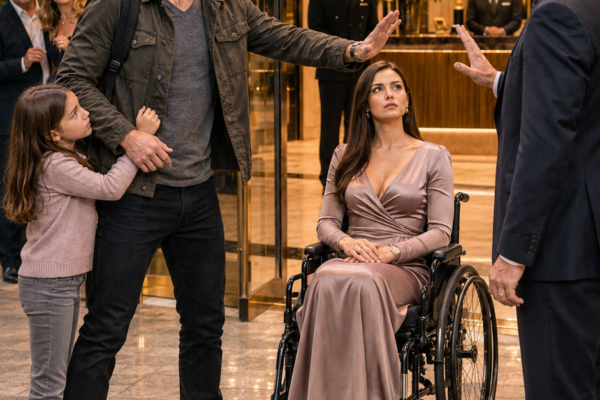
“She’s With Me,” The Single Dad Said — Moments Later the Entire Room Went Silent….

“She’s With Me,” The Single Dad Said — Moments Later the Entire Room Went Silent
The security guard grabbed her arm in front of forty wealthy strangers, and not one person moved to help her.
Then a single father from Queens stood up, looked the guard straight in the eyes, and said four words: “She’s with me.”
Twenty minutes later, the woman’s true identity was revealed—and the powerful men who had humiliated her discovered that their biggest secret was about to destroy everything they had built.
PART 1: THE MAN WHO STOOD UP WHEN EVERYONE ELSE LOOKED AWAY
The Woman Nobody Wanted in the Room
“Ma’am, I’m going to have to ask you to leave.”
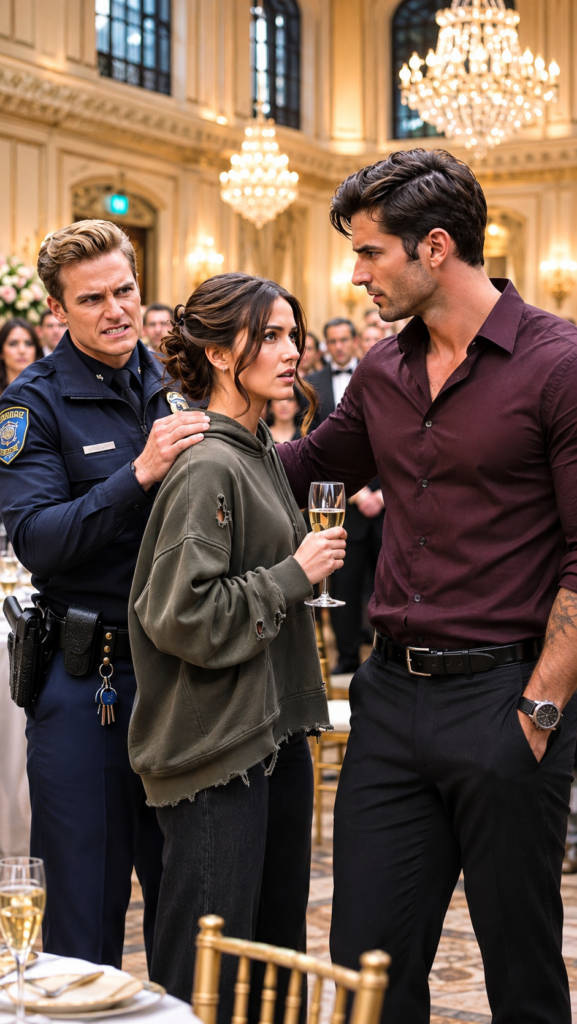
The security guard’s voice was low, but in the elegant private dining room of Manhattan’s Whitmore Hotel, it carried farther than he intended.
The woman standing near the entrance didn’t move.
She appeared to be in her early forties, with dark brown hair pulled into a loose knot and a faded gray jacket that had seen better years. Her shoes were clean but visibly worn. She carried a simple canvas handbag instead of the designer purses hanging from the arms of nearly every woman in the room.
“I was invited,” she said quietly.
The guard glanced toward a silver-haired man standing beside the head table.
Gerald Fitch, the evening’s host, gave an almost imperceptible nod.
“I’m afraid there’s been a misunderstanding,” the guard replied. “This is a private event.”
“I understand that. I’m supposed to meet Arthur Doyle.”
At the mention of that name, several guests exchanged uncomfortable looks.
Arthur Doyle was a respected financial consultant whose connections reached from Wall Street investment firms to some of New York’s most influential charitable foundations.
But Arthur wasn’t standing anywhere near the entrance.
And nobody seemed interested in finding him.
“Mr. Doyle is occupied,” the guard said.
“Would you please tell him Lillian is here?”
“Ma’am.”
The guard’s expression hardened.
“You’re making this more difficult than it needs to be.”
He reached for her arm.
She stepped backward, but he caught her just above the elbow.
It wasn’t a violent movement.
That somehow made it worse.
It was practiced, controlled, and delivered with the confidence of a man who knew that nobody in the room would object.
A woman wearing a diamond necklace looked down at her wineglass.
Two businessmen resumed their conversation.
Someone near the windows gave a small, uncomfortable laugh.
And at the far end of the table, Marcus Hale slowly put down his fork.
He had been watching the scene unfold for nearly a minute.
Now he stood.
“Take your hand off her.”
The guard turned.
“Excuse me, sir?”
Marcus stepped away from his chair.
He was forty-three, broad-shouldered, with the rough hands of a man who had spent twenty years repairing engines. His dark hair was beginning to gray at the temples, and the navy jacket he wore was the same one he’d worn to his wife’s funeral five years earlier.
He didn’t look like a man who belonged at Gerald Fitch’s dinner.
In fact, he looked very much like someone the guard might have been asked to remove.
But Marcus didn’t hesitate.
“I said, take your hand off her.”
The room grew quieter.
The guard released his grip slightly, though his fingers remained on the woman’s sleeve.
“Sir, this guest isn’t authorized to be here.”
Marcus glanced at her.
She was holding herself remarkably still, but he noticed the faint redness beginning to appear on her arm.
He looked back at the guard.
“She’s with me.”
The guard frowned.
“Sir, I need to verify that.”
“Then verify it.”
“What’s your name?”
“Marcus Hale.”
The guard looked toward Gerald.
For the first time that evening, the host seemed genuinely annoyed.
“Mr. Hale,” Gerald called from across the room, “perhaps you’d allow our staff to handle this situation.”
Marcus turned toward him.
“Your staff is handling it. I’m asking them to stop.”
A ripple of discomfort passed through the guests.
Gerald’s smile tightened.
“This is a carefully organized private gathering.”
“Then someone should have organized it carefully enough not to put their hands on a woman who’s standing quietly by the door.”
Nobody spoke.
The guard finally stepped aside.
Marcus turned toward the woman.
“There’s an empty chair next to mine.”
She studied his face.
“Are you sure?”
He glanced toward the table.
“Unless they’re charging by the chair.”
For a brief moment, something almost like a smile touched her lips.
Then she followed him.
And forty people watched as a woman they had considered unworthy of entering their room took a seat beside the one man who had been willing to defend her.
None of them knew that the decision would change their lives.
Least of all Marcus.
A Man Who Had Already Lost Enough
Three hours earlier, Marcus had been standing in the kitchen of his small apartment in Astoria, Queens, trying to convince his twelve-year-old daughter that microwaved spaghetti counted as a respectable dinner.
“It doesn’t,” Sadie informed him.
She stood beside the counter wearing an oversized sweatshirt, her hair tied into an uneven ponytail.
“Your mother used to say the same thing,” Marcus replied.
“Mom could make actual spaghetti.”
“Your mother had standards.”
“And you don’t?”
“I own a garage. My standards involve making sure the brakes work.”
Sadie laughed.
For a few seconds, the kitchen felt almost like it used to.
Then she glanced at the navy jacket hanging from the back of a chair.
“You’re really wearing that?”
Marcus looked at it.
“What’s wrong with it?”
“Nothing. It’s just…”
Her voice softened.
“That’s the jacket from Mom’s funeral.”
Marcus stopped stirring the sauce.
Five years had passed since Elena Hale died after a long battle with cancer.
Five years since he’d sat beside a hospital bed and promised a woman who could barely lift her head that their daughter would never have to wonder whether she was loved.
He had kept that promise.
Some days, it felt like the only thing he’d managed to keep.
Hale Automotive, the repair shop he’d built from nothing, was barely surviving rising rent, equipment costs, and customers who increasingly expected a small neighborhood garage to compete with national chains.
His landlord had recently warned him that the lease would need to be renegotiated within ninety days.
His main hydraulic lift needed a major overhaul.
And Sadie had started asking questions about college that made him calculate numbers he didn’t yet have.
Still, he paid his employees before he paid himself.
He attended every school meeting he could.
And every night, regardless of how exhausted he was, he made sure his daughter had someone sitting beside her at dinner.
Even when dinner came out of a microwave.
“I can wear something else,” he said.
Sadie shook her head.
“No. Mom always said you looked handsome in that jacket.”
Marcus looked away.
“She was biased.”
“Definitely.”
He smiled.
Then Sadie stepped closer and straightened his collar.
“Are you going to get that big contract tonight?”
“Maybe.”
“Mr. Cypher said it could change everything.”
“Don talks too much.”
“He said you could finally replace the broken lift.”
“It’s not broken. It’s temperamental.”
“That’s what you say about the washing machine.”
“Both machines are sensitive.”
She rolled her eyes, but her smile faded when she noticed his expression.
“Dad?”
“Yeah?”
“You don’t have to do all this just for me.”
Marcus turned.
“Do what?”
“Work all the time. Worry about money. Go to dinners you don’t want to go to.”
He crouched slightly so they were eye level.
“Sadie, I work because I like fixing things. I worry about money because I’m a parent. That’s practically the job description.”
She didn’t smile.
He took her hands.
“Listen to me. Your mom and I didn’t plan for things to turn out this way. But there’s nothing about having you that makes my life harder to love.”
Her eyes grew shiny.
“Okay.”
“And one more thing.”
“What?”
“If this dinner goes badly, we’re getting pancakes Saturday morning.”
“With chocolate chips?”
“Don’t get greedy.”
She hugged him.
Marcus held her a little longer than usual.
At seven fifteen, their longtime neighbor, Mrs. Alvarez, arrived to stay with Sadie.
Marcus kissed his daughter’s forehead, picked up his keys, and left for Manhattan.
He had no idea that the most important decision he would make that evening would have nothing to do with money.
The Empty Chair
Don Cypher was waiting outside the Whitmore Hotel when Marcus arrived.
Don supplied automotive parts to independent shops across the city and had known Marcus since before Hale Automotive had a proper sign.
He wore an expensive-looking suit that Marcus suspected he’d borrowed.
“You clean up better than I expected,” Don said.
Marcus examined Don’s tie.
“You look like you’re going to court.”
“Behave yourself tonight.”
“That sounds like a warning.”
“It is.”
Don lowered his voice.
“Gerald Fitch’s company is looking for independent repair partners. Fleet maintenance, parts distribution, long-term service agreements. If the deal works, you could have steady business for years.”
“Provided the terms aren’t terrible.”
“That’s why we’re here.”
Marcus glanced through the glass doors.
Inside, chandeliers illuminated marble floors and enormous flower arrangements that probably cost more than his monthly electricity bill.
“These people really know how to spend money,” he muttered.
Don smiled.
“Try not to tell them that.”
The dinner began exactly as Marcus had expected.
Men discussed acquisitions with the casual confidence of people who’d never had to choose between paying a supplier and repairing their own roof.
Women talked about nonprofit boards, real estate, and invitations to events Marcus had never heard of.
Everyone seemed to know everyone.
Marcus knew Don.
And the waiter who brought him water.
He liked the waiter better.
When Gerald Fitch approached their table, Don immediately stood.
“Gerald, this is Marcus Hale. I told you about his shop.”
Gerald shook Marcus’s hand.
His grip was firm, his smile polished.
“Ah, yes. The mechanic from Queens.”
“Shop owner,” Marcus corrected pleasantly.
“Of course.”
Gerald glanced at his jacket.
“Don tells me you’ve built quite a loyal customer base.”
“I try to do good work.”
“Admirable. Though scaling a business requires something beyond good intentions.”
“Usually it requires customers paying their invoices on time.”
Don coughed into his napkin.
Gerald’s smile remained in place.
“Indeed.”
He moved on.
Marcus leaned toward Don.
“That went well.”
“Please stop helping.”
Forty minutes later, Marcus noticed the woman in the gray jacket.
He watched her approach the entrance, speak briefly to a waiter, and look around the room.
She seemed less interested in the chandeliers than in the people beneath them.
When a server carrying champagne nearly collided with her, she moved aside and apologized.
The server looked relieved.
A woman wearing a red evening gown did not.
“Who invited her?” the woman whispered to her husband.
Marcus heard the question.
He also heard the answer.
“Probably trying to get someone’s attention.”
The woman in gray remained by the entrance.
She checked her phone once.
Then Gerald noticed her.
Something in his expression changed.
He leaned toward the security guard, said a few quiet words, and returned to his guests.
A moment later, the guard approached her.
That was when Marcus saw the hand close around her arm.
And that was when he stood.
Four Words That Changed the Evening
Now the woman sat beside him, with a glass of water she hadn’t touched and forty strangers pretending not to watch her.
Marcus slid the breadbasket closer.
“You hungry?”
She looked at him.
“Not particularly.”
“That’s good. I think this bread costs about eighteen dollars a slice.”
She laughed quietly.
It was the first relaxed sound he’d heard from her.
“I’m Lillian,” she said.
“Marcus.”
“I heard.”
“Right. I wasn’t exactly whispering.”
Her expression changed.
“Why did you do that?”
“Do what?”
“Interfere.”
He frowned.
“Because he was grabbing you.”
“You don’t know me.”
“Didn’t seem relevant.”
She studied him for several seconds.
“Most people would have looked away.”
“Most people did.”
The answer landed harder than he’d intended.
Lillian glanced down at her arm.
Marcus noticed the red marks again.
“Are you okay?”
She nodded.
“Yes.”
He waited.
After a moment, she added, “I’m embarrassed.”
“By what?”
“Being escorted through a room like I was something someone needed to dispose of.”
Marcus folded his napkin.
“That’s their embarrassment. Not yours.”
She looked at him sharply.
It was as though he’d said something she hadn’t expected anyone in that room to understand.
“Do you have children?” she asked.
“One daughter. Twelve.”
“What’s her name?”
“Sadie.”
He smiled without realizing it.
“She thinks she’s smarter than me.”
“Is she?”
“By a significant margin.”
Lillian smiled.
“Her mother must be proud.”
The smile left his face so quickly that Lillian immediately noticed.
“I’m sorry,” she said.
Marcus shook his head.
“No need. Elena passed away five years ago.”
Lillian lowered her eyes.
“I’m sorry,” she repeated, more quietly.
“Me too.”
He looked toward the long windows.
“But Sadie’s doing okay. Better than I expected. She’s got her mother’s stubbornness and, unfortunately, my sense of humor.”
“That sounds like a wonderful combination.”
“It’s expensive in emotional damages.”
They laughed.
Then the conversation shifted.
Lillian asked about his garage, and Marcus found himself explaining a problem with an old delivery truck he’d repaired that morning.
She listened with unusual concentration.
Not the polite nodding he had received from the other guests.
She asked how long the repair had taken, whether he could find replacement parts, and why he continued servicing vehicles that larger companies considered too old to be profitable.
“Because somebody still needs them,” he said.
“That sounds like a difficult business model.”
“It can be.”
“Then why keep doing it?”
Marcus thought for a moment.
“There’s a woman in my neighborhood who drives a fifteen-year-old minivan. She works nights at a nursing home. When that van breaks down, she doesn’t just lose a car. She loses the way she gets to work.”
Lillian listened.
“So you repair it?”
“If I can.”
“Even when she can’t afford much?”
“I don’t work for free every day, Lillian. I’d go out of business. But I can usually figure out something reasonable.”
“And that matters to you?”
He gave her a puzzled look.
“Doesn’t it matter to everyone?”
Lillian didn’t answer.
Across the room, Gerald stepped toward a large presentation screen.
“Ladies and gentlemen, I’d like to share an extraordinary opportunity.”
A financial projection appeared, followed by a series of photographs showing neighborhood businesses, public schools, and redevelopment projects.
Gerald began discussing investment partnerships designed to support underserved communities.
Marcus recognized the language.
He’d heard variations of it from lenders who offered small businesses attractive financing until the fine print began.
Then another slide appeared.
At the top were the words:
WARD-ALIGNED COMMUNITY INVESTMENT STRATEGY
Lillian went completely still.
Marcus noticed.
“Something wrong?”
She stared at the screen.
“Did they explain that partnership earlier?”
“No.”
“Has anyone mentioned Ward Holdings?”
“Not to me.”
Her face had changed.
The embarrassment was gone.
So was the tentative warmth.
What replaced them was a cold, focused attention Marcus associated with people who had just discovered something important.
Gerald continued.
“Our relationships with some of the city’s most respected institutions position us uniquely to deliver measurable financial returns while creating long-term community impact.”
Several guests applauded.
Lillian didn’t move.
“Marcus,” she said quietly, “who invited you here?”
“Don Cypher. Why?”
“Did he tell you Gerald wanted to discuss a maintenance contract?”
“Yes.”
“Did anyone ask you to sign anything?”
“Not yet.”
She nodded.
Then she asked something that made him uncomfortable.
“Did they request information about your customers, employees, or business accounts?”
Marcus considered.
“Don forwarded a questionnaire. Basic stuff. Shop size, equipment, revenue estimates. I haven’t sent it back.”
“Good.”
“Why?”
Lillian looked toward Gerald.
“Because I think someone is selling something they don’t own.”
Before Marcus could ask what she meant, a man hurried toward their table.
Arthur Doyle.
He was pale.
He stopped so abruptly beside Lillian that his chair nearly tipped over.
“Miss Ward?”
Lillian turned.
“Arthur.”
His mouth opened.
Then closed.
“I didn’t realize you’d arrived.”
“I noticed.”
Arthur glanced at the gray jacket, then toward Gerald.
“I was expecting…”
“Someone who looked different?”
“No, I simply—”
“You told me to come quietly. I did.”
Marcus watched Arthur’s expression collapse.
At the head of the room, Gerald noticed the exchange.
He stopped speaking midsentence.
Arthur leaned toward him and whispered something.
Gerald’s face drained of color.
The entire room seemed to sense the change.
Conversations stopped.
A waiter froze near the dessert table.
Then Gerald Fitch stepped away from the presentation screen and approached Marcus’s table.
“Miss Ward,” he said, his voice suddenly overflowing with warmth. “What an extraordinary pleasure. I had no idea you were joining us tonight.”
Lillian regarded him calmly.
“Your security guard knew I was here.”
Gerald blinked.
“There’s clearly been an unfortunate misunderstanding.”
“Was there?”
“Of course. Had we known who you were—”
Lillian interrupted him.
“You should not have needed to know who I was.”
Silence.
Gerald glanced around the room.
Everyone was staring now.
“Lillian Ward,” someone whispered near the windows.
Another guest lifted a hand to her mouth.
Marcus recognized the name a moment later.
Ward Holdings.
The billion-dollar investment company.
The education foundation.
The woman whose picture occasionally appeared on business news websites.
He looked at Lillian.
She looked back at him.
And for one strange second, he saw the embarrassment return.
Not because the room had discovered who she was.
Because the room had suddenly decided she deserved respect.
Gerald pulled out a chair.
“Please, Miss Ward. Allow me to explain.”
Lillian remained seated.
Then she pointed toward the presentation screen.
“Yes, Gerald. I think you should.”
He glanced backward.
“Explain what?”
“Why my company’s name appears in your investor presentation.”
Gerald cleared his throat.
“Our preliminary conversations with Arthur suggested that there might be an opportunity for strategic alignment.”
“Preliminary conversations?”
“Naturally. Nothing has been finalized.”
Lillian reached for the printed investor packet lying beside Marcus’s plate.
She opened it.
Flipped through several pages.
And stopped.
“Arthur,” she said.
Her voice was almost too quiet to hear.
Arthur stepped closer.
“Yes?”
“Did you authorize Gerald to distribute these documents?”
Arthur looked at the packet.
“I reviewed some early materials.”
“Did you review page seventeen?”
Gerald’s eyes moved toward the packet.
For the first time, he looked genuinely afraid.
Lillian turned the document toward him.
There, beneath a polished financial forecast, was a statement describing Ward Holdings as an institutional participant in the proposed investment program.
The statement included an estimated commitment of eighteen million dollars.
And immediately below it was a letter bearing Lillian Ward’s name.
Marcus looked at her.
Her expression had become unreadable.
“That’s a preliminary indication of interest,” Gerald said quickly.
Lillian shook her head.
“No.”
She placed one finger against the signature at the bottom.
“That’s a representation of a financial commitment my company never approved.”
Arthur swallowed.
Gerald attempted a smile.
“Surely we can discuss the terminology privately.”
Lillian slowly closed the folder.
Then she looked across the room at the investors who had spent the evening treating her as though she didn’t belong.
“Before we discuss anything privately, I would like everyone here to hear one thing clearly.”
Gerald went motionless.
Lillian lifted the document.
“Whoever created this letter used my signature without my permission.”
The room fell utterly silent.
And Marcus Hale, the single father who had only wanted a contract to keep his garage open, realized he had walked into something far more dangerous than an unpleasant dinner.
Because the next words out of Gerald Fitch’s mouth would reveal exactly how far the deception had already gone.
PART 2: THE PRICE OF A LAST NAME
The Apology That Came Too Late
Gerald Fitch stared at the document in Lillian’s hand.
Then he made the mistake of laughing.
It was a nervous, calculated little laugh, the kind men sometimes used when they wanted a serious accusation to sound like a minor inconvenience.
“Miss Ward, I assure you, nobody intended to misrepresent anything.”
“Then explain the letter.”
“Arthur provided us with a template from an earlier discussion.”
Lillian turned toward Arthur.
“Did you?”
Arthur adjusted his glasses.
“We had discussed potential collaboration last spring.”
“We discussed whether your consulting firm could introduce us to qualified workforce-development organizations.”
“That’s correct.”
“We did not discuss investing eighteen million dollars in Gerald’s company.”
“No, but—”
“And I certainly didn’t authorize you to reproduce my signature beneath a statement of financial commitment.”
Arthur fell silent.
Near the head table, a woman in an ivory evening dress slowly closed her investor packet.
“Gerald,” she said, “were you telling us that Ward Holdings had committed to this fund?”
Gerald turned toward her.
“We were describing the likelihood of institutional participation.”
“That’s not what you told my husband last week.”
Marcus watched the exchange without moving.
A few minutes earlier, these people had been concerned about whether Lillian’s jacket belonged in the room.
Now they were concerned about whether the money they hoped to earn had been promised under false pretenses.
It was an astonishing transformation.
Lillian stood.
“I’m not going to conduct a legal investigation over dinner,” she said. “But I am asking everyone who received these materials to preserve them. My company will contact the relevant parties tomorrow.”
Gerald stepped forward.
“Surely there’s a less confrontational way to handle this.”
“There was.”
She looked directly at him.
“You could have asked for my permission.”
A long silence followed.
Arthur shifted his attention toward Marcus.
“Mr. Hale, perhaps you can give Miss Ward and Mr. Fitch some privacy.”
Marcus looked at him.
“She can decide that for herself.”
Lillian’s expression softened almost imperceptibly.
“Thank you, Marcus.”
Then she turned back to Arthur.
“And you will stop telling people what arrangements I am supposed to accept.”
Gerald tried once more.
“Miss Ward, about the unfortunate incident at the entrance—”
“The incident where you instructed your guard to remove me?”
Gerald’s eyes flickered.
“I didn’t realize—”
“I know.”
Lillian picked up her handbag.
“That’s the problem.”
Marcus rose from his chair.
Don, who had been watching the entire disaster with a look of disbelief, followed him into the corridor.
“Marcus,” he whispered, “do you have any idea who that woman is?”
“Apparently, yes.”
“She’s one of the most influential investors in New York.”
“Seems that way.”
“And you told her security guard to back off.”
“He was hurting her.”
Don stared at him.
“You’re unbelievable.”
Marcus headed toward the elevator.
“Is that a compliment?”
“I’m still deciding.”
Lillian caught up with them before the elevator doors opened.
“Marcus.”
He turned.
She had removed the gray jacket and folded it over her arm.
Without it, she looked no different from the woman who had sat beside him during dinner.
And yet everything surrounding her had changed.
“You’re leaving?” she asked.
“Yes.”
“I thought you came here to discuss a business contract.”
“I did.”
“Gerald might still be interested.”
Marcus glanced toward the dining room.
“I don’t think Gerald and I would agree on the meaning of a contract.”
Lillian smiled faintly.
Then she grew serious.
“I want you to know how much I appreciate what you did.”
He nodded.
“You’re welcome.”
“I’d like to do something for you.”
Marcus shook his head.
“You don’t owe me anything.”
“That’s not what I meant.”
“I know.”
She looked at him for a moment.
“Would you have helped me if you’d known who I was?”
Marcus considered the question.
“I’d like to think so.”
“That’s not exactly reassuring.”
“It’s the truth.”
He slipped his hands into his pockets.
“I can’t tell you what I would’ve done in a situation that didn’t happen. I just know what I saw.”
“And what was that?”
“Someone standing alone while a room full of people decided she wasn’t worth the trouble.”
Lillian looked away.
Marcus pressed the elevator button.
“I’ve spent enough time watching people get treated differently because of what they can afford,” he added. “I don’t want to spend another evening pretending that becomes acceptable when the person turns out to be rich.”
The doors opened.
“Good night, Lillian.”
“Good night, Marcus.”
He stepped inside.
And for a long time after the doors closed, Lillian stood in the hallway holding the jacket everyone had found so offensive.
The Promise Made in a Small Kitchen
At ten forty-five that night, Marcus found Sadie asleep on the living-room couch.
A science textbook lay open beside her.
Mrs. Alvarez had left a note on the refrigerator explaining that Sadie had insisted on waiting up.
Marcus covered his daughter with a blanket.
Her eyes opened.
“Dad?”
“Go back to sleep.”
“Did you get the contract?”
He hesitated.
“No.”
She blinked.
“Was the guy mean?”
“Not exactly.”
“Then what happened?”
Marcus sat on the edge of the coffee table.
“I met somebody who needed help.”
Sadie pushed herself upright.
“What kind of help?”
He told her a shortened version of the evening.
The guard.
The woman.
The people watching.
The four words he’d said without thinking.
Sadie listened with the intense attention she usually reserved for mysteries and mechanical problems.
“So you pretended she was your guest?”
“Pretty much.”
“And then she turned out to be super rich?”
“Apparently.”
Sadie considered this.
“That’s kind of awesome.”
“I wouldn’t describe most of the evening that way.”
“Did she thank you?”
“She did.”
“Did the mean man apologize?”
Marcus thought about Gerald Fitch.
“He apologized because he found out who she was.”
Sadie’s smile disappeared.
“Oh.”
She looked down at the blanket.
“That’s different.”
Marcus nodded.
“Very.”
For a moment, neither spoke.
Then Sadie asked, “Would you have helped her if she was just a regular lady?”
Marcus reached over and brushed a strand of hair from her face.
“That’s exactly why I helped her.”
She leaned against him.
“Mom would’ve liked that.”
His throat tightened.
“I hope so.”
“She would.”
Sadie wrapped both arms around his waist.
Then, in the small voice she’d used when she was younger, she asked, “Are we going to lose the garage?”
Marcus held still.
He hadn’t realized she knew how difficult things had become.
“Why would you ask that?”
“I heard you talking to Mr. Cypher last week. About the rent.”
He closed his eyes briefly.
Of all the things he’d tried to protect her from, the financial uncertainty had somehow found its way into their kitchen.
“We’re working on it,” he said.
“But if that contract’s gone…”
“We still have customers. We still have work.”
“What if it’s not enough?”
Marcus didn’t answer immediately.
He had promised Elena he would always be honest with their daughter.
Sometimes honesty was harder than reassurance.
“Then I’ll figure out what comes next,” he said. “But I promise you something. Whatever happens to that building, you’re not losing me.”
Sadie nodded slowly.
She didn’t look convinced that everything would be fine.
But she believed him.
And that was enough for tonight.
The Woman Who Didn’t Need Another Boardroom
Four days later, a black sedan stopped outside Hale Automotive.
Marcus was under a Ford pickup when he heard a woman’s voice.
“Excuse me. Is Marcus Hale here?”
“Depends who’s asking.”
He rolled out from beneath the truck.
Lillian Ward stood near the entrance.
This time she wore dark trousers, a cream-colored sweater, and an ordinary raincoat.
She looked almost amused by the expression on his face.
“Good morning.”
Marcus sat up.
“Your car break down?”
“No.”
“Wrong address?”
“No.”
He stood and wiped his hands on a rag.
“Then this is unexpected.”
“I’ve been told that.”
She looked around.
Two mechanics worked near the rear bays. An old radio played softly above the parts counter. A handwritten sign reminded customers that repair estimates were free but miracles were not guaranteed.
There were no marble floors.
No chandeliers.
Nobody rushed to offer Lillian a chair.
A customer near the counter simply asked whether she was waiting for an oil change.
She smiled.
“No, thank you.”
Marcus gestured toward the small office.
“Coffee?”
“Yes, please.”
“It’s terrible.”
“I’ve been warned about worse things.”
They sat at a round table covered with service invoices.
Lillian declined the only clean mug, so Marcus washed another one.
She watched him without speaking.
Finally, she said, “Arthur Doyle has been removed from any further discussions with our company while we review his involvement.”
Marcus paused.
“That doesn’t sound like a pleasant week.”
“It hasn’t been.”
“What about Gerald?”
“Our legal team has contacted the investors who received his materials. We’ve also asked for the original documents and the history of the presentation.”
“Will he get in trouble?”
“That depends on what the evidence establishes.”
Marcus nodded.
It was a measured answer.
He appreciated that.
“Can I ask you something?” he said.
“Of course.”
“Why were you at that dinner dressed like you were hoping nobody would recognize you?”
Lillian looked down at her coffee.
“Because I was hoping nobody would recognize me.”
Marcus raised an eyebrow.
She smiled briefly.
“Arthur mentioned Gerald’s investment proposal months ago. Then I started hearing that Gerald was suggesting my company had agreed to participate. I wanted to hear the pitch myself before deciding whether the claims were exaggerated.”
“So you went undercover?”
“Not exactly. Arthur knew I was coming without an entourage. I asked him not to announce me.”
“Why?”
“Because people usually change the presentation when they know someone like me is listening.”
Marcus looked at her.
“Sounds exhausting.”
“It is.”
She ran a finger along the chipped edge of the table.
“The jacket belonged to my mother. She was a public school counselor in Brooklyn. She used to wear it everywhere, even after the lining started coming apart.”
Her voice softened.
“After she died, I kept it. I wore it that evening because I liked it. I wasn’t trying to look poor.”
Marcus nodded.
“People shouldn’t have to dress a certain way to be treated decently.”
“That’s what I learned.”
He looked at her.
“I think you already knew it.”
She seemed surprised.
“Knowing something intellectually isn’t always the same as watching it happen to you.”
Marcus considered that.
“Fair enough.”
Lillian glanced toward the garage.
“I’ve spent years talking about opportunity, community investment, and access to resources. Then I walked into a room where someone decided I didn’t belong because of my coat.”
She paused.
“And the only person who stood up was a man who had no idea I could do anything for him.”
“Don stood up too,” Marcus said.
“After you.”
“He’s getting slower.”
Lillian laughed.
Then she became serious.
“Marcus, I’d like to invest in your business.”
He stared at her.
“No.”
She blinked.
“You haven’t heard the proposal.”
“I heard the important part.”
“I’m not talking about taking control. I could provide capital for new equipment, expansion, perhaps another location.”
“Why?”
“Because I believe in the person running it.”
Marcus leaned back.
“That’s a generous thought.”
“But?”
“But I’ve got three employees who depend on this place. Customers who trust us. A daughter who already thinks I work too many hours.”
He glanced toward the garage.
“I don’t want somebody putting money into Hale Automotive because I happened to be decent to them one night.”
“This wouldn’t be charity.”
“Then there’d be expectations.”
“Naturally.”
“And what happens when those expectations don’t match the way I run my shop?”
Lillian folded her hands.
“That’s what contracts are for.”
Marcus smiled.
“Now you sound like the people at the dinner.”
The words landed harder than he’d intended.
Lillian looked down.
For a moment, he regretted saying them.
Then she nodded.
“You’re right.”
He leaned forward.
“Listen, I’m not against investment. I’m not even against your company. I’m just not willing to turn this place into something I don’t recognize to make the numbers look better.”
Lillian studied him.
“What if I wanted to help without expecting anything in return?”
Marcus stood and walked toward the office window.
Across the street, the afternoon sun caught the old brick building of East River Technical High School.
He pointed toward it.
“See that school?”
“Yes.”
“They’ve got an automotive program. Good teacher. Good kids. Half the tools are older than the students.”
Lillian stood beside him.
Marcus continued.
“Last month, their diagnostic scanner stopped working. The teacher brought it over here hoping I could repair it. It would’ve cost more to fix than the thing was worth.”
“What happened?”
“I loaned them one of ours.”
“For how long?”
“Still waiting to get it back.”
Lillian smiled.
Marcus didn’t.
“Those kids don’t need a billionaire telling them to dream bigger. They need working equipment and someone who’ll teach them how to use it.”
Lillian looked across the street.
“What’s the teacher’s name?”
“Ben Walker.”
“And he’s good?”
“One of the best mechanics I’ve ever met.”
“Why doesn’t he work somewhere else?”
“Because somebody has to teach the next generation.”
She remained quiet.
Marcus returned to his workbench.
“If you want to invest in something, Lillian, invest there.”
She watched him pick up a wrench.
“You’d rather I help the school than your shop?”
“Yes.”
“Even though you could use the money?”
He stopped.
For the first time, she saw how much the question cost him.
“Especially because I could use the money.”
Lillian didn’t immediately understand.
Then Marcus explained.
“If I accept a gift because I did the right thing once, I’ll spend the rest of my life wondering what I owe you. But if those kids get better equipment, nobody owes anybody anything.”
He lowered his eyes.
“They just get a chance.”
Lillian remained in the garage for another ten minutes.
When she left, she hadn’t signed an agreement.
Marcus hadn’t accepted a dollar.
But something had changed.
And neither of them yet understood how expensive that change might become.
The Records Nobody Had Read
That evening, Lillian returned to Ward Holdings and asked her assistant to bring every file connected to the company’s previous workforce-development grants.
Rachel Morgan had worked for Lillian for eleven years.
She understood the difference between a passing curiosity and a decision that would rearrange her entire calendar.
“How far back?” Rachel asked.
“Three years.”
“All workforce programs?”
“Especially anything involving vocational training, technical education, or equipment procurement.”
Rachel hesitated.
“There’s quite a lot.”
“I know.”
At eight fifteen, the first group of documents arrived.
Lillian sat alone at her desk as Manhattan glittered beyond the windows.
She discovered that Ward Foundation had funded several programs promoting career readiness.
Leadership workshops.
Community employment conferences.
Professional mentoring initiatives.
Consulting reports filled with attractive photographs and polished statistics.
Yet there was almost no evidence of investment in actual classroom equipment.
One program had spent nearly half a million dollars on administrative coordination and promotional materials.
Another had produced a sixty-page report about barriers facing students interested in skilled trades.
Lillian read the report’s recommendations.
Every page described the need for better training facilities.
Not one page identified a school that had received a new lift, diagnostic scanner, or welding station.
At nine thirty, Rachel knocked.
“I found something you should see.”
She placed a folder on Lillian’s desk.
It contained a summary of a two-year, $2.4 million workforce-readiness initiative funded through Ward Foundation grants.
Arthur Doyle’s consulting firm had been retained to coordinate outside partners.
Lillian remembered approving the program’s general objectives.
She did not remember approving its individual subcontractors.
Rachel pointed toward a list of vendors.
“The largest equipment-related subcontract went to a company called Fitch Industrial Solutions.”
Lillian looked up.
“Gerald’s company?”
“An affiliate.”
“How much?”
“Six hundred and eighty thousand dollars, including planned deliveries and installation services.”
Lillian opened the supporting invoices.
Then she read the equipment descriptions.
Refurbished training lifts.
Diagnostic units.
Workshop safety systems.
Several payments had already been processed.
Rachel spoke carefully.
“There’s another problem.”
Lillian looked at her.
“The grant recipient’s quarterly reports say the equipment was delivered to participating schools.”
“Was it?”
“We haven’t confirmed that.”
“Then what have we confirmed?”
Rachel placed a photograph on the desk.
It showed an empty automotive classroom with outdated equipment and several bays marked out of service.
Below the photograph was the name of the school.
EAST RIVER TECHNICAL HIGH SCHOOL — QUEENS, NEW YORK.
Lillian stared at it.
The same school Marcus had pointed toward that morning.
She reached for the invoice again.
The delivery certification was signed by an administrative coordinator.
The receiving school’s acknowledgment was missing.
Then she turned to the final page.
A notation in the margin identified the person responsible for confirming successful fulfillment.
Arthur Doyle.
Lillian slowly set the papers down.
The man who had helped Gerald use her name at dinner had also been overseeing a grant program that claimed to deliver equipment to a school still struggling with broken tools.
She looked at Rachel.
“Get our general counsel.”
“Tonight?”
“Tonight.”
Rachel moved toward the door.
Lillian stopped her.
“And Rachel?”
“Yes?”
“Until we know where that equipment went, I don’t want another dollar released under these contracts.”
Rachel nodded.
As the door closed, Lillian looked again at the photograph.
Across the city, a single father was putting his daughter to bed, unaware that the school beside his garage had just become the center of a problem much larger than anyone had imagined.
And somewhere in Manhattan, Gerald Fitch was about to learn that one falsified promise could expose a trail of very real money.
PART 3: THE SCHOOL ACROSS THE STREET
What the Money Never Bought
The following Monday, Lillian Ward stood in an automotive classroom in Queens.
The room smelled of metal, rubber, and old motor oil.
Fourteen students were working around three vehicles. One had its hood raised. Another sat on an aging hydraulic lift that was no longer permitted to carry a vehicle.
A teenager wearing safety glasses approached her.
“Are you the lady from Ward Foundation?”
Lillian nodded.
“I’m Lillian.”
“I’m Tessa.”
The girl shook her hand confidently.
“Mr. Walker said you’re here to look at our equipment.”
“I am.”
Tessa glanced toward the broken lift.
“Are you going to write another report?”
Lillian paused.
“Another?”
The girl shrugged.
“People come here sometimes. They take pictures. They ask questions about why we like working on cars. Then they leave.”
“Have they helped?”
“One guy gave us a box of notebooks.”
She looked toward the empty lift.
“We were hoping for something a little more useful.”
Lillian felt the words settle somewhere uncomfortable.
Ben Walker, the automotive instructor, approached from the adjoining bay.
He was a tall man in his late fifties with silver hair and grease beneath his fingernails.
“Miss Ward,” he said. “Thanks for coming.”
“Thank you for having me.”
He showed her the classroom.
Two diagnostic computers were outdated.
A tire-changing machine had been out of service for eight months.
One lift had failed a safety inspection and remained unused while the district worked through its replacement budget.
Students shared tools and rotated between projects because there wasn’t enough functioning equipment for everyone.
Lillian examined the grant report she had brought.
“According to this document, your school received a refurbished lift last November.”
Ben stared at her.
“No, ma’am.”
“And a new diagnostic station?”
“We got a brochure about one.”
Lillian looked up.
“A brochure?”
“Yes.”
Ben crossed his arms.
“Someone came last year, took photographs, and told me funding had been approved. Then I received an email saying the installation schedule had been revised.”
“Did you follow up?”
“Six times.”
“What happened?”
“Eventually, they stopped answering.”
Lillian lowered the report.
She’d spent the previous week reviewing financial records.
Now she was standing inside the difference between an approved expenditure and an actual result.
It was a larger difference than she had imagined.
Near the rear door, a familiar voice said, “That machine still giving you trouble, Ben?”
Marcus Hale walked in carrying a portable scanner.
Sadie followed with a small toolbox.
Lillian turned.
Marcus stopped when he saw her.
“Well,” he said. “This is a surprise.”
“Apparently, I’m becoming predictable.”
Sadie glanced between them.
“Dad, is this the lady?”
Marcus gave his daughter a warning look.
Lillian smiled.
“I think I might be.”
Sadie’s eyes widened.
“The one from the fancy dinner?”
“That’s me.”
“The one everybody was mean to?”
“Sadie,” Marcus murmured.
But Lillian crouched slightly.
“Unfortunately, yes.”
Sadie studied her.
“You look normal.”
Marcus closed his eyes.
Lillian laughed.
“Thank you. I think.”
Sadie held out her hand.
“I’m Sadie Hale.”
Lillian shook it.
“Your father has told me about you.”
“Only good things, hopefully.”
“Mostly that you’re smarter than he is.”
“That’s true.”
“Both of you are going to have a long walk home,” Marcus said.
The room filled with laughter.
For the first time in days, Lillian felt something loosen in her chest.
Marcus handed Ben the scanner.
“Keep it until your replacement comes.”
Ben looked at him.
“Marcus, you’ve already done enough.”
“It’s one of the older units.”
“You still use it.”
“We have another.”
Ben knew the truth.
Marcus had only one other scanner suitable for several of the newer vehicles his shop serviced.
Lending this one meant longer waits and more difficult scheduling.
But Marcus had already turned toward a student struggling with an electrical fault.
“Show me what you’ve checked,” he said.
The boy began explaining.
Marcus listened.
Then he handed the student the test leads.
“All right. Don’t tell me what you think failed. Show me how you’re going to prove it.”
Lillian watched.
Nobody asked Marcus whether he had a degree.
Nobody cared about the value of his business.
The students simply gathered around a man who knew something useful and was willing to share it.
By the time Lillian left, she’d made notes about equipment, certification requirements, and the school district’s purchasing procedures.
She’d also learned something she hadn’t found in a single consultant’s report.
The students weren’t asking anyone to rescue them.
They were asking for the same opportunity to learn that students in wealthier schools already enjoyed.
The Boardroom Fight
Two days later, the Ward Foundation board gathered in Manhattan.
This time, Lillian arrived carrying photographs.
Not photographs of smiling executives standing beside oversized donation checks.
Photographs of broken equipment.
She placed them along the conference table.
“I want to redirect a portion of next year’s discretionary education budget toward technical training programs,” she announced.
One trustee, Evelyn Cho, leaned forward.
“What kind of programs?”
“Automotive technology initially. We can consider other skilled trades once we’ve developed a reliable process.”
Another director frowned.
“Our foundation has historically prioritized college readiness.”
“And these students are preparing for careers,” Lillian replied. “Some may attend college. Some may pursue apprenticeships or technical certifications. All of them deserve functioning classrooms.”
Evelyn examined the pictures.
“How much are you proposing?”
“An initial four-and-a-half-million-dollar commitment across several eligible schools, subject to independent equipment assessments, district approval, and competitive procurement.”
The room went quiet.
Then a board member named Richard Caldwell spoke.
“That’s a substantial shift in priorities. And coming immediately after the situation with Gerald Fitch, I worry it could appear reactionary.”
Lillian didn’t deny it.
“You’re right to ask.”
Richard looked surprised.
She continued.
“I spent an evening watching people judge a woman by her clothing. The next week, I discovered we’d been judging educational success by the number of reports we commissioned.”
She placed a photograph of East River’s broken lift in front of him.
“I signed the original grant authorization. I relied on people whose reports I didn’t examine closely enough. That part is my responsibility.”
Evelyn studied her.
“What’s happened to the money already allocated?”
“Our independent review is ongoing. We’ve frozen further payments on the disputed contracts. We will pursue recovery if the evidence supports it.”
“And Arthur Doyle?”
“His firm is no longer authorized to represent our interests.”
Richard tapped the table.
“We still need to establish whether there were actual failures of delivery, accounting mistakes, or intentional misrepresentations.”
“Agreed,” Lillian said. “We won’t substitute assumptions for evidence.”
She opened another folder.
“But that investigation doesn’t change what the students need.”
The discussion continued for nearly two hours.
Board members questioned the budget.
Outside counsel reviewed potential conflicts.
The foundation’s program director explained how equipment purchases would be verified before reimbursement.
One trustee insisted that no vendor associated with the disputed contracts participate until the review was complete.
Lillian agreed.
At last, Evelyn looked around the table.
“I’d support a carefully monitored pilot, provided teachers and district representatives help define what gets purchased.”
“So would I,” Richard said, reluctantly.
The proposal passed with conditions.
Lillian had secured permission to begin something meaningful.
She had not yet secured the equipment.
And she was beginning to understand why people like Ben Walker had grown tired of promises.
The Man Who Wanted Credit
Gerald Fitch called the following afternoon.
His tone was no longer charming.
“Lillian, we need to discuss the damage being done to my company.”
She sat behind her desk.
“I’m listening.”
“Several investors have suspended discussions. My lending partners are asking questions. Arthur says your legal team is treating a draft letter as though it were a criminal conspiracy.”
“I haven’t made any criminal allegation.”
“Then why is everyone acting like I stole something?”
“Because you distributed documents representing an unapproved financial commitment.”
Gerald exhaled sharply.
“You know how these deals work.”
“I know how legitimate ones work.”
Silence.
Then he changed tactics.
“I heard about your new education initiative.”
“Did you?”
“Automotive training. Interesting coincidence.”
Lillian remained quiet.
“Fitch Industrial Solutions has experience in that sector,” he continued. “Whatever happened at the dinner, we could still be valuable partners.”
“The foundation won’t consider your company while the existing contracts are under review.”
“You’re making a mistake.”
“That may be your opinion.”
Gerald’s voice hardened.
“You’re allowing a mechanic you met for twenty minutes to influence decisions involving millions of dollars.”
Lillian felt her jaw tighten.
“Marcus Hale did not make this decision.”
“Come on, Lillian.”
“He pointed me toward a school. The evidence inside that school made the decision unavoidable.”
“He’s using you.”
Lillian stood.
“Gerald, if Marcus wanted to use me, he would have taken the investment I offered him.”
That stopped him.
She continued.
“He refused it. Then he asked me to help students he doesn’t employ, families he doesn’t know, and a school he doesn’t own.”
Gerald said nothing.
“Your company had a contract to help some of those students. I’m still trying to establish whether you fulfilled it.”
She ended the call.
For several seconds, Lillian stood motionless beside her desk.
She knew Gerald was angry.
What she didn’t know was how willing he might be to protect the story he’d been selling.
The Signature Marcus Never Wrote
On Friday afternoon, Don Cypher arrived at Hale Automotive looking troubled.
Marcus was preparing a service estimate when Don closed the office door.
“We have a problem.”
Marcus looked up.
“How bad?”
Don handed him a folder.
“Bad enough that I drove here.”
Inside was a copy of a supplier presentation Gerald’s firm had recently circulated to potential business partners.
Marcus recognized the company logo.
Then he saw his own garage.
A photograph of Hale Automotive appeared beneath the heading:
INDEPENDENT TECHNICAL PARTNER — FIELD VALIDATION
Marcus frowned.
“What is this?”
“Keep reading.”
The following page described a proposed technical-equipment program.
According to the document, Marcus had inspected and endorsed certain refurbished training lifts supplied by Fitch Industrial Solutions.
The recommendation was presented as evidence that the equipment was suitable for educational use.
Marcus read the paragraph twice.
Then a third time.
“I’ve never inspected their lifts.”
“I know.”
“I’ve never even seen them.”
Don pointed toward the bottom of the page.
There was a signed statement.
Marcus Hale — Owner, Hale Automotive.
Marcus stared at it.
The signature looked disturbingly familiar.
His first name curved sharply downward.
The final stroke of his surname extended beneath the last letter.
It was his signature.
Or a copy of it.
He slowly sat down.
“Where did they get this?”
Don pulled out the hotel attendance sheet from his briefcase.
“A contact sent me a copy of the guest registry from that dinner. Remember signing in?”
Marcus did.
A clipboard near the reception desk.
His name.
His signature.
The guard checking the invitations.
He looked back at the document.
The signature had apparently been reproduced beneath a statement he had never written.
Don lowered his voice.
“Gerald’s company has been telling potential partners you’re a technical advisor.”
Marcus pushed the folder away.
“That’s a lie.”
“I know.”
“If somebody installs those things and they fail, they’ll say I approved them.”
“That’s what worries me.”
Marcus stood so suddenly that his chair struck the wall.
“My name is on every invoice that leaves this shop. I’ve spent twenty years making sure people can trust it.”
Don watched him.
Marcus looked toward the workshop.
One of his employees was showing a customer a worn brake rotor, explaining why it needed replacement.
Outside, Sadie was walking toward the garage after school.
She waved when she saw him through the office window.
Marcus lifted his hand automatically.
Then he turned back to Don.
“They didn’t just use my name to sell equipment.”
His voice dropped.
“They’re putting my word behind something that could hurt somebody.”
Don nodded.
“That’s why I came.”
Marcus picked up the folder.
For the first time since the dinner, he understood that standing up for a stranger might cost him more than the business contract he’d already lost.
And the worst part was that someone had taken the one thing he couldn’t afford to lose.
His reputation.
PART 4: THE TRUTH BEHIND THE SIGNATURE
The Cost of Doing the Right Thing
Marcus had repaired cars that arrived at his garage with shattered windows, destroyed engines, and entire transmissions hanging together by little more than luck.
He could almost always identify the damage.
What frightened him now was that he couldn’t see how far the damage to his name had already spread.
The next morning, he sat across from an attorney named Mara Sutton, recommended by Don after years of handling commercial disputes for small businesses.
Mara examined the supplier presentation.
“Did you ever give Fitch Industrial Solutions permission to represent you as an advisor?”
“No.”
“Did you inspect the equipment?”
“No.”
“Have you received any payment from them?”
“Not a dollar.”
She set down the document.
“Then we need to make that clear immediately. In writing.”
Marcus leaned forward.
“Can I make them take my name off?”
“We can formally demand that they stop using it and correct the representations they’ve already distributed. We can also preserve evidence of where the document went.”
“How much is this going to cost?”
Mara hesitated.
Marcus gave a humorless smile.
“That’s usually where things get interesting.”
She explained her fees and agreed to begin with a limited engagement covering the immediate corrections and document-preservation notices.
Marcus took out his checkbook.
He wrote the first payment knowing it would delay the repair of his garage’s remaining lift.
Mara noticed.
“Mr. Hale, if the financial pressure is significant, we can discuss the scope before proceeding.”
Marcus finished signing.
“My employees depend on people trusting the work we do here.”
He handed her the check.
“If that goes away, I don’t have much of a business left.”
That evening, Sadie found him sitting at the kitchen table.
A stack of papers lay beside an untouched plate of food.
She approached cautiously.
“Dad?”
He looked up.
“Hey, sweetheart.”
“Are you mad?”
“No.”
“You look mad.”
“I’m thinking.”
“That’s what you say when you’re mad.”
He managed a smile.
Sadie glanced at the documents.
“Is it about the rich lady?”
Marcus closed the folder.
“Not really.”
“Is someone trying to hurt our garage?”
He stared at her.
She folded her arms.
“I’m twelve, Dad. I’m not five.”
He pulled out the chair beside him.
She sat.
Marcus explained that someone had used his name to claim he’d approved equipment he had never examined.
Sadie’s expression darkened.
“That’s cheating.”
“It’s worse than cheating.”
“Can you prove it?”
“I think so.”
She looked at the stack of invoices.
“Why would somebody do that?”
“Because they wanted other people to believe something that wasn’t true.”
She was quiet.
Then she asked, “Is it because you helped Lillian?”
Marcus considered lying.
He could tell her it had nothing to do with the dinner.
But that wouldn’t be honest.
“I think helping her put me in a room with people I normally wouldn’t have met,” he said. “Some of those people are making choices they shouldn’t.”
Sadie lowered her eyes.
“So maybe you shouldn’t have helped.”
Marcus felt the words more deeply than she intended.
He looked at his daughter.
“Do you really believe that?”
“No.”
Her eyes filled.
“I just don’t want anything bad to happen to you.”
Marcus moved beside her.
“I know.”
She pressed her face against his shoulder.
For five years, he’d tried to be both parents.
He’d fixed bicycles, learned how to braid hair badly, sat through dance recitals, and memorized which friends made Sadie feel included.
But he couldn’t always fix the fear underneath her questions.
He held her.
“Being decent doesn’t mean nothing bad will happen,” he said. “Sometimes doing the right thing makes people uncomfortable. Sometimes they push back.”
She looked up.
“Then why do it?”
Marcus thought about Elena.
About the hospital room.
About the promise he’d made.
“Because I want you to grow up knowing that somebody else’s bad behavior doesn’t get to decide who you become.”
Sadie stared at him.
Then she nodded.
He kissed her forehead.
And only after she went to bed did he return to the table and calculate how long Hale Automotive could survive if the legal expenses continued.
The Guard Who Had Followed Orders
Lillian first learned about the forged endorsement from Rachel.
By then, her legal team had already found inconsistencies in the original grant records.
Three equipment deliveries had been marked complete even though the schools had no corresponding acceptance forms.
Several serial numbers belonged to refurbished units stored at a New Jersey warehouse.
Other records were still being verified.
The pattern was troubling.
But Marcus’s forged endorsement changed the situation.
Someone had taken the name of an independent mechanic and presented his nonexistent approval as technical evidence.
Lillian called him immediately.
He answered on the fourth ring.
“Marcus Hale.”
“It’s Lillian.”
A pause.
“I figured you’d hear about it.”
“I’m sorry.”
“You didn’t put my signature on that paper.”
“No. But my company worked with people who did.”
Marcus remained quiet.
Lillian continued.
“We’ve referred the documents to outside counsel. I also want you to know that your name won’t be included in any foundation announcement without your permission.”
“I appreciate that.”
“Is there anything you need?”
He glanced toward the workshop.
“I need whoever did this to stop.”
“I intend to find out exactly what happened.”
There was another pause.
Then Marcus said, “Don’t make promises you can’t control.”
Lillian closed her eyes briefly.
“You’re right. I’ll tell you what we’re doing instead.”
She explained the document review, the frozen payments, and the process for notifying recipients of inaccurate representations.
Marcus listened.
When she finished, he said, “That’s better.”
After the call, Rachel entered Lillian’s office.
“There’s someone in the lobby asking to see you.”
“Who?”
“Ray Collins.”
Lillian frowned.
“The security guard?”
“Yes.”
Ray stood when she entered the small conference room.
Without his uniform, he looked older.
His hands were clasped so tightly that his knuckles had turned white.
“Miss Ward,” he began, “I owe you an apology.”
Lillian sat opposite him.
“Why are you here, Ray?”
He swallowed.
“I got fired after that dinner.”
She remained still.
“Gerald said I mishandled a guest.”
“Did you?”
“Yes, ma’am.”
The direct answer surprised her.
Ray looked down.
“I shouldn’t have grabbed your arm. I could’ve asked you to wait while I checked with the host.”
“Why didn’t you?”
“Mr. Fitch told me to get you out. He said you were wandering around asking about Arthur and making guests uncomfortable.”
Lillian remembered the way Gerald had glanced toward the entrance.
“Did he know my name?”
“Not that I heard. He just called you the woman in the gray coat.”
Ray shifted in his chair.
“I’d been working security contracts for nine years. I thought refusing an instruction would cost me the assignment.”
“And following it cost you the assignment anyway.”
He nodded.
“I know.”
Lillian studied his face.
“Ray, I appreciate your apology. But why come to Ward Holdings?”
He reached into his jacket.
“Because I kept a copy of the incident report.”
He slid several pages across the table.
The report recorded the time he’d approached Lillian.
It identified Gerald’s instruction.
And it included the name of the event coordinator who had confirmed that the woman by the entrance should be removed before the financial presentation began.
Ray hesitated.
“After that night, I kept wondering why Mr. Fitch wanted you out so badly.”
Lillian looked down at the report.
The timing was significant.
Gerald had ordered her removal just before showing a presentation that used her company’s name without authorization.
It did not prove every allegation against him.
But it explained why her unexpected presence had made him nervous.
Lillian looked up.
“Thank you for bringing this.”
Ray nodded.
“Will it help?”
“It may.”
He stood.
She stopped him.
“Ray.”
“Yes?”
“You were wrong to put your hands on me.”
“I know.”
“But that doesn’t mean you deserve to carry responsibility for every decision Gerald made.”
His shoulders lowered.
It was the first time he’d appeared able to breathe.
Lillian asked Rachel to provide Ray with information about independent employment resources and to arrange for counsel to receive his report.
She made no promise of a job.
And Ray didn’t ask for one.
As he left, he said quietly, “That mechanic was right.”
Lillian looked at him.
“About what?”
“He didn’t know who you were. He just knew I shouldn’t have been doing what I was doing.”
Lillian nodded.
“Yes.”
Ray paused.
“I wish I’d been that brave.”
The Delivery Nobody Authorized
By Thursday evening, the foundation’s review team had established that several pieces of equipment charged to the earlier workforce program had never been accepted by the schools named in the reports.
A portion remained in storage.
Some units had not been independently inspected since refurbishment.
And Fitch Industrial Solutions was still attempting to fulfill outstanding delivery orders under the old program.
Lillian had stopped payments through the foundation.
But the existing shipping instructions were more complicated.
The contracts involved multiple parties, including a grant administrator, an equipment distributor, and school district receiving offices.
One shipment had already been released.
Rachel brought the latest information into Lillian’s office shortly after six.
“We have the equipment manifest.”
Lillian looked up.
“Where is it going?”
“East River Technical High School.”
“Has the district agreed to accept it?”
“The receiving office has a delivery appointment on file. The school principal wasn’t aware of the shipment until we called.”
Lillian stood.
“What about the equipment certification?”
“The vendor’s packet includes an inspection statement.”
“From whom?”
Rachel’s face tightened.
“Marcus Hale.”
Lillian stopped.
“Again?”
“It’s the same endorsement attached to the new shipment.”
She took the manifest.
Eight refurbished training lifts.
Four diagnostic workstations.
Several boxes of tools.
Delivery scheduled for seven the following morning.
Lillian read the serial numbers.
Two appeared on the list of units that required additional inspection.
Others were still unverified.
Her phone was already in her hand.
“Call the district facilities director. Tell them the technical endorsement is disputed and the equipment must not be installed or accepted as compliant on that basis.”
Rachel nodded.
“And Marcus?”
“I’ll call him.”
She glanced toward the windows.
The city was darkening.
For the first time since the dinner, she felt something close to fear.
Not for her own reputation.
Not for her company’s finances.
For the students who could end up working beneath equipment whose safety hadn’t been established.
When Marcus answered, Lillian went straight to the point.
“Gerald’s company is sending training lifts to East River tomorrow morning.”
He stopped working.
“What kind of lifts?”
She read the model numbers.
Marcus went silent.
Then he asked for the serial numbers.
Lillian gave them to him.
He wrote them on the back of a service invoice.
“One of those models had a hydraulic-locking mechanism that required a manufacturer safety modification,” he said. “I can’t tell you whether those particular units are affected without checking the records.”
“That’s what concerns us.”
“Has the school agreed to install them?”
“The receiving office scheduled delivery. We’re trying to stop acceptance until proper inspection.”
Marcus looked across the street.
The lights of East River’s workshop were still burning.
“I’ll call Ben.”
“Marcus, you don’t need to—”
“Those are his students.”
His voice was firm.
“I’m not letting someone wave a piece of paper with my name on it and call that a safety inspection.”
He hung up.
Then he picked up his keys.
Sadie appeared in the doorway.
“Dad? Where are you going?”
Marcus looked at the school across the street.
“To make sure somebody checks the equipment before it gets near a classroom.”
He kissed her forehead.
And as he hurried toward the garage entrance, his phone vibrated again.
It was a message from Ben Walker.
Marcus, the district receiving clerk says the vendor insists the delivery is already cleared. They’ve scheduled an installation crew for tomorrow morning. Your signed approval is listed in the paperwork. What do I tell them?
Marcus stared at the words.
Then he typed his reply.
Tell them I never approved a single piece of that equipment. And I will be there at six thirty.
For the first time, the false document wasn’t merely threatening his reputation.
It was being used to bypass the very checks meant to protect the students.
And the next morning, Marcus would have to stand in front of another group of powerful decision-makers and tell them something they did not want to hear.
PART 5: THE ROOM THAT FINALLY LEARNED TO LISTEN
Six Thirty in the Morning
At six twenty-eight the following morning, Marcus Hale arrived outside East River Technical High School carrying a folder, a flashlight, and the same worn toolbox he’d used when he first opened his garage.
Ben Walker stood beside the workshop entrance.
The school’s principal, Denise Navarro, was speaking on the phone.
She looked exhausted.
“Mr. Hale,” she said, ending the call. “Thank you for coming.”
“Has anything arrived?”
“Not yet.”
“Good.”
Denise glanced at his folder.
“Mr. Walker says your name appears on the inspection paperwork.”
“It does.”
“And you didn’t sign it?”
“No.”
She studied him.
“Then we have a serious problem.”
Marcus opened the folder.
Inside were copies of the false endorsement, his written denial, and the correction notice Mara Sutton had sent to Fitch Industrial Solutions the previous day.
He placed them on the workbench.
“I’ve repaired and inspected vehicle lifts for years,” he said. “I know what a proper inspection involves. You don’t certify machinery from a photograph, and you don’t approve equipment you’ve never touched.”
Denise nodded.
“The district facilities director has instructed us not to accept the equipment as safety-cleared until the documentation is verified.”
“That’s the right decision.”
At seven twelve, the delivery truck arrived.
Two men climbed out.
One carried a clipboard.
“Morning. Equipment delivery for the automotive program.”
Denise stepped forward.
“We’re refusing acceptance pending verification of the certification documents.”
The driver looked confused.
“Ma’am, it’s already scheduled. We’ve got an installation crew coming.”
“The installation is on hold.”
The driver checked his papers.
“Everything’s approved.”
Marcus stepped beside her.
“Show me the approval.”
The driver handed him the packet.
There it was again.
His name.
His signature.
A statement describing equipment he had never inspected.
Marcus placed the document beside the original guest-registration signature Mara had obtained with his permission during the review.
He pointed toward the matching strokes.
“That signature came from an attendance sheet at a hotel. It isn’t an equipment inspection.”
The driver stared at him.
“You’re Marcus Hale?”
“Yes.”
“Then why would somebody—”
“That’s what we’re trying to establish.”
The driver looked toward Denise.
“I just deliver what they tell me to deliver.”
“I understand,” she replied. “This isn’t your fault. But we can’t accept the shipment under these documents.”
The driver made a phone call.
Then another.
For twenty uncomfortable minutes, the truck remained outside the school while the logistics company contacted the distributor and district officials confirmed that the delivery was suspended.
At seven forty, the driver climbed back into the cab.
The truck pulled away.
Nobody cheered.
Nobody celebrated.
Marcus simply watched it disappear around the corner.
Ben came to stand beside him.
“You know,” the teacher said, “there was a time I would’ve been thrilled to see a truck full of equipment pull up here.”
Marcus nodded.
“You still should be.”
Ben looked at him.
“Just not equipment we can’t trust.”
“Exactly.”
A few minutes later, Lillian arrived.
She found Marcus standing beside the school doors, holding a cup of coffee Ben had made for him.
“Did they leave?” she asked.
“They did.”
“Without unloading?”
“Without unloading.”
Lillian released a long breath.
“The district confirmed the hold with our counsel. An independent inspection will determine which units, if any, can safely be used.”
Marcus nodded.
“Good.”
She looked at him.
“Thank you for coming.”
He smiled tiredly.
“You keep saying that.”
“Because you keep doing things worth thanking.”
Marcus looked toward the workshop.
Through the windows, students were beginning to arrive.
He watched one boy help another carry a box of tools inside.
Then he said, “I didn’t come here to save anybody.”
“Why did you come?”
“Because I know what can happen when someone signs off on work they didn’t do.”
Lillian followed his gaze.
For several seconds, neither spoke.
Then Marcus added, “People have to be able to trust the person whose name is on the paper.”
Lillian looked down at the folder in his hand.
She thought about the letter at Gerald Fitch’s dinner.
The unapproved financial commitment.
The missing equipment.
The reports she’d accepted without asking enough questions.
“You’re right,” she said.
And this time, she intended to do more than agree with him.
The Reckoning
The independent review lasted several weeks.
By the end, the foundation’s auditors and outside counsel had established that substantial payments had been approved for equipment that had not been delivered or properly accepted under the applicable grant requirements.
Some units remained in storage.
Others lacked the supporting inspection records required for installation.
The forged technical endorsement had been circulated as part of the supplier’s marketing and fulfillment documentation.
The evidence also showed that Arthur Doyle had permitted his firm to distribute an investment presentation containing an unauthorized representation of Ward Holdings’ financial commitment.
Lillian did not hold a dramatic press conference accusing everyone of crimes.
She insisted on something less theatrical and more difficult.
Documentation.
Corrections.
Accountability.
The foundation terminated its consulting relationship with Arthur’s firm, pursued contractual remedies against the responsible parties, and referred the disputed records to the appropriate authorities for review.
Gerald Fitch’s company lost its place in the foundation’s supplier network.
Several potential investors withdrew from Gerald’s proposed fund after learning that Ward Holdings had never approved the commitment described in his presentation.
His lawyers contested portions of the foundation’s findings.
Civil claims and regulatory questions remained unresolved.
But Gerald could no longer present Lillian’s name—or Marcus’s—as proof of promises they had never made.
At an extraordinary foundation board meeting, Lillian stood before the trustees.
“I want something included in the official minutes,” she said.
Evelyn Cho looked up.
“Go ahead.”
“I approved the original workforce program. I did not knowingly approve these misrepresentations, but I was responsible for asking whether our controls were sufficient.”
Richard Caldwell leaned back.
“Lillian, we relied on the administrators’ certifications.”
“Yes. And that reliance wasn’t enough.”
She placed the final review summary on the table.
“Our funding created an opportunity for students. Our oversight failed to ensure that the promised equipment reached them. We need to correct both problems.”
The board approved stronger grant-verification procedures, independent technical inspections, and direct confirmation from receiving schools before final equipment payments.
It also authorized the first phase of the new technical-education initiative.
This time, the program would not be measured by the number of press releases it generated.
It would be measured by usable equipment, trained instructors, student participation, and the actual condition of the classrooms.
For the first time in many years, Lillian left a board meeting without feeling as though she’d merely moved numbers from one column to another.
She had made decisions that would change what happened outside the building.
The Contract That Meant Something
Three weeks later, Don Cypher walked into Hale Automotive holding another folder.
Marcus looked up from an engine.
“If that’s another document with my signature on it, I’m moving to Alaska.”
Don laughed.
“Relax. This one’s legitimate.”
He placed the folder on the counter.
It was a proposal from a Queens-based delivery cooperative operating a fleet of forty vehicles.
The company was looking for a dependable independent repair partner.
Don had introduced Marcus to its operations manager after learning that the cooperative planned to replace its existing maintenance provider.
Marcus read the proposal carefully.
“Why me?”
“Because you’ve got the experience, the capacity to handle the work with a reasonable schedule, and a reputation for not selling customers repairs they don’t need.”
Marcus looked up.
“What’s the payment schedule?”
“Thirty days.”
“Parts?”
“Separate reimbursement under an agreed pricing formula.”
“Minimum volume?”
“Not guaranteed. But they’ve provided their maintenance history.”
Marcus continued reading.
There was no promise of instant wealth.
No extraordinary investment.
No demand that he surrender ownership of his garage.
Just a practical service agreement that could provide a dependable stream of work.
“Did Lillian arrange this?” he asked.
Don shook his head.
“No. She doesn’t even know about it.”
Marcus looked at the numbers.
For the first time in months, the future of his business appeared manageable.
He negotiated several changes.
His lawyer reviewed the final terms.
Then he signed the agreement.
Two weeks later, he arranged a payment plan for the lift replacement and began discussions with his landlord about renewing the garage lease.
The financial problems didn’t disappear overnight.
But he finally had a way forward that didn’t depend on somebody’s generosity.
That Saturday, Sadie found him in the garage examining the new lift installation schedule.
“Does this mean we’re keeping the shop?”
Marcus looked at her.
“We’ve still got a lot of work to do.”
“That’s not an answer.”
He smiled.
“It means we’ve got a good chance.”
Sadie threw her arms around him.
“That’s an answer.”
Marcus held her tightly.
He thought about Elena, about the years of uncertainty, and about how often he’d mistaken carrying everything alone for keeping his promise to their daughter.
He was beginning to understand that accepting a fair opportunity wasn’t weakness.
And that protecting his family didn’t require closing himself off from everyone else.
The Letter in the Drawer
Several months passed.
The new technical-education program moved forward slowly, then steadily.
School districts assessed their needs.
Teachers selected equipment appropriate to their courses.
Independent specialists verified safety and installation requirements.
The foundation released funding against documented milestones instead of promotional promises.
At East River Technical High School, the broken lift was replaced.
Two modern diagnostic stations arrived.
New tools filled cabinets that had been almost empty for years.
Ben Walker called Marcus the morning the first installation was certified.
“You should come see this.”
Marcus laughed.
“Ben, I’ve seen lifts before.”
“Not this one.”
Marcus arrived after work.
Students were gathered around one of the new diagnostic stations.
Tessa, the girl who had once asked Lillian whether she was writing another report, was demonstrating how to identify an electrical fault.
She turned toward Marcus.
“Mr. Hale, look.”
He watched her interpret the readings.
Then he grinned.
“Not bad.”
“Not bad?”
“For somebody who used to connect the leads backward.”
She laughed.
“I did that one time.”
“Three.”
“Two.”
“Ask Mr. Walker.”
Ben shook his head.
“I’m not getting involved.”
Lillian arrived a few minutes later.
No photographers accompanied her.
She stood near the doorway, listening as Tessa explained the problem to another student.
Marcus approached.
“Looks like the investment finally arrived.”
Lillian smiled.
“Looks that way.”
“How many schools?”
“Six in the first phase. More if the program meets its goals and the next budgets are approved.”
“That’s good.”
She glanced around the workshop.
“The teachers made most of the important purchasing decisions.”
“Smart.”
“And we built in independent inspections.”
“Even smarter.”
Lillian smiled at him.
Then she reached into her bag.
“I brought you something.”
Marcus raised an eyebrow.
“Please don’t tell me it’s another investment proposal.”
“No.”
She handed him a small envelope.
Inside was a handwritten note.
Marcus,
You once told me that the best investment was giving someone the opportunity to learn something useful.
I thought I understood what that meant. I didn’t.
You didn’t ask me to admire your character. You asked me to look across the street.
And when I finally did, I saw people my foundation had been discussing for years without truly listening to them.
Thank you for reminding me that doing good is not the same as being seen doing good.
Lillian.
Marcus read the letter twice.
Then he folded it carefully.
“I appreciate this.”
“I know.”
He slipped it into his jacket.
“Can I tell you something?”
“Of course.”
“You don’t have to keep thanking me.”
Lillian looked toward Tessa.
“Maybe not.”
Then she smiled.
“But I don’t think I’ll ever stop being grateful.”
The Last Empty Chair
Eight months after the dinner at the Whitmore Hotel, East River Technical High School hosted a community open house to celebrate its renovated automotive workshop.
Parents gathered beside local business owners, educators, and foundation representatives.
Marcus arrived with Sadie.
She was wearing a blue dress beneath her winter coat and carrying a small camera.
“Dad,” she whispered as they entered, “this place looks completely different.”
He nodded.
The old broken equipment was gone.
Freshly installed workstations lined the room.
Safety signs hung beside each bay.
Students moved between their projects with a confidence Marcus hadn’t seen during his earlier visits.
Lillian stood near the back of the workshop speaking with Ben Walker.
She wore a simple gray jacket.
Marcus recognized it immediately.
He smiled.
“Still wearing that coat?”
She turned.
“Of course.”
“Thought you might’ve retired it.”
“Not a chance.”
Sadie approached.
“Hi, Lillian.”
“Hi, Sadie.”
“Did you know my dad used to think the most expensive part of a car was the engine?”
Marcus frowned.
“I never said that.”
“You said fixing a transmission was like paying for a second car.”
“That’s completely different.”
Lillian laughed.
For a few moments, they stood together watching the students prepare a demonstration.
Then Ben called for everyone’s attention.
Tessa stepped forward.
She was nervous.
Marcus could see it in the way she kept adjusting her safety glasses.
A few months earlier, she had been working with broken tools and sharing outdated equipment.
Now she stood beside a training engine she’d helped rebuild with three other students.
Ben nodded encouragingly.
Tessa took a breath.
“When we started this project, we had to borrow tools from another class,” she said.
Several parents smiled.
“We spent weeks just trying to figure out what was wrong. Sometimes we couldn’t run the tests we needed.”
She looked toward the new diagnostic station.
“Now we can.”
Her voice became steadier.
“I used to think I wasn’t very good at this because everything took me longer than the other students.”
She paused.
“Then Mr. Walker told me that you can’t learn a skill properly if nobody gives you the tools to practice it.”
Marcus glanced at Lillian.
She was listening with her hands clasped in front of her.
Tessa looked toward the audience.
“I’m applying to an automotive engineering program next year. I don’t know if I’ll get in.”
She smiled.
“But at least now I know I can do the work.”
The audience applauded.
Marcus felt Sadie slip her hand into his.
Then Tessa turned toward the engine.
“Okay,” she said. “Let’s see if we fixed it.”
She pressed the starter.
The engine turned over.
Once.
Twice.
Then it caught.
A clean, steady mechanical rhythm filled the workshop.
Tessa’s mouth fell open.
One of her classmates laughed in disbelief.
Ben leaned against the workbench and closed his eyes.
Marcus recognized that sound immediately.
An engine running the way it should.
A problem understood.
A job finished properly.
For several seconds, nobody in the room spoke.
Even the wealthy donors who had arrived expecting speeches and photographs stood motionless, listening.
Then the workshop erupted in applause.
Tessa covered her mouth, overwhelmed.
Her classmates surrounded her.
Sadie clapped so hard that her camera swung against her coat.
Marcus watched the students, feeling something warm and painful move through his chest.
He thought of Elena.
How she would have loved this place.
How she would have smiled watching Sadie celebrate someone else’s success.
Lillian stepped beside him.
“Are you all right?” she asked.
Marcus nodded.
“Yeah.”
His voice was rough.
“Just thinking.”
“About what?”
He looked at his daughter.
Then at the students.
Then at the workshop that had nearly received equipment under a fraudulent inspection.
“About how close we came to missing all this.”
Lillian followed his gaze.
“I know.”
They stood together in silence.
Finally, she said, “There are people who think you changed my life that night.”
Marcus smiled.
“People say a lot of things.”
“They’re right.”
He turned toward her.
“Lillian, I didn’t change your life.”
“You helped me see something I’d stopped noticing.”
“Maybe.”
She waited.
Marcus looked toward the students again.
“But you were the one who decided what to do about it.”
For a moment, Lillian said nothing.
Then she nodded.
“That’s fair.”
Sadie hurried back toward them.
“Dad! Tessa said we can look at the engine up close.”
Marcus smiled.
“Go ahead.”
“Come with me.”
He looked at Lillian.
“Looks like I’m needed.”
“You’re always needed somewhere.”
He laughed.
Then he followed his daughter across the workshop.
Lillian watched them go.
A single father in an old navy jacket.
A twelve-year-old girl who loved him more than she could possibly understand.
Two ordinary people whose lives had not suddenly become perfect.
The garage still needed work.
Bills still arrived.
Sadie still complained about his cooking.
Marcus still missed his wife every day.
But he had something he hadn’t possessed when he walked into the Whitmore Hotel.
Not wealth.
Not influence.
Something quieter.
The knowledge that standing up for another person had not required him to surrender himself, even when the consequences became frightening.
And Lillian had learned something equally important.
Respect that appeared only after someone discovered your net worth wasn’t respect.
Generosity offered only to purchase admiration wasn’t generosity.
And power meant very little unless it could be used responsibly when nobody was standing nearby to applaud.
Later that evening, as the open house ended, Lillian noticed a small handwritten sign beside the repaired training engine.
It had been written by Tessa and her classmates.
Thank you to everyone who gave us a chance to prove what we could do.
Lillian read it twice.
Then she looked across the room.
Marcus was helping Sadie put on her coat.
He was laughing at something she’d said, his expression open and unguarded.
He never noticed Lillian watching him.
He had no reason to.
The evening was over.
There were no cameras waiting for him.
No wealthy investors preparing to offer him a fortune.
No elegant room holding its breath.
Just a father getting ready to take his daughter home.
As they reached the exit, Sadie looked back.
“Dad?”
“Yeah?”
“Remember the night you helped Lillian?”
“Of course.”
“Do you think Mom would’ve been proud?”
Marcus stopped.
For a moment, he couldn’t speak.
Then he knelt beside his daughter and took her hands.
“Sweetheart, your mother used to tell me something when we first opened the shop.”
“What?”
“She said you never really know what kind of person somebody is until helping another person costs them something.”
Sadie looked at him.
“Did helping Lillian cost you something?”
Marcus thought about the lost contract.
The legal bills.
The sleepless nights.
The fear of losing his garage.
Then he looked toward the newly equipped workshop.
“Yes,” he said quietly.
“Was it worth it?”
He brushed a strand of hair away from her face.
“Every bit.”
Sadie smiled.
“Then I think Mom would’ve been really proud.”
Marcus pulled her into his arms.
He held her until the ache in his chest softened.
Then he stood, took her hand, and walked out into the cool Queens evening.
Behind them, the lights remained on in the automotive classroom.
The students had already begun planning their next project.
Lillian watched from the doorway as father and daughter crossed the street toward Hale Automotive.
She remembered the first moment she’d seen Marcus.
A man sitting alone at the far end of an expensive dinner.
A man with an old jacket, tired eyes, and hands roughened by years of work.
He hadn’t known her name.
He hadn’t known what she owned.
He hadn’t known whether helping her would benefit him at all.
He had simply seen someone being treated badly.
And when everyone else looked away, he stood.
Four words had been enough.
“She’s with me.”
The entire room had gone silent.
But the most important thing about that night wasn’t the silence.
It was what happened afterward.
Because one single father had reminded a powerful woman that human dignity wasn’t something to be purchased, negotiated, or granted only after checking a person’s bank account.
And together, without ever planning to, they had helped build something far more valuable than the eighteen-million-dollar promise that had brought them into the same room.
They had given young people a real opportunity.
Marcus didn’t need a statue.
He didn’t need a newspaper headline.
He didn’t even need another thank-you note.
He had a daughter to raise, a garage to run, and a life to keep building.
And that was enough.
THE END